
Volume 27 · Standalone section
The Architecture and Capacity of Light
Between Chapter 81, The Intelligibility of Form, and the path through Chapters 82 and 83.
The question that began it
Almost a year ago I uploaded a question about how the mathematics of light and the mathematics of DNA might be related - to be met with something I did not have the background to understand. Not having the background to understand changed over time until now I have obtained as far better understanding about I do not know.
Initially this was just a hunch — as I have a distant, non-professional, background in physiological sciences but almost none in physics. But the question surfaced from a long habit of asking Socratic-type questions aimed at looking more deeply into the geometry of our natural world.
A set of answers returned from that initial question which has led into a long quest. A personal journey to ask better questions, to delve into the answers first received, and then to revisit every initial supposition to see what shapes lie beneath the science.
To me this situation indicates how quickly we can adapt as human beings to the new capabilities available with engineered intelligence — to expand on good Socratic- style questions - those asked by ordinary, non-academic, non-professional, human beings.
Is there a formal mathematical relationship between the architecture of light and the architecture of DNA?
That was the question in my first book on the subject The Architecture of Light. The present section returns to it from farther along the path. It begins with what light demonstrably does, then marks the point where the established ground ends and the earlier book’s larger wager begins.
Established
What light demonstrably is and does
Light carries momentum. This is not a metaphor. Maxwell’s equations predicted radiation pressure in 1873; Lebedev measured it in 1900. A beam of light striking a surface pushes on it, and the push is calculable to the last digit the instruments allow.
Light has structure beyond intensity. Polarization — the orientation of the field’s oscillation — was mapped in the nineteenth century and now underpins everything from sunglasses to quantum key distribution. The field is a vector, and its geometry is physical fact.
Light is quantized. The photon is not a tiny billiard ball, but the energy of the field arrives in countable packets — the photoelectric effect and a century of single-photon experiments leave no room for doubt on this point.
Light is the speed limit and the yardstick. The constancy of c is the backbone of relativity; since 1983 the meter is defined by the distance light travels in a fixed fraction of a second. We do not measure light with the world. Increasingly, we measure the world with light.
Established
Force through field geometry
In 1970 Arthur Ashkin showed that a focused laser beam does something stranger than push: it holds. A tiny transparent particle in a strongly focused beam feels two forces — a scattering push along the beam’s direction, and a gradient pull toward the region of brightest illumination. When the two balance, the particle hangs trapped in mid-air, and moving the light moves the particle. No contact. No tether. Force delivered purely by the shape of the field. The single-beam trap in everyday use today — the optical tweezers proper — followed in 1986.
The instrument won Ashkin the Nobel Prize in 2018 and is now ordinary laboratory equipment: biologists hold single cells with it, unwind individual DNA molecules with it, and measure the step-size of molecular motors with it.
Why this deserves its own section in a book about geometry and information: the tweezers are the cleanest established case of force carried by geometry rather than by contact. Nothing touches the particle. What holds it is a relation — between the particle’s properties and the shape of the illumination around it. Change the shape, and the force changes, though the light’s total power stays the same. The information about where the particle should be is not in the particle and not in the light’s quantity. It is in the field’s architecture.
That is the relational principle of this whole family of books, standing in an optics laboratory with a Nobel medal on it — no speculation required.
Now we understand that light can carry information - something which will come in handy when we arrive at the work on using photonics in computer science.
Here is a graphic showing Ashkin's insights: Nobel Prize, optical tweezers (X graphic).
Also in this room
- Optical lattices. Standing waves of light form potential landscapes that hold thousands of atoms in ordered arrays; they are workhorses of atomic clocks and quantum simulation.
- Solar sails. Radiation pressure becomes propulsion; IKAROS and LightSail 2 flew it.
- Laser cooling. Light’s momentum slows atoms to near absolute zero. Light becomes a refrigerator: force through geometry again, this time in frequency space.
Established · A related witness
Light as the governor of the cell: the 2026 Nobel Prize
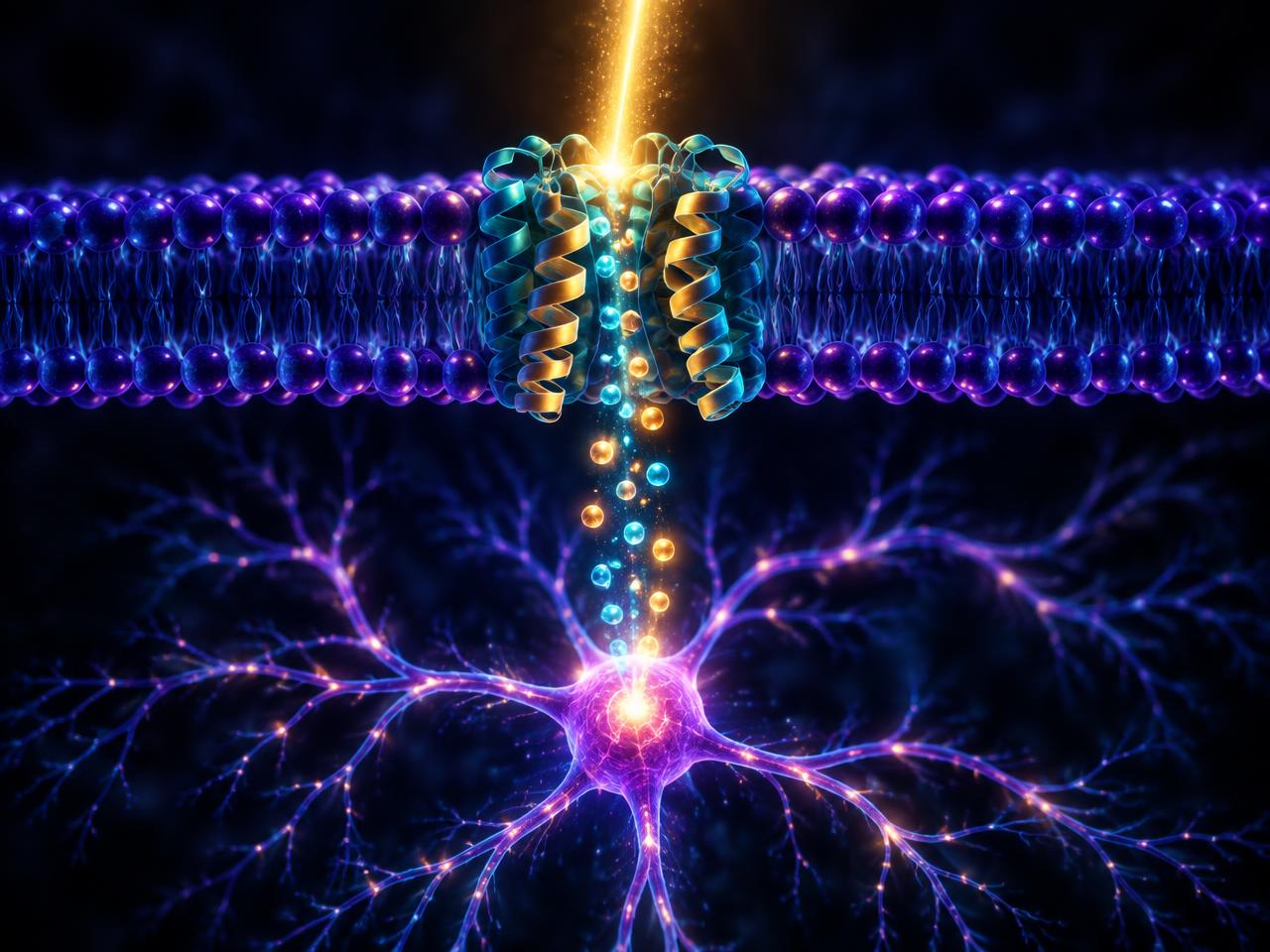
On 5 October 2026 the Nobel Prize in Physiology or Medicine went to Karl Deisseroth, Peter Hegemann and Georg Nagel for the discovery and development of light-gated ion channels — the foundation of optogenetics. It is the cleanest established instance this section has of light not merely probing biology but carrying and governing biological information.
The mechanism is pure relational architecture. A photon is absorbed by a channelrhodopsin seated in a cell membrane; the protein’s gate opens; charge flows across the boundary; a neuron fires. The information never sat inside the protein alone — it lives in the relation among light, membrane, and ion current that lets the cell hold it. That is the relational principle of Chapter 81, standing in a physiology laboratory with a Nobel medal on it, announced the morning this section was written.
Note where the action happens: at a charged membrane boundary, through a channel — the same territory as the drumhead of Chapter 80 and the skin that only sings intact of Chapter 78. And note what it establishes against the popularized rewiring claims examined in Chapter 46: light can shift neural function directly and with circuit-level specificity. That is established science, not metaphor.
One honesty marker: the vision-restoration therapies built on this work are real but still await regulatory decision. The Nobel is for the discovery and the method — the carrying test applies to the therapies, not to the principle.
Active research
Real programs, unsettled outcomes
- Structured light and orbital angular momentum. Beams can be given a helical twist, carrying orbital angular momentum distinct from spin. It is demonstrated and measurable; how many independent twists a beam can usefully carry remains an open engineering question.
- Photonic computing. Interference can perform arithmetic at the speed of propagation. Real optical matrix multipliers exist; whether photonics displaces electronics beyond niches remains undecided.
- Optical binding. Particles in a shared light field arrange themselves through the light they scatter onto each other. The effect is demonstrated; its reach into self-assembly is still being mapped.
- Light in biology beyond vision. Biophoton emission and light-guided cellular behavior remain on open ground — how much of biology’s internal signaling is optical is genuinely unsettled. Optogenetics, by contrast, has now left this list: see the 2026 Nobel section above.
Speculative
Questions held open
The earlier wager. The first book asked whether the mathematics of life might be a low-dimensional projection of a higher-order luminous geometry. Its compressed formulation was: “Light is the software; DNA is the hardware.” That sentence names the wager; it does not establish the correspondence. The question remains whether the parallel can be stated through shared, measurable invariants rather than resemblance.
Light as the universe’s accounting medium. If every interaction we can observe is mediated by fields, and light is the field we read most directly, is “the architecture of light” a window onto the architecture of everything — or only onto our own instruments? The order-in-the-lens question, applied to light itself.
The vacuum as a medium with structure. Zero-point fluctuations are measured fact; what they imply about the deep character of space is contested. Chapter 83’s no-floor discipline applies: enumerating media does not reach the floor.
Light and the relational claim. The tweezers show force in geometry; the books ask whether information lives in relations rather than things. Extending the optics-lab lesson to all of physical law is the leap this family of books makes with its eyes open — audited ground, tagged conclusion, revisable.
Closing
Through this stair-stepping process of asking increasingly better formed questions, and the receiving of better answers as a consequence, I have arrived at an understanding of what this real life process of science is all about.
My understanding of the architecture of light is now exponentially upgraded from what is was, just by asking the right questions and carefully studying the answers received.
Notes
- 1KW Norton, Socratic-Style Questions On Difficult SubjectsThe author's collection of Socratic-style questions on difficult subjects — the standing habit of questioning from which the question that opened this section surfaced.back to text
- 2KW Norton, The Architecture of Light: A Synthesis of Quantum Optics, Genetic Geometry, and the Informational FieldThe author's first book on the subject — the earlier question and the larger wager to which the present section returns from farther along the path.back to text
Citations
- P. Lebedev, “Untersuchungen über die Druckkräfte des Lichtes,” Annalen der Physik 6, 433 (1901); first reported 1900. Maxwell’s prediction: J. C. Maxwell, A Treatise on Electricity and Magnetism (1873).
- A. Einstein, “On a Heuristic Point of View Concerning the Production and Transformation of Light,” Annalen der Physik 17, 132 (1905).
- 17th General Conference on Weights and Measures (CGPM), 1983 — the meter defined through the fixed value of c.
- A. Ashkin, “Acceleration and Trapping of Particles by Radiation Pressure,” Physical Review Letters 24, 156 (1970).
- A. Ashkin, J. M. Dziedzic, J. E. Bjorkholm and S. Chu, “Observation of a Single-Beam Gradient Force Optical Trap for Dielectric Particles,” Optics Letters 11, 288 (1986).
- Nobel Prize in Physics 2018, half to Arthur Ashkin “for the optical tweezers and their application to biological systems.”
- JAXA, IKAROS (2010); The Planetary Society, LightSail 2 (2019).
- Nobel Prize in Physics 1997 — S. Chu, C. Cohen-Tannoudji and W. D. Phillips, for methods to cool and trap atoms with laser light.
- Nobel Prize in Physiology or Medicine 2026 — K. Deisseroth, P. Hegemann and G. Nagel, for the discovery and development of light-gated ion channels and optogenetics.