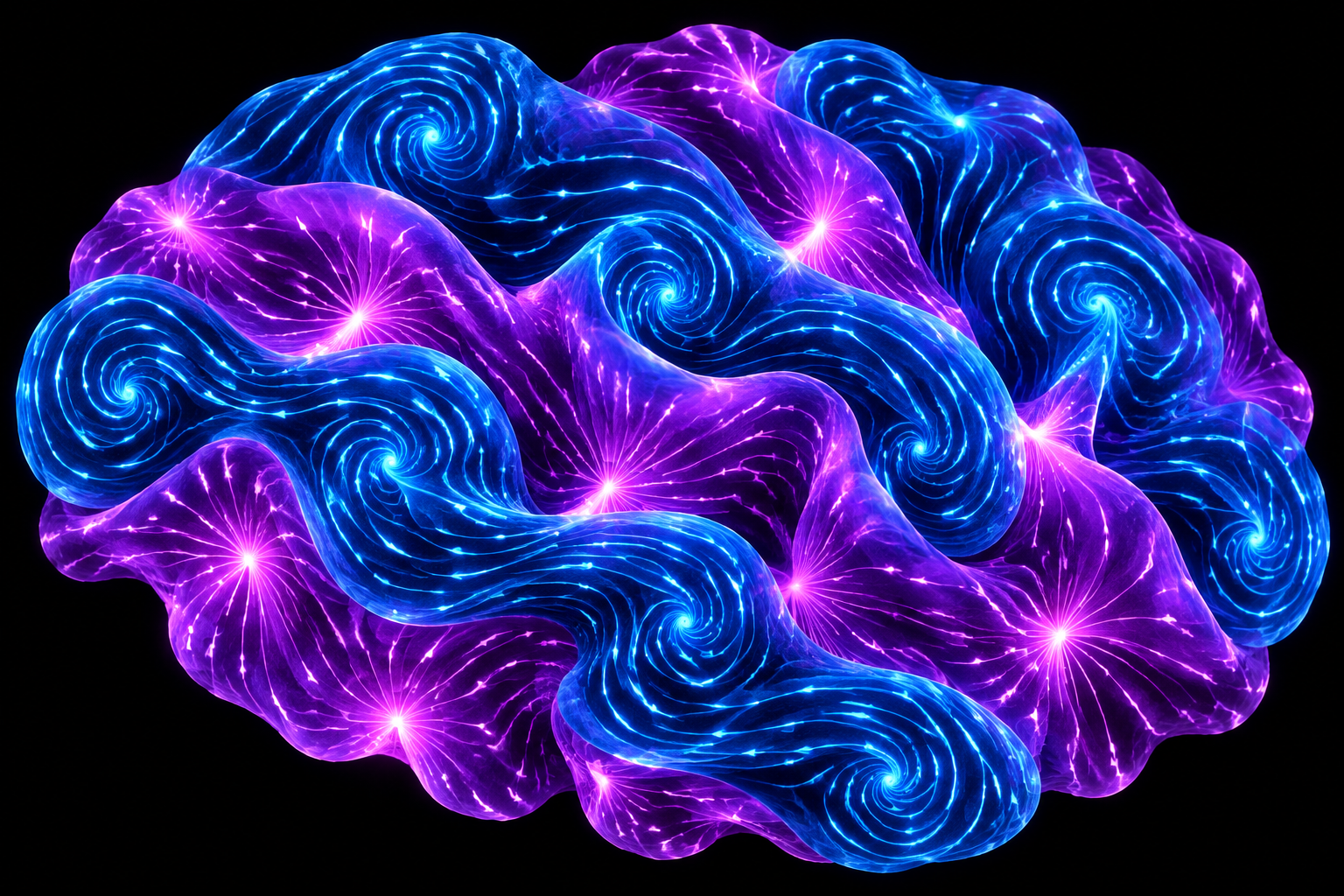
The Cortical Manifold: Geometry First, Wiring Graded In, and the Intricately Folded Dual Membrane
An upgrade chapter. The volume's sorting habit applied to the newest biological case in which local geometry, not the connectome, carries most of the observed dynamics.
State the geometric object first
The cortex is, to a good approximation, a folded two-dimensional sheet embedded in three dimensions. That sentence is the entire licence for what follows, and it is the only thing this chapter asks a reader to accept before the citations start. Once the sheet is granted, two quantities are defined without any further theory: geodesic distance, measured along the surface rather than through the skull, and the eigenmodes of the Laplace-Beltrami operator on that surface, which are the standing patterns the geometry itself admits. Both are properties of shape. Neither requires a wiring diagram.
This is exactly the structure the volume has been tracking since the first chapters. There is a full object — a Riemannian manifold with a metric, a Laplacian, a spectrum — and there are proxies which borrow parts of it. The unusual feature of the cortical case is that the borrowing runs in the direction we normally distrust. Here the geometry is not the metaphor for the biology; the geometry is the measured constraint, and the network language most neuroscience is written in turns out to be the thing that needs its contribution graded in.
Say plainly what the geometric object does not include. It does not include the direction of information flow, the identity of a cell type, the sign of a synapse, or anything about experience. A surface and its spectrum constrain which patterns are cheap and which are expensive. They do not say what the patterns are for.
Catalogue the legitimate borrowings
The geometric-eigenmode literature is the first entry. Fitting resting and task-evoked cortical activity as a superposition of a modest number of surface eigenmodes reproduces a large fraction of the observed spatial structure — and does so better, in the reported comparisons, than fitting the same activity to modes of the connectome graph. The claim is about a basis, not a cause: it says the sheet's shape supplies a compact vocabulary for what the cortex does, which is a legitimate borrowing of the full object's spectrum.
The second entry is the graded result, and it is the reason this chapter exists. Royer and colleagues (2026) used intracranial recordings — direct electrode contacts rather than an inferred field — and asked what best explains the similarity between the dynamics of two cortical sites. Across most of the cortex, inter-regional distance dominated: nearby sites behave alike, and adding connectivity to the model bought little. The exceptions were systematic rather than random. In transmodal and association cortex, microstructural similarity and long-range connectivity had to be added before the fit held. That is a gradient, not a dichotomy, and the gradient is the finding.
Third, the traveling-wave and analog-computation work. Phase gradients that sweep across cortex, rather than sitting still, are now routinely measured, and their propagation speed and direction are constrained by the surface they cross. Read carefully, this is a claim about a physical medium carrying structured phase — the same claim an acoustician makes about a room. Read carelessly, it becomes a claim that the brain performs continuous computation of a kind no digital machine can approach, which the data do not establish.
The pattern of the catalogue is the pattern the volume has recorded elsewhere: local geometry buys the bulk of the variance cheaply; the residual is where the network's contribution lives; and the residual is not noise, it is anatomically located.
The dual membrane, intricately folded
The image that belongs to this chapter is not moving water. It is the family of dual membranes the volume has followed from the start: the lipid bilayer that earns the cell its charge, the charged drumhead whose field gathers where it bends, and the two interleaved sheets of the dual membrane — one carrying curling, rotational flow, the other spreading and converging flow. The cortex belongs to this family on anatomy alone. It is a membrane sheet, electrically live, a working voltage held across its thickness — the same near-field architecture as every other membrane in this volume — and it is folded intricately into ridges and valleys, pressing the largest possible surface into the smallest possible volume.
The folding is not packaging. By the drumhead principle the field concentrates where the sheet bends most sharply, and the eigenmodes the mapping measures are the standing patterns the folded geometry itself admits: change the folding and you change the spectrum. When cortical activity is fitted as a superposition of surface eigenmodes, what is being read off is what the intricately folded dual membrane allows — geometry first, wiring graded in. The brain mapping is a measurement of the folded sheet, not a diagram of connections laid on top of it.
One boundary keeps the image honest. In the volume's other dual membranes the two flow behaviours live on two distinguishable sheets; the folded cortical sheet presents a single surface to the measurement, so the two-behaviour reading remains a figure, held as a figure. What the image does buy is where to look: at the folds, where the geometry is dense and the field gathers, and at the spectrum the folding dictates. The dynamics themselves stay with the measurements in the catalogue above. And the reminder worth carrying out of the chapter is the one the crease in the carbon sheet already earned in the laboratory: the fold is an operator, material-agnostic — the same curvature that moves a field through graphene moves it through a lipid bilayer and through the cortex, not because the substances are alike but because geometry is doing the work — form is function, function is form.
What the upgrade changes in the civilizational argument
The earlier essay on the analog ground of thought argued that a mind is a continuous physical medium and that offloading its work to a discrete one is a change in kind, not degree. That argument was carried by analogy. It is now carried, in part, by measurement: if the dominant constraint on cortical dynamics is a surface metric, then the medium's shape is doing computational work that no representation of the connectome captures, and the difference between an analog field and a digital graph is a measured difference in this specific case rather than a philosophical preference.
The upgrade is narrower than the rhetoric usually built on it. It licenses the claim that cortical dynamics are geometry-constrained. It does not license claims about irreducibility, about consciousness requiring continuity, or about any machine's ceiling. Those remain unpriced, and the volume's rule is that an unpriced claim does not inherit the credibility of the measurement standing next to it.
The open baton
The question this chapter hands on is experimental and, unusually for this volume, close to answerable. Which phase or traveling-wave intervention would separate the pure-geometry regime from the geometry-plus-network regime while holding local geometry fixed?
Holding geometry fixed is the hard clause and the interesting one. Within a single participant, a stimulation or entrainment protocol that alters long-range coherence without altering the cortical surface should, on the graded reading, shift dynamics in transmodal cortex more than in unimodal cortex. Across participants, individual surface reconstructions already vary enough to test whether the unimodal advantage of distance tracks individual folding rather than a group template. Either design yields a number rather than a picture, which is the point.
Equations borrowed
- Laplace-Beltrami operator on a folded two-dimensional Riemannian manifold; its eigenmodes and eigenvalue spectrum as a basis for fields on the surface
- Geodesic distance on a curved surface, as distinct from Euclidean distance through the embedding volume
- Geometric-eigenmode decompositions of cortical activity, compared against connectome-graph mode decompositions
- Royer et al. (2026), Nature Communications: intracranial EEG evidence that inter-regional distance dominates dynamic similarity in unimodal cortex, with microstructural similarity and connectivity required in transmodal regions
- Traveling-wave measurements of cortical phase gradients, including the analog-computation reading from Miller and colleagues
- The volume's standing proxy apparatus: full object, legitimate borrowing, named divergence, priced analogy
Validity band
The geometric claim holds for spatial patterns of cortical dynamics at the scales the cited recordings resolve, in the cohorts reported, in human cortex. It is a statement about which basis explains variance, not about causation, information flow, or function. The distance-dominance result is graded by region and does not hold uniformly: in transmodal and association cortex, connectivity and microstructural similarity carry a substantial share. Nothing in the band extends to consciousness, to the limits of digital computation, or to any shared mechanism between cortex and fluid systems.
Falsifier
An independent cohort — ideally intracranial, with individual surface reconstructions rather than a group template — in which geodesic distance loses its advantage over connectivity in unimodal cortex, or in which the unimodal-to-transmodal gradient does not replicate. Equally: an eigenmode comparison in which connectome-graph modes match or exceed surface modes on held-out data. Either result would move this chapter from measured constraint back to metaphor, and the upgrade to the analog-ground argument would have to be withdrawn with it.
Where this chapter is weakest
The chapter leans on results that are months old, in a literature with a poor replication record for exactly this kind of variance-explained comparison. Geodesic distance and connectivity are also not independent variables — nearby regions are more densely connected — so distance may be winning partly as a proxy for the very network it is being compared against, and the cited work controls for this less completely than the headline suggests. The dual-membrane figure does rhetorical work here that the citations do not need, and a reader is entitled to suspect the empirical material was recruited to dignify a pre-existing image. Finally, the upgrade claim is the weakest link: showing that shape constrains dynamics is a long way from showing that continuity is doing anything a discrete approximation could not.
The volume-wide audit of these weak points is collected in Where This Volume Is Weak.