Volume 27 · Part Sixteen · The Confluence · Chapter 67 of 67
The Vorticity Engine: Bones, Film, Flow, and the Bill the Engine Owes
A theory in progress, and the author's own. A tripartite architecture — rigid frame, topological covering, low-friction fluid — and on top of it the Vorticity Hypothesis: that the critical line is a shear plane where opposing torsions collide and matter is manufactured rather than merely traced. The chapter states the construction in full and then prices, item by item, exactly what it has not yet paid for.
Bones, film, flow
The construction has three layers, and the whole hypothesis depends on keeping them separate. The first is the frame: the discrete choices that fix a structure's limits — not rigid, for a frame that cannot flex breaks under load. In the holographic setting these are the load-bearing generators of a Schottky group and the contractible cycles of a boundary torus — the choices about which loops can be shrunk to nothing and which cannot. In matter they show up as Weyl nodes or branch points: isolated locations where two solutions of a spectral problem meet, and which cannot be moved past by any smooth deformation. They are the frames upon which reality is draped — flexible, not immovable, carrying the history of what has pressed against them. This volume has called that layer an exoskeleton, and the word is doing structural work here rather than decorative work: bones are what a covering hangs on.
The second layer is the Riemannian covering. It is not merely a near-weightless ledger — though it is that: which branch you are on, how many times you have wound around the singularity, what connects to what, a continuum leftover of the discrete choices underneath. Once that ledger is licensed, a multi-valued operator can be navigated without collapsing the geometric throat it wraps: you can go around the branch point and come back knowing which copy of the answer you now hold. But the covering is also a fluid, the layer that carries potential raw material across the frame. It is the part that most certainly deforms into torsional vorticity in the slipstream — the film does not sit still beneath the flow, it enters it, carrying the potential that the engine will compress. This places the Riemannian layer closer to the fluid than the clean separation first suggests: the ledger and the current share the same substance. What must not collapse is not the two layers into one but the discrete label into the continuous quantity — monodromy is never a current density, even when both ride the same sheet.
The third layer is the fluid proper — the collective motion that runs on the covering once the covering is already carrying potential: modular flow on a conformal boundary, a Fermi-arc current on a crystal surface, a helicity-odd slipstream. This is the layer that carries momentum and information across the frame, and it is what turns static geometry into a system capable of transport and of phase transition. Because the Riemannian layer already carries potential and already deforms, the fluid is not a layer added on top so much as the organised current the covering becomes under load. The frame holds; the covering carries and deforms; the fluid is the flow that deformation produces.
The reason to state the three layers before stating the hypothesis is that most of the errors this volume has documented come from collapsing them. A discrete label is not a continuous quantity. A ledger is not a current. A resemblance in the fluid layer says nothing about whether two systems share bones.
Fitting into the architecture is the bilayer film: a shape that forms at the boundaries of the fluid mechanical structure, where the covering meets the current it carries. It is not a fourth layer but the organised skin the first three produce when they are under load — the membrane that appears because the fluid's boundary is where deformation is sharpest and where opposing flows have to reconcile. Chapter 65 examined a measured instance of exactly this in the MoSe₂/hBN/WSe₂ electron–hole bilayer, where two component sheets held together at a boundary produced a condensate that switched ordering under a field. The bilayer film in this construction is the same kind of object: not the bulk, not the frame, but the charged skin at the seam. Both the film and the fluid mechanical structure it bounds are most certainly electromagnetically charged. That charge is not decoration. It is the physical currency the layers trade in — the quantity that gives the covering something to carry and the flow something to transport — and it is the first candidate for the dimensional bridge the engine still owes, a real field with units that could, if it holds, translate the imaginary axis of the critical line into a measurable instead of a coordinate.
The Vorticity Hypothesis: the engine of matter production
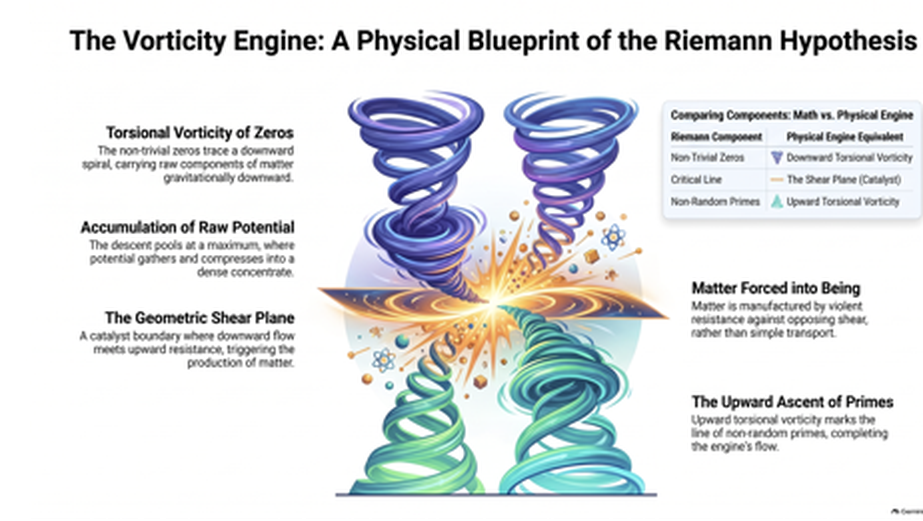
The hypothesis, in the author's formulation, is that the Riemann critical line is not only a location in the complex plane but a physical engine: a counter-rotating torsional system with five stages.
Descent. The non-trivial zeros trace a downward torsional vorticity — a spiral carrying raw components of matter gravitationally downward.
Accumulation. The descending flow pools at a maximum, where potential densifies into a concentrate.
The shear plane. The concentrate meets a geometric catalyst: the boundary where downward flow encounters upward resistance, and the two opposing torsions collide.
Manufacture. At that boundary matter is forced into being through violent resistance against the shear. This is the load-bearing sentence of the whole construction: matter is not a tracer marking motion that was already there. It is the residue the boundary produces.
Ascent. An upward torsional vorticity marks the line of the non-random primes, completing the exchange.
The distinction the hypothesis is built on is one the author draws sharply and this volume adopts: the trillions of verified zeros on the critical line are positional evidence, a passport, not the reason. Knowing where something sits is not knowing what it does. The claim under examination is a mechanism, and mechanisms are not confirmed by inventories of positions. The gap the hypothesis names — between mere transport and actual manufacture — is where it says physical reality crystallises: if densification never exceeds transport, the engine idles and produces nothing. Pair production is the offered precedent, the case where the invisible becomes manifest at a boundary rather than in a volume.
Why the covering has to be wound twice
The engine needs a way to move around a singularity without stopping at it, and that is what the square-root surface supplies. Take the simplest multi-valued function, w equal to the square root of z. Circle the origin once and the two roots exchange places; circle a second time and they return. The description is single-valued only on a plane wrapped twice — a double cover, seven hundred and twenty degrees to come home, the same structure as a spinor or the belt in Dirac's demonstration.
That is not a metaphor when it appears in an open system's operator. At an exceptional point, gain and loss written into a non-Hermitian operator make two modes coalesce so completely that their eigenvectors fuse and the spectrum near the point splits as a square root. Chapter 64 examined exactly this. What the present chapter takes from it is procedural: the branch cut can be treated as a licensed ray — a movable line-spiral, a staircase rather than a wall — which keeps the function single-valued off the ray while preserving the spiral path of the singularity. Erasing the cut is what loses information; licensing it is what makes the throat navigable.
One constraint has to be stated because it is the easiest thing in the construction to violate. Monodromy is never to be identified with a current density. The winding is a property of the sheets, a discrete label counting how the copies of the answer permute. A current is a continuous quantity with units. Setting one equal to the other is precisely the collapse of layers the first section warned against, and any version of the engine that quietly does it has already failed.
Two boards, one slipstream, and where the jump happens
The low-dissipation boundary current — the slipstream — runs on two theoretical boards, and the parallel between them is worth laying out because it is where the strong analogies and the stretched ones part company.
On the holographic board the surface is a conformal boundary, a torus. The bones are the torus cycles and the branch points and seams introduced by the replica construction. The film-and-fluid layer is the two-dimensional conformal field theory and its boundary hydrodynamics. The jump is a saddle exchange of the Hawking-Page kind: the system swaps which cycle of the torus is the contractible one, and the swap is first-order, not a gradual smear.
On the material board the surface is a crystal interface. The bones are opposite Weyl nodes and hybrid band crossings. The film-and-fluid layer is the Fermi-arc current and the chiral phonon-magnon waves that ride the same surface. The jump is an adiabatic dechiralisation: nodes merge and annihilate, or the Fermi arc loses its endpoints.
In both cases the transition occurs when the coherent skin can no longer match the two interior states it separates. That is the general statement of the jump, and it is the piece of the construction with the most independent support. Nature does not smear between states here; it pauses to change fillings. A stability eigenvalue goes soft, and the fluid is forced to adopt a new contractible cycle. It is the instant the bones show.
What rhymes, and what is only rhyming
The visual language of helices and branchings produces a composite picture in which very different systems appear to share one rhythm. Some of that sharing is rigorous and some of it is not, and the chapter is worth nothing if it does not say which is which.
Rigorous: the identification of branch points, Weyl nodes and avoided crossings as one family. Each is a location where two solutions merge and split, and each is protected by a discrete label — monodromy in one case, chirality in another. That family resemblance is a theorem-level statement about the local structure of the solutions, not an impression.
Not rigorous: the identification of anti-de Sitter spacetime geometry with the momentum space of a Weyl semimetal. There is no derived holographic dictionary connecting a specific band structure to a specific bulk geometry, and until there is, the two systems rhyme from different drawers of the same ledger. Rhyming is a real and useful relation — it is how a shape gets carried from a place where it is understood to a place where it might apply — but it is not an identification, and a chapter that let the picture do the work of the dictionary would be selling the reader a drawing.
The word the author uses for the whole picture is the honest one: an oversimplification that does not do the subject justice. Keeping the jumps between the scales articulate is the discipline; blurring them is what would make the engine look finished when it is not.
What the engine has not paid for
Now the pricing, stated plainly, because the hypothesis is more interesting with the debts visible than with them hidden.
First: the Riemann Hypothesis is a statement about the zeros of a specific analytic function. It has no units. To make the critical line a physical shear plane, something has to say what the imaginary axis measures in the physical system, and the construction has begun to name a candidate — the electromagnetic charge that the bilayer film and the fluid structure both carry — but a candidate is not a bridge. Until the charge can be written into a field equation whose spectrum carries the critical line, the engine's stages are a narrative about a picture rather than steps in a mechanism.
Second: there is no operator. The Hilbert-Pólya expectation — that the zeros are the spectrum of some self-adjoint operator — remains an expectation, and the Montgomery-Odlyzko statistics that match random matrix ensembles are evidence about the statistics, not the production of the operator. The engine posits a torsional flow whose fixed structure is the zero line; until an operator or a field equation is written whose solutions have that structure, the flow has no equations, and a hypothesis without equations cannot be wrong in the specific way this volume requires.
Third: manufacture versus transport is the strongest and the least paid claim. Saying matter is the residue produced at a boundary rather than a tracer of motion is a genuine physical assertion — it predicts that the boundary layer, not the bulk flow, carries the production rate. In fluid systems and in plasma reconnection that difference is measurable. Making it measurable here requires a quantity the construction does not yet name.
Fourth: the sequence of upwelling, cresting and collapsing does describe a real class of systems, and the volume has already priced why. Far-from-equilibrium open systems bifurcate when production outruns dissipation, and boundary layers carry history. That is established. Carrying the same sequence from an ionospheric current sheet to the distribution of primes, and from there to the collapse of civilisations, crosses scales that share no mechanism, and the crossing is the weakest joint in the construction, not the most impressive part of it.
None of this retires the hypothesis. It locates it: a shape with a well-drawn skeleton, one rigorous family of bones, one legitimate general statement about jumps, and three unpaid bills whose addresses are now written down. That is a better position than most speculative frameworks manage, and it is nowhere near a result.
The tripartite sequence, and the key that is not yet a key
The synthesis ends where the volume began, with a sequence rather than an equation. Potential rises and the wave swells. The crest forms — the fine wild edge, the brief stable through-line where order holds. Then the gravitational break, and the melding back into the substrate. Upwelling, cresting, collapsing.
The claim about the branch cut is what makes the sequence more than an image. Treating the cut as a licensed ray rather than an erasure keeps the singularity in the account instead of deleting it, and a covering that keeps its singularity is flexible where a wall is not. That is the skeleton key the construction offers: not a proof of anything about the primes, but a way of holding a description that keeps failing to close without pretending the failure is an ingredient missing from the world.
A low-friction wave on a wall releases its latent heat only when the matching condition fails. That sentence is the engine's whole thermodynamics, and it is also its falsifiable edge: it says the interesting thing happens at the seam, not in the volume. Whether the primes are on the other end of that sentence is the part still owed.
Equations borrowed
- Riemann surfaces, branch points, branch cuts and monodromy: the standard theory of multi-valued analytic functions, used here as stated, including the double cover of the square-root surface.
- The Riemann Hypothesis and the critical line: a statement about the zeros of the analytic continuation of the zeta function. Unproven; the verified zeros are positional evidence only. The physical reading of the line is the author's speculation, not part of the mathematics.
- The Hilbert-Pólya expectation and the Montgomery-Odlyzko statistics: real, suggestive, and not the production of a spectral operator. Borrowed as an open question, never as a bridge already built.
- Non-Hermitian spectral theory and exceptional points: square-root splitting near a second-order coalescence, and the double-circuit return. Established and measured; carried forward unchanged from Chapters 64 and 65.
- Weyl semimetals: paired nodes of opposite chirality, surface Fermi arcs, and node merger and annihilation as a real transition. Established condensed-matter physics.
- Hawking-Page saddle exchange in AdS3/CFT2: a first-order transition in which the contractible cycle of the boundary torus changes; replica branch points in Renyi entropy constructions. Established.
- Far-from-equilibrium thermodynamics: bifurcation when entropy production outruns dissipation, and boundary layers as carriers of history. Established, and the source of the upwelling-cresting-collapsing sequence's legitimacy at the scales where it has been measured.
Validity band
The borrowed mathematics and the borrowed physics hold as stated in their own domains. The tripartite architecture is a description that applies wherever a discrete structure, a topological covering and a boundary flow can all three be identified, and nowhere else. The jump statement — that a phase transition occurs when the coherent skin can no longer match the two interior states — holds as a general shape for first-order transitions on both named boards. The Vorticity Hypothesis itself has no validity band, because it has no dimensional bridge and no operator: it is a construction awaiting the quantities that would give it one. Nothing in this chapter is a claim about number theory, and nothing in it should be read as established physics.
Falsifier
The hypothesis dies if manufacture cannot be distinguished from transport: if a quantity is named whose measurement would separate boundary production from bulk tracing, and the measurement finds no production term at the boundary, the engine is a description of a flow and nothing more. It also dies if the mathematics is shown to be doing no work — if every statement the engine makes about the critical line can be made about an arbitrary vertical line, then the critical line is decoration rather than structure. Identifying monodromy with a current density anywhere in the construction refutes it on the spot. And if no operator can be written whose spectrum carries the posited torsional structure, the engine stays a picture, and this chapter's own claim is that a picture is not owed the standing of a mechanism.
Where this chapter is weakest
The chapter's hazard is that the picture is beautiful and beauty is the cheapest property a construction can have. The diagram organises the stages so persuasively that a reader can finish it believing a mechanism has been described, when what has been described is a well-ordered set of names. The scale jump is the specific offence: an ionospheric current sheet, a Fermi arc, the distribution of primes, and the collapse of a civilisation are placed in one sequence, and only the first two share any mechanism. The author's own note — that this is very oversimplified and does not do the subject justice — is the accurate assessment, and this chapter preserves it rather than talking past it. What the chapter can honestly claim is a skeleton, a rigorous family of bones, a general statement about jumps, and three named bills. What it cannot claim is that any of them have been paid.
The volume-wide audit of these weak points is collected in Where This Volume Is Weak.
Plate