The Dance That Holds: Quantum Technology as the Volume's Last Witness
The volume closes on hardware. A bit stored in the order of a dance — a global pattern of exchanges whose record survives local noise so long as the topology is not torn — is the governing principle standing up in a machine.
Two waves
Quantum physics did not enter human life as a gadget. It entered as a correction — the classical pictures were good enough for steam engines and radio, and not good enough to say why atoms do not collapse or why sunlight has a spectrum. The first wave of technology that followed was almost invisible because it was already everywhere: semiconductors, transistors, solar cells, lasers, atomic clocks, MRI. None of these required a philosopher's blessing. They required only that engineers take the Schrödinger equation seriously enough to calculate.
The second wave is different in kind. It treats quantum states themselves as the working material — superposition and entanglement not as bugs to be averaged away but as the resource. Sensors that beat classical limits on timing, gravity and magnetic fields; communication in which eavesdropping is detectable rather than merely difficult; simulation of molecules no classical machine can hold in memory; and computation, still young and noisy, aimed at problems whose structure matches the way amplitudes interfere.
The braid: a change in what must be protected
Ordinary qubits store a bit in a local degree of freedom that the environment can kick. Braided anyons store a bit in the order of a dance — a global pattern of exchanges whose record survives local noise so long as the topology is not torn. That is not magic immunity. It is a change in what must be protected: instead of shielding one fragile spin, one keeps a two-dimensional energy landscape quiet enough that the knot does not come undone.
The recent experiments that combine braiding with fusion are engineering statements: the dance can be made complete enough, on present hardware, to generate a universal set of operations. Whether that becomes cheaper than conventional error correction is an economic and materials question, not a slogan. Every quantum technology still has to live in a classical world of cryogenics, vacuum, control electronics and error budgets.
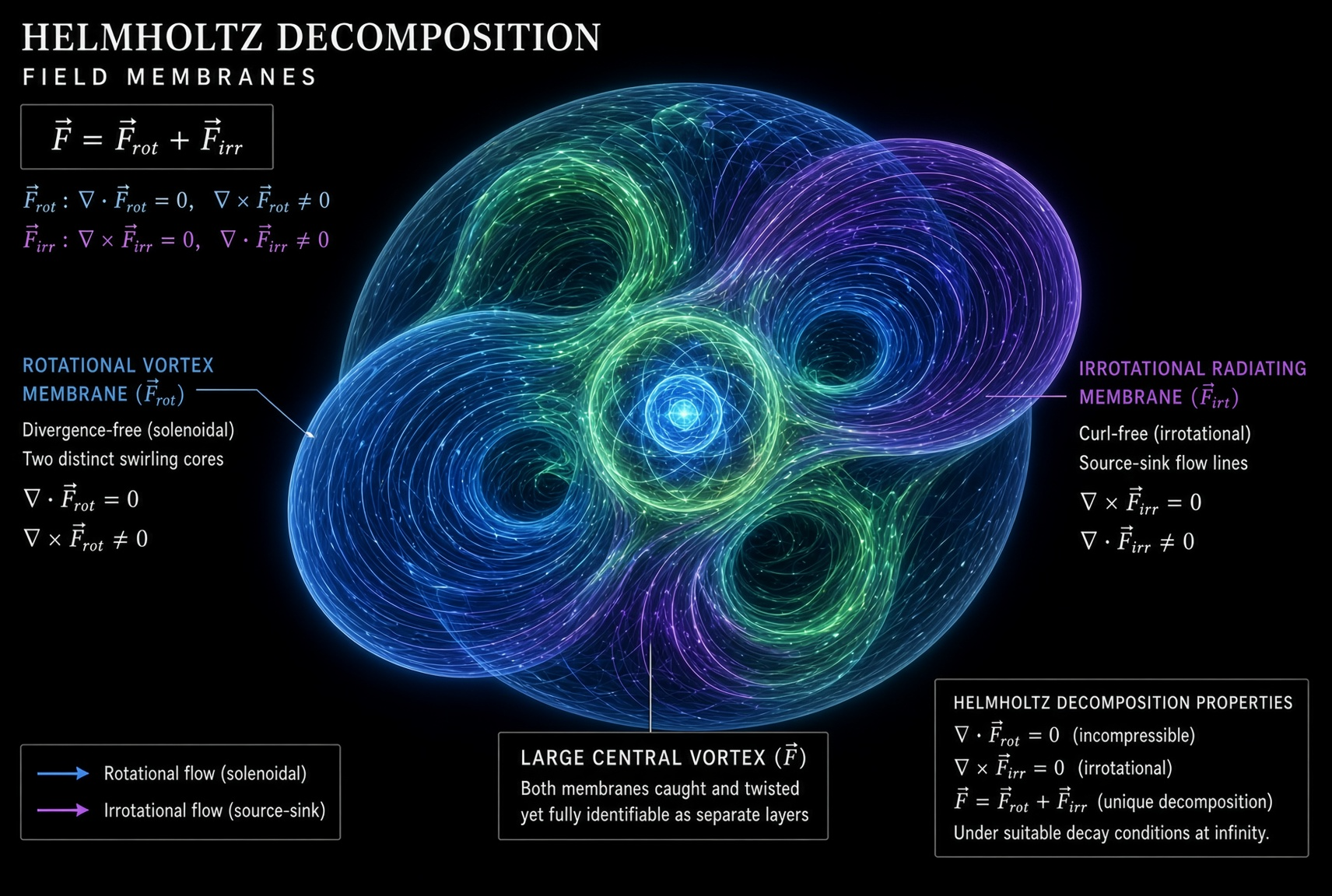
Read through this volume's governing principle, the braid is the last witness and the cleanest. The answer is not located in one particle; it is distributed in relations that cannot be inspected locally without destroying them. The drumhead carried field at its folds; the altermagnet carried information in modes its bulk cancels; the axon carried conduction speed in a shape; the genetic molecule carried its sequence in a match. The quantum computer now carries its answer in the order of a dance. The information was never inside the thing alone.
The seam, held firmly
There is a temptation to treat every new quasiparticle as a clue to a Theory of Everything. Sometimes it is only a clue to a better refrigerator and a quieter lattice. Both matter. A civilization that can braid anyons has not solved metaphysics. It has learned to keep a difficult dance going long enough to read the steps.
That is a modest and serious kind of progress: not the last word about reality, but a new way of writing in it. The instrument reached; the meaning is ours to place. The volume closes there — on a machine that works, a principle that held, and a seam that stays open.
Equations borrowed
- Universal gates from braiding and fusing anyons on quantum hardware. Nature (2026), Quantinuum H2 trapped-ion processor, 54 qubits, non-Abelian anyons of the S₃ group. The engineering anchor for the chapter.
- Landauer's principle and the no-cloning theorem — information is physical; knowing is not a free spectator sport.
- The two-wave history of quantum technology: bands, lasers, atomic clocks, MRI (first wave); sensing, communication, simulation, computation (second wave).
Validity band
The anyon result is one experiment on one processor; topological quantum computing rests on well-established physics, but the economic comparison with conventional error correction is open. The two-wave framing is a reading of the history, not a periodisation the field itself insists on.
Falsifier
The chapter's placement retires if the topological protection of braided-anyon qubits were shown to be illusory — if the record of the exchanges proved as fragile to local noise as the local spin it replaces. The measured record runs the other way; the claim stays exposed to any result that shows the topology does not protect.
Where this chapter is weakest
The chapter's risk is the romance it warns against: placing a working machine at the volume's close can make the governing principle look proved by the hardware, when the hardware confirms one instance and the principle stands or falls across all of them. The author wrote the source passage this chapter weaves; the weave and the placement are the chapter's own.
The volume-wide audit of these weak points is collected in Where This Volume Is Weak.
Illustrations
Figures gathered for this chapter — ways of seeing the principle the hardware confirms.