The Lump and the Well: Whether Gravity and Matter Could Be One Ordering, and the Test That Would Decide It
A question walked toward across this part of the volume, taken as far as the audited ground allows and then stopped at its own seam. If a medium can order itself into a persistent twist with energy in its core, the lump and the well might be one object rather than a mass placed in a field — and the quantity that would prove it is named here rather than assumed.
Two descriptions, and a measurable factor of two
Newton's law gives the force between two masses as falling with the square of the distance, always directed toward the centre. Because that force is central, angular momentum is conserved, and the radial motion reduces to a problem whose solutions are the conic sections: the distance from the centre varies with the angle according to a single shape parameter, the eccentricity. Zero gives a circle, a value between zero and one gives an ellipse, one gives escape, and more than one gives an unbound hyperbolic pass. The star sits at a focus and not at the geometric centre. Kepler's first law is not an extra axiom; it is a theorem of the inverse square, and the inverse square is itself the statement that a field spreading uniformly through a sphere must thin as that sphere's area grows.
Einstein's account keeps the arithmetic in the weak, slow limit and replaces the mechanism entirely. There is no force. A body in free fall follows the straightest available path through a spacetime whose shape is set by the energy and momentum in it; weight appears only when something prevents that path from being followed. The two accounts are not a matter of taste, because they disagree measurably. Mercury's perihelion advances by an extra amount per century that the force law cannot supply. Clocks run slow deeper in the well, by enough that satellite navigation would fail within a day if the correction were dropped. And light grazing the Sun is deflected by twice what a corpuscle in a Newtonian field would give. That factor of two is the cleanest cut the subject has between a force acting in space and a geometry that is the arena.
It matters for this chapter that the cut is a number and not an argument. Whatever account of gravity is offered, it must produce the conic orbits with the source at a focus, and it must produce the doubled deflection. A picture that yields the first and not the second has recovered Newton and stopped short of the measurement that distinguishes him from Einstein.
What can be lifted out, and what cannot
Asking whether gravity can be abstracted from spacetime turns out to be three questions wearing one coat. Whether gravity is a thing residing in spacetime or the shape of spacetime itself is an ontological question. Whether the physics can be written with a fixed background and gravity as an extra field on top is a mathematical one. Whether orbits, weights and clocks can be computed without mentioning curvature is a practical one. Newton answers all three affirmatively. General relativity answers the first with a flat no and the other two with an approximation that works until it does not.
The lock is the equivalence principle. A body in free fall cannot locally distinguish gravitation from acceleration, so gravitation is not a force applied within a pre-existing arena; it is a statement about which paths are straight. The gravitational field in that language is the metric itself, and there is no residue left over when you try to remove it — switch gravity off and you do not recover a unique background, you recover flat space only after choosing a vacuum and a chart. The familiar split of the metric into a flat part plus a small perturbation, which gives gravitational waves and the spin-two graviton, is a genuine and useful abstraction whose background is a gauge choice and whose validity ends when the field is strong enough to be the geometry.
The abstraction nonetheless has a long list of working forms, and the list is worth having because it shows that nothing in the subject forbids asking the question. Newtonian force on absolute space. A massless spin-two field on flat space, which under gauge invariance and coupling to energy-momentum nearly rebuilds the full theory. Teleparallel gravity, which reproduces the predictions with torsion of a flat connection instead of curvature of a metric, so that a different piece of geometry carries the name. Thermodynamic arguments in which the field equation appears as an equation of state once horizons are granted an entropy proportional to area. Analogue systems in which a metric is a derived object of a non-gravitational medium. And background-independent programmes in which the fundamental inventory is relations or causal order, and both gravity and spacetime are meant to arrive together. None of these separates gravity from spacetime. They either approximate it, re-describe it, or postpone both.
This is the deeper answer to the question: what is the floor? Gravity cannot simply be abstracted because nothing can be abstracted and survive the abstraction as the thing itself. An abstraction can preserve a relation well enough to calculate with it, but the survival belongs to the calculation, not to the world that was stripped away. The moment gravity is lifted out of the relations that make distance, duration, matter and motion intelligible together, what remains is a map whose usefulness may be exact within its range but whose independence was made by thought. Nothing but thinking makes it so. The floor cannot therefore be another object hidden beneath the others. If there is a floor, it must be the relational ordering from which objects, distances and gravitation become distinguishable at all.
The audited ground: a medium that makes a geometry
Everything in this section is established and belongs to other people. It is set out first because a leap has to start from somewhere that holds weight, and a mystery cannot bear weight.
Sound in a moving fluid obeys, at long wavelength, the wave equation of a massless field on a curved metric assembled out of density, sound speed and flow velocity. The geometry is not fundamental; it is the kinematics of the medium written in a form that looks like relativity. The standard derivation assumes irrotational flow, which matters here — the ordinary acoustic metric dislikes vorticity, and admitting it requires extra work rather than coming free.
A sink with swirl in it — the draining bathtub — produces two surfaces: one where the flow exceeds the sound speed, and one where the inward radial flow does. From the point of view of a sound wave this is a rotating, collapsing geometry with a horizon. Streamlines spiral inward. An inward-converging twist is therefore permitted in the analogue — downward only as seen from a footing, and there is no footing here — and it is a choice of background flow rather than a demonstration that gravitation must be a drain.
The most everyday proof that a twist in a field can do continuous work is already wired into the civilisation outside the laboratory. Tesla's polyphase motor does not push its rotor; the rotating magnetic field gives the rotor a geometry to fall through, and the field's ordering does the work. Rotation carried by a field, doing work without contact, is not a speculation awaiting permission — it is the grid. The same man's other art belongs to the resonance family this volume keeps meeting: tune the circuit until the relation sings, and a small drive, rightly timed, builds a large response.
One further established case belongs here, and it comes from the equations of gravitation themselves rather than from any laboratory fluid. In 1949 Gödel produced an exact solution of Einstein's field equations for a rotating universe, in which the twist of the geometry is sufficient to permit closed timelike curves — paths along which an observer, always moving forward in their own time, returns to an earlier point in time. The result did not show that time travel exists, and Gödel's universe is not ours: it does not expand, and no such curve has ever been observed. What it showed is narrower and, for this chapter, more useful. The field equations permit a globally twisted spacetime; rotation is not an ornament added to the geometry but something the geometry itself can carry. The closed curve is the figure the twist produces when it is forced shut, and it is worth holding against the volume's own emblem. The spiral that recurs without closing — returning to the same angular position at a new radius — is the figure of an open ordering; Gödel's loop is the same twist with the ends joined. That the equations permit the closed version, and that nature as far as every observation goes declines it, is the audited form of a claim this chapter needs: the twist is in the physics already, and the question is never whether geometry can twist but what the twist is a relation to.
One established case is worth setting beside the bathtub, not as a substrate but as the cleanest lesson in what geometry does to dynamics. Constrict a pipe and the flow speeds up at the narrowing. Continuity requires it — the same throughput through less area — and Bernoulli's balance prices the exchange, the pressure dropping as the speed rises. The speed is not a property the water carries into the pipe; it is what the water does at the boundary. Move the walls and the flow answers, and the relation between fluid and geometry is the whole phenomenon. This is the ground the chapter is entitled to: boundary conditions are geometry entering the equations. But read with the discriminator in hand, the same case marks the exact distance the claim has to travel. In the pipe the geometry is an input — the walls are given, the fluid responds. In the lump-and-the-well picture the geometry is meant to be an output — the ordering is meant to produce the well, not to be staged inside one. Every established example of the relation runs the first way; the hypothesis requires the second. The lesson transfers and the arrangement does not. There is a no-floor-safe reading of the constriction: walls stop meaning walls and start meaning a local change in the ordering itself, and whatever plays the part of speed rising here becomes the observable. Naming that quantity is precisely the work the discriminator demands, and nothing in the established case names it.
A further case sits beside the constriction, and it is harder to hold in the mind, because what happens in space is more multidimensional than what we commonly observe on the ground. The inverse-square law is, as noted above, the price of a field spreading through three dimensions: the flux through each shell is conserved while the shell's area grows as the square of the radius, and the density falls accordingly. What makes the case difficult is not the arithmetic but the imagining. Nothing on the ground spreads into an ever-increasing sphere. The ground gives channels, constrictions, and directional falls, and the intuition built on them has to be deliberately widened to hold a radial expansion into growing dimensionality. A downward torsional vorticity is not going to correspond to what the eye is accustomed to seeing, because there is no down without a footing, and in space there is no footing. The difficulty is epistemic — it is in the observer, not in the geometry — and it matters for this chapter because the same widening is what the hypothesis demands of the reader. The no-floor discipline turns the case against the picture: the spreading presupposes the three spatial dimensions through which it spreads. The dimensionality of space is not derived by the radial expansion; it is the stage the expansion is performed on, which is another floor by another name.
Below a superfluid transition the circulation around a vortex is quantised in units set by Planck's constant over the particle mass. The vortex is then a topological defect: its core is a region where the order parameter vanishes, and energy is trapped there. This is the point at which a phase transition stops being decoration. Without a transition there are transient swirls that dissipate. With one there are stable defects, and a stable defect with energy in its core is the first object in this whole picture that could plausibly answer to the word matter.
Volovik's superfluid-vacuum programme carries this furthest. Near topological points in a fermionic vacuum, low-energy gravity, gauge fields and Weyl fermions can emerge together, with the helium-three phases as the laboratory template. Matter and geometry there are not stacked one upon the other; they are two faces of the same ordered state seen at long wavelength. Whether our vacuum is such a state is not established. That the arrangement is coherent and has a laboratory analogue is.
Space is not empty, and the word vacuum should not be allowed to smuggle nothingness into the argument. There are particles at very low density, background radiation, gravitational and electromagnetic fields, the Higgs field at a nonzero value, and the quantum vacuum whose fluctuations can do measurable work. We know this by instrument rather than by metaphysical comfort: spacecraft count particles, spectra disclose matter between stars, microwave telescopes measure the background radiation, and laboratory plates measure the Casimir force. But not empty is not the same as the right kind of medium. Quantised circulation needs an order parameter, a phase, and a coherence length. A superfluid can supply those. Whether the cosmological vacuum can supply their equivalent is precisely the question, not a premise the chapter may borrow for free.
The temptation, once the superfluid ground is set out, is to widen the picture by naming more media, and to let the family's size pass for progress toward the no-floor. It is the opposite. Every established analogue is a flow staged on a background already there, so each medium added is another floor, and enumeration reproduces under more names the very thing the fifth clause denies. The chapter is not searching for the right earth-based medium; it has refused itself that comfort. What survives the audit is not a better analogue but two findings that need no catalogue: a vortex is medium-specific, its effective geometry built from that medium's density and propagation speed, so it cannot be lifted across media as a fixed object; and portable is not universal. The superfluid defect remains the starting ground, not because it is representative but because its persistence is topological rather than forced. It is the audited ground the leap begins from, not a medium the leap may borrow for free.
The leap, and what it would have to claim
The proposed picture is an emergent quantum fluid-and-wave universe, organised through phase transitions and constituted by relationships. It is not a fluid poured into a container called spacetime, nor a wave travelling across a floor already supplied. Fluid, wave, matter, distance, duration and gravitation are names for distinguishable behaviours of the ordering once relations have made those distinctions possible. The phase transition is therefore not an event occurring inside the universe's prior architecture. It is the change of relational order through which a new architecture, and the forms it can sustain, emerge together.
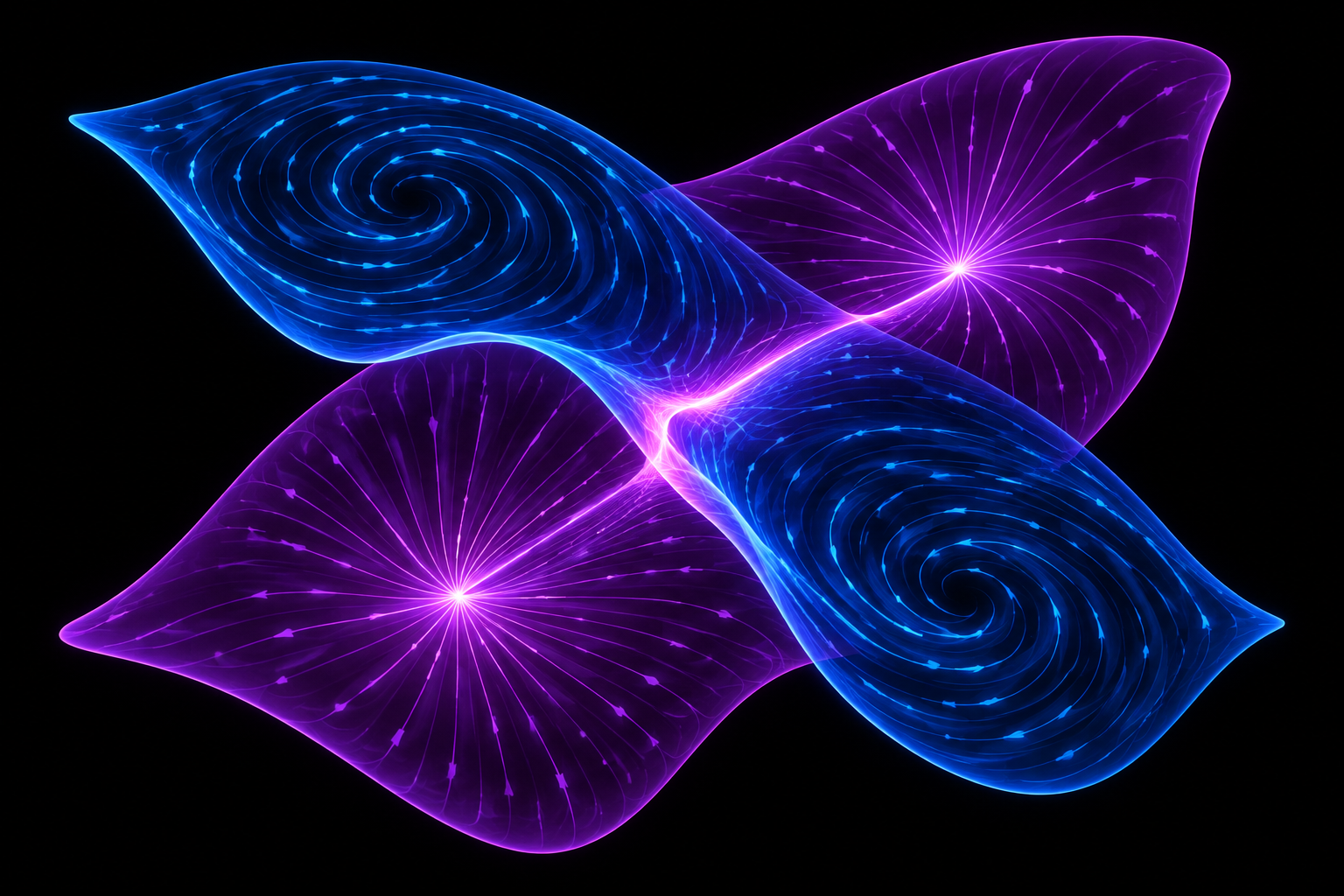
The borderline is where the question of matter gets asked. When the downwelling and the upwelling meet, the meeting is not a quiet seam: the two rotations scrape against one another along a narrow front, and along that front the medium is worked hardest — high energy, high density, high diversity crowded together. What appears unique about phase transitions — and they are undoubtedly involved in the formation of matter from the universal substrate — is that they happen there, at the boundaries where the involved structures meet: the components of matter emerging from the substrate when the borderline is sufficient to allow it. Read the substrate this way and it is a slipstream — a fluid carrying its components, hydrogen among them, in a dynamic, tumbling, highly torsional, low-friction framework. And the stars in their courses form a slipstream network of their own: a vast net in which the hydrogen formed at these boundaries is funneled into the stars, each star its own fluid-mechanical thermodynamic crucible. The boundary is where the ordering is paid for; the star is where the payment is spent. Nothing in the picture rides for free.
The leap this chapter takes from that ground is a single sentence: that the well and the lump may be one ordering rather than a mass placed in a field, with a phase transition as the thing that makes the twist persistent and its core the place where the energy sits. The attraction is then not a force reaching out from the lump; it is the shape of the ordering around a place where the ordering has been driven to a defect. The volume has arrived at this from the other direction four times already. The field concentrates where the charged sheet folds. The magnet's information survives in its modes when its bulk cancels. The quantum memory's carrier and protector are one relation. The axon's conduction is set by the geometry the membrane negotiates. In each the form is what a relation does while it holds, and nothing is stored in a part taken alone.
There is a temporal reading of the same picture, and it is the one the human mind finds hardest to hold, because what happens in space is more multidimensional than what we commonly observe on the ground. Read the well not as a force acting in space but as the condition that gives the wave form its duration. A localised wave structure without the ordering around it disperses; with the ordering, it persists long enough to be a thing rather than a passing event. Gravity, in this reading, is the glue that expedites the temporal existence of wave forms — not an attraction reaching across space but the relation that holds a form in time. The phase transition makes the twist persistent; the well, seen from outside, is what that persistence costs. This is the same sentence the volume has arrived at before — the form is what a relation does while it holds — but read from the temporal side rather than the spatial one. It does not relax the discriminator: the quantity of the twist that is asked to equal the mass must still deflect light by the measured amount and not by half. It deepens the picture without lowering the bar, and it inherits the same floor: time, no less than space, is part of the arena the hypothesis has not yet produced.
Stated strictly enough to be worth arguing with, the hypothesis has to claim roughly five things. That there is a medium with a phase in which long-wavelength excitations see an emergent Lorentzian metric. That a transition or a quench produces stable topological twists whose cores carry rest energy. That those cores act back on the medium so that the effective geometry far from a core matches the standard exterior solution, with the mass in it equal to the core energy divided by the square of the propagation speed. That the twist localising the core is the same structure that sources the geometry. And that no spacetime floor is left underneath for the whole construction to stand on while pretending to have produced the standing.
The first two exist in the laboratory. The third is partly studied in condensate models that assign a vortex an inertial mass and let it source an effective attraction. The fourth and fifth are the speculative joint, and the fifth is the deeper one. The earlier mistake would be to imagine spacetime as the floor on which the medium swirls. If the floor remains, the model has not derived gravity; it has borrowed the arena in which a laboratory fluid was already allowed to move. If the floor is removed, then the topological part of the vortex has to carry more than imagery. It has to be part of the way the arena arrives.
The seams, beginning with the missing floor
The first seam is prior to universality, because it asks what vorticity is a relation to. In the established cases it is a relation among parts of a medium, read inside a metric, across a neighbourhood. Something flows; the geometry tells rotation what it means; locality tells one part of the flow what counts as next to it. All three are already present before the curl is named. That is the fault line in the earlier picture: it still imagined a spacetime floor. The vortex could swirl on the floor, bend on the floor, perhaps even look like a well from the floor, but it had not produced the floor. It had only been staged there.
This is the deeper reason the chapter refuses to keep adding media. The expectations against which a medium is judged were never neutral; they were calibrated on a footing — a surface, under a pull, in three visible dimensions with one arrow of time running forward. Gravity read the wrong way, time as glue rather than corridor, a well with no down: these are not the universe being strange. They are the universe read without the ground's accent. The audited ground is surveyed to be refused because the ground is where the expectations were calibrated, and the refusal is of a parochial footing, not of established physics as scenery. None of this produces the topological part the narrow door requires. It states why the intuitive discomfort is not an objection to be met with a better-chosen analogy but the honest signature that the footing has been noticed.
There is one narrow door through that objection, and it has to stay narrow. Strip the metric away and the vortex does not disappear all at once. Part of it is differential and topological: a phase winds, a loop closes, a circulation is quantised. What requires the metric is the rest of the body: the axial vector with a measured magnitude, the speed of sound, the comparison of propagation to distance, the statement that a ray was bent by this much rather than that much. If the topological part can be made prior, then the metric-dependent part might arrive later as an effective geometry. That is the only way the hypothesis escapes the floor it first imagined. It is also the load-bearing claim the chapter cannot yet pay.
The cosmological constant is where that floor refuses to stay quiet. General relativity carries Λ as the term that remains when matter is removed, and the accelerated expansion it drives has been measured in the supernova and microwave-background record to a fit tight enough that ΛCDM is the working cosmology. The vacuum beneath, meanwhile, supplies an energy density of its own through quantum zero-point fluctuations, and the two do not agree. The estimate from the vacuum overshoots the observed dark-energy density by something on the order of 120 decades, which is the widest quantitative mismatch in physics and a standing sign that whatever is under the picture is not understood. For this chapter the point is a rule the floor imposes even after it is denied. The quantity of the twist that is meant to equal the mass in the potential must also not secretly equal Λ. A vortex medium that sourced the right mass while generating the wrong vacuum energy would have failed the discriminator from the other end: it would have produced the lump and the well and still not accounted for the term that persists when both are gone.
The temporal reading inherits the same floor by a second route, and that route has a name in the current literature. If the arrow of time is fundamental — as Al-Khalili has argued, that entropy increases because the arrow already points that way rather than the arrow following from the increase — then the reading of the well as the relation that holds a form in time leans on a direction handed down from outside, which is the fifth clause denied under another word. The closer kin is Rovelli's thermal-time programme, in which the flow is an emergent, perspectival effect of the thermodynamic state with no fundamental arrow, a view that rhymes with this chapter's impulse that the form is what a relation does while it holds. Kinship is not the narrow door: Rovelli's programme has not produced the metric from topology either, and it supplies a candidate ordering rather than the topological part the door requires. What is taken from Al-Khalili is his refusal of the past hypothesis — the low-entropy initial condition invoked to start the clock — as a cheat smuggled in after the fact, which is the chapter's own instinct about a flow put in by hand at the bathtub's rim; what is declined is the assumption that the arrow is given, since a given arrow is the temporal face of the very floor the chapter has refused. The honest standing is that both are retained as audited ground and neither is assumed: the temporal reframe is permitted only if the arrow is produced by the same structure that produces the well, and it inherits the floor the moment the arrow is taken as given. This is the one place where an open disagreement among physicists maps directly onto the chapter's deepest seam, and the chapter takes it as reason to keep the question open rather than as permission to choose a side.
The second seam is universality. In a fluid, the sound-gravity acts on sound. The constituents of the fluid go on falling in the ordinary gravity of the room they are in. If spacetime is to be the medium, then the same geometry must act on everything carrying energy, including the microscopic degrees of freedom that compose the medium itself. Most analogue models never close that loop, and the programmes that try to — superfluid vacuum, induced gravity, causal-order and other background-independent programmes — remain unfinished. This is not a technicality. Universality of coupling is the single most thoroughly tested feature of gravitation, and any account that has to add it afterwards is weaker than the account it hopes to replace.
The third seam is a word doing unearned work, and the volume's own discipline names it. Torsion in Einstein–Cartan gravity is a property of the connection, sourced algebraically by intrinsic spin rather than by mass, and in the standard treatment it does not propagate; it is slaved to spin density and negligible except where that density is enormous. A hydrodynamic vortex is orbital angular momentum of a flow, with a core and a circulating velocity field. These are two twists that rhyme. Calling both of them torsion is a borrowed shape, permitted only until someone writes the map from the curl of the velocity field to the torsion tensor — and unless that map is written, the picture has two different twists and one word. Things in common, not homology, applied to the chapter's own favourite term.
The fourth and smaller seam concerns direction, and it splits in two. Free fall in general relativity picks out no preferred direction in space, so a downward-trending flow looks at first like a category error. It need not be one, if the claim is about a tendency in the ordering — flow toward the core, energy cascading inward — rather than about a cosmic down. And down is in any case a statement made from somewhere. An observer stationed on the far side of the same well, or riding the flow itself, would draw the identical twist trending upward; the word reports the observer's footing, not the structure. What could survive every vantage is convergence — inward from everywhere at once — which is the only directional claim the picture is entitled to make, and the only one this chapter should be heard as making. But convergence earns the analogue its own falsifier, because a source and a sink give the same outer surface: if reversing the inward sense leaves the effective geometry unchanged, the trend was decoration and should be dropped.
The quantity that would decide it
The carrying test is a single question, and it is sharper than anything else in the chapter. Which quantity of the twist is meant to equal the mass that appears in the gravitational potential — the depleted particle number of the core, the zero-point energy of its vibrational modes, the quantised circulation, or a spin-torsion density? And can that same quantity, without adjustment, deflect light by the measured amount rather than by half of it?
Every part of the question is load-bearing. Naming one quantity forbids quietly switching to another when a different observation is demanded, which is how a picture of this kind usually survives longer than it should. Requiring the same quantity to do both jobs is what forces the account past Newton, because recovering the inverse square alone recovers only the half that was never in dispute. And requiring it without adjustment is the difference between a prediction and a fit. That is the cut between a fluid poem and a theory of gravitation, and this chapter is on the near side of it.
The four candidates can be priced in advance, and pricing them is the sharpest thing the chapter can do without new physics. Depleted particle number is a count, dimensionally a number rather than an energy, so it reaches the potential only through an assumed energy per missing particle — which is the adjustment the test forbids, unless that energy is fixed independently and in advance. Zero-point energy of the core modes is an energy and therefore the least strained identification, but it is the quantity whose absolute value is notoriously unfixed in every medium it has been computed for, and it is the same quantity that overshoots the observed dark-energy density by roughly 120 decades; whatever prescription tames it here must be the prescription that tames it there, or the account has paid one debt by opening a larger one. Quantised circulation is set by Planck's constant over the constituent mass and is therefore fixed by the medium rather than by the defect, which makes it a poor candidate for a mass that must vary continuously from a dust grain to a star. Spin-torsion density is sourced by intrinsic spin and, in the standard treatment, does not propagate, so it cannot reach out to bend a ray at an impact parameter far outside the core. Three of the four are refuted by their own dimensions or by their own non-propagation before any measurement is taken. That leaves one live candidate carrying a known catastrophe, which is a narrower and more useful standing than four open options.
There is a stage short of the test that would nonetheless count as progress, and naming it keeps the chapter from resting on an all-or-nothing demand. If the core energy of a vortex in an analogue medium can be shown to source an effective exterior geometry whose deflection of the medium's own excitations exceeds the analogue-Newtonian value by a factor approaching two, with the prefactor fixed by the medium's parameters and not fitted after the fact, the fourth clause would have acquired laboratory support without the fifth being settled. That is a bench measurement in principle, not a cosmological one, and it is the nearest thing to a falsifiable next step the hypothesis owns. It would not remove the floor. It would establish that the structure localising the core is capable of sourcing the geometry, which is the one clause standing between an audited analogy and a candidate mechanism.
What the chapter does claim is narrower and, to my mind, worth keeping. The picture in which a lump and a well are the same object is coherent, has laboratory analogues in which parts of it are realised, and belongs to the same family of readings as the four measured cases that precede it in this part of the volume. Coherence and family resemblance are not evidence. They are grounds for asking the question in a form that could fail, which is what has been attempted here.
The checkpoint question, then, is not whether the vortex trends downward, and not whether the picture can be imagined on a spacetime floor. The floor is the thing under question. The question is: what single quantity is being asked to carry the mass, what structure lets that quantity define distance rather than merely occupy it, and what measurement would take it away? Until that is answered, the correct standing for this chapter is an audited leap with its debt unpaid and its creditor named.
Equations borrowed
- W. G. Unruh (1981), 'Experimental black-hole evaporation?', Physical Review Letters 46, 1351: the acoustic metric, in which long-wavelength sound in a moving fluid obeys the wave equation of a massless field on a curved background. Borrowed as the chapter's foundational established result; the derivation's assumption of irrotational flow is reported rather than glossed.
- M. Visser (1998), 'Acoustic black holes: horizons, ergospheres and Hawking radiation', Classical and Quantum Gravity 15, 1767, and the draining-bathtub flow: the ergosurface and acoustic horizon of a swirling sink, borrowed as the controlled form of an inward-converging twist.
- Continuity and Bernoulli's balance for a constricted flow: the speed rises at a narrowing because the boundary conditions enter the equations. Borrowed as the cleanest established case of geometry entering the dynamics, and as the marking of the chapter's distance from its goal — in the pipe the geometry is an input, and the hypothesis requires a case where it is an output.
- Onsager and Feynman on quantised circulation in a superfluid, and the standard treatment of a vortex as a topological defect with a core in which the order parameter vanishes: borrowed as the reason a phase transition, rather than a swirl, is the load-bearing element.
- G. E. Volovik, The Universe in a Helium Droplet (Oxford, 2003), and the superfluid-vacuum programme: low-energy gravity, gauge fields and Weyl fermions emerging together near topological points, with the helium-three phases as template. Borrowed as the existing serious form of the chapter's hypothesis, and reported as unfinished.
- Einstein–Cartan gravity as developed by Hehl, von der Heyde, Kerlick and Nester (1976): torsion sourced algebraically by intrinsic spin, non-propagating in the standard treatment. Borrowed in order to hold the distinction between it and hydrodynamic vorticity, not to merge them.
- K. Gödel (1949), 'An example of a new type of cosmological solutions of Einstein's field equations of gravitation', Reviews of Modern Physics 21, 447: the rotating exact solution permitting closed timelike curves. Borrowed as the established proof that the field equations themselves permit a globally twisted spacetime; reported with its limits — the solution does not expand, no closed timelike curve has been observed, and the result is a possibility-proof about the equations, not a claim about our universe.
- Newton's derivation of the conic orbits from the inverse square, and the general-relativistic light-deflection result with its factor of two relative to the Newtonian value: borrowed as the pair of measurements any candidate account must produce.
- T. Jacobson (1995), 'Thermodynamics of spacetime: the Einstein equation of state', Physical Review Letters 75, 1260; Sakharov's induced-gravity proposal (1967); and background-independent programmes such as causal sets, loop quantum gravity, causal dynamical triangulations and group field theory: borrowed only as evidence that deriving both geometry and gravitation from more primitive bookkeeping is an established line of work, not that any one programme has succeeded.
- The cosmological constant as carried by the Einstein field equation, the measured accelerated expansion of the universe from the Type Ia supernova Hubble diagram (Riess et al. 1998; Perlmutter et al. 1999) and its concordance fit in the ΛCDM cosmology (Planck Collaboration 2018 and subsequent), and the vacuum-energy problem — the discrepancy between the observed dark-energy density and quantum zero-point estimates, conventionally quoted at roughly 120 orders of magnitude: borrowed as the term that remains when matter is removed, and as the rule that the chapter's candidate mass-quantity must not secretly equal a cosmological constant of the wrong size.
- Jim Al-Khalili on the arrow of time as fundamental — that entropy increases because the arrow already points that way, and not the reverse — and his characterisation of the past hypothesis, the low-entropy initial condition invoked to explain the thermodynamic arrow, as a cheat: borrowed as the established position against which the temporal reframe is tested, since a fundamental arrow would be the temporal face of the floor the chapter's fifth clause denies.
- Carlo Rovelli's thermal-time programme, in which temporal flow is an emergent perspectival effect of the thermodynamic state rather than a fundamental arrow: borrowed as the closer kin to the chapter's relational impulse, taken only as far as kinship and refused as a closed account, since the programme has not produced the metric from topology.
- The bounded-jump method, the carrying test, the zero-and-infinity suspicion, and the 'things in common, not homology' discipline — the volume's own, from Chapters 76, 80, 81 and 82 — borrowed back and turned on this chapter's own vocabulary.
Validity band
Established and not the chapter's: the acoustic metric for long-wavelength excitations of a moving fluid; the ergosurface and horizon structure of a swirling sink; the speed-up of a flow at a constriction under continuity and Bernoulli's balance, read as geometry entering the dynamics as an input; quantisation of circulation and the existence of vortex cores below a superfluid transition; the algebraic sourcing of Einstein–Cartan torsion by intrinsic spin; Gödel's 1949 rotating exact solution of the field equations, permitting closed timelike curves, reported as a possibility-proof about the equations and not a claim about our universe; the conic orbits as a theorem of the inverse square; the measured light deflection at twice the Newtonian value; the accelerated expansion of the universe and the measured cosmological constant within the ΛCDM fit; the vacuum-energy discrepancy between the observed dark-energy density and quantum zero-point estimates; and the non-emptiness of space as measured by particles, radiation, fields and quantum-vacuum effects. Partly studied and reported as such: condensate models that assign a vortex an inertial mass and let it source an effective attraction. Speculative and labelled at every appearance: that a persistent post-transition twist is both the lump and the well; that the structure localising a core is the same structure sourcing the surrounding geometry; that the relevant vacuum is the right kind of medium rather than merely not empty; that the twist can source a vacuum energy of the measured size rather than the catastrophic one; and that no background spacetime remains underneath; and that the well, read temporally as the relation that gives a wave form its duration rather than a force acting in space, is a reframe of the same claim and inherits every seam the spatial reading carries. The temporal reframe inherits that floor by a second route as well: unless the arrow of time is produced by the same structure that produces the well, the reading of the well as the condition of a wave form's duration borrows a direction from outside, and the question of whether the arrow is fundamental rather than emergent is reported here as an established disagreement (Al-Khalili for the former, Rovelli for the latter) and not adjudicated. The chapter names no field, writes no equation of its own, and does not claim our vacuum is a superfluid. The hypothesis is offered as a permitted line of thought with its discriminating measurement stated, which is a weaker standing than any measured chapter in this part and is marked as such. The four candidate mass-quantities are priced within the chapter on dimensional and propagation grounds alone, which is argument rather than measurement and is offered as such; and the analogue bench test named there — a doubled deflection of the medium's own excitations with the prefactor fixed by the medium's parameters — is proposed, not performed.
Falsifier
The hypothesis fails as a candidate account of gravitation if no single quantity of the twist — depleted particle number, zero-point energy of the core modes, quantised circulation, or spin-torsion density — can be identified with the mass in the gravitational potential and, without adjustment, also produce the measured light deflection rather than half of it. It fails at the deepest seam if the vortex requires a pre-existing metric and neighbourhood in order to be defined, because then it has not produced spacetime but only performed inside it. It fails on universality if the medium's own constituents must be granted a separate background gravitation, leaving a laboratory spacetime underneath. It fails on the medium claim if the vacuum is merely non-empty rather than phase-bearing in the way quantised circulation requires. It fails on the vacuum energy if the quantity identified with the mass also implies a cosmological constant that contradicts the measured dark-energy density, since producing the lump and the well while mis-accounting for the term that survives both is the same failure from the other end — and any candidate quantity that cannot even be asked the question has not reached the standing where the test applies. It fails on the torsional claim if no map can be written from the curl of the velocity field to the spacetime torsion tensor, in which case the shared word is retired and the two twists are held apart. It fails at the bench if the analogue deflection stays at the analogue-Newtonian value, or reaches the doubled value only with a prefactor fitted after the fact, because the one clause that could have been supported short of the full test would then have gone unsupported. The directional claim fails if reversing the inward sense of the flow leaves the effective geometry unchanged, since the trend would then be decoration. The temporal reframe fails if the arrow of time is shown to be fundamental rather than produced by the same structure as the well, since the reading of the well as the condition of a wave form's duration would then borrow a direction handed down from outside the ordering the chapter is trying to derive. The chapter's placement of this question alongside the measured cases of this part fails if those cases are shown to share only a vocabulary — that is, if the relation-carries-the-form reading is doing no work in any of them that a component-wise account could not do.
Where this chapter is weakest
The chapter is the weakest in this part by design and should be read that way. Its debt is unpaid: it specifies the measurement that would decide the matter and then does not supply it, which is honest but is not a contribution to physics. The analogue results it leans on are genuine and are also the easiest material in the subject to over-read, because a wave equation that looks like curved-space propagation is a mathematical resemblance and not a demonstration that our metric is a fluid's kinematics. The most serious hazard is now visible: the chapter may still be borrowing the spacetime floor it is trying to derive, and the vacuum-energy mismatch counts the same hazard in decades — naming the floor gone while the cosmological constant remains unexplained is to have moved the floor one place down rather than removed it. The word torsion is the next hazard, and flagging the hazard is not the same as removing it — a reader who wants the vortex and the spacetime twist to be one thing will find enough vocabulary here to believe it. The five-part strict statement of the hypothesis is the chapter's most useful page and also its most flattering, since setting a speculation out in numbered clauses lends it the appearance of a programme. And the resemblance to Chapters 76, 80, 81 and 82 is a real part of why this question was asked in this volume at all, which means the chapter is at some risk of confirming the frame it was written inside — the failure the volume's own method warns against most sharply, and the reason the discriminator is stated before the picture rather than after it. The temporal reading of the well as the glue of a wave form's duration is the chapter's deepest reframe and also the hardest to keep honest, because the move from force to temporal condition is easy to feel as insight before it has earned anything the discriminator can test. The passage that sets the reframe against the live disagreement over the arrow of time is a hazard of the same shape, since citing Al-Khalili and Rovelli could be read as the chapter taking a side it has explicitly declined, and the only honest use of the disagreement is as the reason the question stays open. The pricing of the four candidates is the apparatus at its strongest and also carries its own conceit: eliminating three of them by dimension and non-propagation narrows the field without advancing the survivor one step, and a reader may take the narrowing for a result. The surviving candidate is the one saddled with the largest unexplained number in physics, which means the chapter's best case is also its most exposed.
The volume-wide audit of these weak points is collected in Where This Volume Is Weak.
The two readings of the skin
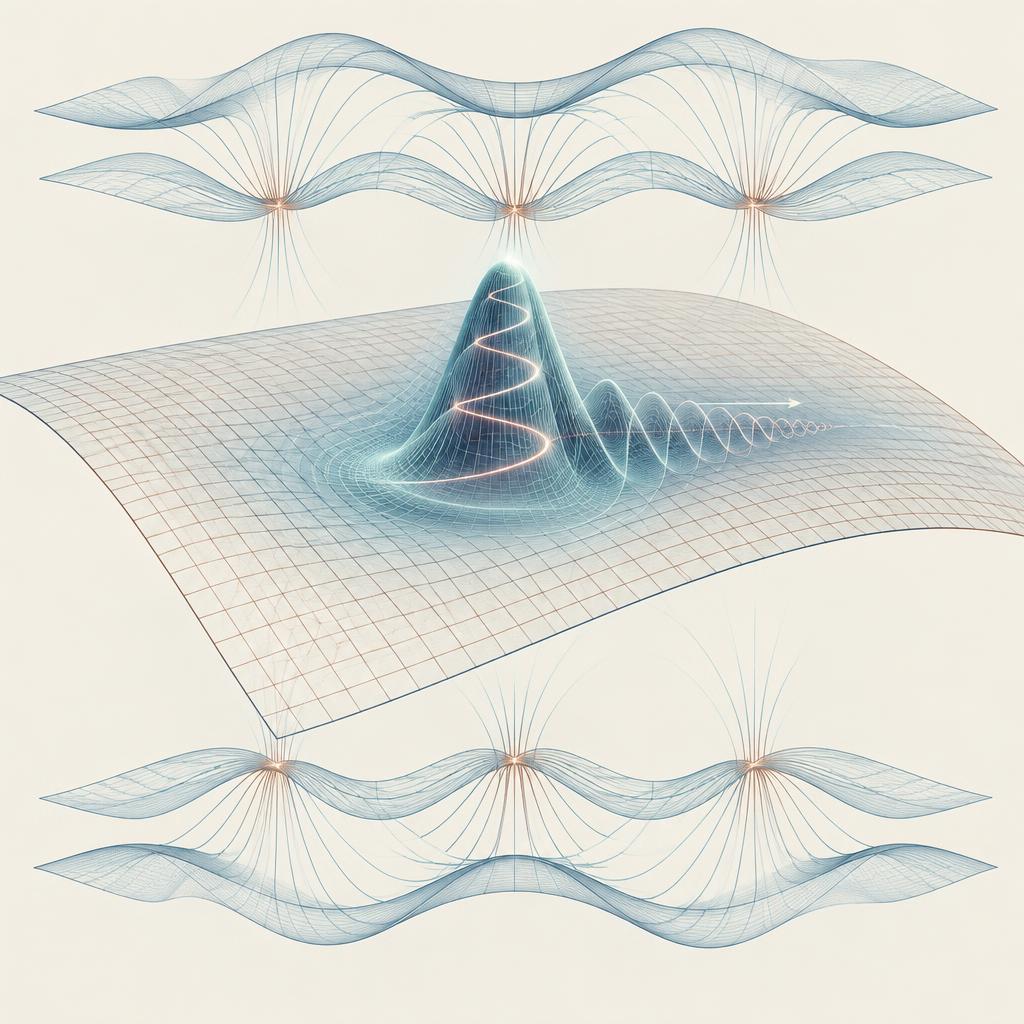
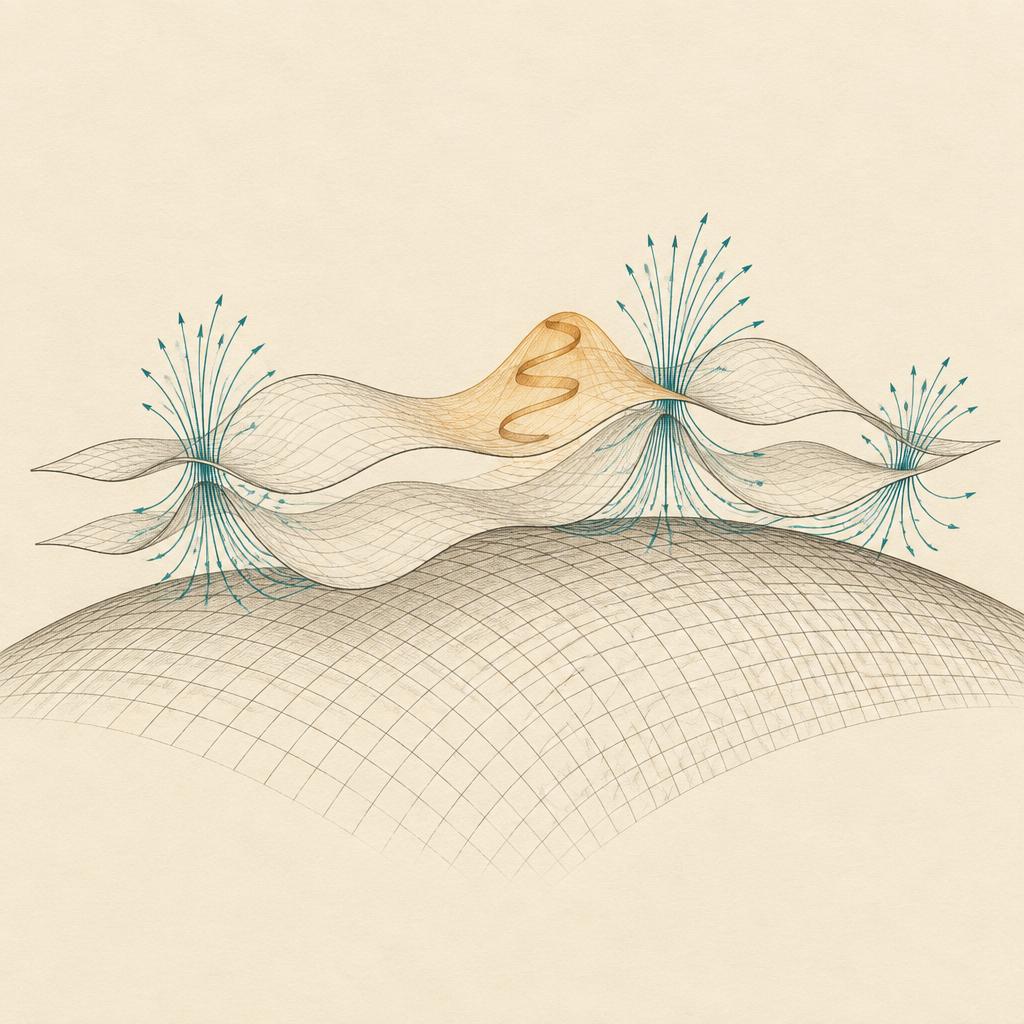
The chapter's picture admits two layerings, and the choice between them is the author's. In the first reading the manifold skin — the surface that carries the dimensionality — runs between the two sheets of the dual membrane. In the second the skin lies beneath and carries both sheets, which rest on it and undulate in step. In both, the membranes are already electromagnetically live, the field gathering where they bend, and the wave packet rides with its phase inside its envelope.