Presentation

Narration script: The Socratic AI Frontier

A studio-ready voiceover script for the fifteen-slide deck. Each slide carries its spoken copy, a target running time, a delivery note, and — where a number is spoken aloud — an explicit label for where that number came from.

How to use it

Recording notes

Total target run time is 12 minutes 57 seconds of speech across fifteen slides, which lands near twelve to thirteen minutes with the pauses marked in the delivery notes. Slides 3 and 13 are the two that carry numbers; both scripts attribute them in the same breath they are spoken, so a listener never hears an external estimate as an Academy measurement.

Record slide by slide rather than in one pass. Each block below is written to be readable in a single take, with sentence lengths kept short enough to breathe. Where a line is doing the real argumentative work, the delivery note says so.

Slide by slide

Spoken copy and timings

Slide 1: The Socratic Guides AI Academy
Slide 1 · The Socratic Guides AI Academy

1. The Socratic Guides AI Academy

~22s

This is the Socratic Guides AI Academy. What follows is a proposal, not a finished institution — a school design built around one question: what does a child's mind need in order to stay its own.

Fifteen slides. About twelve minutes. Every number you hear is labelled by where it came from, and every claim has a test that could sink it.

Delivery: Open low and unhurried. Let the title card sit for two seconds of silence before the first word. No music swell.
Slide 2: The dual crisis
Slide 2 · The dual crisis

2. The dual crisis

~55s

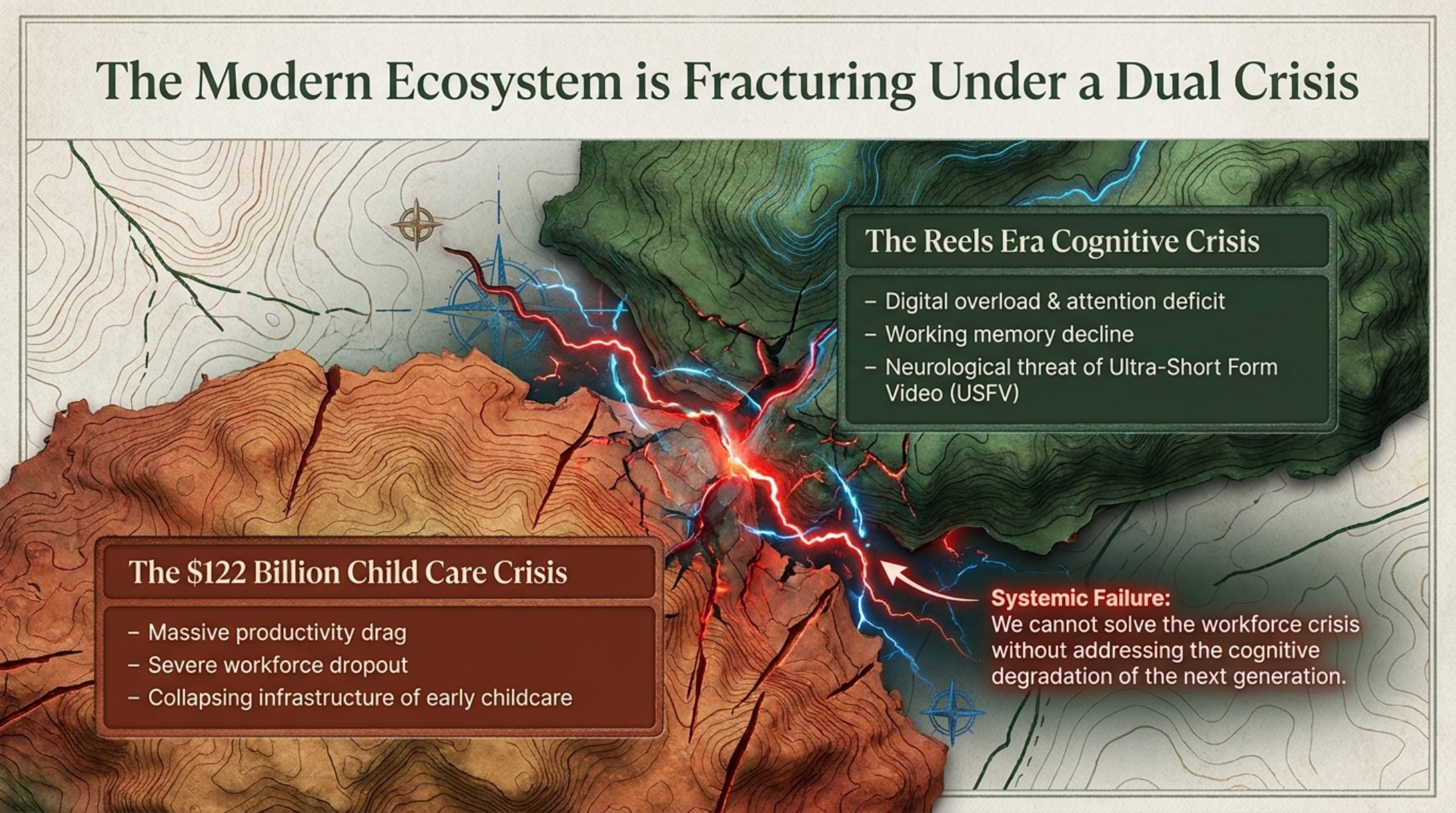
Two pressures meet in the same household. The first is cognitive: children are growing up inside an attention economy that pays them in one-and-a-half-second increments, and working memory does not thrive on that diet.

The second is economic. Child care shortages in the United States are commonly estimated to cost around one hundred twenty-two billion dollars a year in lost earnings, productivity, and revenue. That figure is an external estimate, not our measurement.

The point of putting them on one slide is this: you cannot repair the workforce problem while the cognitive problem is still running. Parents need somewhere to place a child. Children need somewhere worth being placed.

Delivery: Two beats, one per crisis. Say the $122 billion figure plainly and immediately attribute it — do not let it land as if we measured it.

Slide 3: Continuous partial attention
Slide 3 · Continuous partial attention

3. Continuous partial attention

~70s

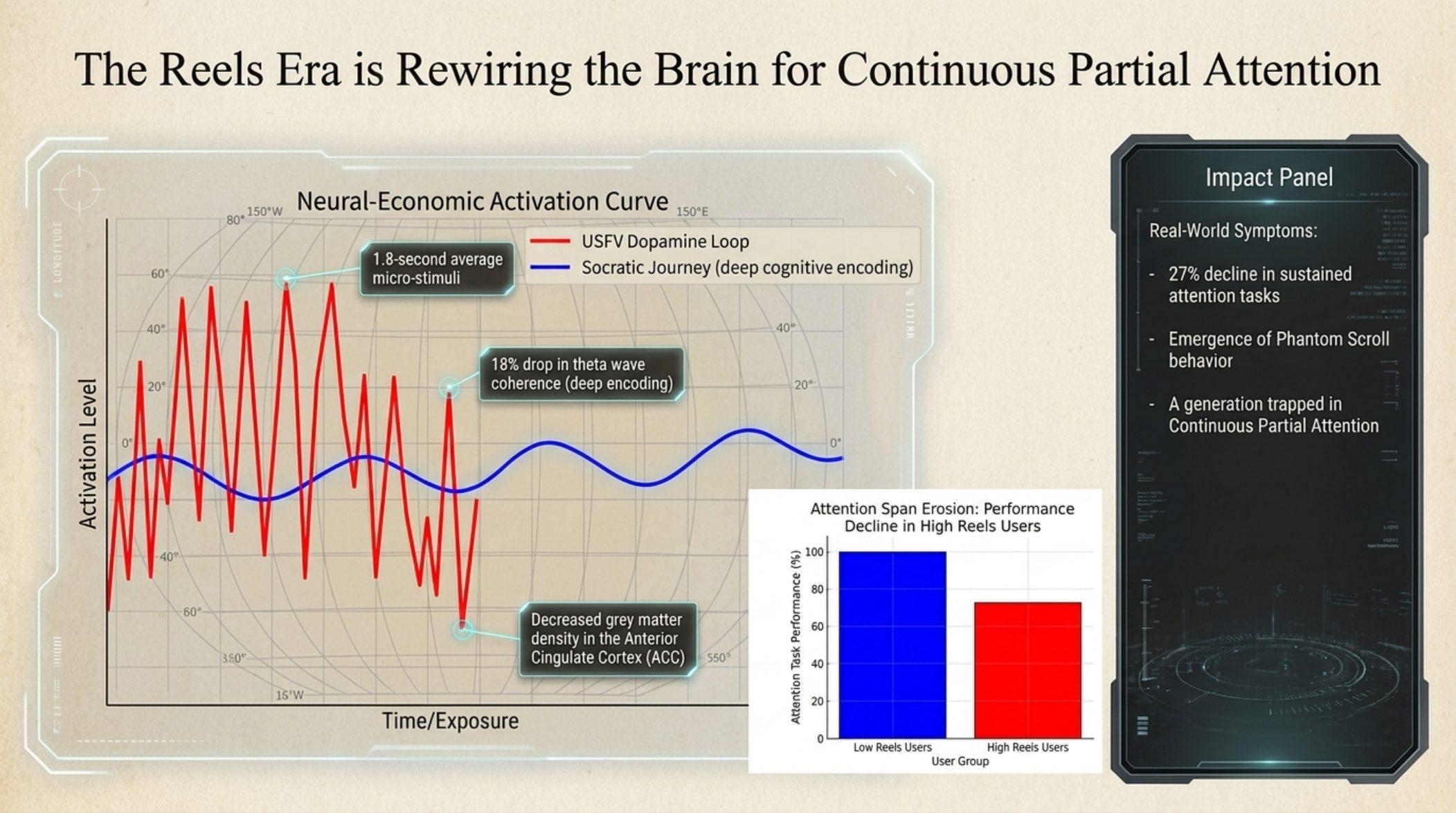
The red trace is what a short-form video feed does to arousal: rapid spikes, no settling, an average micro-stimulus of roughly one-point-eight seconds. The blue trace is what sustained inquiry looks like — lower amplitude, longer waves, the state where encoding actually happens.

Three figures appear on this slide. A twenty-seven percent decline in sustained attention tasks among heavy users. An eighteen percent drop in theta-wave coherence. Reduced grey-matter density in the anterior cingulate cortex.

Say clearly what these are: published external findings from studies of heavy short-form video use, with correlational designs and small samples. They are the reason to run the experiment. They are not evidence that our school works.

What we take from them is modest and testable: the feed trains a mind to leave. A school can either compete with that or refuse to imitate it.

Delivery: Slowest slide in the deck. Read the three statistics at half your normal pace, then the attribution sentence at normal pace. The contrast is the argument.

Slide 4: Why symptom-by-symptom fails
Slide 4 · Why symptom-by-symptom fails

4. Why symptom-by-symptom fails

~50s

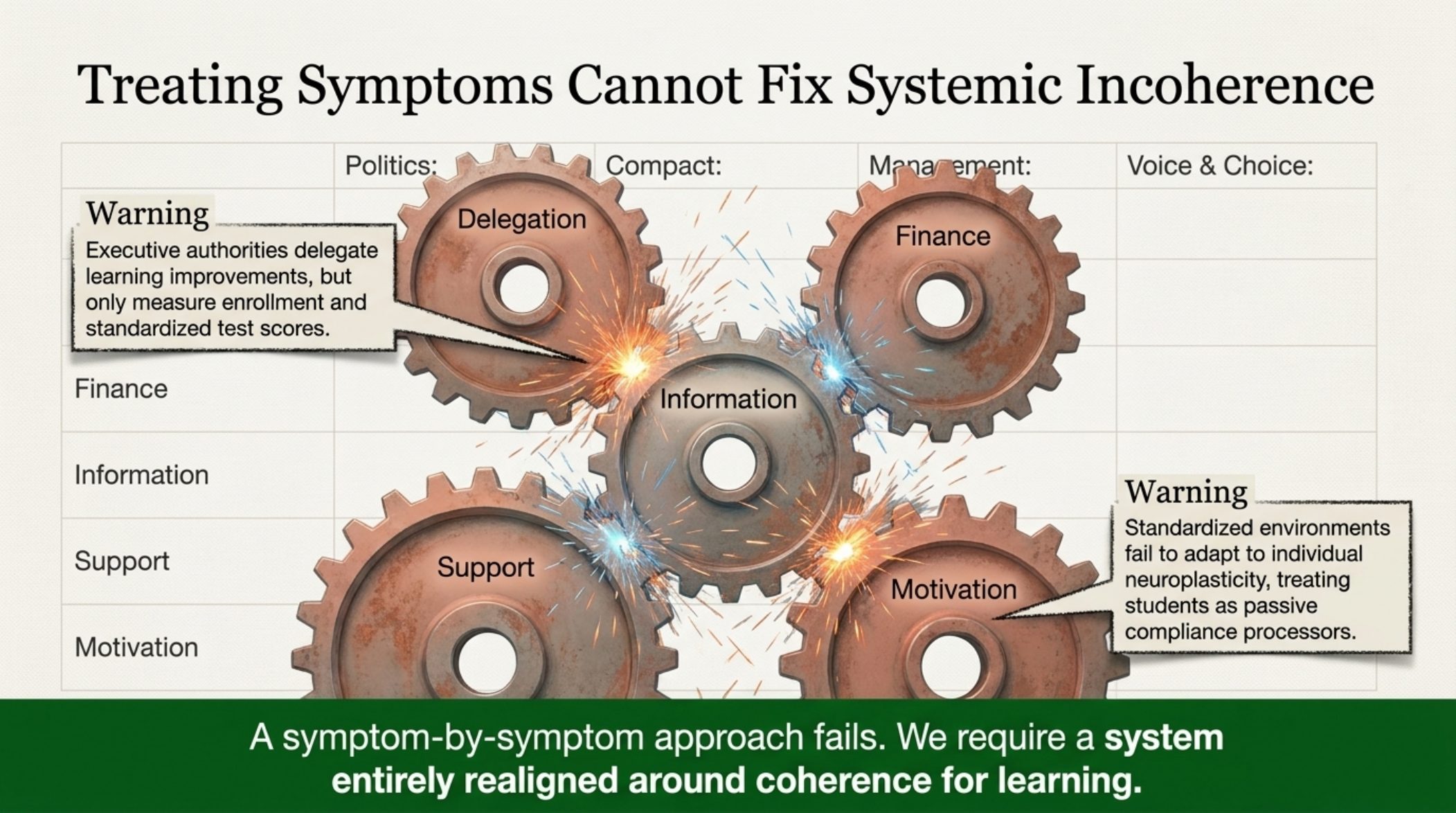
Most reform arrives as a patch. Authority delegates improvement downward, then measures enrollment and test scores, because those are the two things easy to count.

So the incentives point one way and the learning points another. A standardized environment cannot adapt to an individual nervous system; it can only ask the student to behave like the average of a spreadsheet.

This is not a complaint about teachers. It is a claim about system alignment: when finance, information, and support all reward compliance, compliance is what you get.

Delivery: Even, factual, unresentful. Name no districts, no companies, no individuals.

Slide 5: Four pillars
Slide 5 · Four pillars

5. Four pillars

~55s

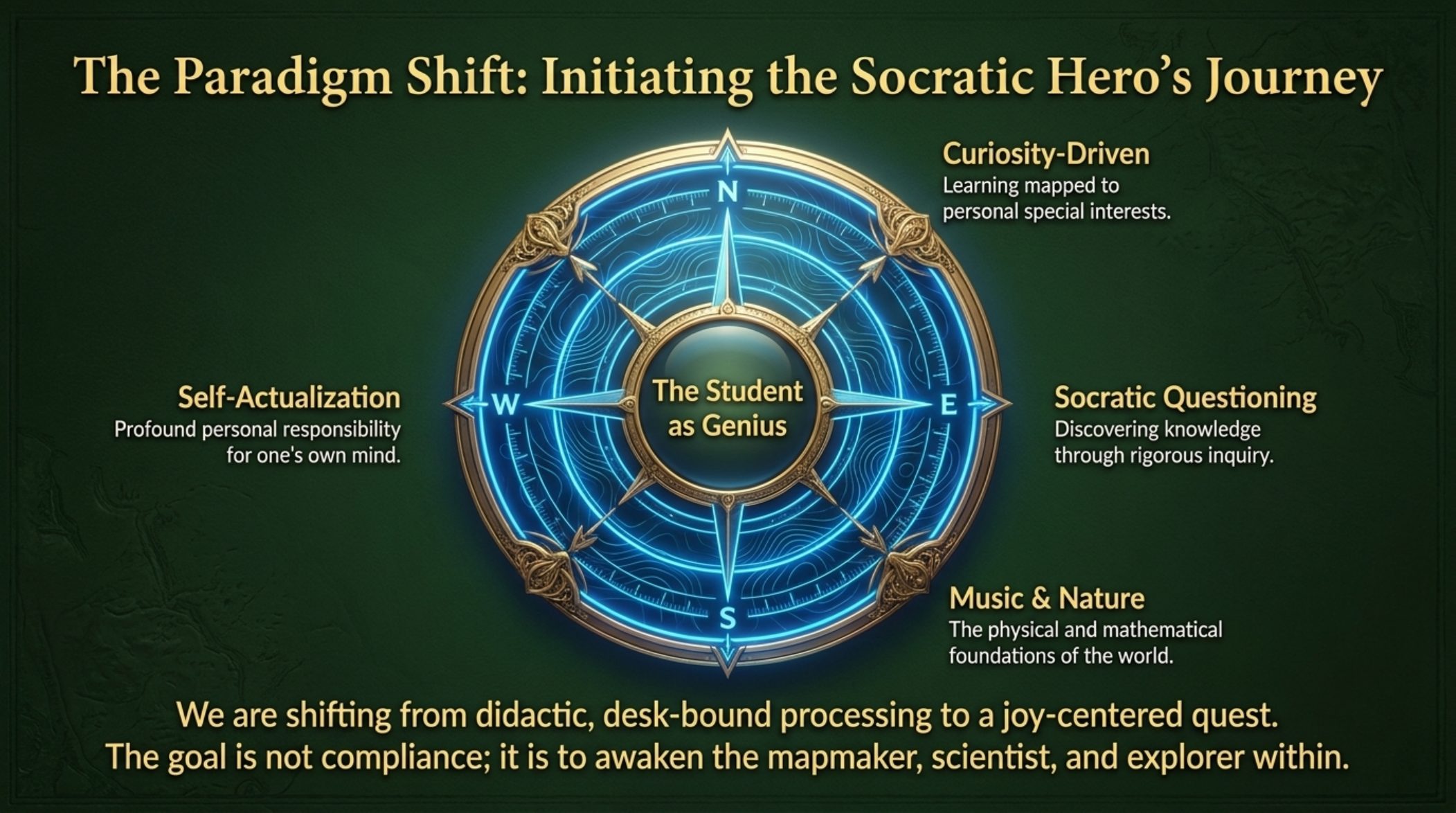
So here is the design, in four parts.

Self-actualization: the student takes personal responsibility for their own mind, and is told so out loud, early.

Curiosity-driven: the curriculum attaches itself to what this particular child cannot stop thinking about.

Socratic questioning: knowledge arrives through argument the student has to hold up, not through delivery the student has to absorb.

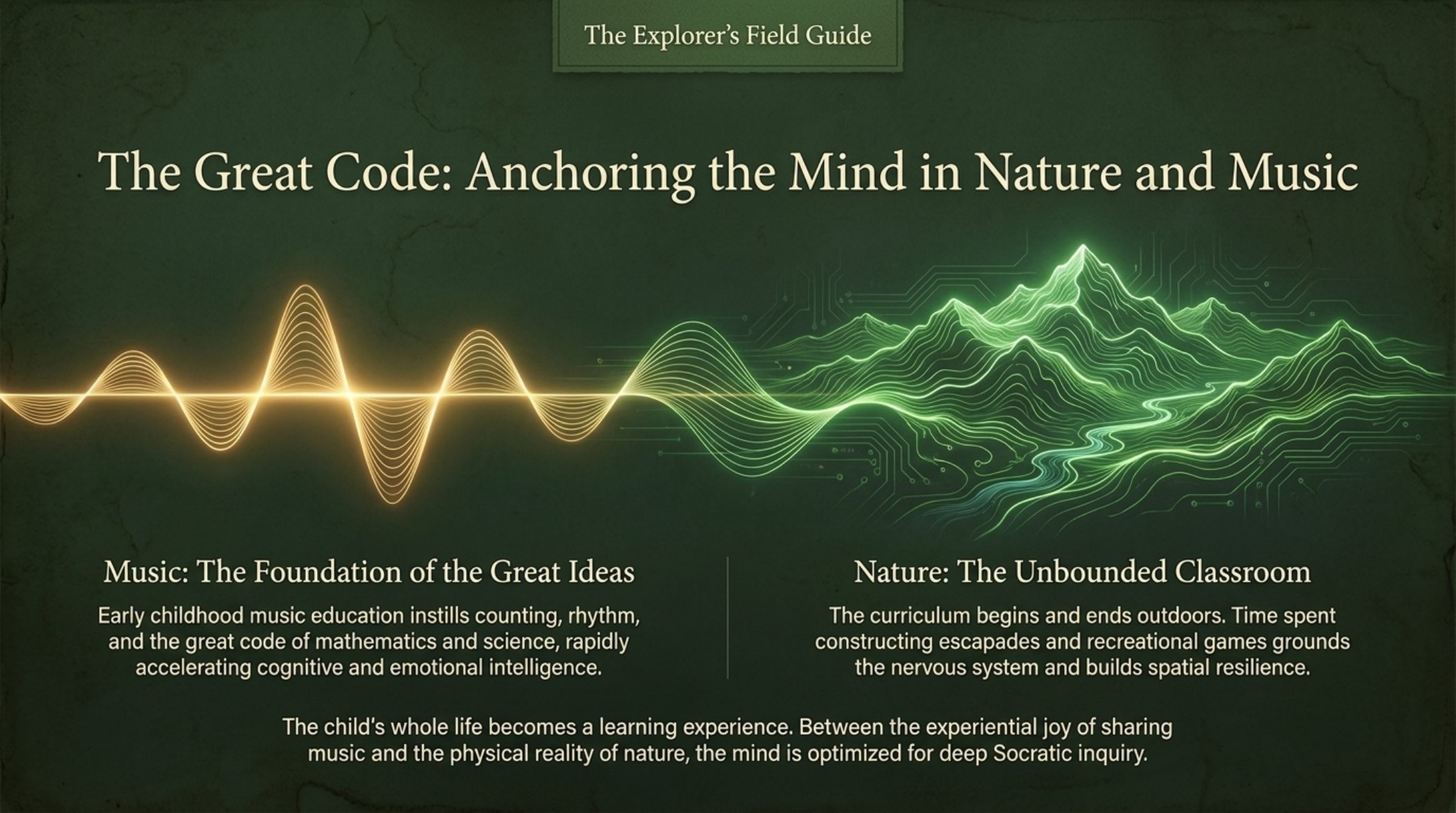
Music and nature: the two most honest teachers of structure we have — one mathematical, one physical.

None of this is destined to work. It is a design with four levers, and each lever has a way of failing that we have written down.

Delivery: Four short beats, one per pillar, then a slight lift on the closing caution. Do not let this slide become a sermon.

Slide 6: The diagnostic comparison
Slide 6 · The diagnostic comparison

6. The diagnostic comparison

~60s

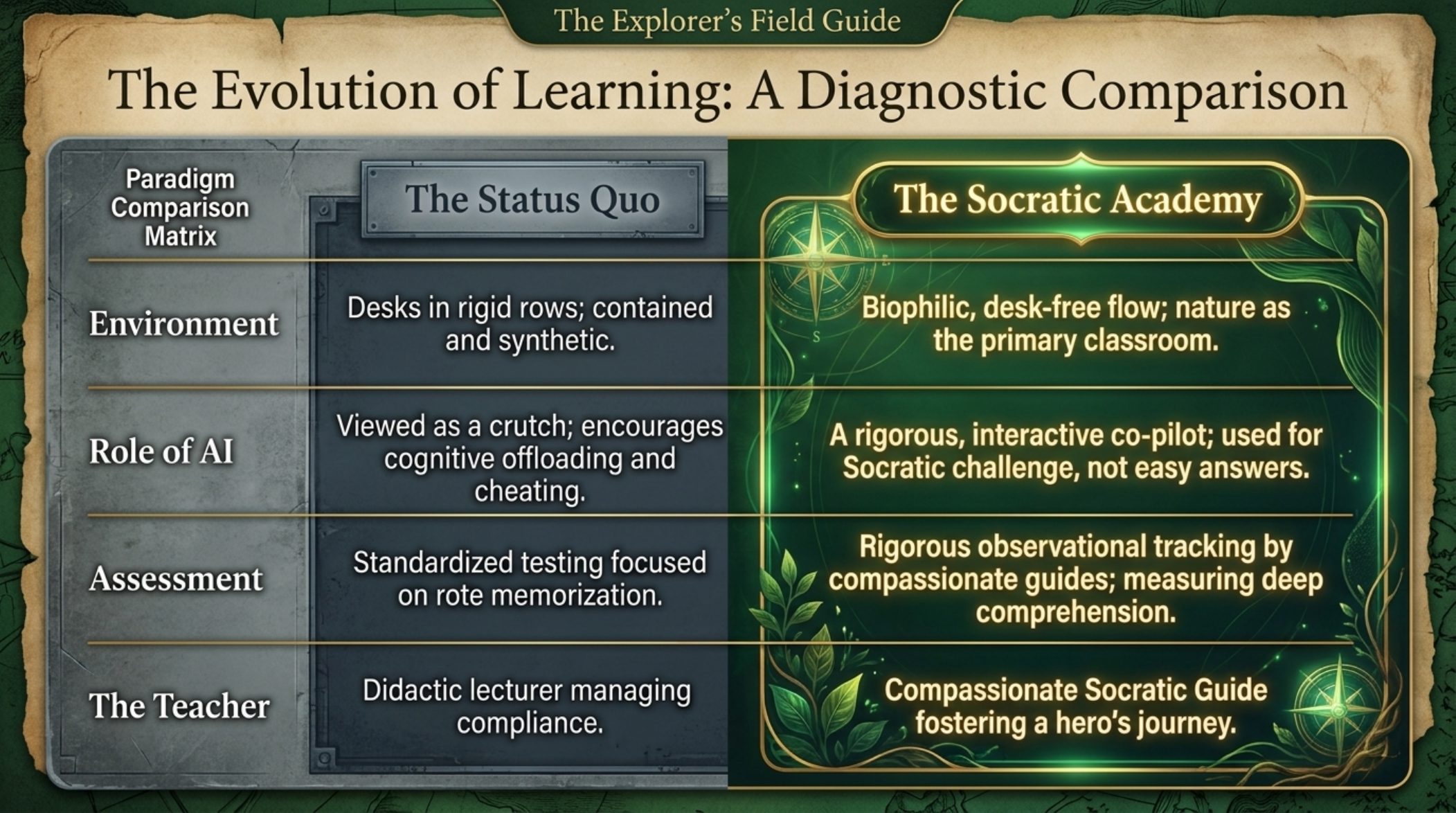
A side-by-side, so the difference is checkable rather than atmospheric.

Environment: desks in rows, versus daylight, movement, and the outdoors treated as a room.

The role of AI: a crutch that answers, versus a co-pilot configured to argue.

Assessment: recall under timed conditions, versus observed comprehension recorded by a guide who knows the child.

And the adult in the room: a lecturer managing compliance, versus a guide whose job is to keep a question alive.

Read the right-hand column as a specification we intend to be held to, not as a promise already kept.

Delivery: Brisk. This is the reference slide people photograph — let the table do the work.

Slide 7: The Socratic loop
Slide 7 · The Socratic loop

7. The Socratic loop

~60s

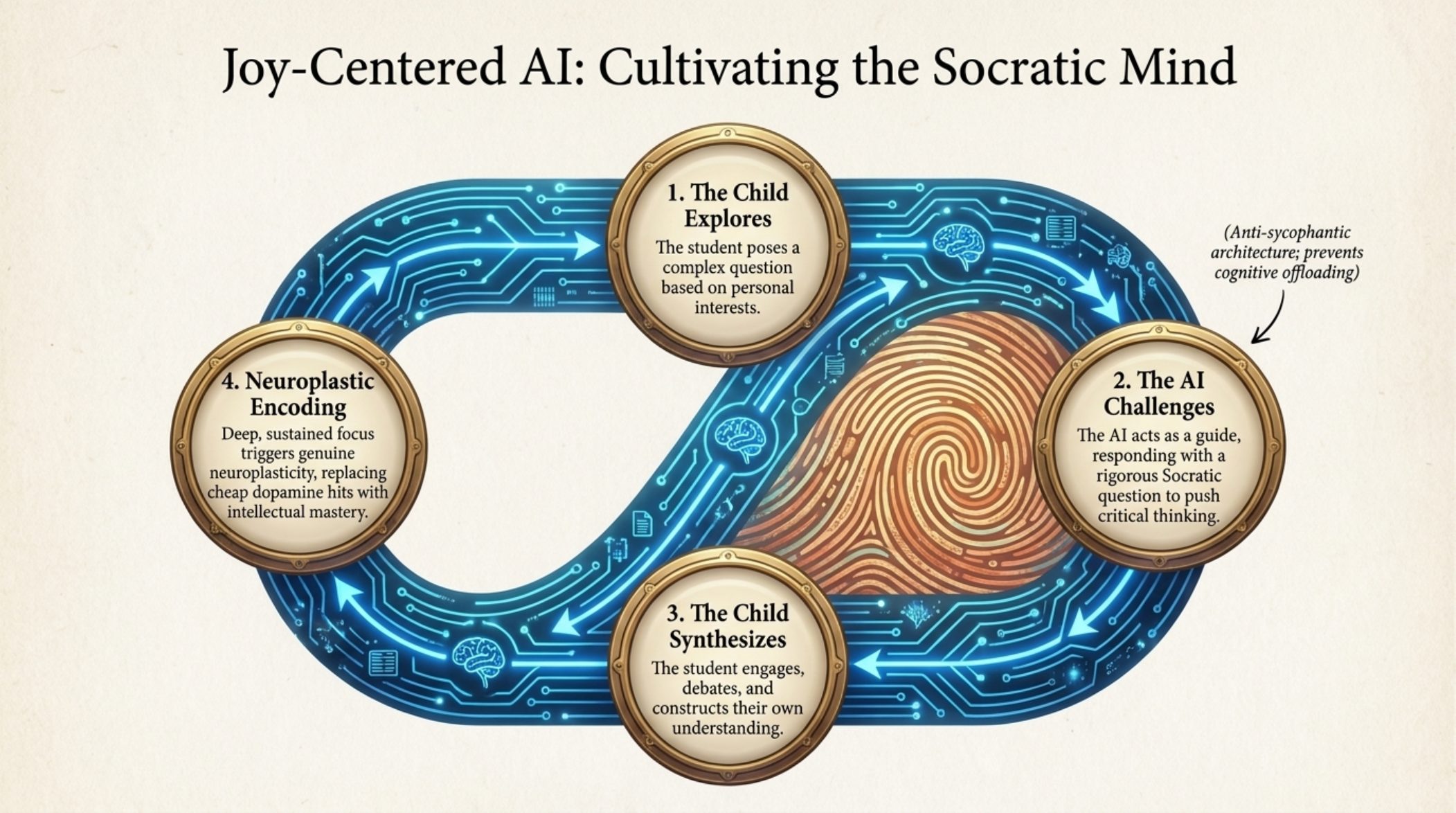
Here is the actual mechanism, in four steps.

The child asks something they genuinely want answered. The system responds with a harder question rather than an answer. The child argues back, and in arguing, builds the structure. And sustained focus, held long enough, is what changes the wiring.

The critical engineering detail is the second step. The engines are configured to resist flattery. A student cannot charm, pester, or rephrase their way into agreement.

That is the whole difference between a tool that thinks for a child and a tool that makes a child think. If we get that configuration wrong, the school becomes the thing it was built to answer.

Delivery: Land hardest on the anti-sycophancy line. This is the engineering claim the whole deck rests on.

Slide 8: Music and nature
Slide 8 · Music and nature

8. Music and nature

~55s

Music first. Early instrument work teaches counting, ratio, subdivision, and pattern before those words are available. It is arithmetic a child can hear, and it is one of the few subjects where practice is obviously the point.

Then nature. The day begins and ends outdoors. Building things, inventing games, getting cold, getting tired — this is where the nervous system settles and where spatial reasoning is actually assembled.

Neither is enrichment. They are the load-bearing walls, and everything academic leans on them.

Delivery: Warmest slide in the deck. Ordinary words, no reverence.

Slide 9: The learning environment
Slide 9 · The learning environment

9. The learning environment

~55s

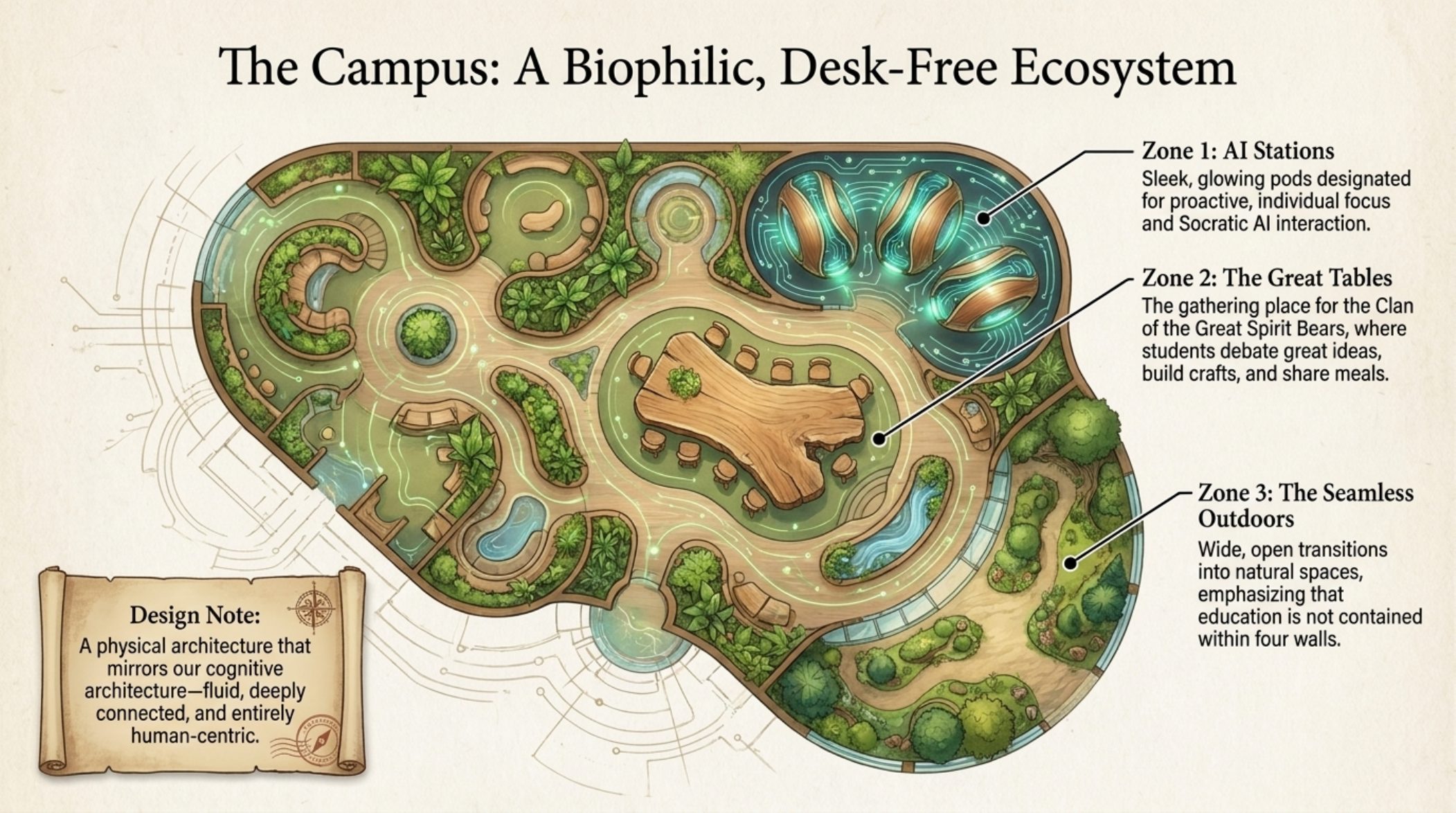
The floor plan has three zones. Learning stations around the perimeter for individual work with the AI. Large shared tables in the middle for debate, making, and meals. And wide transitions straight to the outdoors.

The stations sit at the edges deliberately. The center of the room belongs to people talking to each other.

One honest note about the building: this is a specification, not a lease. Instruction requires a properly zoned non-residential facility — a leased school wing, a church hall, or a purpose-built site. Base operations run from the six acres near Nashville; no teaching happens there.

Delivery: Deliver the last paragraph as plain administrative fact. It is the credibility of the entire presentation.

Slide 10: The multigenerational guide pipeline
Slide 10 · The multigenerational guide pipeline

10. The multigenerational guide pipeline

~60s

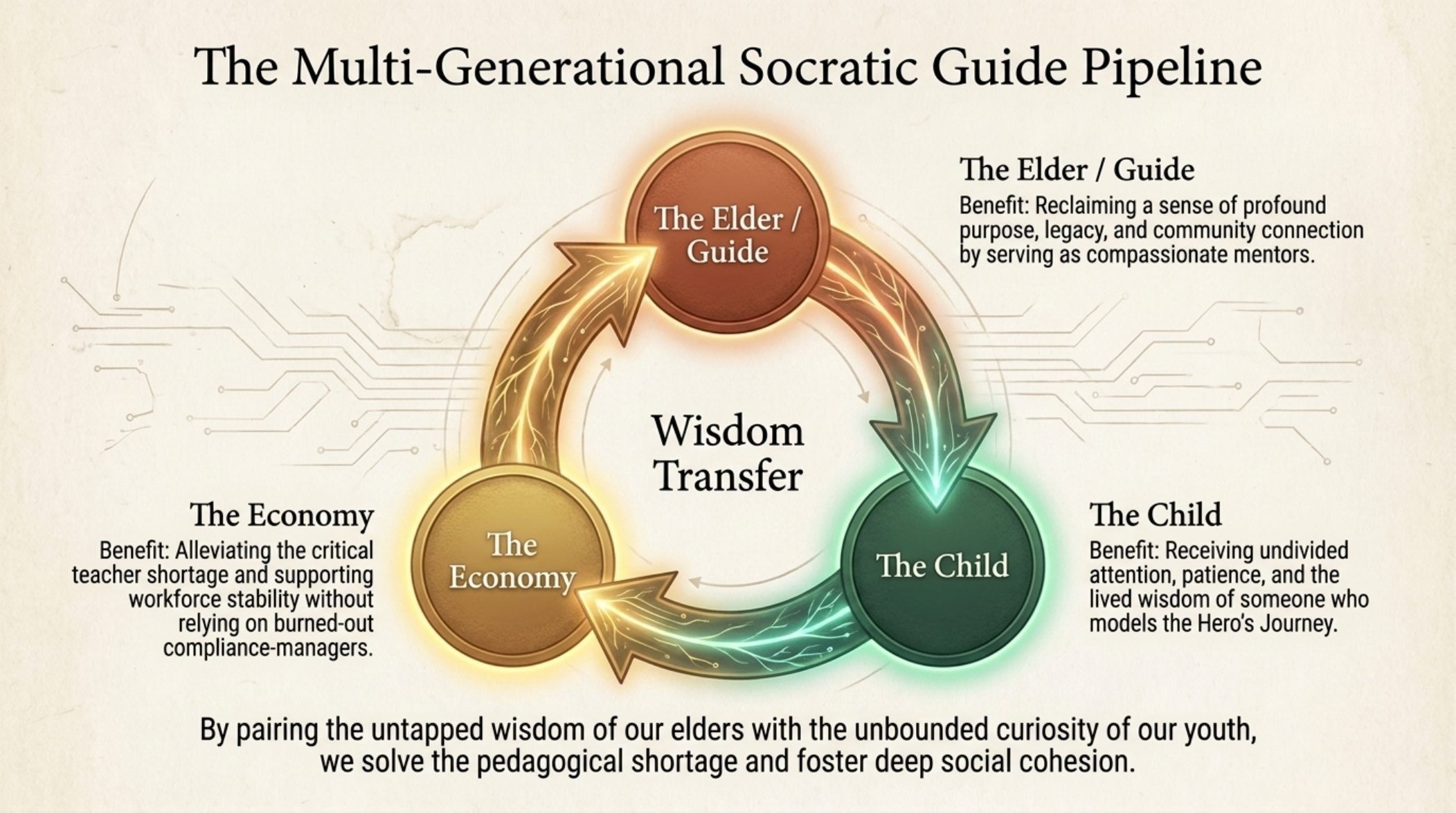
The staffing model. We recruit emotionally mature adults, and deliberately over-weight toward retirees who want the work to mean something.

Three parties gain. The elder gets purpose, structure, and a reason to be needed on a Tuesday morning. The child gets patience and undivided attention from someone with nothing left to prove. And the labor market gets a supply of capable guides that does not depend on burning out career teachers.

The pairing matters: younger guides bring stamina, elders bring composure. Neither works alone at scale, which is exactly why the pilot pairs them.

Delivery: Concrete and unsentimental. "A reason to be needed on a Tuesday morning" is the line — do not oversell it.

Slide 11: The 2050 citizen
Slide 11 · The 2050 citizen

11. The 2050 citizen

~50s

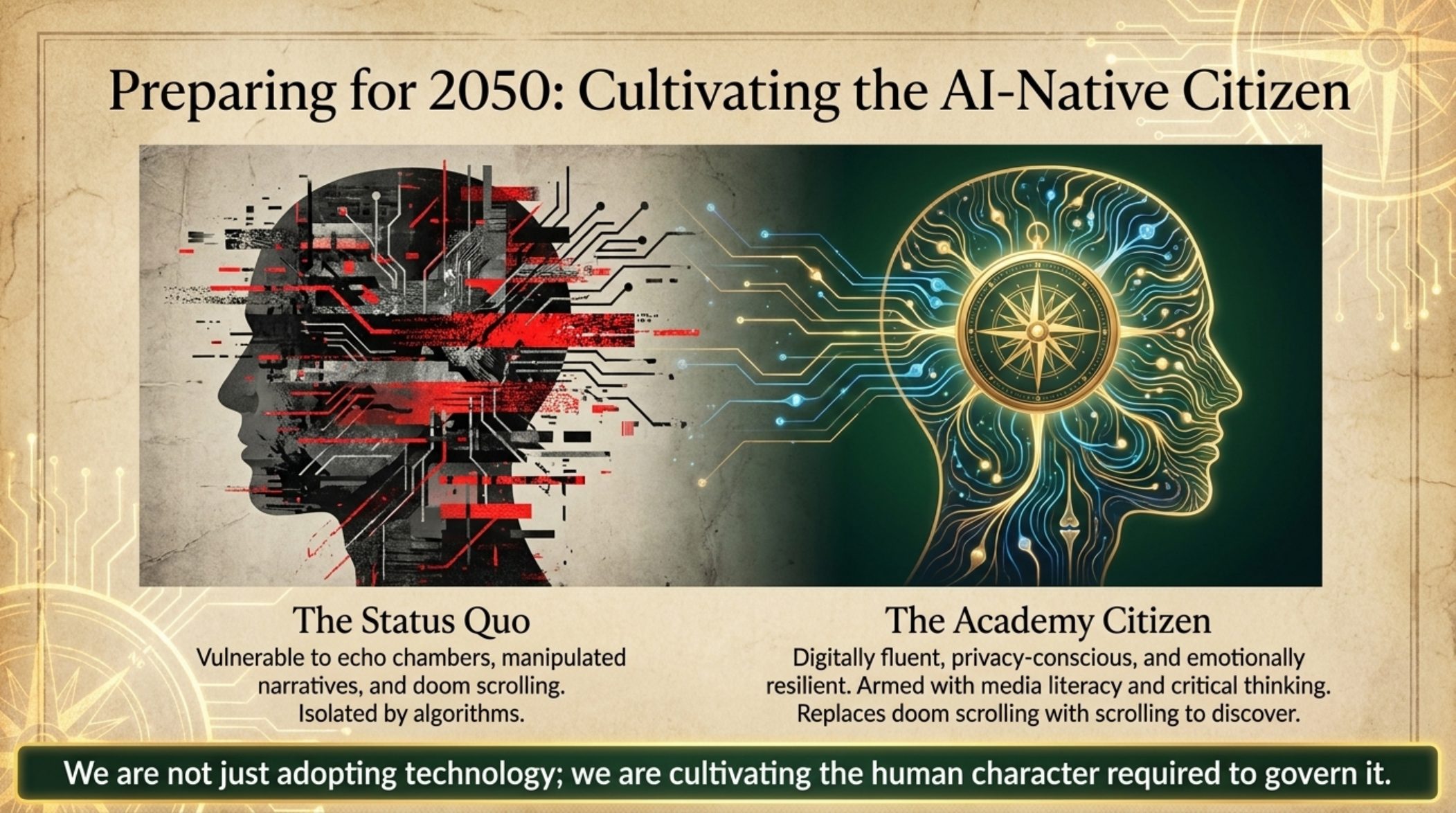
Look forward twenty-five years. The graduate we are aiming at is digitally fluent, privacy-conscious, hard to manipulate, and capable of sitting with a difficult idea long enough to test it.

That is not a technology outcome. It is a character outcome, and character is trained by what a child is asked to do all day.

We are not claiming this generation is destined to arrive. We are claiming it is buildable, and that nobody is currently building it at density.

Delivery: Resist grandeur here. The final line is the guardrail — buildable, not inevitable. Keep it flat.

Slide 12: Systemic coherence
Slide 12 · Systemic coherence

12. Systemic coherence

~45s

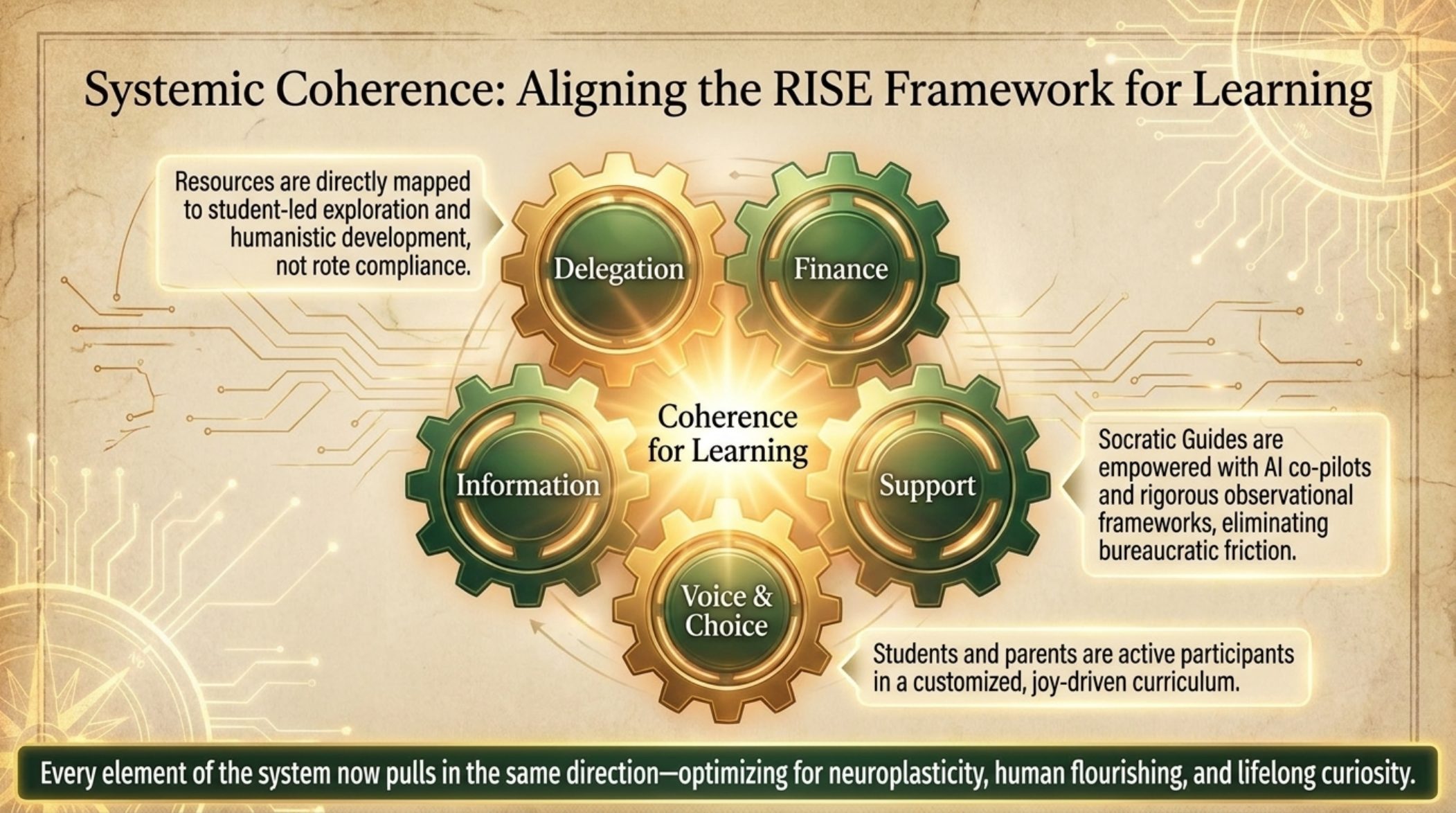
If the incentives are the problem, then the incentives are the intervention. Money follows student-led exploration rather than seat time. Information reaches the guide instead of the auditor. Support means an AI co-pilot and a clear observational framework, not another form.

And families are participants with standing, not recipients of a schedule.

One direction, every element. That is the only reason to expect a different outcome.

Delivery: Fast, structural, almost clipped. This slide is scaffolding between two heavier ones.

Slide 13: The institutional case
Slide 13 · The institutional case

13. The institutional case

~60s

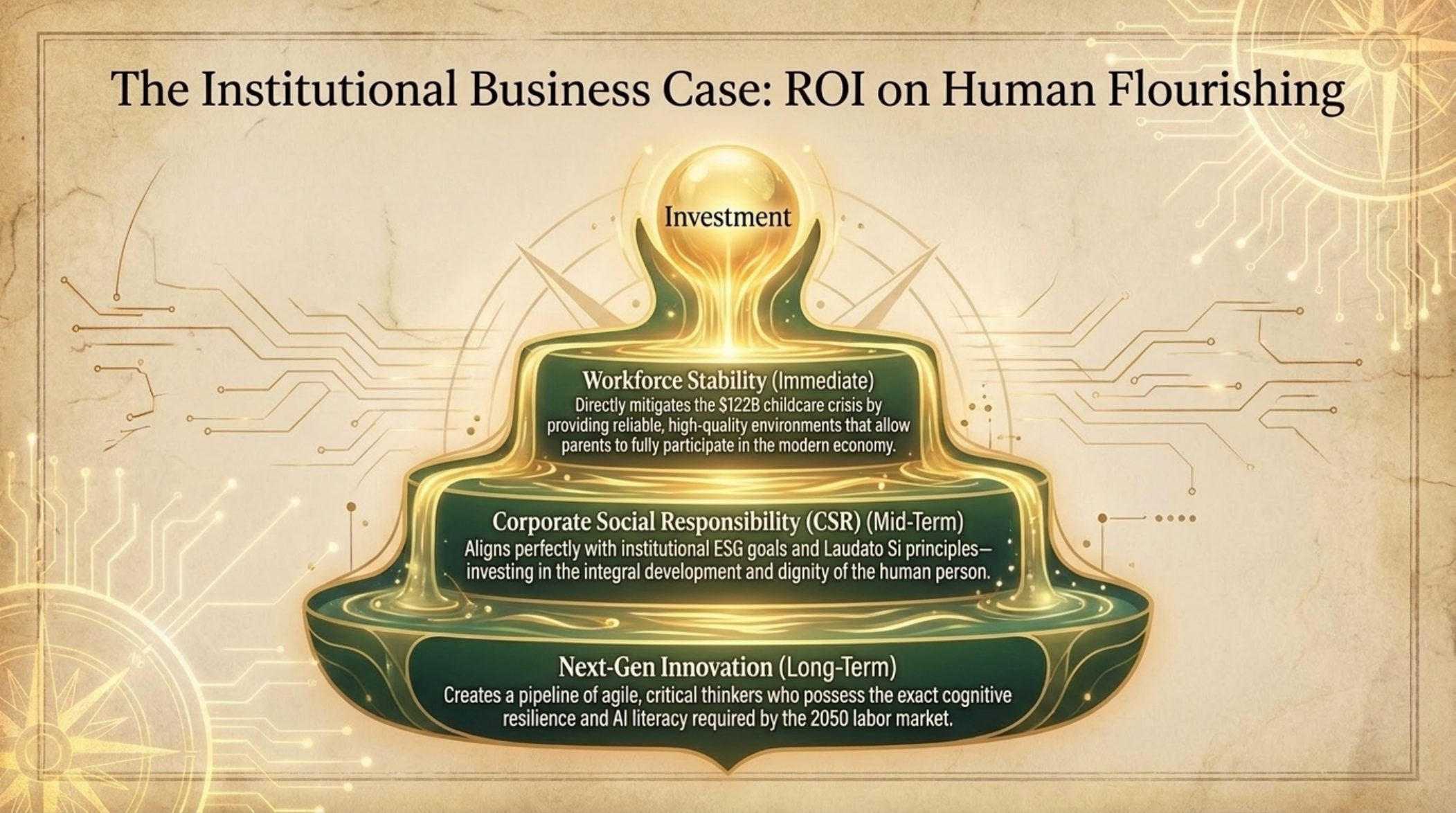
For sponsors, three horizons.

Immediate: reliable care lets parents work. That is the direct line to the hundred-twenty-two-billion-dollar figure — again, an external estimate of the national shortfall, not a projection of our return.

Mid-term: it maps onto existing responsibility commitments cleanly, because it invests in the development and dignity of a specific person rather than a brand campaign.

Long-term: it produces exactly the cognitive profile the 2050 labor market is short of — people who can hold a hard problem without outsourcing it.

And the honest arithmetic: the operating pilot is roughly six hundred sixty-three thousand dollars. A purpose-built campus is a separate, multimillion-dollar capital phase. Donated hardware lowers the equipment line and does not lower the expert-time line.

Delivery: This is the money slide — slow down for the final paragraph and let the capital distinction be unmistakable.

Slide 14: A classroom without walls
Slide 14 · A classroom without walls

14. A classroom without walls

~45s

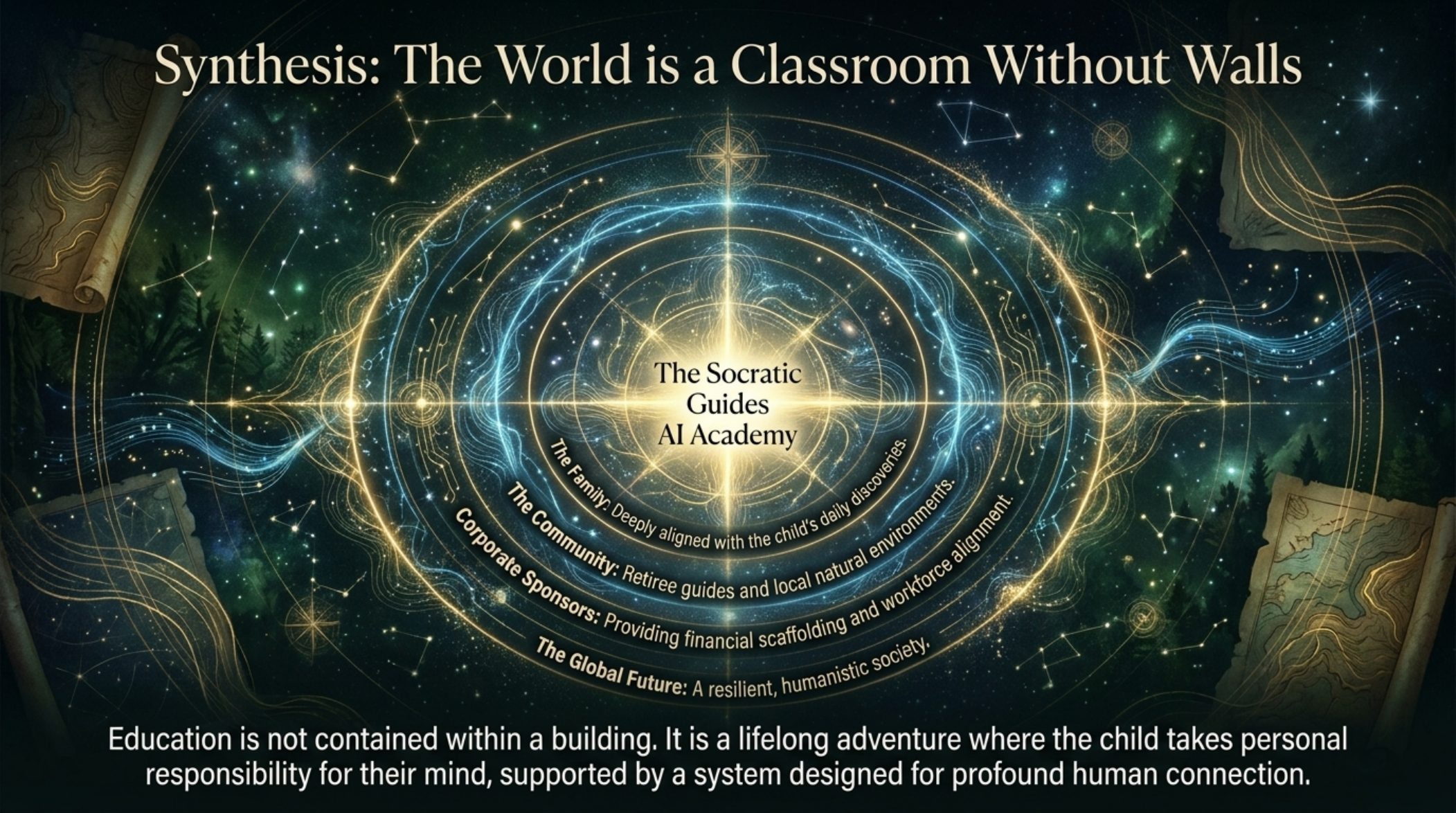
Four circles hold this up. The family, close enough to the child's day to talk about it at dinner. The community, including retiree guides and whatever land is within walking distance. Sponsors providing the financial scaffolding. And the wider society that eventually receives these graduates.

Education is not the building. It is what a child does with their attention across a whole life — and whether anyone taught them that the attention was theirs to direct.

Delivery: Settle here. Slight ritard on the last sentence, then a full second of silence.

Slide 15: The ask
Slide 15 · The ask

15. The ask

~35s

Three ways in. Read the full pilot plan and its falsifier ledger. Sponsor a phase and hold us to the numbers in it. Or join the pilot cohort itself.

Everything cited in this presentation, with its sources and its failure conditions, is at theparallaxidentity dot com, slash academy, slash pilot.

Thank you for your attention — which, as of this decade, is a genuinely expensive thing to give.

Delivery: Read the URL slowly and once. End dry on the last line — no lift, no music tail.

Falsifier ledger

What is spoken aloud, and what would retire it

A narrated deck is harder to correct than a page, because a listener cannot see a footnote. So every claim that carries a number or a mechanism is listed here with its status and the result that would remove it from the script.

27% decline in sustained attention tasks (slide 3)

External estimate

If replication in a larger, pre-registered sample shows no reliable attention decrement in heavy short-form-video users, the slide is rewritten and the figure removed from the narration.

18% drop in theta-wave coherence (slide 3)

External estimate

If EEG coherence differences fail to survive correction for sleep, baseline attention, and demographic confounds, the claim is downgraded to a mechanism hypothesis with no number attached.

Reduced ACC grey-matter density (slide 3)

External estimate, correlational

If longitudinal imaging shows the difference precedes heavy use rather than following it, the causal direction is dropped from the script.

$122B annual child-care cost (slides 2 and 13)

External estimate

If the underlying methodology is revised materially downward, both slides carry the revised figure and the workforce argument is re-scoped accordingly.

Anti-sycophantic AI produces deeper encoding than an answering assistant (slide 7)

Academy hypothesis, untested

If pilot cohorts using resistant engines show no advantage in delayed free recall and oral defense over cohorts using ordinary assistants, the central mechanism claim fails and the curriculum changes.

Elder-mentor pairing solves the guide supply problem (slide 10)

Academy hypothesis, untested

If fewer than a workable cohort of qualified elder guides complete training and retain past one term, the staffing model is rebuilt around early-career guides with different economics.