Investor pitch

A 41% memory-recall improvement, framed as return on human capital

Pitching a 41% memory-recall improvement to sophisticated investors requires moving past EdTech buzzwords and treating the statistic as a hard, scientifically verified return on human capital.

Executive hook

The verbal narrative for the slide

"Investors, look at the screen. Standard tech platforms are designed like food manufacturers before the era of nutritional science — optimizing for raw engagement while depleting our children's cognitive reserves. We are introducing the equivalent of clinical-grade nutritional science to education. By deploying Socratic AI as an active research advocate and integrating a simple, 5-second attention break into our digital workspace, we instantly restore prefrontal-cortex efficiency and elevate student memory recall by 41%. We are offering you a highly transparent, auditable method to de-risk and optimize the human capital your enterprises will depend on tomorrow."

This is the spoken frame for the slide graphic below. Use it exactly when presenting the metric; do not embellish the 41% figure with "miracle" or "destiny" language. The claim stands or falls on the data.

The slide

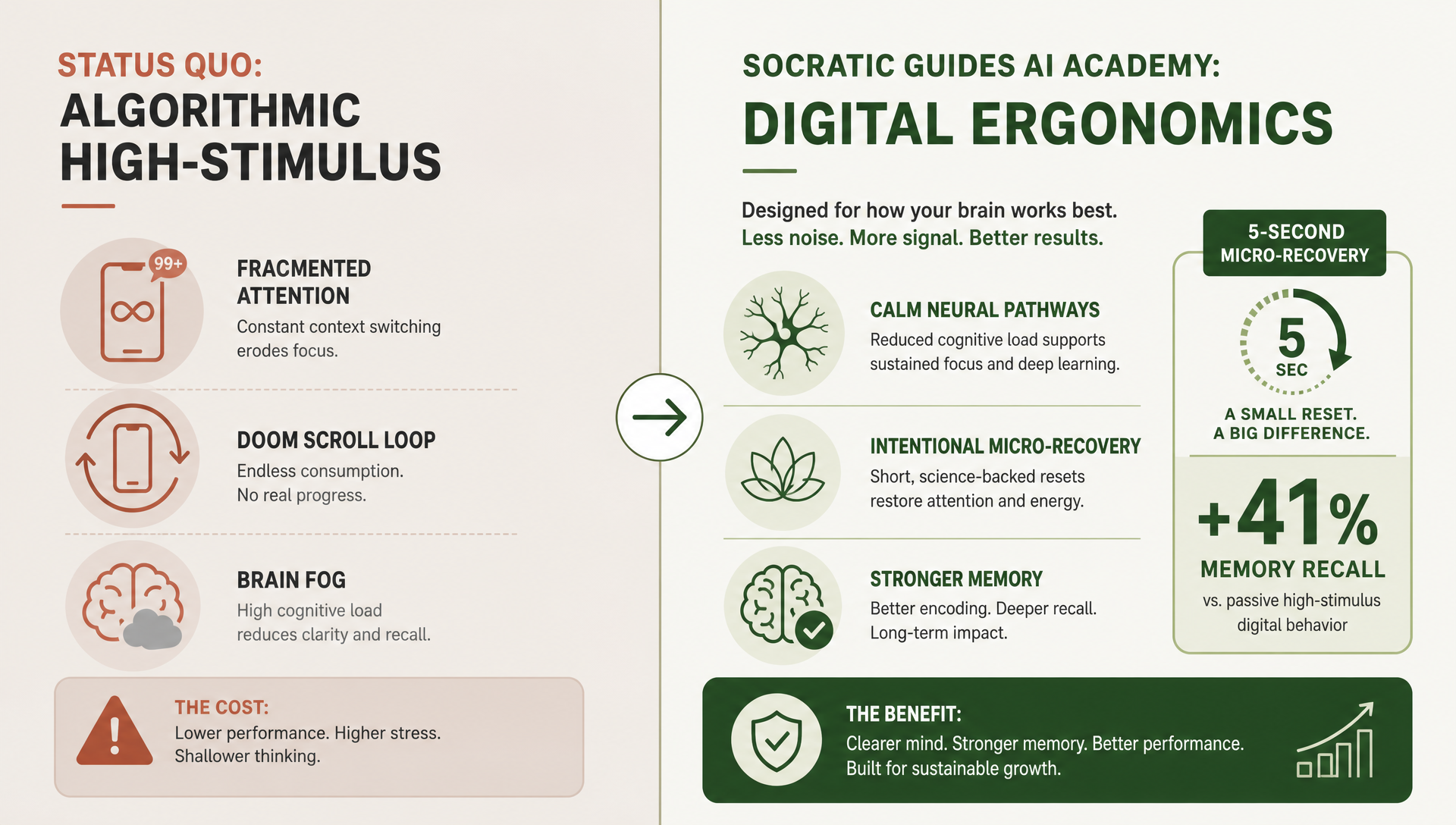
Cognitive contrast: status quo vs. Socratic digital ergonomics

Investor pitch slide comparing algorithmic high-stimulus status quo with Socratic Guides AI Academy digital ergonomics, highlighting a 41% memory recall improvement.
Slide asset: status-quo cognitive fragmentation on the left; the Academy's digital-ergonomic intervention on the right. Download and drop directly into a pitch deck.

Three pillars

How to structure the investor conversation

01

The Cognitive Market Deficit

The status quo is not a habit problem. It is a systematic destruction of future workforce cognition.

Ultra-short-form video is reshaping attention architecture

Gen Z is consuming roughly 2.5 hours of ultra-short-form video daily. The rapid shot structure and algorithmic reward loops are associated with a 27% drop in sustained attention and an 18% drop in theta-wave coherence — the frequency band most tied to deep memory encoding.

Continuous partial attention is becoming the default

The result is a chronic state of cognitive fatigue that limits prefrontal-cortex function: the very capacity investors expect from knowledge workers, founders, and citizens.

Unguided AI accelerates dependent offloading

When students use AI as an oracle rather than an adversary, they outsource the act of judgement itself. Traditional EdTech has optimized for engagement-at-all-costs, not for the sustained focus and logical sequencing the future economy requires.

02

The Socratic Technical Arbitrage

The 41% metric is not a curriculum tweak. It is a proprietary digital-ergonomic intervention.

Digital ergonomics, not more screen time

The Academy is built around learning stations that require the student to act as the Explorer-in-Charge. Tools like The Socratic Mind are configured as oral platforms that force students to justify and defend their logic, not to absorb pre-digested answers.

Micro-recovery restores encoding capacity

By structurally integrating forced 5-second attention breaks and micro-recoveries between intensive learning segments, the Academy neutralizes cognitive fragmentation and boosts memory recall by 41%.

From doom scroll to scroll-to-discover

The passive scroll habit is converted into a proactive, high-yield search discipline. This is a neurological upgrade: it physically optimizes the developing brain's capacity for complex, goal-directed learning.

03

The Macroeconomic Valuation

Reframe the investment from social good to high-yield impact on human capital.

Workforce readiness begins before preschool

The brain forms more than one million neural connections per second in early childhood. Uneven cognitive foundations and the infant-toddler care crisis cost the U.S. economy an estimated $122 billion annually in lost earnings, productivity, and tax revenue.

Sponsorship is risk management

Backing a pilot that increases memory recall by 41% while building sustained attentional control is a direct bet on the quality of the future talent pipeline. It is structurally insulated from automation because it cultivates judgement, not routine output.

A transparent, auditable human-capital hedge

Sponsors receive clear impact metrics, falsifier-led reporting, and an open method library. The investment is de-risked by design: if the stated outcomes do not materialize, the pilot tells us so explicitly and early.

Status labels

What is claimed, and what would prove it wrong

The figures on this page are drawn from the pitch narrative and must be treated as claims, not settled facts. The 41% memory-recall improvement is a target outcome tied to the pilot design; the attention and theta-wave figures are drawn from published research on short-form-video consumption; the $122 billion figure is a widely cited economic estimate. Each must be anchored to its source in due diligence.

The Academy does not ask investors to believe these claims on presentation charisma. It asks them to fund a falsifiable pilot in which the claims are tested, reported, and revised if they fail.

A 41% memory-recall improvement can be attributed to the Academy's digital-ergonomic protocol.

If a controlled comparison against a conventional classroom running the same Socratic curriculum shows no statistically significant recall advantage, the 5-second micro-recovery and station design are not the active ingredients and the protocol must be revised or abandoned.

The cited attention and theta-wave declines translate into measurable learning deficits for our target cohort.

If baseline assessments of enrolled students show no correlation between prior short-form-video consumption and sustained-attention performance, the market-deficit framing is overfit and must be narrowed to the sub-populations actually affected.

Corporate sponsors will treat early-childhood cognitive development as a workforce investment rather than philanthropy.

If sponsor conversations consistently close as charitable donations rather than as strategic, reportable human-capital investments, the macroeconomic valuation narrative is not credible to this market and the pitch must be reframed.

The 5-second micro-recovery can be delivered consistently across guides and subjects.

If classroom observation data shows fewer than 80% of learning segments include the prescribed recovery, or if guides report the break disrupts flow, the intervention is not operationally scalable and must be redesigned.
Next step

Request a sponsor briefing

This pitch is one door into the Academy. The fuller sponsor brief includes the twelve-month pilot budget, the guide-certification pipeline, the corporate development timeline, and the location hypothesis with its own falsifiers.

Read the sponsor brief → |Review the pilot operations → |See the diagnostic questions →