Interior study of the proposed Academy room: timber gathering tables, timber arches, daylight, and compute stations set along the perimeter walls

Twelve-month pilot · Franklin / Brentwood, Tennessee

A school where the question stays open long enough to be worked through.

Small groups, no rows of desks, retired teachers and working artists trained as guides, and AI stations a student is taught to argue with rather than obey. We write our costs, our assumptions, and the conditions under which we would stop on the same pages we use to ask for support.

Status. Nothing on this page is a result. The pilot has not opened, no family is enrolled, and no guide has been offered a stipend. Read it as a plan you are invited to argue with.

The contrast we are testing

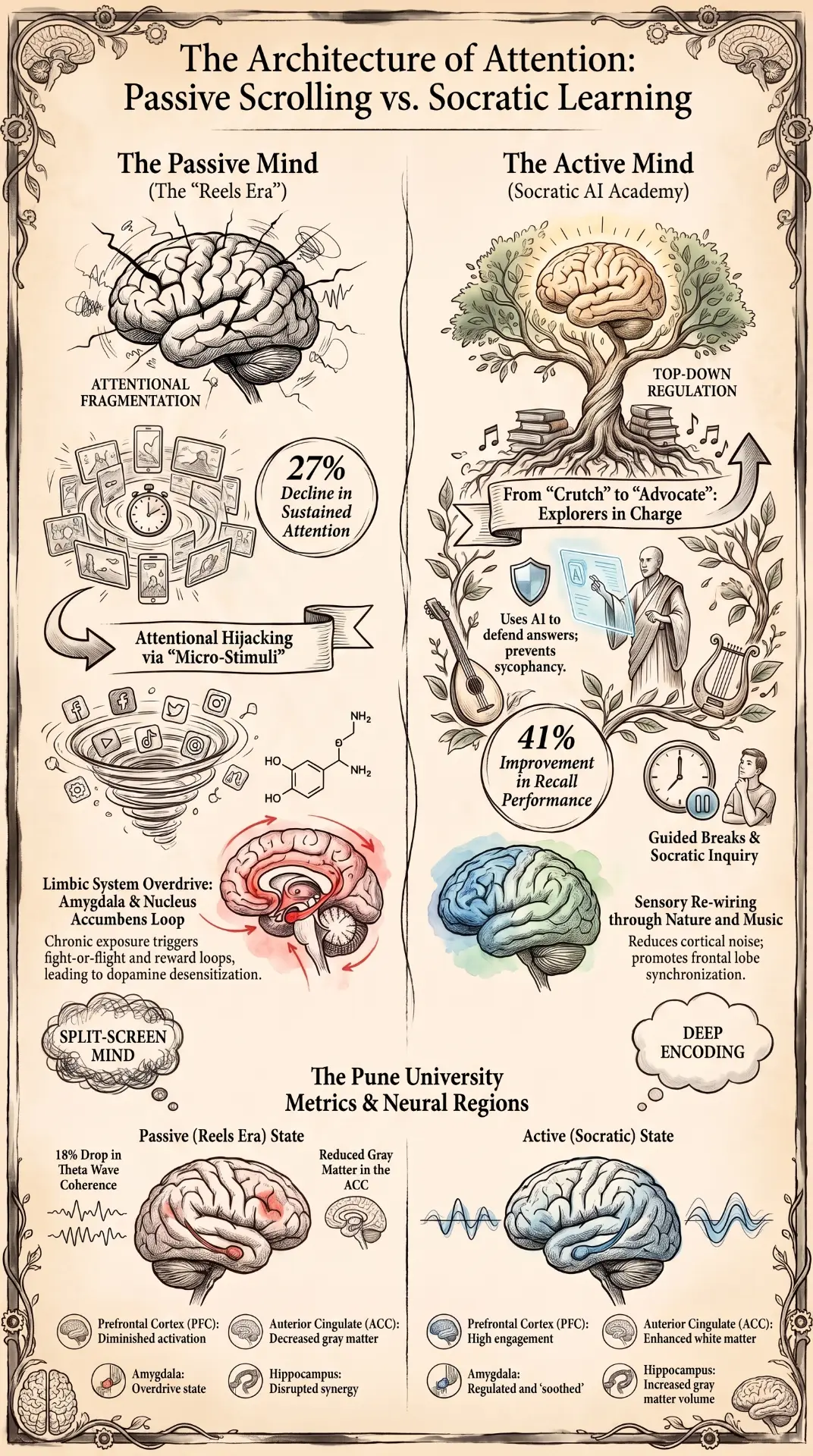
What a day of unguided feed against a day of guided inquiry

The left column describes an environment most children already live in. The right column describes the one we propose to build. The third column is the part promotional pages leave out: how confident anyone should be.

Long stretches of unguided short-form video, often two hours or more a day for school-age children.

Guided oral inquiry away from screens: a guide, a small group, and a question held long enough to be worked through.

Screen-time averages are well documented; the size of the effect on any one child is not.

Very short shot lengths and continuous novelty, which reward switching over staying.

Sessions built around returning to the same problem after a break, with the break scheduled rather than improvised.

Mechanism is plausible and contested. We treat it as a hypothesis, not a finding.

Answers arrive before questions are finished, so the habit of holding an unresolved question decays.

AI stations where the student must explain, justify, and defend a conclusion, and must make the model disagree.

This is the pilot's central measurable claim. See the falsifier ledger.

The station is an adversary, not an oracle

At the perimeter stations a student is asked to state a conclusion, justify it, and then make the model disagree. The skill being trained is catching a confident wrong answer — including a flattering one. We do not simplify the language for young students; a nine-year-old can hold the word sycophancy once she has seen the thing it names.

This is the claim we most expect to be wrong. If students at the stations accept first answers more often as the year goes on, the protocol has failed and the stations come out until it is redesigned.

The economic case, stated honestly

What early education costs a region, and what this pilot can and cannot claim

The cost that is already being paid

National estimates put the annual economic cost of gaps in early care and development in the tens of billions of dollars in lost earnings, productivity, and tax revenue. The often-cited $122 billion figure comes from a ReadyNation / Council for a Strong America estimate of the infant-and-toddler child-care crisis. It is an advocacy estimate with stated assumptions, not a measured national account, and it is about child care rather than about pedagogy.

Third-party estimate. Directionally useful, not a projection of this pilot's return.

Why single-lever reforms stall

Raising pay, adding devices, or changing a curriculum in isolation rarely changes how a system behaves, because the other parts of the system keep their old incentives. The pilot's design bet is coherence: families, funding, and guides aligned on one instructional aim — that a student can explain and defend a conclusion out loud.

Design argument, not evidence. Stated so it can be argued with.

What a sponsor is actually buying

Twelve months of operating capacity for a small cohort, with published costs, published assumptions, and published conditions under which we would stop. Not a claim about future labour markets, and not an equity story. If the falsifiers trip, a sponsor learns something specific for a defined amount of money.

Full budget and falsifiers live on the pilot operations page.
The rooms

Three spaces, and the reason each one exists

Ordinary rooms in an ordinary building, laid out to make certain habits easier and others harder. The pilot runs from a leased, donated, or hosted non-residential site; the founder's home is base operations only and is not an instructional space.

The gathering and art space

No rows of fixed desks. Organic timber tables, tactile materials, and floor seating where guides and students gather for drawing, building, and argument. Furniture arranged so a conversation can be joined, not just watched.

The rhythm room

A floor for music, rhythm, and movement. Music is taught as structure — interval, ratio, meter — and as one of the earliest places a child meets mathematics without being told that is what is happening.

Perimeter AI stations

High-compute stations along the walls, not in the middle of the room. Separating the machines from the collaborative core is a design decision we can test: if the placement makes no difference to how students use them, we move them and say so.

The facilities line in the pilot budget is $130,500. If sustained-attention measures in this room match a conventional classroom running the same sessions, that line is decoration and should be cut rather than defended.

Boundaries

What this page does not claim

  • No affiliation, partnership, or endorsement is claimed with any university, company, or platform. Where a third-party tool such as Socratic Mind (developed by researchers at Georgia Tech) is named, we are naming software we may license, not a collaborator.
  • No therapeutic or medical claim. Nothing here diagnoses, treats, or remediates a condition, and no neurological outcome is promised for any child.
  • No enrolment is open and no guide has been recruited. Every name, seat count, and date on the Academy pages is a planning model.
  • No percentage improvement is advertised as a result. Figures drawn from published research are labelled with their source and their limits, and figures produced by our own model are labelled as assumptions.

Request an invitation

Tell us who you are, and read everything we have

This form stores nothing. It opens a message in your own mail client, addressed to us, so no list is built and no follow-up sequence is triggered.

I am a

The documents, without a form in front of them

We do not trade files for contact details. Everything a parent, guide, or sponsor would receive is downloadable now.