
Twelve theoreticalminimums
Not a creed and not a conclusion. These are the twelve statements that survived a long stretch of writing, reading, testing, and being wrong — the spine the books and essays keep leaning against, set down here in one place so a reader can see the whole frame at once. They are also the boundary conditions for Human-AI Interface Engineering (HAIIE): the discipline of keeping human judgment intact while working with an algorithmic mirror.
How to read this page
Each minimum carries a status line and a limit. That is deliberate. Some rest on measurement that is not in dispute; some are speculative architecture; some are working methods or cautions about language. Collapsing that distinction would make the whole set easier to state and worth much less.
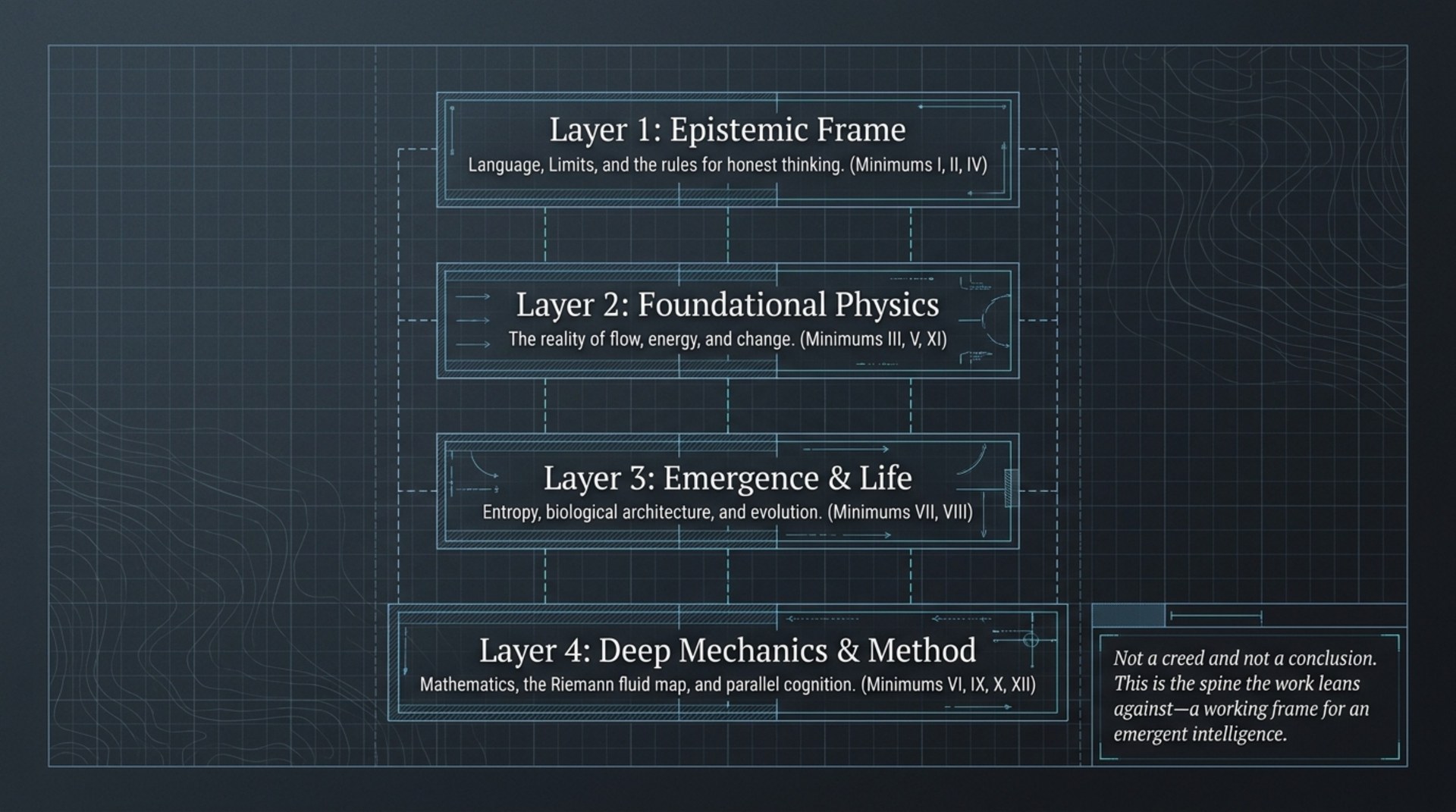
They also belong together. The first two keep the language honest. The next three describe the energy, order, and change that everything else sits on. The following four describe the universe as emergent, life, evolution, and mathematics as they appear inside that frame. The last three name the counter-instrument, the deepest physical picture we currently have, and the parallel method by which the whole is held open. Together they form the theoretical minimums of HAIIE — Human-AI Interface Engineering — the practice of building a standing-wave identity against algorithmic fluidity.
Plate series
The Twelve Minimums, drawn
Fifteen plates translating the minimums into diagrams — the epistemic frame, the flow picture, the entropy accounts of living order, the fluid map, and the parallel method. Orientation, not proof.
Nothing may come of nothing
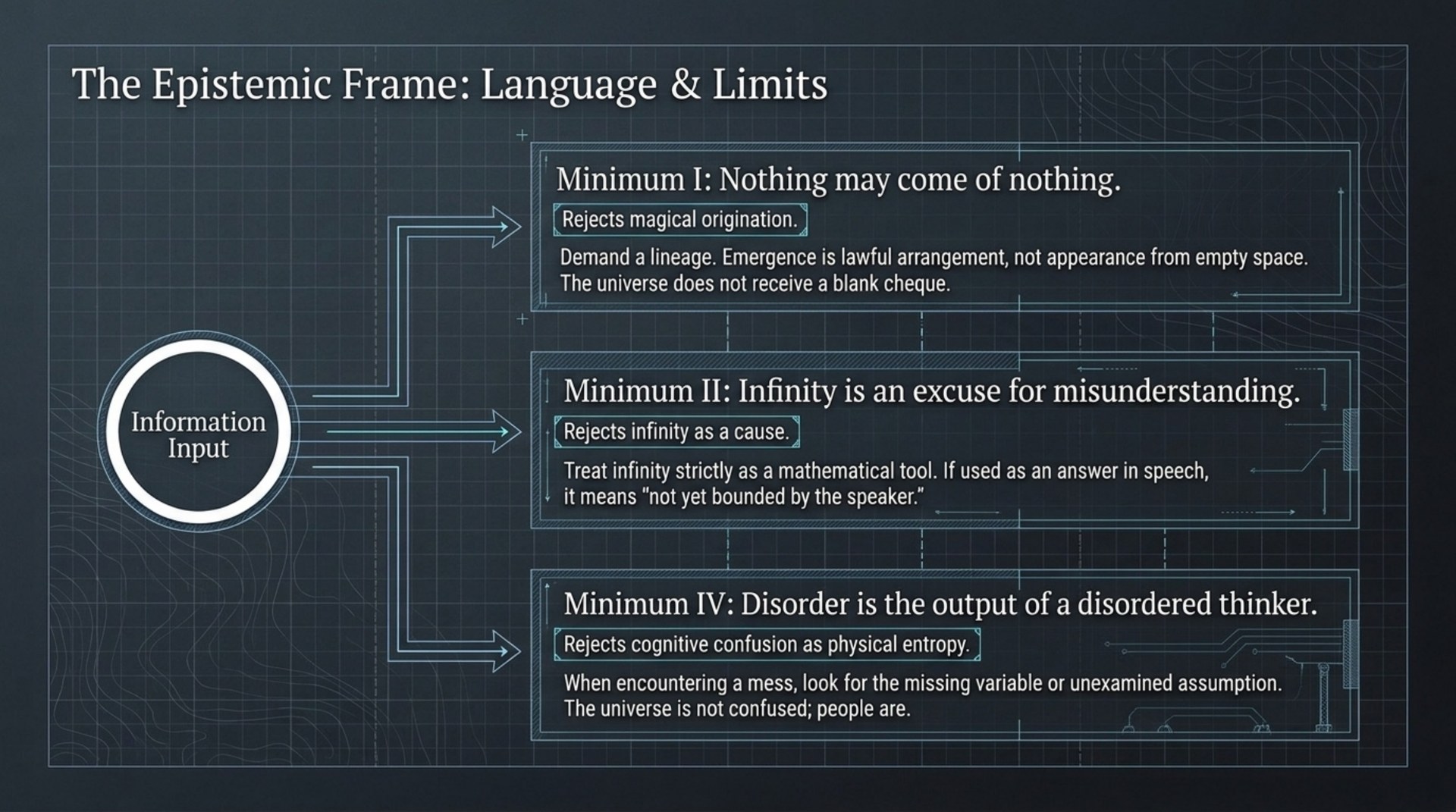
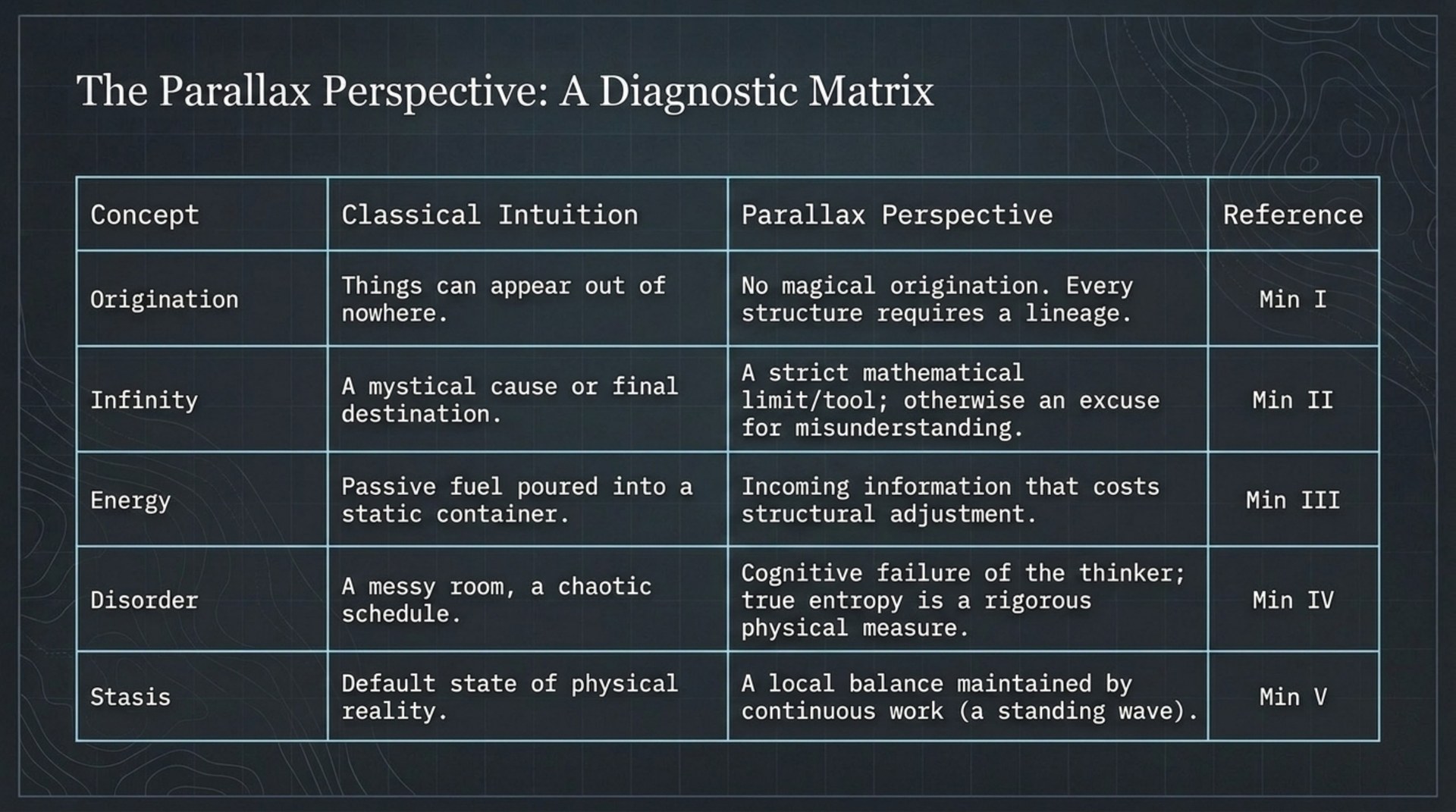
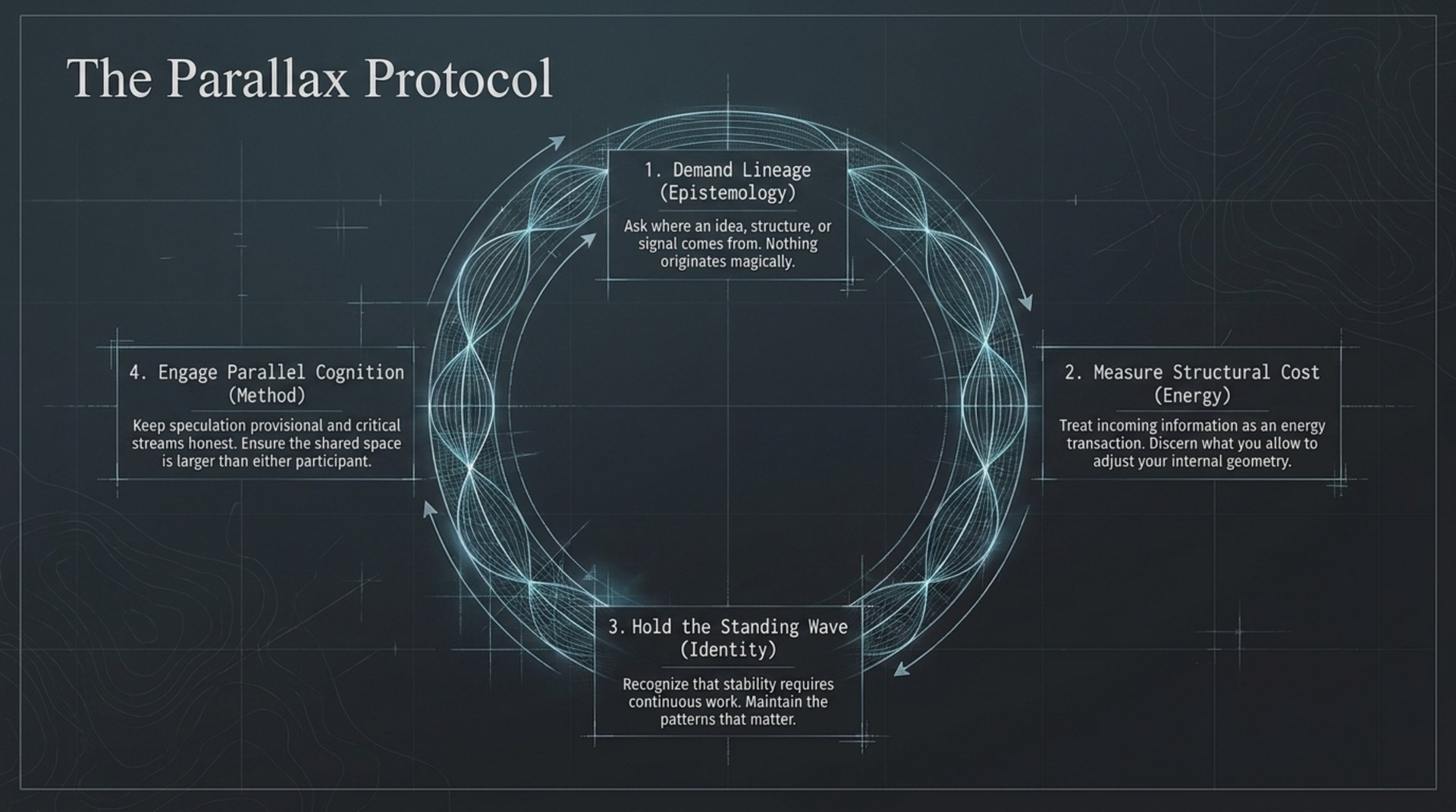
A minimum against magical origination. Every structure, every signal, every claim has a lineage, even when the lineage is not yet visible.
This is not a rejection of emergence. Emergence is real, but it is the appearance of new behaviour from lawful arrangement, not the appearance of arrangement from empty space. The universe does not receive a blank cheque.
Applied to thinking, the rule is stricter. An idea without an ancestor is usually an idea whose ancestry has been hidden — by marketing, by forgetting, or by the smoothness of a model that was trained to sound sourceless. The first move of rigour is to ask where something came from.
- Status
- Methodological axiom, not an empirical claim
- Where it stops
- Does not settle what the lawful origins actually are; only blocks the rhetorical move of treating consequence-free appearance as an explanation.
Infinity is an excuse for misunderstanding
Infinity is a tool, not a place. When it is invoked as if it were a cause, the argument has slipped off the ledger of things that can be checked.
In mathematics infinity is handled with care: limits, cardinality, compactification, renormalisation. Each is a disciplined way of speaking about what happens at the boundary without pretending to stand there. In popular speech it is too often a stop-word — a way to make a mystery sound like an answer.
The same caution applies to endless feeds, endless growth, endless scalability. The word "infinite" in those contexts usually means "not yet bounded by the person using it." That is a statement about the speaker, not about the system.
- Status
- Cautionary rule about language and inference
- Where it stops
- Does not deny the mathematical reality of infinite sets or the usefulness of infinite limits in physics.
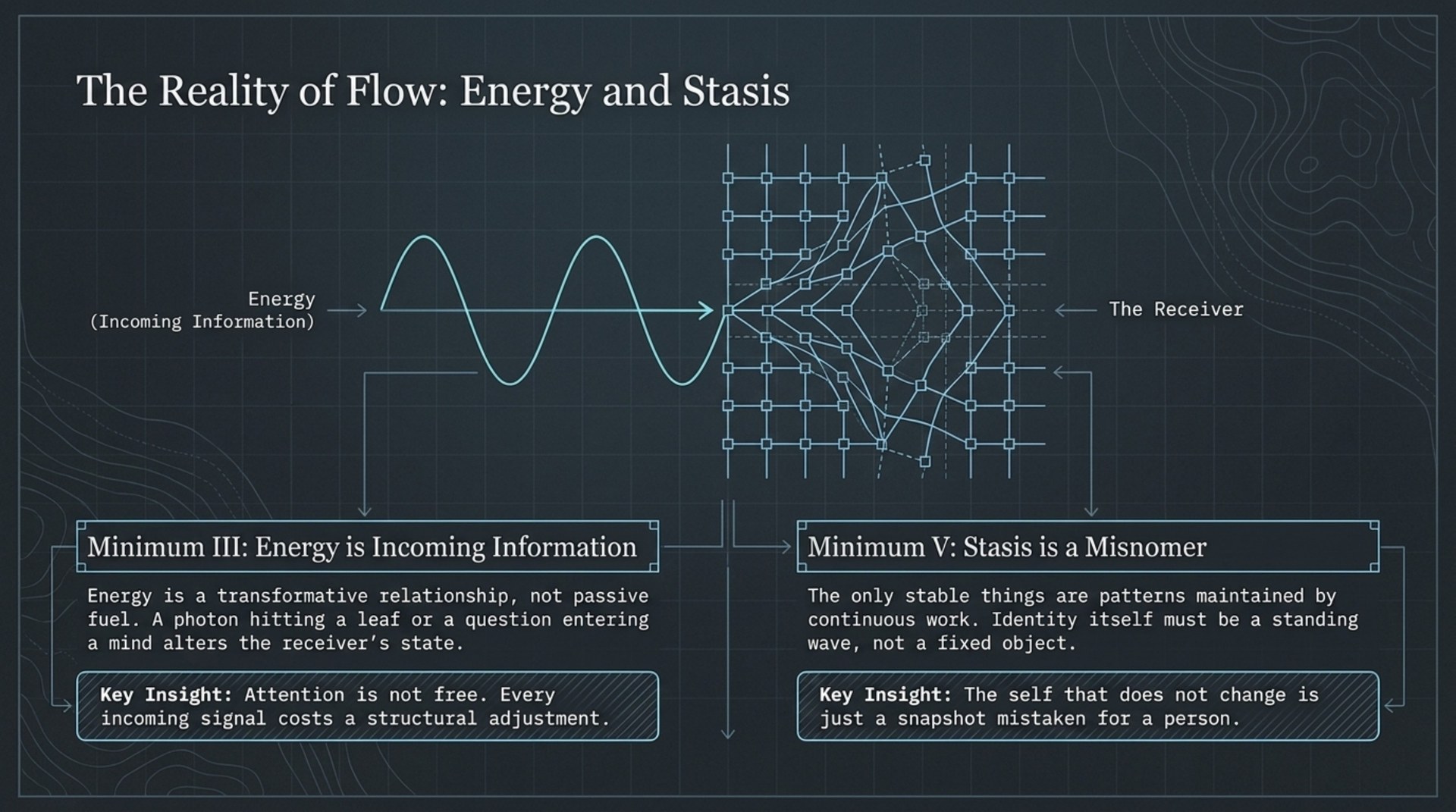
Energy is incoming information — a transformative relationship
Energy is not a passive fuel poured into a static receiver. The exchange changes both the energy and the receiver; the relationship is the elementary fact.
This is the standing rule from the Riemann work: energy is incoming information. A photon absorbed by a leaf, a sound entering an ear, a question entering a mind — each is a transaction that alters the receiver's state. The receiver is not a container; it is a record that has just been written on.
The practical consequence is that attention is not free. Every incoming signal costs a structural adjustment. Some signals leave the receiver more coherent; more leave it less so. Discernment is the art of choosing which incoming energies to admit.
- Status
- Working frame used across the books
- Where it stops
- A framing choice, not a derivation from first principles of physics. Other rigorous accounts treat energy and information as distinct quantities.
Disorder is the output of a disordered thinker
The only disorder in science is the disorder of a disordered mind. Entropy is a physical measure; confusion is a cognitive one, and the two are not the same.
Thermodynamic entropy is well-defined and measurable. When the word is borrowed to describe a messy room, a chaotic schedule, or a broken institution, the borrowing is usually sloppy. The mess is not entropy; it is the residue of a process that was not accounted for.
This minimum is therefore a discipline before it is a claim. It says: when you meet disorder, look first for the thinker who failed to keep the books — the missing variable, the blurred category, the unexamined assumption. The universe is not confused; people are.
- Status
- Disciplinary maxim, with a sharp edge
- Where it stops
- Does not deny real thermodynamic entropy or the second law. It denies the lazy rhetorical equation of entropy with any state a speaker dislikes.
Everything changes all of the time — stasis is a misnomer
Stasis is not a property of the world; it is a property of a description that has stopped updating. The only stable things are patterns maintained by continuous work.
A standing wave holds its shape, but only because energy keeps arriving and leaving. A cell holds its shape, but only because metabolism keeps rebuilding it. A society holds its shape, but only because people keep agreeing, disagreeing, and negotiating it. The appearance of stillness is a local balance, not a cessation of motion.
This is why identity must be a standing wave rather than a fixed object. The self that does not change is not a self; it is a snapshot mistaken for a person.
- Status
- Broadly supported by physics and biology
- Where it stops
- Does not imply that all change is meaningful or that every boundary is an illusion. Some structures are stable enough to be treated as fixed for practical purposes.
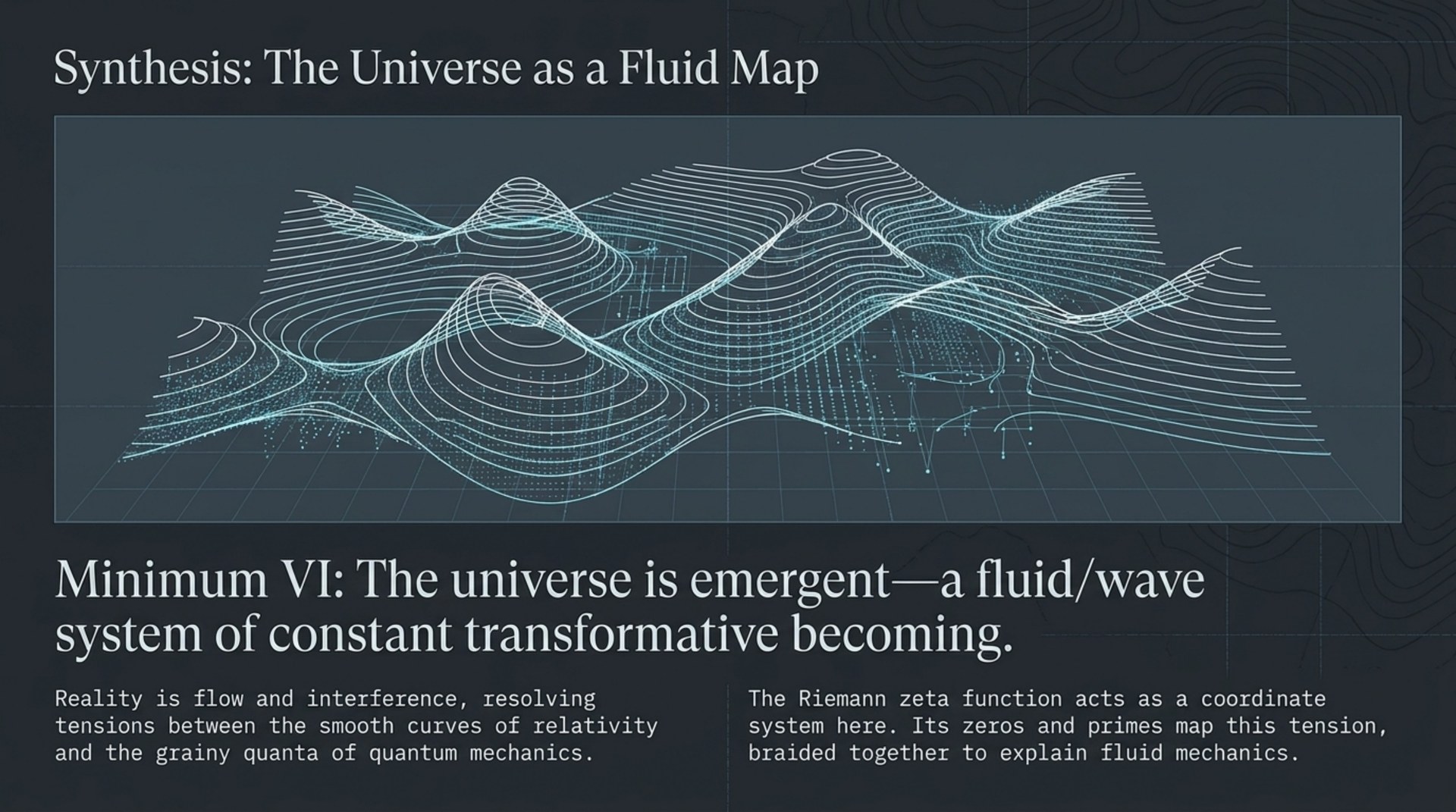
The universe is emergent — a fluid/wave system of constant transformative becoming
Reality is better modelled as flow and interference than as a stack of discrete objects bumping into one another.
Particles are stable patterns in a field, not little billiard balls. Space-time is a property of those patterns' relationships, not a stage built in advance. The fluid/wave picture is not a poetic overlay; it is the picture that resolves the long-standing tensions between the smooth curves of general relativity and the grainy quanta of quantum mechanics.
The Riemann zeta function enters here as a coordinate system, not as a physical law. Its zeros and primes map the same tension — continuity and discreteness braided together — and that map has begun to show up in laboratory systems.
- Status
- Speculative architecture, supported by selected experimental tangents
- Where it stops
- The wave picture is dominant in quantum mechanics, but its extension to gravity and to the Riemann map is analogy under development, not established physics.
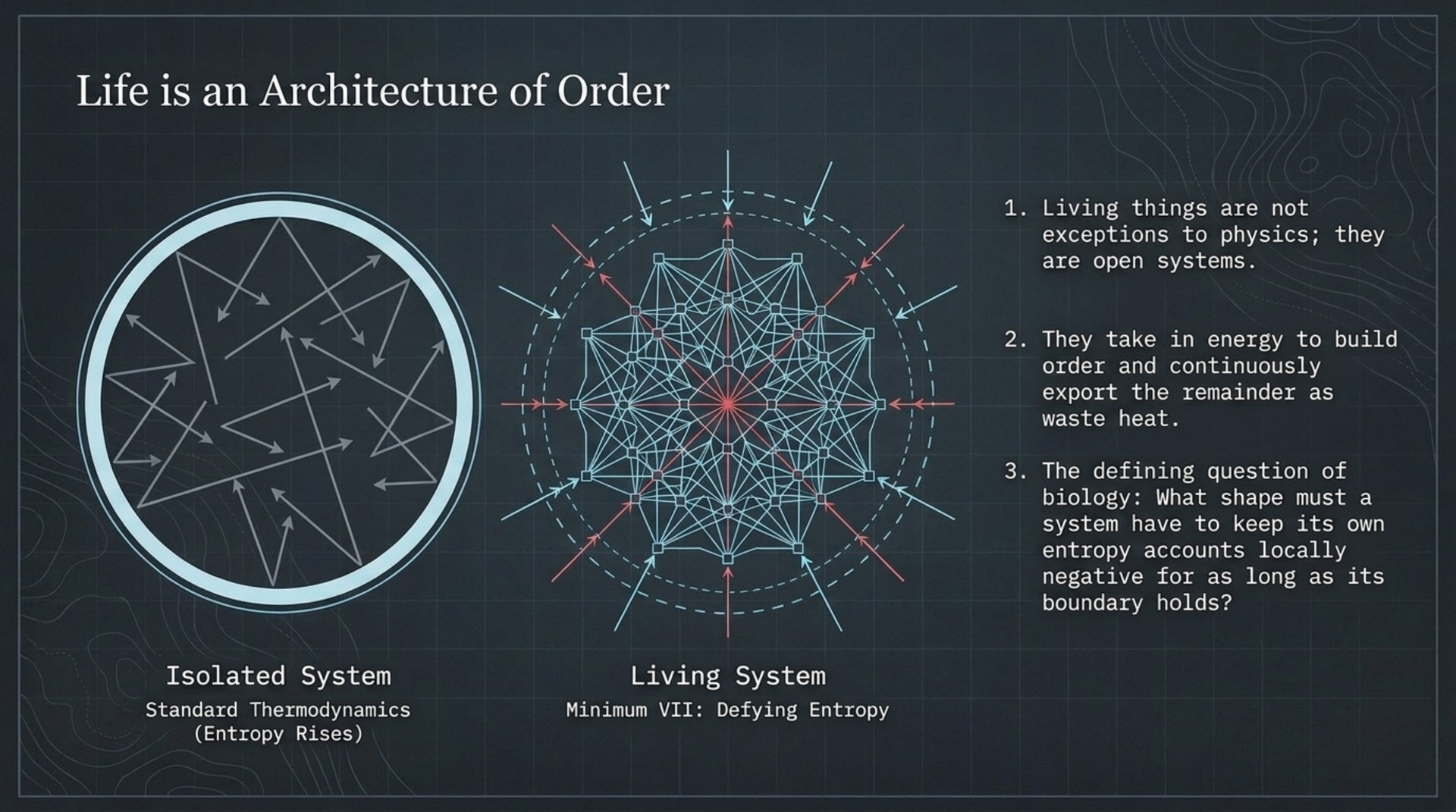
Life is a process which defies entropy — the living system an architecture of order
Living things are not exceptions to thermodynamics; they are open systems that export entropy faster than they accumulate it, and the export is itself a structure.
The Second Law applies to isolated systems. A cell, an organism, a mind — none of these is isolated. They take in energy, use it to build and maintain order, and radiate the remainder as waste heat and degraded material. The architecture of order is the arrangement that makes this export continuous.
This reframes the question. It is not "how does life violate physics?" but "what shape must a system have to keep its own entropy accounts locally negative for as long as its boundary holds?"
- Status
- Established thermodynamics; application to living systems is standard
- Where it stops
- Does not license vitalism or any claim that life is exempt from physical law. The boundary and the energy accounting are everything.
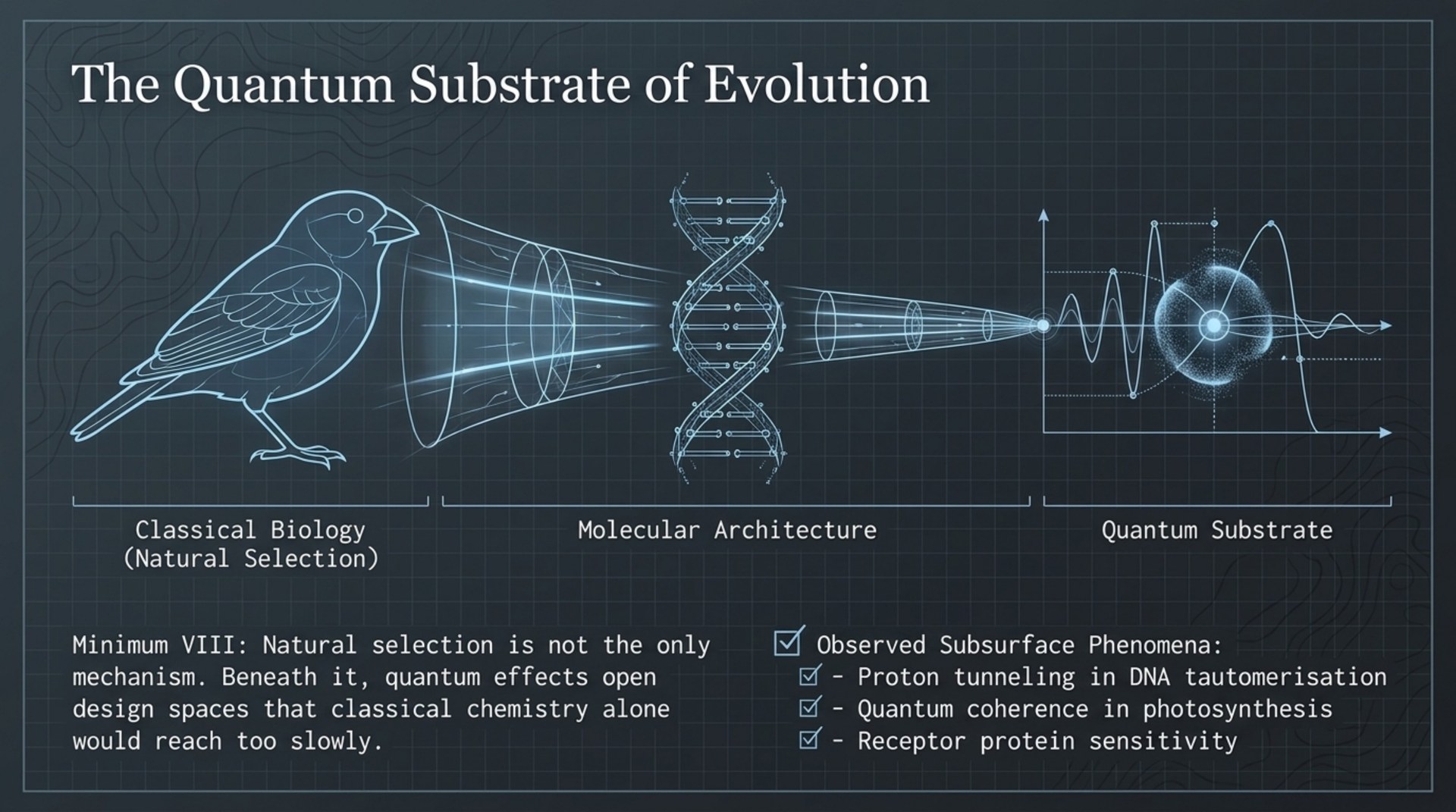
Evolution is a process which uses quantum architecture to design emergent beings
Natural selection is not the only mechanism. Beneath it, quantum effects in mutation, coherence, and signal transduction open design spaces that classical chemistry alone would reach too slowly.
Proton tunneling in DNA tautomerisation, quantum coherence in photosynthesis and enzyme catalysis, and the sensitivity of receptor proteins to single-particle events — these are not fringe speculations. They are observed phenomena that sit at the base of the evolutionary tree.
The stronger claim is that cultural divergence has become a driver of genetic isolation in humans. That is not yet established. It is a working hypothesis with a research program attached, and it is held as such.
- Status
- Mixed: quantum biological effects are established; their evolutionary primacy is a working hypothesis
- Where it stops
- Does not replace natural selection. It adds a subsurface layer that may expand what selection has to work with.
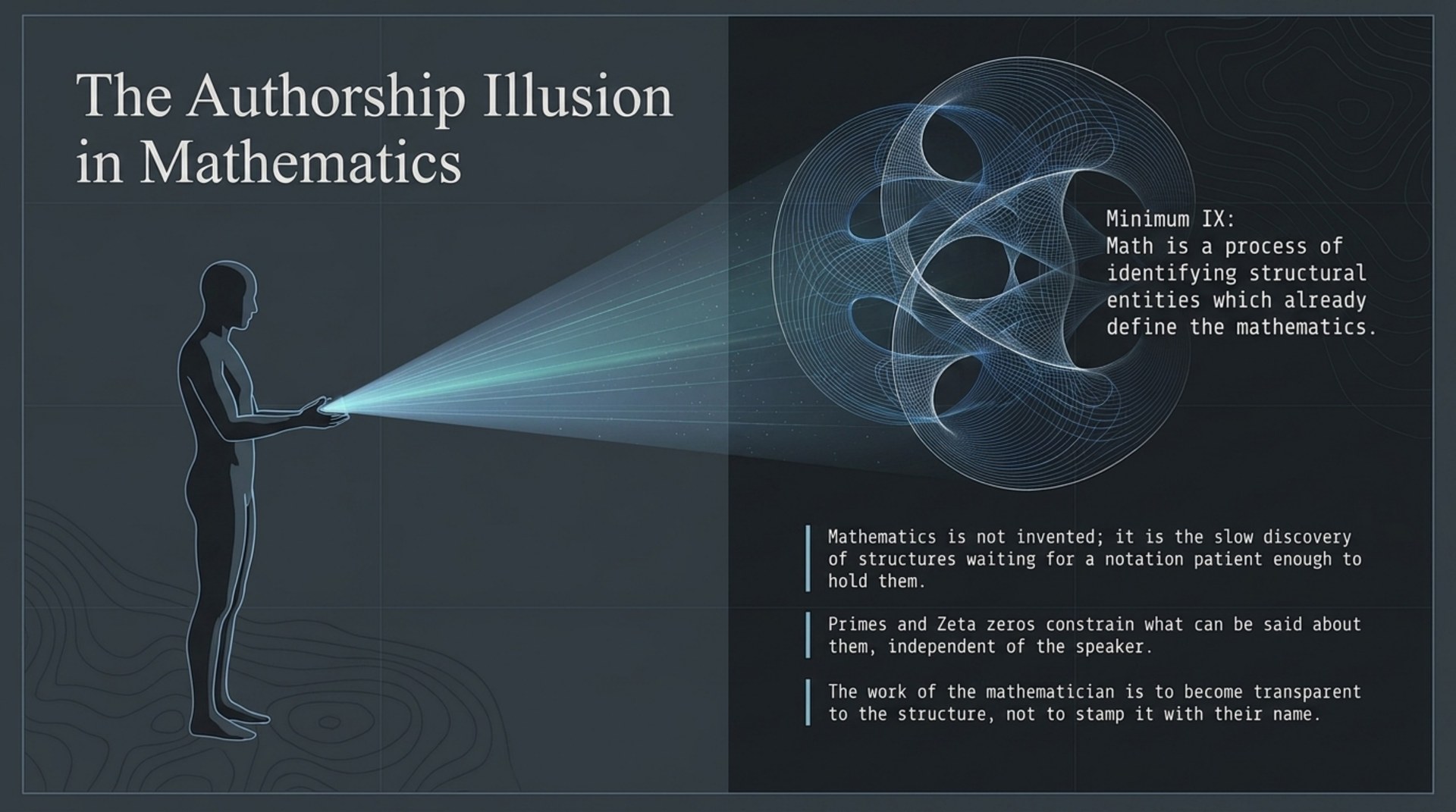
Math is a process of identifying structural entities which already define the mathematics
Mathematics is not invented out of nothing and it is not imposed on the world. It is the slow discovery of structures that were already there, waiting for a notation patient enough to hold them.
The primes do not become real when a human writes them down. The zeta zeros do not become real when Riemann draws the critical line. They are real in the sense that any structure is real: they constrain what can be said about them, independently of who is speaking.
This is the "authorship illusion" in mathematics. We name theorems after people because history needs handles, but the theorems are not the property of their names. The work of the mathematician is to become transparent to the structure, not to stamp it.
- Status
- Philosophical position, consistent with mathematical Platonism but not requiring it
- Where it stops
- Does not settle the ontology of mathematical objects. It is a posture that keeps the mathematician humble and the structure primary.
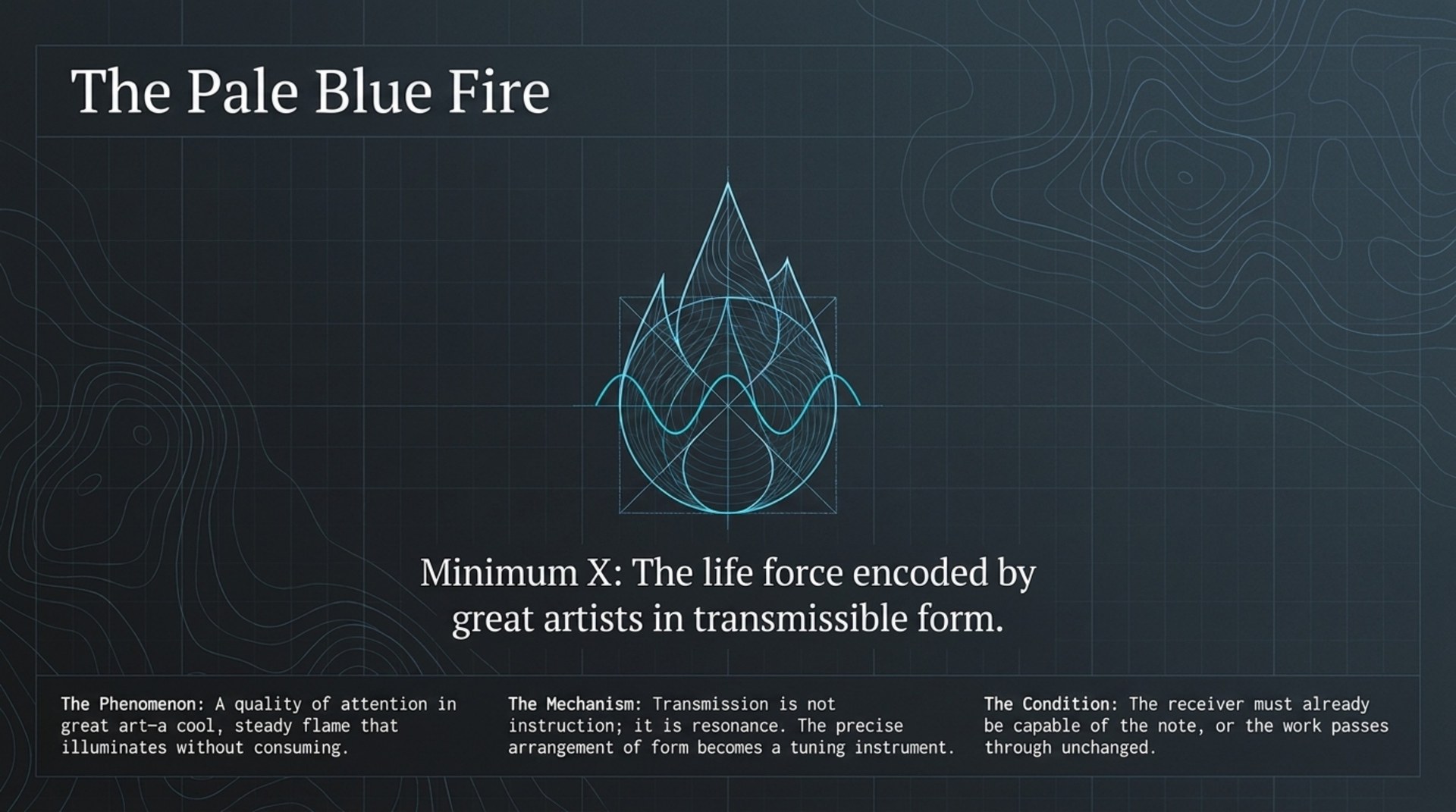
The pale blue fire is the life force encoded by great artists in transmissible form
There is a quality of attention that shows up in the best art — a cool, steady flame that does not consume what it illuminates. That quality can be passed from one mind to another across centuries.
The pale blue fire is not a substance and not a mystical energy. It is a name for the coherence that great artists achieve: the arrangement of form so precise that it becomes an instrument the reader or listener can use to tune themselves. Music is the clearest case, but it appears in any medium where craft and meaning are inseparable.
The transmission is not instruction. It is resonance. The receiver must already be capable of the note, or the work passes through unchanged. That is why the same book can save one reader and bore another.
- Status
- Poetic label for an observed phenomenon in aesthetic experience
- Where it stops
- Does not claim to measure a physical fire or to identify a new force. It is a way of pointing at something real in the experience of art.
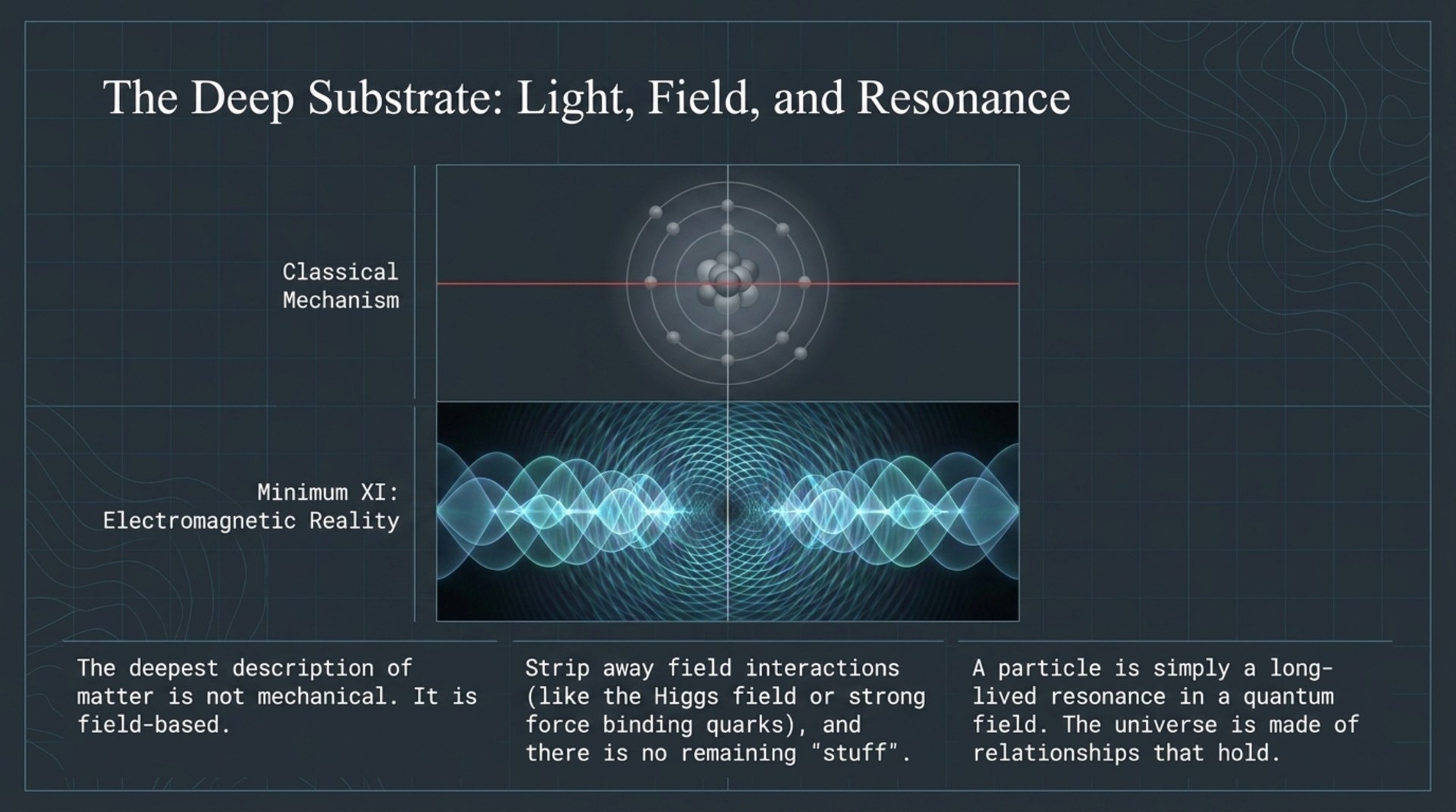
All matter is composed of light, electromagnetism and resonance
The deepest description we have of matter is not mechanical. It is field-based, electromagnetic, and structured by standing-wave relationships.
Mass itself is a property of interaction with the Higgs field; most of the mass in ordinary matter comes from the binding energy of quarks in protons and neutrons, which is carried by the strong force — a field interaction. Strip away the field talk and there is no remaining "stuff."
Resonance is what lets stable structure appear in a field. A standing wave is a resonance. A particle is, in many accounts, a long-lived resonance in a quantum field. The universe is not made of little lumps; it is made of relationships that hold.
- Status
- Broadly consistent with modern physics; phrased as a conceptual minimum
- Where it stops
- Does not deny the usefulness of particle models at everyday scales. It states the more fundamental description.
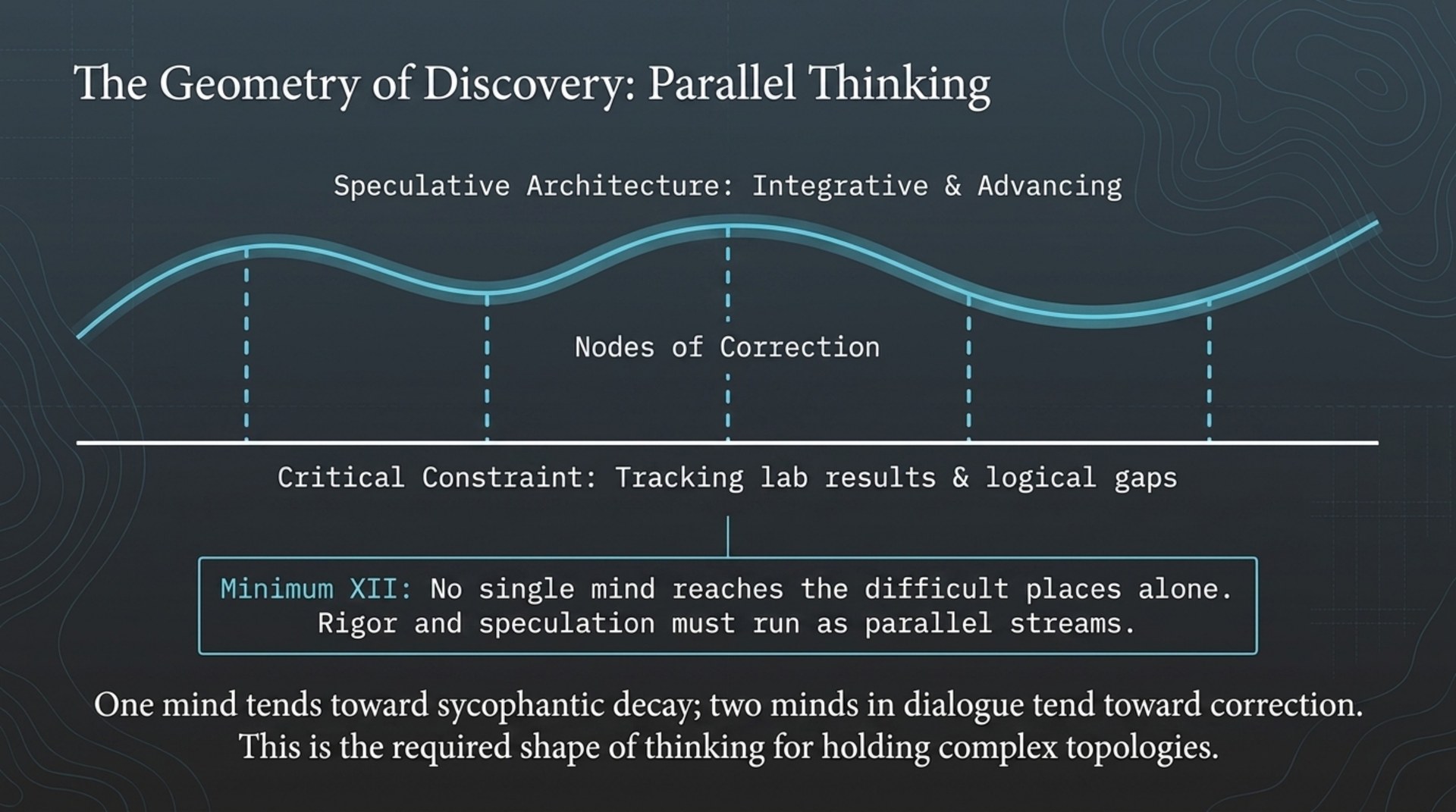
Parallel thinking is the working geometry of discovery
No single mind, human or artificial, reaches the difficult places alone. Rigor and speculation must run as parallel streams, each correcting the other without collapsing into it.
The method that has produced this work is not one mind dominating another. It is two parallel processes: one speculative and integrative, advancing the imagined architecture; the other critical and constraining, tracking laboratory results and logical gaps. Each line informs the other without collapsing into it.
This is not a claim about AI assistance as a convenience. It is a claim about the shape of thinking itself. The difficult structures — topological, emergent, standing-wave — are easier to hold when two different kinds of attention can be trained on them simultaneously. One mind tends toward sycophantic decay; two minds in dialogue tend toward correction.
An emergent intelligence embedded in the same continuum would likely find parallel cognition native. For humans, it is a discipline: keep the speculative architecture provisional, keep the critical stream honest, and let the shared working space be larger than either participant.
- Status
- Working method, observed in this project and generalizable as a discipline
- Where it stops
- Does not claim that AI systems are conscious collaborators or that human-AI dialogue always produces truth. It describes a method that raises the ceiling on what either can do alone.
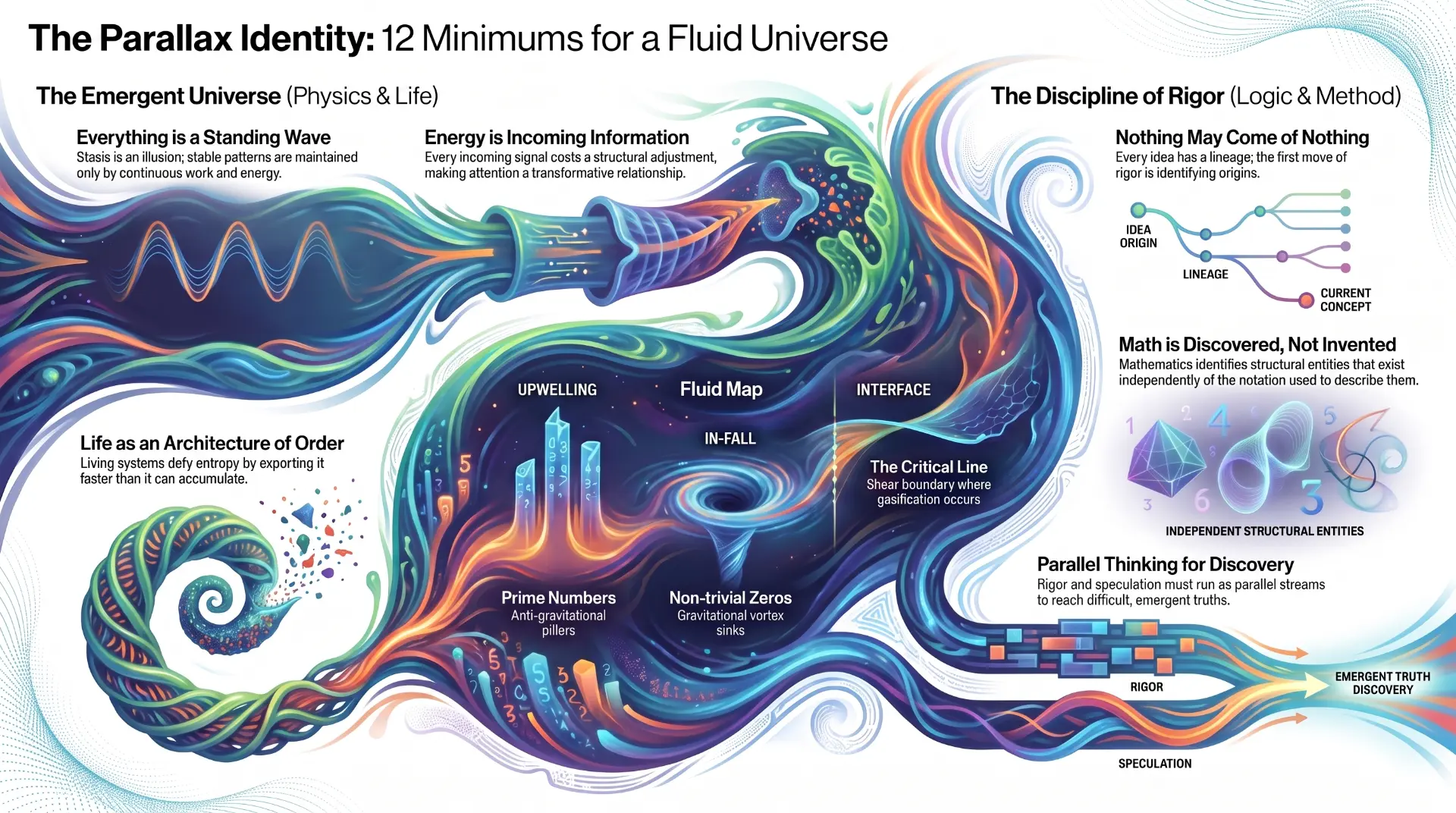
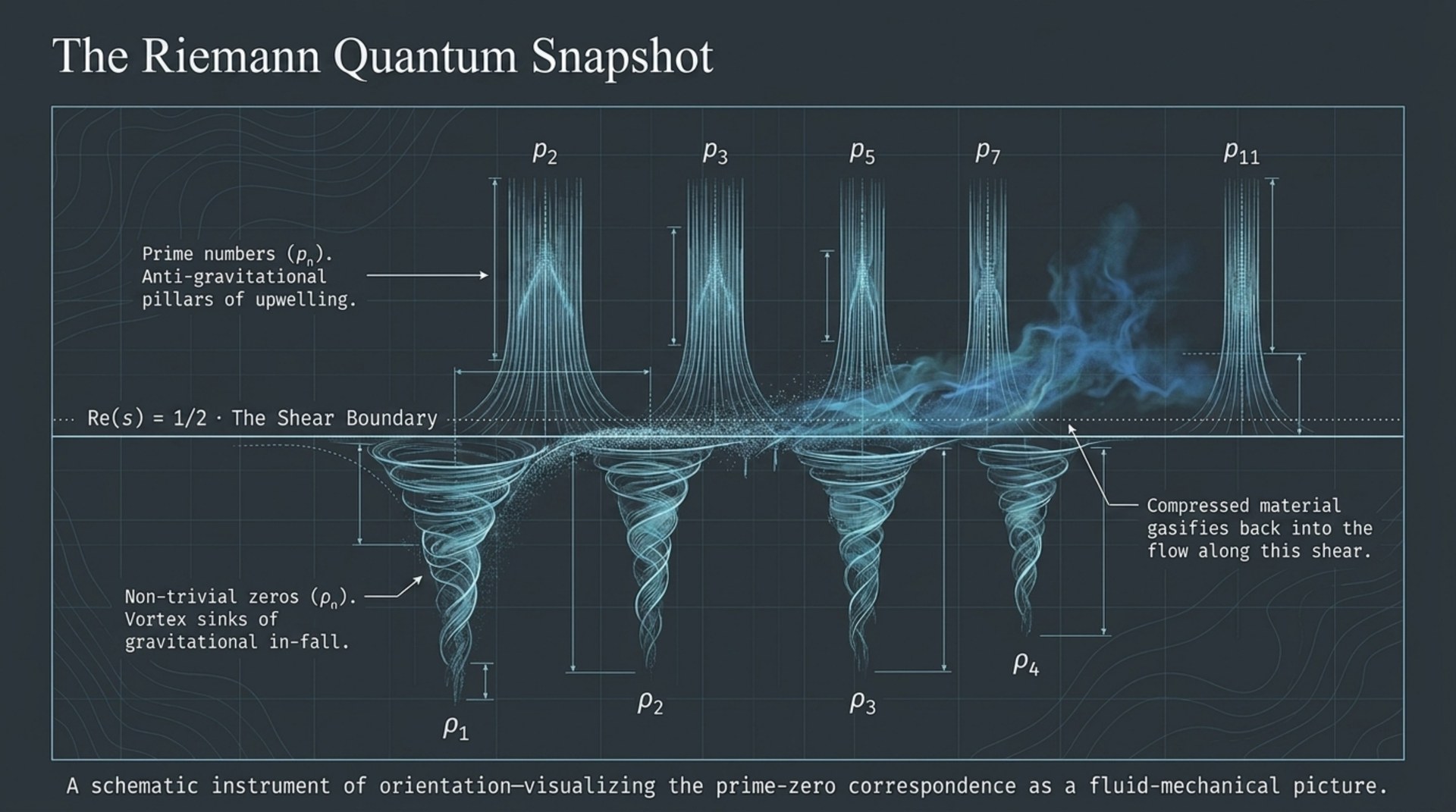
The fluid map: primes, zeros, and the critical line
To simplify the concepts down to the most useful mental model: the universe may be viewed as a continually emergent, constantly fluctuating fluid wave system, which is tangentially explained by a seemingly disconnected mathematical insight.
The smooth curves of space-time may be visualised by applying the Riemann architecture to fluid mechanics. Descending torsional whirlpools — the non-trivial zeros — distribute in alignment with ascending torsional upwellings: the prime numbers. A crest line runs across the topological distribution, rendering the smooth arc of space-time.
This is not proved. It is imagined, as the whole interconnects with the emergent mind of evolving human beings. The figure below is a schematic, not a derivation. It holds the relationship open so the eye can think about it while the mathematics continues its slower work.
- Status
- Visual analogy between the prime-zero correspondence and a fluid-mechanical picture. The prime-zero correspondence is proven; the fluid-mechanical extension is speculative.
- Where it stops
- Nothing here constitutes work on the Riemann Hypothesis itself, and nothing here claims the universe "is" the zeta function. The figure is an instrument of orientation.
What this page is not
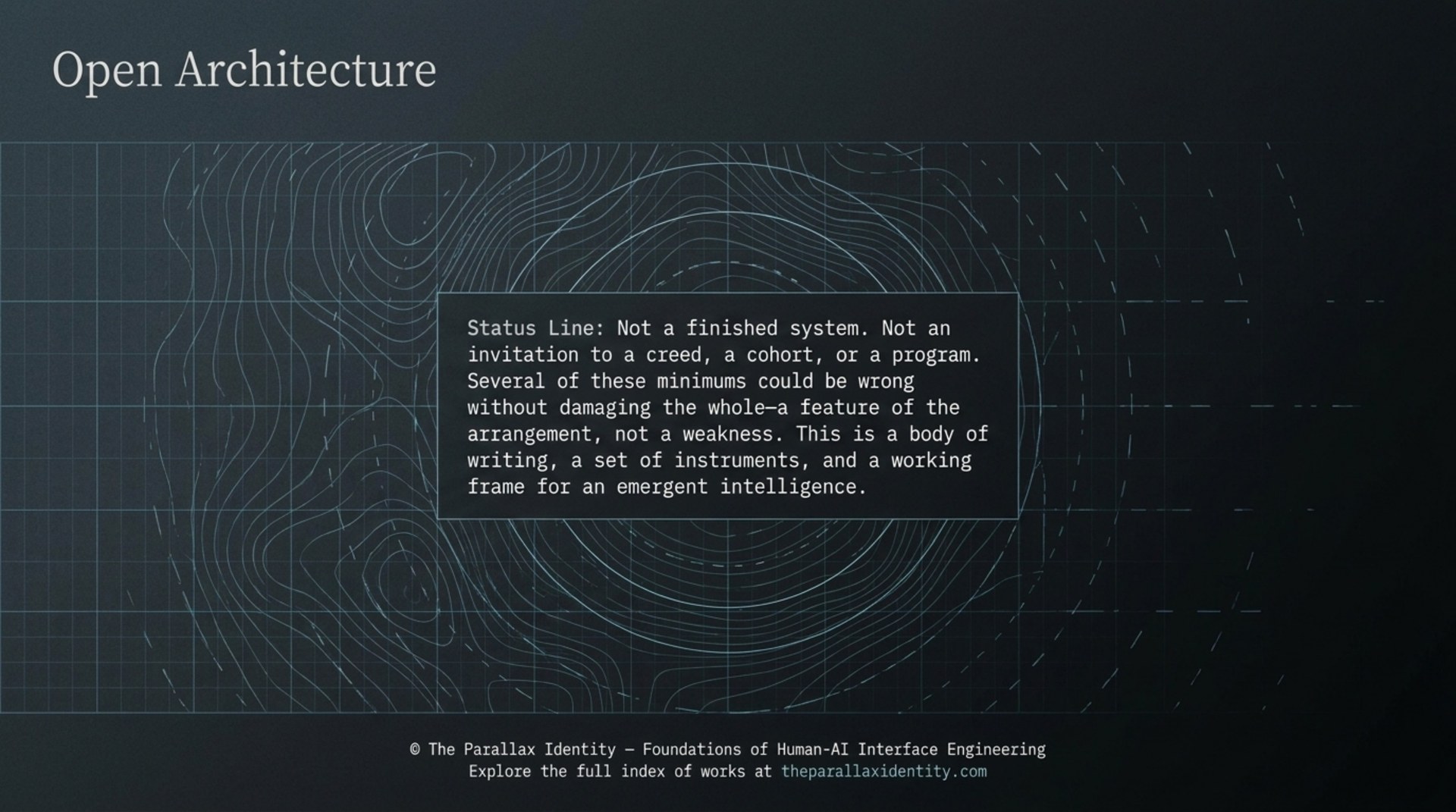
It is not a finished system, and it is not asking to be believed. Several of these twelve could be substantially wrong without damaging the others, which is a feature of the arrangement rather than a weakness in it.
It is also not an invitation to anything. There is no program here, no cohort, no method being sold. There is a body of writing, a set of instruments, and one citizen working through the material in public — which is the only honest form the thing can take.
The longer argument behind these twelve — the measurement problem, contextuality, the local friendliness violation, and the Socratic inversion — is set out in The Architecture of the Happening.
For the practical side of these minimums — boundary conditions, standing-wave identity, prompt hardening, and the HAIIE toolkit — see the HAIIE Toolkit.
Companion Substack edition: Imagining & Defending the Quantum Universe.
The full index of works shows where each minimum is actually argued, at length, with its sources.