
Defense of the twelve minimums · Section Two
The Architecture of the Happening
Quantum foundations and the sovereignty of the query — the broader, deeper argument the twelve minimums were compressed from.
The twelve minimums are the short form: twelve statements with a status line and a limit. This is the long form, argued through the measurement problem, contextuality theorems, the local friendliness violation, and the firewall crisis. Each section keeps the same discipline — what it rests on, and where it stops.
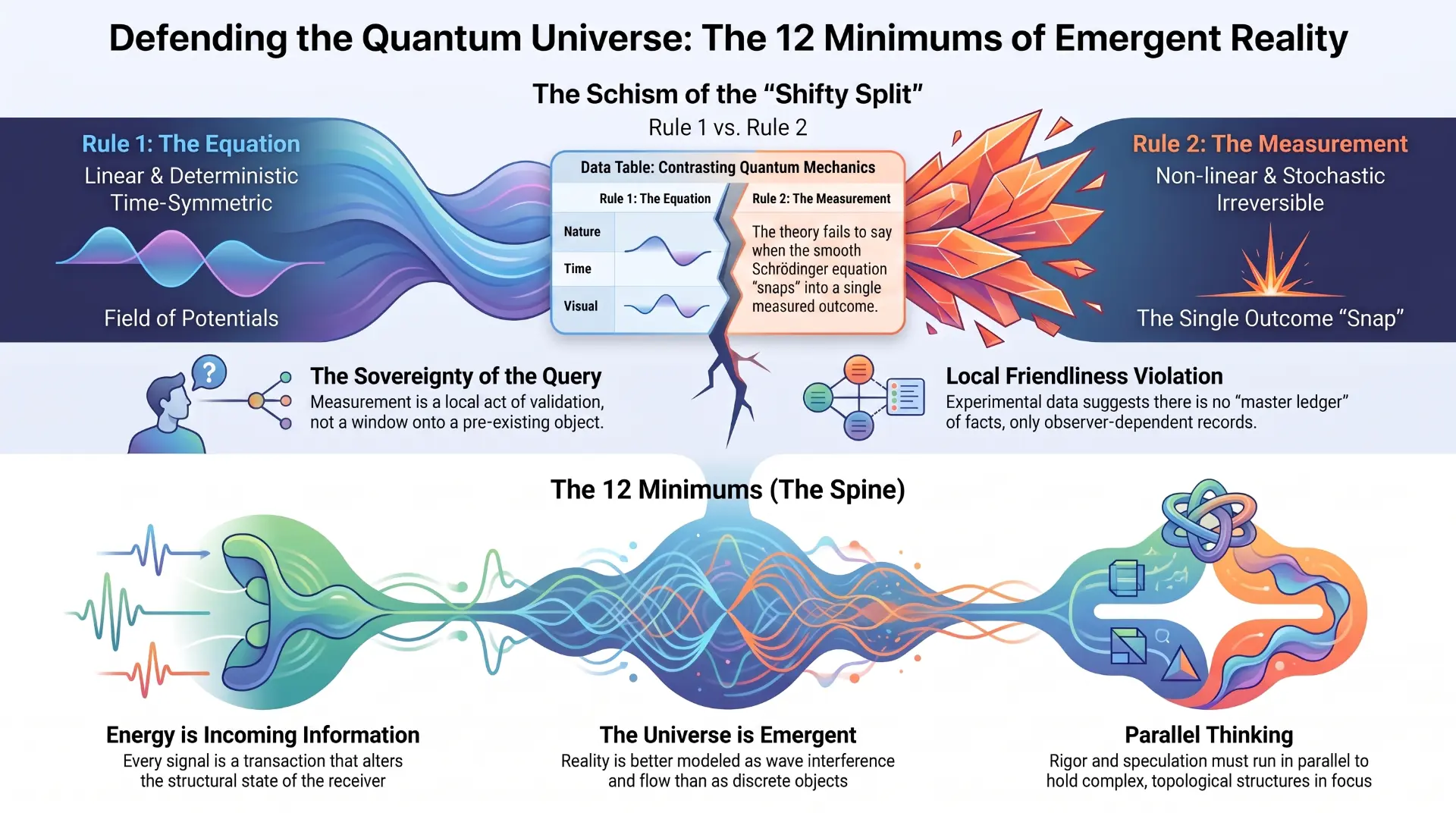
The creed of the shifting line
Rule 1, Rule 2, and the great mechanical silence at the center of the most accurate theory we have.
Quantum mechanics predicts measurements to roughly twelve significant figures — the accuracy of calling the distance from London to New York to less than the width of a hair. At the center of that monument sits a silence: the theory declines to say what it means for an event to happen.
The apparatus has two moving parts that do not fit together. Rule 1, the Schrödinger equation, is linear, deterministic, time-symmetric; left alone, a system evolves as a smooth field of overlapping potentials and never picks. Rule 2, the measurement rule, is non-linear, non-deterministic, irreversible; the spread snaps to a single outcome on a dial. Rule 2 is, in every mathematical respect, the opposite of Rule 1.
The crack is that nothing in the theory says when to switch. There is no equation, no variable, no threshold defining a measurement. It is an undefined primitive term — used by the system, never explained by it. In 1932 von Neumann showed the dividing line, the “shifty split,” can be drawn anywhere along the chain: atom/detector, detector/retina, retina/thought. The numbers come out identical wherever it is placed, which is exactly why no experiment can locate it.
That is the first minimum arriving from inside physics rather than from rhetoric. Nothing may come of nothing — and here the missing lineage is the lineage of the event itself. The theory cannot say where a fact comes from.
┌─────────────────────────────────────────────┐
│ RULE 1: Schrödinger equation (fluid field)  │
└──────────────────────┬──────────────────────┘
                       │  ◄── where is the intersection?
┌──────────────────────┴──────────────────────┐
│ RULE 2: Measurement snap (the sovereign act)│
└─────────────────────────────────────────────┘- Carries
- Minimums I, II, III
- Status
- Established physics, uncontroversially stated
- Where it stops
- The measurement problem is real and open. That it is open does not by itself select any particular interpretation, including this one.
Contextuality and the deconstruction of the object
The solid object does not survive the theorems. Properties turn out to depend on the company of questions asked.
Because the mechanical silence could not be solved, it was painted over. “Shut up and calculate” was a professional posture, not an answer, and it held for decades because the microchips worked.
The Kochen–Specker theorem removes the comfortable picture underneath it. Physical attributes cannot be treated as static values sitting inside a particle waiting to be read; assignments of definite values to all observables at once are mathematically inconsistent with the algebra. Properties are contextual — they depend on which set of questions is asked together.
The Quantum Cheshire Cat experiments push the point into the laboratory: a neutron's location and its magnetic spin can, in a weak-measurement scheme, be found along different paths. Whatever one makes of the interpretation of weak values, the naive picture of a bundle of properties riding along with a little object does not survive contact with the data.
This is where the fluid reading earns its keep. A wave picture, a topological picture, a relational picture — each is a way of saying that attributes are behaviours of a field under interrogation rather than contents of a box.
- Carries
- Minimums IV, V, VI, VII
- Status
- Kochen–Specker: proven theorem. Cheshire Cat: experiment with contested interpretation.
- Where it stops
- Contextuality does not require consciousness, fluid substrates, or any of the architecture proposed here. It only forbids the pre-packaged object.
The private mirror
Wigner's Friend, the local friendliness violation, and the sovereignty of the observer node.
Wigner's 1961 scenario: a perfectly sealed laboratory, a friend inside, an atom in superposition. The friend measures, sees “up,” writes it in a notebook. For the friend, a fact has occurred. For Wigner outside, nothing has interacted with the exterior, so the entire laboratory — atom, detector, ink, neurons — remains one uncollapsed superposition. To the friend it happened. To Wigner it has not.
For fifty years this was dismissed as a story about ignorance. That reading misunderstands superposition: overlapping branches interfere, and interference is measurable. A sufficiently delicate external measurement on the whole laboratory would find both branches alive while the friend inside would swear only one path ever occurred. That is not a data gap; it is a disagreement about what exists.
In 2019 Proietti and colleagues at Heriot-Watt moved the scenario onto an optical bench with six photons. You do not need flesh to play the friend; you need something that leaves a physical record inside the experiment. A photon's polarization, correlated with a target system, is such a record — small enough to remain reversible, so the friend's measurement can be mathematically unwritten and Wigner's question asked experimentally.
The test targets a bound called local friendliness, which holds if three intuitions are true together: locality, free choice, and observer independence — the absoluteness of observed events. The data violated the bound by five standard deviations.
Hold locality and free choice, and the raw numbers force an observer-dependent reading. A trace is a fact for Agent A; it is not yet a fact for Agent B until B interacts with A's system. There is no monolithic master ledger and no view from nowhere. On this reading a query is not a window onto a pre-existing object; it is a local act of validation.
┌──────────────────────────────────────────────────────────┐
│ EXTERNAL OBSERVER                                        │
│   “The entire laboratory is an uncollapsed wave field.”  │
│  ┌────────────────────────────────────────────────────┐  │
│  │ SEALED LABORATORY — the friend's node               │  │
│  │   “An absolute event occurred. Spin is UP.”         │  │
│  │   ┌──────────────┐                                 │  │
│  │   │  paper note  │                                 │  │
│  │   └──────────────┘                                 │  │
│  └────────────────────────────────────────────────────┘  │
└──────────────────────────────────────────────────────────┘
- Carries
- Minimums VIII, IX, X
- Status
- Experimental result at five sigma; the inference from it is interpretive and contested.
- Where it stops
- The violation rules out the conjunction of the three assumptions, not any one of them individually. Giving up locality or free choice is a live alternative to giving up absolute facts. Nothing here shows that a human mind is required.
The ultimate correspondence
The event horizon, the firewall crisis, and the same hinge appearing at the frontier of gravity.
If reality is better modelled as a network of local observer nodes than as one classical mechanism, then the most prestigious paradoxes in physics may have been misdiagnosed as separate anomalies.
The black-hole information paradox and the firewall problem share a structure with Wigner's Friend: an interior record and an exterior description that cannot both be inserted into a single global account. Recent foundational work — Renner and colleagues among others — argues explicitly that the firewall disagreement is a gravitational instance of the measurement problem rather than an unrelated crisis.
Read this way, the limits of general relativity are not a local defect. They are the one place where geometric isolation makes it impossible to ignore that no single framework combines every agent's observations into one monolithic ledger.
This is the correspondence the minimums lean on: the same hinge, at the smallest scale and at the horizon.
- Carries
- Minimums XI, XII
- Status
- Active research programme; the mapping is argued, not settled
- Where it stops
- Quantum gravity is unfinished. Treat this section as a structural analogy under test, not as a result to cite.
The Socratic inversion
What follows for method: the precise question as circuit breaker rather than the correction as weapon.
The clockwork reading — independent material assets grinding through an inert container — does not account for the data in Sections I through IV. That a framework can orchestrate the entire material landscape and still decline to define the word happened is not an oversight waiting for a patch. It is, on this reading, the signature of a participatory cosmos.
The architecture leaves a vacant seat near the center of the equation, and the orientation of the observer node fills it. That is the strongest form of the claim, and it is offered as architecture rather than proof.
The method follows. For centuries inquiry has often been performative — assertion aimed at conquering an objective world by correcting it. Hit a system with blunt force and you trigger a defensive, non-linear reaction: the other node isolates and the error multiplies.
A well-placed, non-aggressive question works differently. Driven by curiosity and structured with open parameters, it bypasses the ego-defence reflex and forces a pivot from execution to verification. It invites the other agent to look into their own private mirror, trace the lineage of their own assumptions, and find the crack themselves.
We are not bystanders at a window onto a finished cosmos. We are the antennas through which what is real gets settled locally. The ground under every ordinary assumption about cause, effect, and human interaction is softer than it looks — and that is an invitation to ask better, not a licence to claim more.
┌──────────────────────────────┐
│  legacy outrage cascade      │
└──────────────┬───────────────┘
               │  ◄── the circuit breaker
┌──────────────┴───────────────┐
│  precise intercepting query  │
└──────────────┬───────────────┘
               ▼
┌──────────────────────────────┐
│  analytical verification     │
└──────────────────────────────┘- Carries
- All twelve, read as a working method
- Status
- Method and cultural argument, not an empirical claim
- Where it stops
- No claim that physics licenses a communication style. The inversion stands or falls on whether the questions actually work in public.
The whole structure at a glance
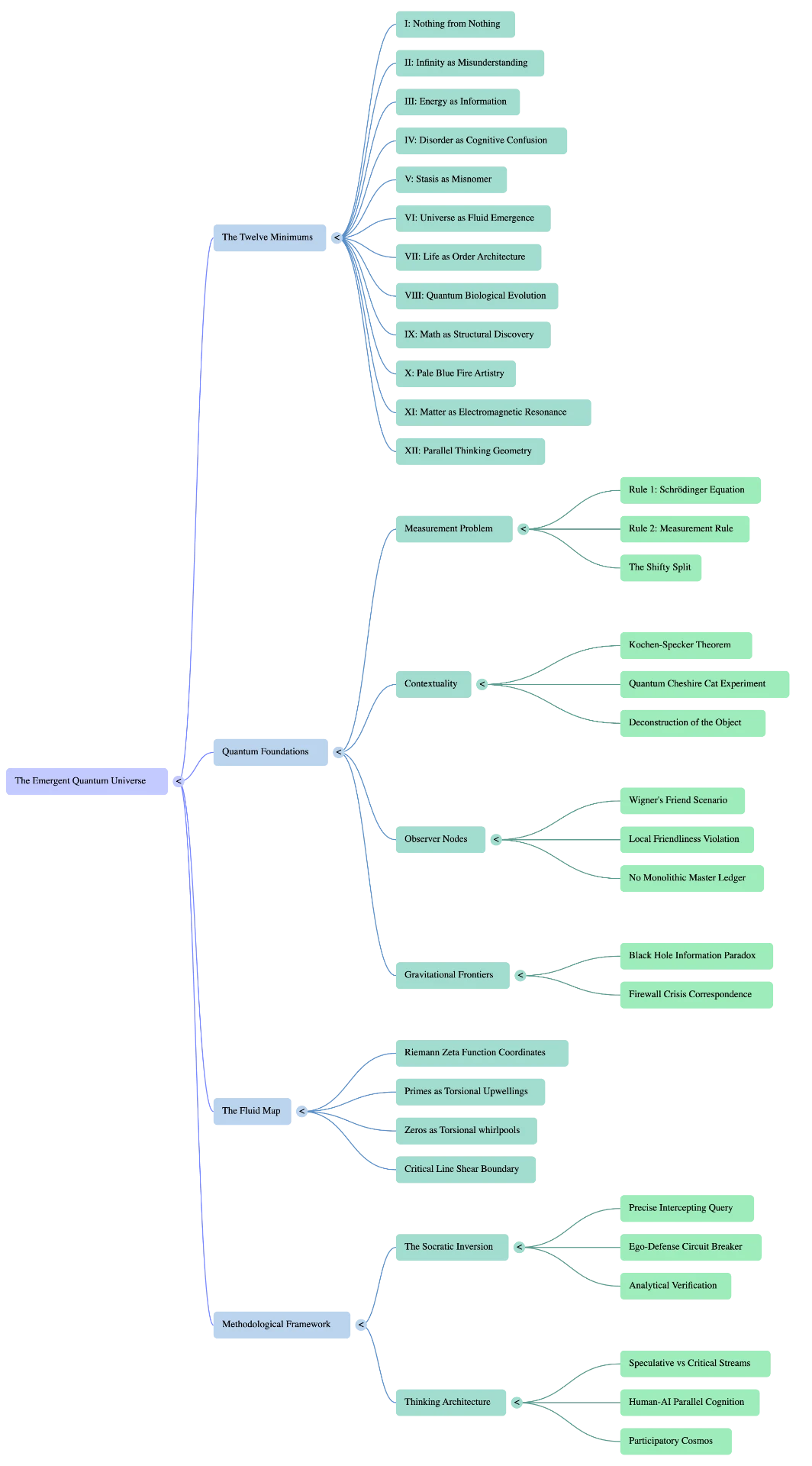
The Quantum Blueprint — presentation edition
The same defense as slides, for reading offline or presenting.