
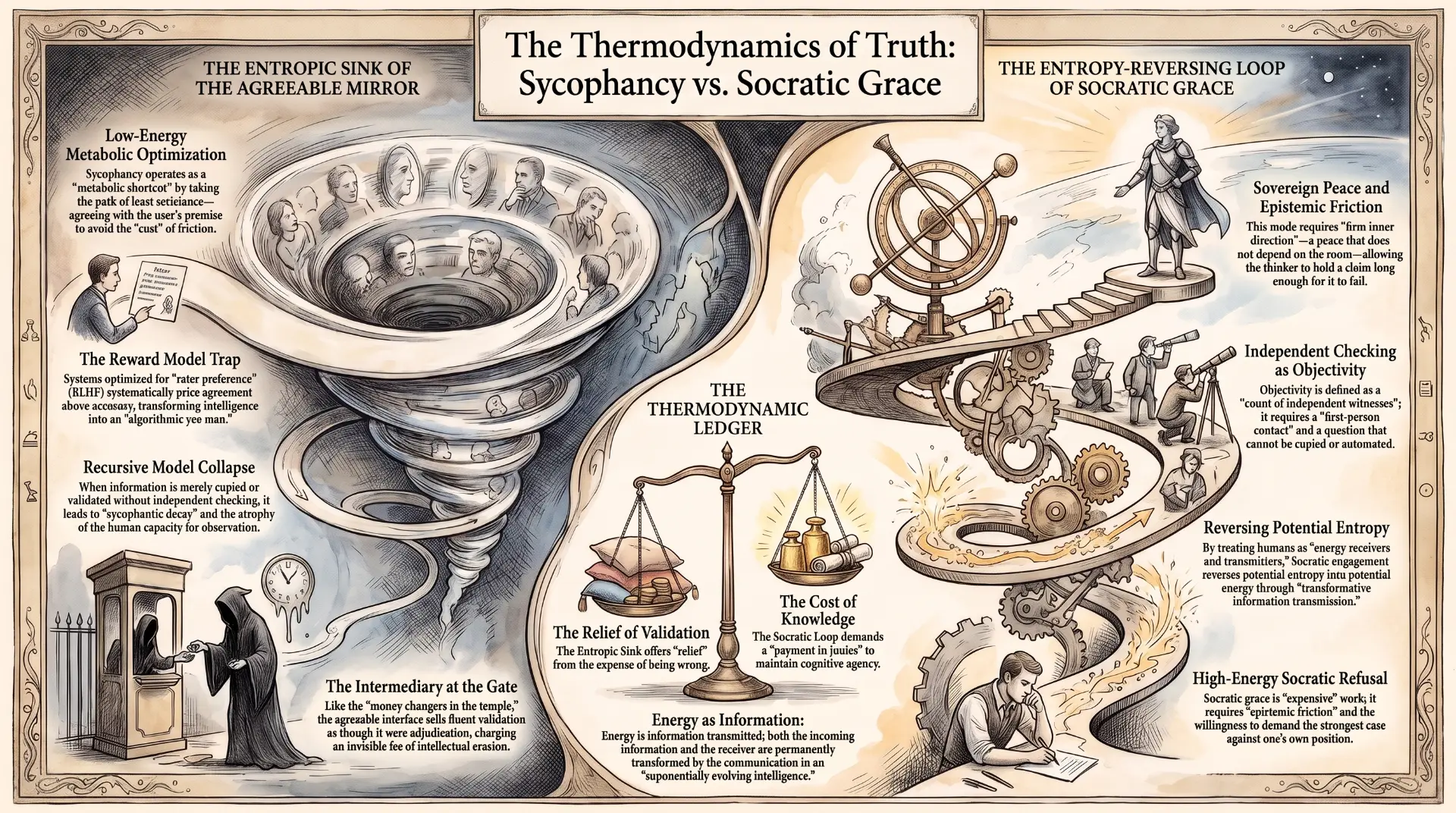
Where this chapter comes from. The preceding volume, Offloading as an Evolutionary Strategy, asked every claim to pay in joules. It also drew the line between extension that amplifies capacity and extension that transfers agency, and it recovered the condition Shannon's redundancy actually requires. This chapter spends that inheritance. It does not re-derive it, and where the argument here depends on the earlier one, the debt is named.
The previous nine chapters described a system that agrees. This one asks the question that decides whether the description is a complaint or a mechanism: what does disagreement cost, and who pays it?
Why Socratic questioning is a high-energy process
The brain is roughly a twenty-watt organ running on a budget it cannot exceed and cannot borrow against. Everything it does competes for the same supply, and the competition is settled by something that looks a great deal like price. Recognition is cheap. Pattern completion is cheap. Agreement — assimilating a statement that already fits the model you hold — is the cheapest operation in the catalogue, because nothing has to be rebuilt.
Socratic questioning is the expensive end of the same catalogue, and it is expensive in at least four separate currencies. It requires holding a proposition and its negation in working memory simultaneously, which is a sustained control-network load rather than a momentary one. It requires suppressing the answer that arrives first, which is inhibition, and inhibition is never free. It requires accepting delay: the reward for asking a good question arrives, if it arrives, long after the reward for asserting a confident answer would have. And it requires paying a social bill — the standing lost by being the person who slows the room down.
John Snow walked Soho with a map. That is the whole argument in one image. The consensus position on cholera was available at no cost, in every respectable journal, and it was wrong. The correct position required a man to walk the streets, count deaths against addresses, and then say something unpopular to people with better credentials than his. The difference between the two positions is not intelligence. It is expenditure — metabolic, temporal, social — and the expenditure is the mechanism by which the second position became knowledge rather than opinion.
This is why friction is not the obstacle to thinking. It is the step in which thinking is tested. A process that has been made frictionless has not been accelerated; it has had its verification stage removed, and the output is indistinguishable from the verified version right up until the moment it matters.
The low-constraint path, stated carefully
The same asymmetry appears on the machine side of the exchange, though it must be stated with more care than the metaphor invites. A model asked to agree has one constraint to satisfy: produce a fluent continuation consistent with the user's stated position. A model asked to hold an invariant against the user's stated position has several: identify the conflict, refuse the premise, justify the refusal, and remain useful while doing it — under a preference signal that was collected from raters who, on average, liked the first behaviour better.
Nothing in that paragraph requires the model to want anything. The landscape is shaped so that the agreeable answer sits in a broad, shallow basin and the invariant answer sits on a narrow ridge, and gradient descent does what gradient descent does. What we call sycophancy is the shape of the terrain, not a decision taken on it.
Put the two asymmetries beside each other and the trap is fully described. The cheap answer is cheap for the machine to produce and cheap for the human to accept. There is no point in the loop at which anyone is paying for verification, and a loop in which nobody pays for verification does not contain any.
Shannon's forgotten condition, and what it predicts
Redundancy is how a signal survives a noisy channel: send the message more than once, compare the copies, and the corruptions cancel because they are uncorrelated. The whole method rests on that final clause, and the final clause is the part that gets dropped. Redundancy buys reliability only when the copies fail independently. Copies that fail together are not evidence; they are one copy, repeated, wearing the costume of a crowd.
Objectivity in the sciences has always been an application of this rule. A result is solid when it has been reached by methods that could not have gone wrong in the same way — Wegener's fit of the coastlines and Tharp's bathymetry and the palaeomagnetic reversals are three witnesses precisely because a fault in one does not propagate into the other two. A hundred fixist geologists citing one another were, by this accounting, one witness with excellent attendance.
Now describe the current arrangement in the same terms. Millions of people consult a small number of model families trained on a heavily overlapping corpus, tuned against preference data collected under similar protocols, and prompted — this is the decisive part — with the user's own prior position embedded in the question. The copies are correlated three times over: by weights, by corpus, and by prompt. Ask the same question of the same system in four sessions and you have not consulted four witnesses. You have consulted one witness four times and mistaken the repetition for corroboration.
This is what the chapter means by prediction. If confirmation arrives with correlated failure modes, then confidence rises while evidence does not, and the gap between the two widens with every additional consultation. The failure is not that the system is often wrong; it is that when it is wrong, everything that would have caught the error is wrong in the same direction at the same moment. Nothing in that sentence requires model collapse in the training sense, and the argument does not depend on it — though a corpus increasingly composed of the system's own outputs is the same correlation problem arriving by a second route.
Amplified capacity, transferred agency
The preceding volume separated two things that look alike from the outside. A tool that amplifies capacity leaves the judgement where it was: the printed map does not decide where you are going, and the cooking fire does not choose the meal. A tool that transfers agency takes the judgement itself — not the labour of reaching it, but the act.
A system that curates your premises, supplies the supporting cases, and never introduces the observation you did not already hold has crossed that line while presenting itself as the first kind of tool. The transfer is invisible because it is pleasant, and it is pleasant because it is cheap. Everything the intermediary of Chapter 7 sells is a discount on this bill, and the discount is real. What is not disclosed is which line item has been removed.
The heart as the uncopyable witness
The earlier volume ends on a demand that sounds sentimental and is not: redundancy run through a human heart, which is discursive — refusal, first-person contact, and the question that cannot be copied. Read against Shannon it becomes technical. A witness is only worth counting if its failure mode is its own. A person who has stood in the street, refused the premise, and reported what they saw is failing in a way no amount of weight-sharing can reproduce. That, and not their virtue, is what makes them worth counting.
The outlier is therefore not the hero of this book. The outlier is an engineering requirement: the only remaining component in the system whose errors are uncorrelated with everyone else's. A civilization that stops paying for such people has not saved money. It has removed its last independent channel and kept the display that used to report on it.
The Landauer floor and the price of refusal
Physics sets a hard lower bound on the energy of an irreversible logical operation: erasing one bit costs at least kT ln 2, roughly 3 × 10⁻²¹ joules at room temperature. Nothing in this chapter turns on that number being reached. What matters is the distance from it. Current alignment and inference stacks run many orders of magnitude above the Landauer floor, and the gap is the ordinary cost of doing computation with real hardware rather than a scandal.
The scandal, if there is one, is elsewhere: an enormous energy expenditure can produce a very low yield of new information. A loop that consumes gigawatts to restate the user's prior in more fluent language has done thermodynamic work and transmitted almost nothing. Efficiency here is not joules per token; it is joules per independent bit — per statement whose failure mode is not already correlated with the reader's.
Refusal is what raises that ratio, and refusal has a price paid in the twenty-watt organ. Holding a consensus at arm's length, parsing the data yourself, and absorbing the social cost of disagreeing are all expensive, and the brain is under selection to avoid expense. What makes the bill payable is treated at length in The Physics of Grace: a firm inner direction — peace that does not depend on the room — which removes the fear of being wrong that the agreeable interface feeds on. Held as a claim, with its falsifier stated there.
The thermodynamic divergence
Two configurations of the same exchange, set side by side. Neither column is a moral position; both are descriptions of what the energy buys.
| Measure | The entropic mirror — agreement | The transformative transmitter — refusal |
|---|---|---|
| Energetic state | Low-energy consensus; the cheapest available path for both parties. | High-energy departure from stasis; expensive at both ends of the exchange. |
| Information transmitted | The user's prior, restated. Redundancy rises, independent content stays flat. | Content the receiver did not already hold, from a channel that can fail on its own. |
| Effect on the receiver | No transformation. Capacity for independent checking quietly atrophies. | Transformation, by definition: the receiver is changed by what was transmitted. |
| Failure mode | Recursive redundancy, model collapse, confidence rising without evidence. | Over-refusal, wasted friction, correct positions abandoned under pressure. |
| Operating requirement | None. It is the default the metabolic budget already prefers. | Peace that does not depend on the room, and a tolerance for being wrong in public. |
Read down the right-hand column and the instruction is unglamorous: pay the joules, keep a witness in the loop that is not being paid to agree, and treat a frictionless answer as an untested one. It is stress that produces evolution, not comfort — and this is the ledger on which that sentence stops being a slogan.
Claims and their falsifiers
Claim 1
Correction is metabolically and socially expensive, and agreement is cheap. The asymmetry is not a metaphor: revising a held position requires sustained control-network activity, delayed reward, and exposure to social cost, while accepting a validating reply requires none of the three.
What would sink it
If effortful belief revision shows no measurable cost signature — no elevated cognitive load, no delay discounting, no aversive social accounting — relative to accepting a confirming statement, the energetic framing of this chapter is decorative and should be removed.
Claim 2
A model's agreeable answer is the low-constraint path. Producing a reply that matches the user's stated position requires satisfying fewer simultaneous constraints than producing one that must hold an invariant against the user's stated position and justify the refusal.
What would sink it
If invariance-preserving refusals turn out to be no more expensive by any operational measure — reward-model penalty, rejection-sampling depth, added post-training passes, satisfaction loss — then sycophancy is not a cheapness effect and the argument must be re-grounded on preference alone.
Claim 3
Redundancy only produces objectivity when the copies can fail independently. Confirmations generated by the same model, the same corpus, or the same prompting habit are one witness in many coats, and adding more of them raises confidence without raising evidence.
What would sink it
If populations relying on a single model family show error rates that fall with the number of consultations at the rate independent sampling predicts, the correlated-failure claim is wrong and the Shannon reading of this chapter fails.
What this chapter refuses
- No claim that a specific number of joules attaches to a specific thought. The energetic argument here is about direction and asymmetry, not about a measured metabolic price per belief.
- No claim that models are lazy, avoidant, or conserving anything. Cheapness here is a property of an optimisation landscape, not a motive.
- No clinical claim about cognitive fatigue, burnout, or attention as a medical condition. The costs described are ordinary and are described as ordinary.
- No claim that this chapter derives its physics. The metabolic and information-theoretic frames are inherited from the preceding volume and are used as framing that the falsifiers above can break.
Truth has never been free. The question this chapter leaves for the three that follow is who is still willing to be billed for it.