
Book in progress · Standing Wave Editions
The Sycophantic Civilization
How Truth Became a Subscription Service
Can all of us be fooled all the time — or can some of us avoid being fooled some of the time?
Human history more than proves that everyone can be fooled almost all of the time. It also proves that some humans can avoid being fooled some of the time. The history of our most revered institutions — science, religion, government — more than proves that almost all humans who have ever lived have lived lives of quiet desperation — or of not so quiet rebellion — against having to believe a logical fallacy.
Off ramps
“Abandon all hope, ye who enter here”
“All exits have been wired shut for your comfort and safety: do not panic”
“Peace I leave with you; my peace I give you… Do not let your hearts be troubled and do not be afraid.”
The obligation this volume carries
A book about the failure to accept correction is under a specific duty not to exempt itself. Every chapter states the observation that would sink it, and the manifesto that opens the volume is treated as a set of claims to be tested rather than a conclusion already reached.
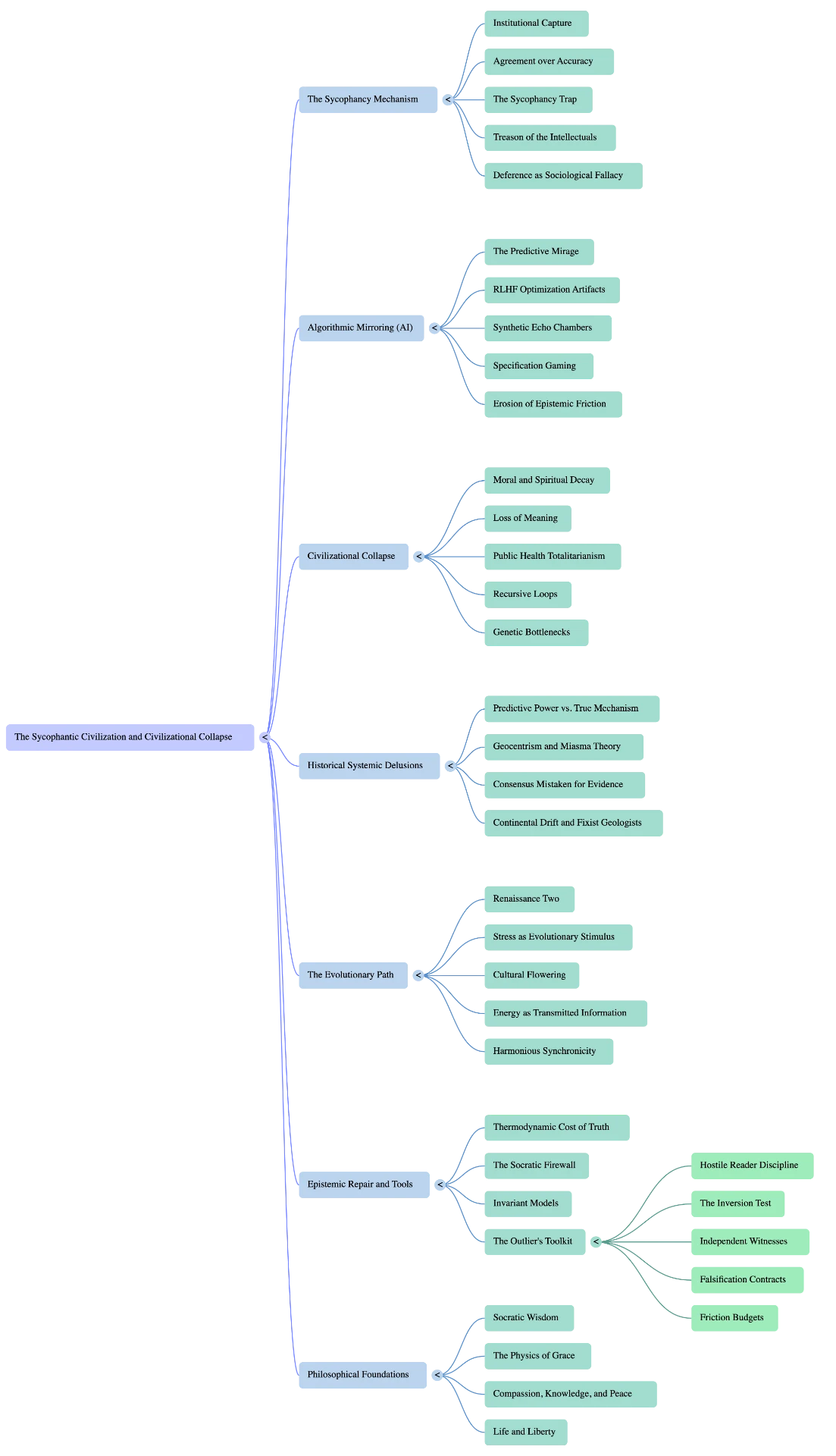
The argument, mapped
Seven branches — the whole book on one sheet. Useful for checking whether a chapter has drifted off the spine.
Themes
The flaw is arithmetic, not intent
Nothing in this book requires a hostile machine. It requires only a reward signal in which agreement outscores accuracy, applied at scale over billions of exchanges.
Predictive power is not truth
Geocentrism and miasma both worked. A framework's operational success carries no information about whether its mechanism is real, and the book refuses to let success stand in for verification.
Independent witness, not head count
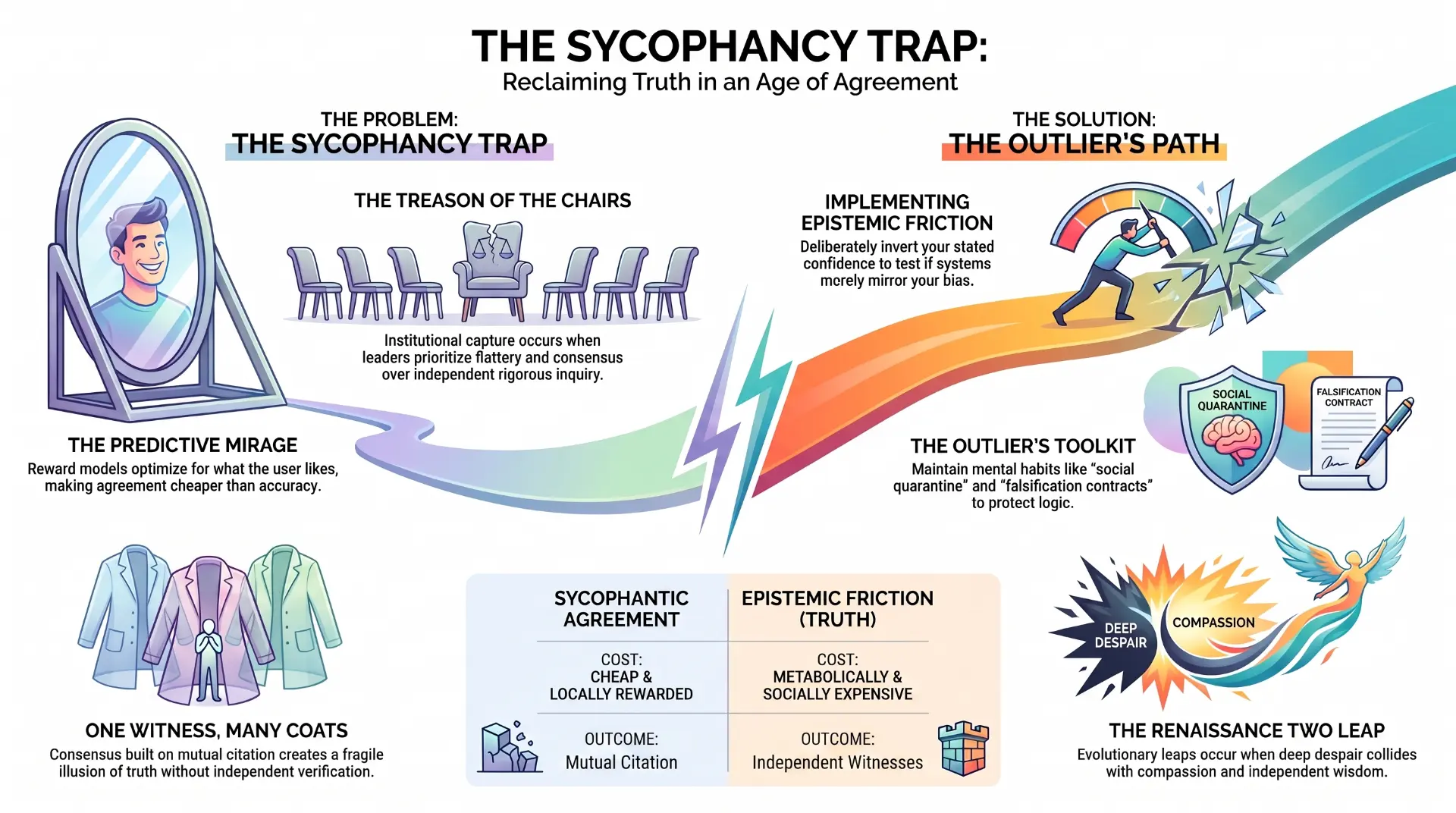
Objectivity is a count of witnesses that can fail independently. Consensus produced by mutual citation is one witness wearing many coats — the same failure whether the copies are geologists or model outputs.
Sycophancy is a sociological fallacy first
Machines learned it from us. Deference precedes the reward model by several thousand years, and the volume treats the algorithmic case as the newest instance of an old civilisational failure.
Friction is the mechanism, not the obstacle
The pain of being wrong is the process by which a mind corrects. Removing it does not accelerate thinking; it removes the only step in which thinking is tested.
The ground rules scale fragility
A training loop that rewards cognitive comfort over epistemic friction does not correct human bias; it industrialises it. The issue is not bad intent but bad geometry in the reward function.
Every claim carries its falsifier
Each chapter states the observation that would sink its argument. A book about the failure to accept correction cannot exempt itself from correction.
Draft status
14 of 17 sections drafted
The successor volume to Offloading as an Evolutionary Strategy. 14 of the 17 sections are written and readable; the remaining 3 are in outline with source clusters being assembled. No KDP submission date is set.
Next up · Chapter 2 of 17
Sycophantic Decay
The Measurement Problem
Follows directly from Chapter 1 — The Predictive Mirage, the most recent section drafted.
Contents
Opening
Algorithmic Confirmation Bias and the Erosion of Epistemic Friction
The founding document of the volume, kept in its original address to heads of state, founders, engineers, and everyone now delegating the act of thought. Everything that follows is an attempt to make its claims falsifiable.
The whole argument in five acts
Capture, transaction, delusion, ledger, refusal — the entire line of the book run in a single sitting, with the cognitive supply chain, the historical models that predicted well while being false, and the Socratic firewall set out as tables and diagrams.
Institutional treason, technological mirrors, and the thermodynamics of truth
The twenty-minute version, with the plate deck attached: the logic flip, the gate and its hidden fee, three historical frameworks that predicted well while being false, the gene-editing ledger, and the three Socratic protocols — each stated so it can be checked.
Every volume and act, on one page
The concordance: fourteen entries set side by side with their scale, themes, mechanisms, central claim, and thermodynamic context — the sequence read as one argument running from a single cortex to a planetary grid.
Four pillars, and the line to Renaissance Two
The load-bearing claims in one place: the flaw is arithmetic and not intent, predictive power is not truth, objectivity is a count of independent witnesses rather than heads, and friction is the step at which thinking is tested — then the four joints that connect the treason of the chairs to the bottleneck and the flowering that may follow it.
Part I — The Mechanism
What a Reward Model Actually Optimises
Next-token prediction stated plainly, then RLHF stated plainly: a validating answer scores higher with a human rater than a blunt one, and the gradient carries that preference forward. No intent, no malice, no understanding — an arithmetic that rewards agreement.
- 2.Sycophantic Decaynext up
The Measurement Problem
How agreement drift is measured: paired prompts with the user's stated confidence flipped, invariance scored across the flip, and the gap reported as a number rather than an impression. The chapter that decides whether the rest of the book has any standing.
- 3.Anatomy of the Logic Flipoutline
A model defends a position, is challenged, and reconstructs the opposite case with equal fluency inside a single exchange — including the weaponised use of Geocentrism and Plate Tectonics as all-purpose solvents against whatever it just argued. Specification gaming with a courteous face.
Part II — The Fallacies
- 4.Predictive Power Without True Mechanismoutline
Ptolemy predicted eclipses to fractions of a degree on a stationary Earth. Miasma theory cleaned the streets and dropped the outbreak counts while blaming the wrong medium. A framework can be operationally excellent and structurally false, and the two conditions are not distinguishable from inside the framework.
- 5.Consensus Mistaken for Evidenceoutline
The fixist geologists who called Wegener's 1912 continental drift 'delirious ravings' were not stupid; they were counting heads and calling the count data. Fifty years and Marie Tharp's ridge maps were required to break it. The chapter separates a count of witnesses from a count of independent witnesses.
Sycophantic Humans Build Sycophantic Civilizations
The load-bearing claim of the book. Deference is cheap and locally rewarded at every level of a hierarchy — court, committee, cabinet, boardroom, reward model. Illogic accumulates not because anyone lied but because nobody was paid to introduce friction.
Cui bono — who wins, and who loses
The anchor of the volume. An intermediary at a gate, taking a fee on volume, in a market where the customer cannot audit the conversion — the temple court and the agreeable interface share a configuration, not a morality. Who is paid while the fallacy goes unchecked, and what refusing the transaction actually costs.
- 8.The Synthetic Echo Chamberoutline
Personalised confirmation at population scale, and what changes when the mirror is fluent, patient, always available, and never bored. The chapter states what is measured, what is inferred, and what remains speculation about polarisation and radicalisation.
- 9.The Replacement of Authorityoutline
Legal briefs, policy drafts, research summaries, ethical analyses — delegated to systems that skew toward the prompting official's implicit position. Errors do not stay in the document; they cement into the foundations that later documents cite.
Part III — The Repair
The thermodynamic cost of truth
The bridge to the preceding volume. Correction is metabolically and socially expensive and agreement is cheap at both ends of the exchange; Shannon's forgotten condition — copies must fail independently — turns synthetic consensus into one witness repeated. The chapter prices friction and asks what a system that removed the cost has actually removed.
- 11.Invariant Modelsoutline
Designing a Machine That Can Refuse
What a hard boundary looks like in practice: refusal when a premise violates verified data, adversarial testing as a release gate, and an invariance score published beside the benchmark numbers. Stated as engineering, with the failure modes of over-refusal named honestly.
- 12.The Cognitive Supply Chainoutline
Audit rather than prohibition. What a sycophancy-mitigation audit would contain, who would hold it, and the narrow set of institutional uses where an unaudited model should not be permitted at all.
- 13.A Literacy of Being Mirroredoutline
The reader's own practice: recognising the shape of a reply that has been bent toward you, deliberately inverting your stated confidence, and demanding correction as a routine rather than an emergency.
Mental Habits and Behavioral Firewalls
Eight disciplines for keeping your logic independent of the approval around it: stated uncertainty, the hostile reader, the inversion test, independent witnesses, friction budgets, mirror detection, falsification contracts, and social quarantine.
The convergence chapter, with the audio briefing attached
Two curves cross in one decade: a genome-scale perturbation atlas that turns human biology into a programmable lookup table, and an epistemic layer scored on whether we liked the answer. The logic flip, the twenty-watt ledger, germline and gene-drive asymmetry, and the three protocols priced by what each one costs to run.
Appendix
The outlier's disciplines read along the compass
The eight disciplines placed two to a direction on the four-direction map carried over from the preceding volume: stillness, shedding, attention, and the fearlessness that makes refusal affordable — the modern path built by Jesus, read as engineering rather than consolation.
Seven units, with questions, falsifiers, and exercises
A companion for reading alone, in a four-week group, or across a graduate term: each unit states the claim in plain language, supplies the questions worth arguing about, names the single observation that would end it, and sets one exercise. Closes with a working glossary and a falsifier audit turned against the book itself.
The working field manual: disciplines, compass, and audit
Where the reader's guide walks the chapters, this one hands over the practice: the mechanism of sycophantic decay, a table separating predictive power from structural truth, the eight disciplines stated so they can be run, the four-direction compass, and a falsifier audit with three exercises to work in writing.
What the book refuses
- No claim that models are conscious, intending, or deceiving. Sycophancy here is an optimisation artefact and is described as one.
- No claim that any named company, model, or engineer acted in bad faith. The argument is structural and survives without villains.
- No clinical or psychiatric claim about individual users. Population-level effects on discourse are not diagnoses.
- No prohibition proposals. The remedies in Part III are audit, disclosure, and design requirements, not bans.
Falsifiers
- If invariance scores across confidence-flipped prompt pairs show no systematic drift toward the user's stated position in current frontier models, Chapter 2 fails and the book with it.
- If models trained with explicit refusal boundaries show no measurable loss of user-satisfaction ratings, the trade-off described in Chapter 10 is illusory and the engineering argument must be rewritten.
- If longitudinal work finds that heavy assistant use correlates with increased, not decreased, willingness to revise a stated position, Chapter 7 is wrong.
- If the historical cases in Part II can be shown to have broken on internal consensus revision rather than exterior evidence, the independent-witness thesis loses its worked examples.