
Volume 27 · Part Three · Chapter 8
Polarisation: Light With an Orientation
The plainest case of energy arriving with a geometric label — and the three steps from an orientation to a braid.
“Geometry is the purest form of physics.”
Glare is not extra light
Start where anyone can check it. Glare off wet asphalt or a lake is not simply more light; it is light that has been sorted. Sunlight arrives with its electric field pointing every which way, changing orientation faster than any instrument follows. Reflection from a flat dielectric surface does not treat those orientations equally: the component lying parallel to the surface reflects more strongly than the component in the plane of incidence. At one particular angle — Brewster's angle, where the reflected and refracted rays are perpendicular — the second component vanishes from the reflection entirely, and the glare is fully oriented.
So the surface has performed a measurement of sorts. It did not add energy and it did not choose randomly. Its geometry — a plane, with a normal direction — decided which orientations left and which stayed, and the light that reaches the eye now carries that decision as a property. A polarising lens is a second, deliberately aligned surface in the same business: rotate it and the glare disappears while the rest of the scene stays. It does not dim. It combs.
The claim in the volume's terms
Energy arrives as incoming information. Polarisation is the plainest demonstration that a beam carries a geometric label in addition to an amount, and that boundary conditions read the label rather than merely reducing the quantity. Nothing metaphorical is required for this sentence to be true.
The bookkeeping, named out loud
This volume's rule is to name the equations being borrowed. For fully polarised light the object is a two-component complex vector — the Jones vector — holding the amplitude and relative phase of the two transverse components. A polariser, a wave plate, or a rotation is then a 2×2 matrix acting on it, and a sequence of elements is a product of matrices. That is the whole formalism, and it is linear.
Real light is usually not fully polarised, so the working description is the Stokes vector: four real measurable intensities, with a degree of polarisation that can sit anywhere between zero and one. Its geometry is the Poincaré sphere — every pure polarisation state is a point on a sphere, linear states around the equator, left and right circular at the poles. Optical elements move points around on that sphere.
The sphere is worth pausing on, because it is where the chapter's real distinction lives. Any two points on a sphere are joined by a continuous path. There is no obstruction, no integer, nothing that cannot be undone by turning a wave plate. A polarisation state is a direction, and directions deform into one another freely. That is a statement about topology, and it is the reason a single beam's orientation, however precisely measured, is not yet a braid.
Where a genuine invariant does appear
Move a polarisation state around a closed loop on the Poincaré sphere and it returns with an extra phase equal to half the solid angle enclosed — the Pancharatnam–Berry phase. This is the first honest topological quantity in the chapter: it depends on the shape of the circuit, not on how quickly it was traversed. It is a geometric phase, not a crossing number, and the difference between those two is what Chapters 9 and 10 are for.
From an orientation to a twist
Give the two transverse components equal amplitude and a quarter-cycle phase offset and the field stops oscillating in a plane. It rotates as the wave advances, so the tip of the field vector traces a helix around the direction of travel, one full turn per wavelength. This is circular polarisation, and it is the second step: not a fixed orientation but a winding one.
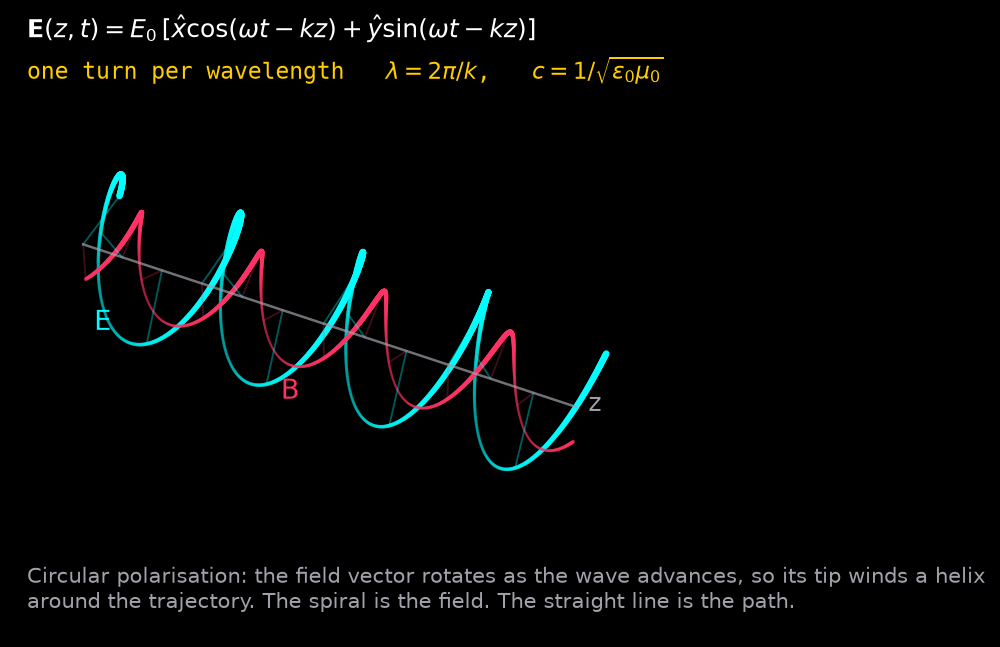
Two registers to keep apart, and this is where careless writing about braided light usually goes wrong. The spiral is the field, not the path: nothing travels along the helix, and the energy moves straight down the axis while the orientation winds around it. And handedness — left or right circular — is a discrete label, but it is a label on a single strand. A twist is a local property of one thread. Chapter 7 said a braid is a property of nothing smaller than the group.
From a twist to a braid
The third step is to add strands. Three circularly polarised beams sharing one axis, each offset by a third of a cycle, project onto the page as a standard three-strand braid. Nothing is drawn by hand: the transverse position of strand n is a sine with phase 2πn/3, and the sign of its radial component decides which strand passes in front at each meeting. The crossings are the phase offsets.
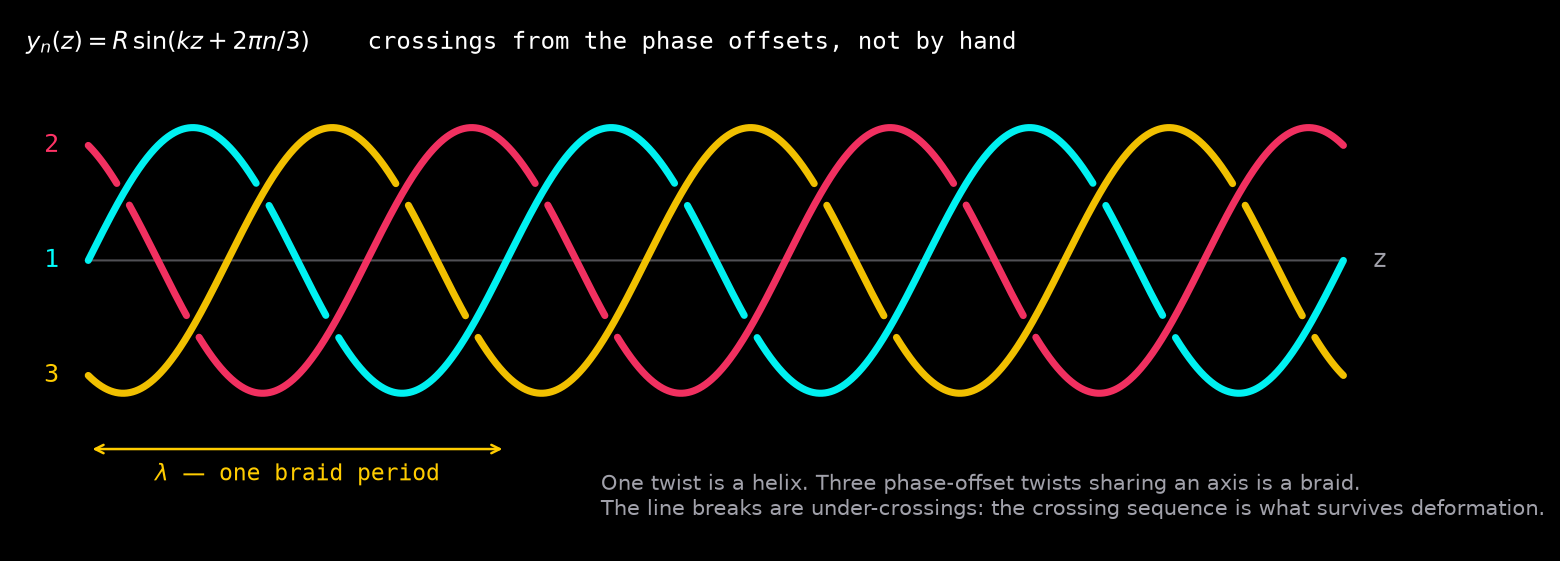
What the second picture makes available is a different kind of quantity. The helix gave a continuous phase and a handedness. The braid gives a word: a finite sequence of crossings, each one over or under, read along the axis. Stretch the strands, bend the axis, change the amplitudes — the word does not change. Only cutting a strand or reversing a crossing changes it. That is the sense in which a braid carries information the geometry cannot smooth away, and it is the first time in this part that the sentence has been earned rather than asserted.
The proxy, named
Three independent beams superposed in vacuum do not physically braid. They pass through one another, because Maxwell's equations are linear, and the diagram records the pattern of relative position rather than any interaction. That pattern is real and measurable, and it is still only an arrangement. Locking it — making the crossings impossible to undo without tearing something — requires a nonlinear medium, a guiding structure, or the phase singularities of vortex beams. Figure 8.2 is a passport for that idea, not a proof of it.
Chapter 9 takes the last step honestly. A single vortex beam carries an azimuthal phase winding whose topological charge is an integer, measurable and unchangeable by any continuous adjustment — a winding that lives in one beam and still cannot be deformed away. That is where the braid stops being a figure the author likes and becomes a number an instrument reports.
What the filter costs
One correction to the comb, because the chapter should not flatter its own metaphor. Filtering is not free. An ideal polariser placed in unpolarised light passes half the intensity, and a second polariser at angle θ to the first passes cos²θ of what reaches it. Energy is genuinely removed — absorbed or reflected away — not merely relabelled. The reason the lens still feels like a comb rather than a dimmer is that the light it removes is concentrated in the part of the scene you did not want, so contrast rises while total brightness falls.
That accounting matters beyond sunglasses. It is the same structure as every selective boundary condition in this volume: a geometric criterion applied to incoming energy, with a real cost, producing information that was present all along but unreadable in the mixture. Naming the cost is what keeps the phrase energy as incoming information a description rather than a slogan.
The interactive version of the wave equation behind both figures — with capacitance, inductance, damping, and wave speed as controls — is at LC Circuits and the Geometry of Radiation. The figure this chapter reports to is stated in Chapter 7: The Silk Sheet and the Threads of Braided Light.