
Volume 27 · Part Three · Chapter 14
Correlation Without Signals: Graphs and Hypergraphs
The correlations belong to the state as a whole. Once that is drawn, it looks like a mind — and the resemblance has to be priced.
Nothing is travelling between the particles
Entanglement is hard to picture because almost every available picture is wrong in the same way. The mind reaches for two objects and something passing between them — a thread, a message, an influence in transit. Bell’s work closed that route: the observed correlations exceed anything a local account with signals can produce, and no faster-than-light message is available to rescue the picture. What is left is stranger and simpler. The correlations are not carried between the parts. They are properties of the state that includes both parts, and the parts do not separately have the values the correlation relates.
This is a topological statement before it is a physical one. A relation that belongs to the whole and not to its members is exactly what survives when you stop asking where things are and start asking how they are connected. It is the same move the braid makes: the crossing sequence is real, the positions of the strands are not the content.
The claim, with its status
Established physics: quantum correlations are properties of the joint state and cannot be reproduced by local signalling. Borrowed picture: drawing that state as a network. The picture is a bookkeeping device for the correlation structure, not a claim that the state is a network of wires.
Links belong to pairs; hyperedges belong to subsets
Draw the register honestly and the drawing splits in two. Pairwise correlations give an ordinary graph: nine subsystems, a line wherever two of them are correlated, brightness standing in for strength. That is the left panel below, and it is the picture most people already have in mind when they say entangled.
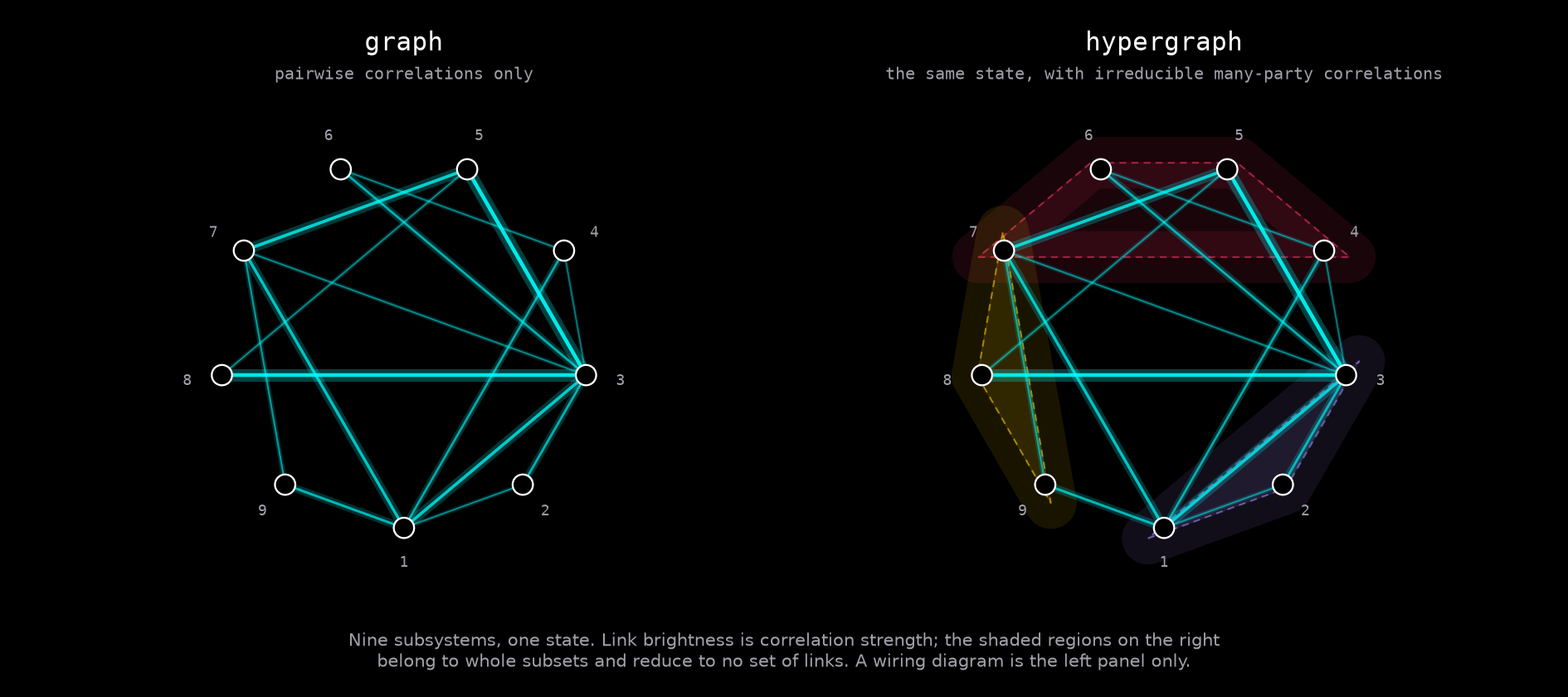
The right panel adds what the graph cannot hold. Some correlations are irreducibly many-party: a three- or four-subsystem group can be correlated in a way that no set of pairwise numbers reproduces — the GHZ state is the standard textbook case, where every pair, examined alone, looks uncorrelated while the triple is maximally correlated. Those relations need an edge that touches more than two nodes, which is a hyperedge, and a drawing that has them is a hypergraph rather than a graph.
And the whole figure moves. Under any interaction the correlation structure rewires: links brighten and fade, hyperedges form and dissolve. The static image is one frame. What the volume cares about is which features of that changing structure are invariant — which relations survive redrawing — because those are the ones carrying information rather than describing a particular sketch.
Why it looks like a map of a mind
The resemblance is immediate and it is not an accident of drafting style. Network neuroscience arrived at the same object from the other direction: regions as nodes, correlated activity as links, and a standing recognition that what a region is explains far less than which paths cross which, in what order. Both fields, working on incomparable substrates, found that the geometry was scaffolding and the relations were content. When two disciplines independently reach for the same mathematics, the mathematics is usually telling the truth about a shared structural situation, not about a shared mechanism.
Neuroscience also needed the second panel. Pairwise correlation between regions turned out to be insufficient — higher-order interactions, the kind where a triple of areas is jointly informative in a way no pair is, are now their own literature. That convergence is the interesting part: two fields discovered, separately, that a graph of pairs underdescribes the system, and both had to enlarge the drawing in the same direction.
Where the resemblance fails
- Signals. Neural links are signal paths — spikes with a direction, a delay, and a metabolic cost. Quantum links are explicitly not that. The drawings coincide; the referents of the lines do not.
- Plasticity. A brain graph rewires by growing, pruning, and reweighting connections that persist for years. A correlation graph rewires by unitary evolution and decoherence on femtosecond-to-millisecond scales. Same verb, different physics, no shared timescale.
- Direction. Neural connectivity is directed and hierarchical; quantum correlation is symmetric. Any argument that leans on the arrows has left the quantum case behind.
So the honest sentence is narrow, and the narrowness is the point. Quantum many-body states and neural systems are both described by changing hypergraphs, and both reward attention to invariants rather than positions. Nothing in that licenses a quantum account of thought, and nothing in it needs one. The shared object is the mathematics of relations that belong to wholes — which is the subject of this part of the book, arrived at twice.
The proxy, named out loud
This volume’s rule applies here as everywhere. The graph is a proxy for the state, not the state. It discards the phases, keeps a chosen measure of correlation, and reports the result as a picture, which is precisely why it is useful and precisely where it will mislead. Two genuinely different states can produce the same drawing under a coarse enough measure; the drawing will not warn you.
The falsifier is clean. If a graph or hypergraph summary predicts a measurement outcome the full state does not — or fails to distinguish states that are experimentally distinguishable — the correction lives in the discarded information, not in the topology. The invariants survive that correction. The picture may not, and no amount of luminosity in the links changes it.
The braid form of the same instinct is stated in Chapter 7: The Silk Sheet and the Threads of Braided Light, and the step from an orientation to a braid in Chapter 8: Polarisation. The boundary-entanglement version of the emergence claim is Chapter 6.