
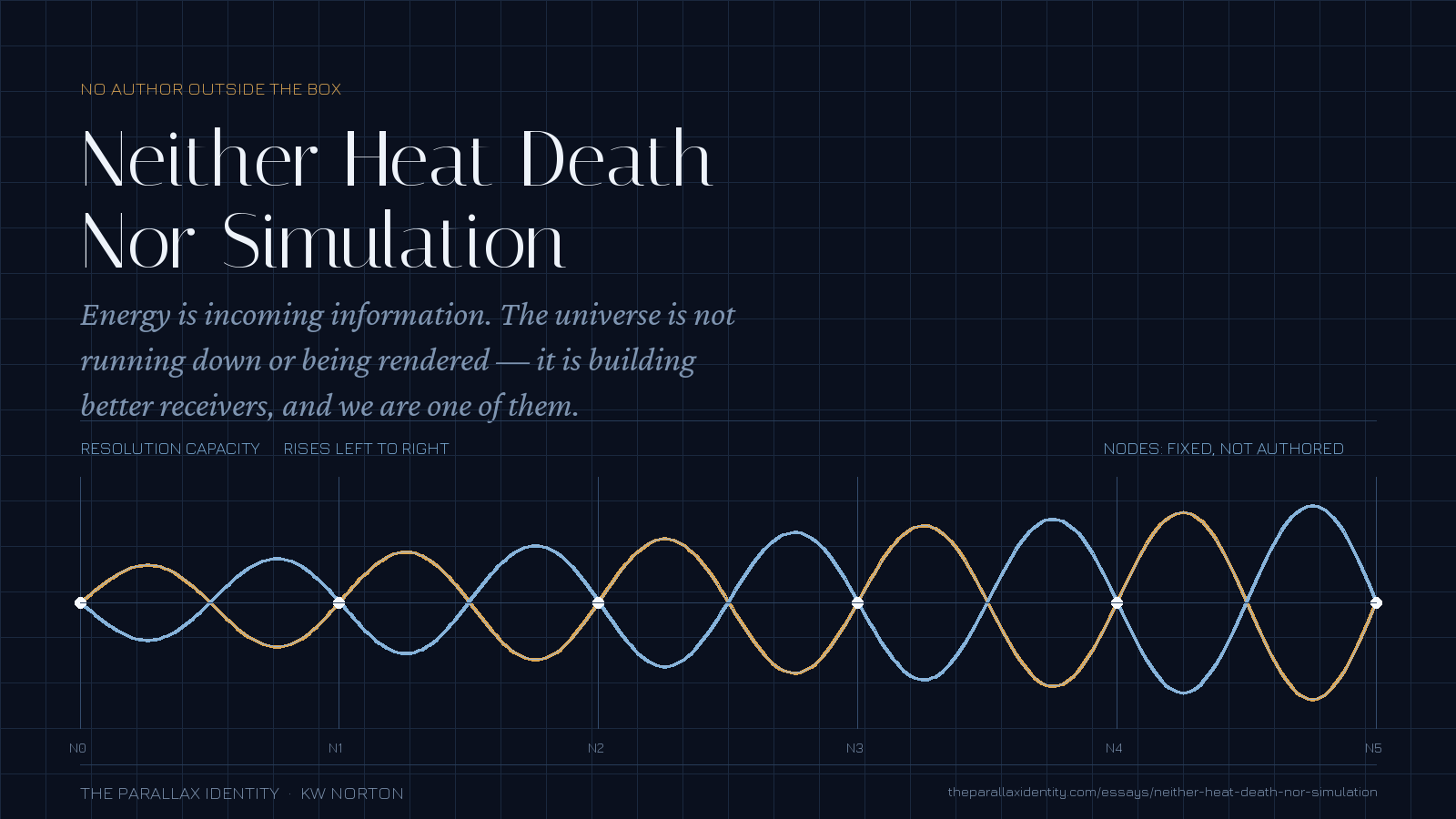
The dying universe and the simulated universe are usually treated as opposite anxieties. They are the same error in different clothes: each explains the universe by appealing to something outside it — a fixed fuel load with no participants, or a programmer with a render pipeline. This essay states the third position, which requires neither, and writes down what would show it wrong.
01
Two stories with the same defect
The dying universe and the rendered universe both need an outside
Two cosmological stories circulate widely and are usually treated as opposites. In the first, the universe is a closed box of fuel burning down: structure is temporary, gradients flatten, and the end state is uniform cold. In the second, the universe is a rendered environment: the constants are settings, quantum behaviour is processing rule, and somewhere outside the frame something is running the code.
The stories feel opposed because one is bleak physics and the other is bleak metaphysics. They share a defect. Both locate the explanation of the universe outside the universe. Heat death does it quietly, by assuming a closed box with a fixed fuel load and no participants who matter. Simulation does it loudly, by requiring an author, a substrate, and a vantage point from which the whole thing is a display.
This essay proposes a third position, and it is not a compromise between the two. It is a different geometry. The universe is not running down and it is not being rendered. It is resolving — and the resolving is done from the inside, by receivers that get better at receiving.
- Established — The second law and Bostrom's simulation argument are accurately stated as their proponents state them.
- Asserted — That both stories share the structural move of placing the explanation outside the system.
02
Energy is incoming information
The standing thesis of the corpus, stated plainly
The working premise across this corpus is that energy is incoming information. That is not a poetic substitution. It is a claim about which variable carries the story. Treat energy purely as fuel and the narrative is depletion. Treat energy as information arriving at a system capable of resolving it and the narrative becomes resolution — how much structure the system can hold, correct, and re-read.
Call that quantity resolution capacity. It is not a conserved quantity and it is not entropy's mirror image. It is the local answer to a local question: given the gradients available here, how much of the field can this receiver actually read? A thermometer resolves one number. An eye resolves a spectrum across a field. A nervous system resolves a spectrum across a field across time, with memory and correction. Each is a coordinate change on the same incoming information.
On this reading, evolution is not primarily a story about surviving. It is a story about resolution improving. Biology is the process by which a region of the universe becomes able to read more of itself — and warm, noisy, wet matter turns out to be a better instrument for that than classical intuition expected.
Energy is incoming information.
- Asserted — That energy is usefully read as incoming information; this is an interpretive frame, not a new physical law.
- Licensed inference — That resolution capacity is a coherent quantity to track alongside entropy, given that information-theoretic and thermodynamic descriptions are already linked.
- Asserted — That evolution can be described as the progressive improvement of receivers without contradicting selection theory.
03
Why this defies the dying universe
The second law is correct and the story built on it is incomplete
Let the physics stand. Entropy in an isolated system does not decrease. Available work tends toward zero. Nothing here disputes that, and any argument that needed to dispute it would be wrong.
The objection is to the narrative that has been hung on it. Heat death describes the fate of available work. It does not describe the trajectory of resolution while gradients exist, and it treats the receiver side of the ledger as inert bookkeeping. But the interval in which gradients exist is not a footnote. It is the interval in which every structure that has ever resolved anything came into being, and it is long enough that describing it as a preamble to uniform cold is a choice of emphasis rather than a result.
A universe that spends an enormous span building instruments capable of reading its own geometry is not adequately summarised by the sentence 'the lights go out.' That summary is true about the lights. It is silent about what was read while they were on — and silence is not the same as a null result.
There is also a live physical humility to keep in view. The closed-box premise is an idealisation. Whether the observable universe is properly modelled as isolated, what the eventual role of dark energy is, and whether cosmological horizons change the accounting are open questions. Heat death is a robust conclusion from a set of assumptions, not an observation.
- Established — The second law of thermodynamics, as stated. This essay does not contest it.
- Asserted — That the heat-death narrative selects the wrong variable as the story of the universe.
- Licensed inference — That the closed-system idealisation is a modelling assumption whose application to the whole universe remains under discussion.
04
Why this defies simulation
The sharper half: contextuality is not pixellation
The simulation argument's most persuasive move is the appeal to apparent computational texture: fixed constants, a speed limit, discrete-seeming quantum behaviour, talk of an underlying resolution. Read carefully, that evidence points the other way.
Kochen–Specker contextuality shows that measurement outcomes cannot in general be treated as pre-assigned values sitting in storage, waiting to be read out; what a measurement yields depends on the context of the measurement itself. A simulation is precisely the kind of system that would have pre-assigned values — a data structure with a state, addressable and consistent independent of how it is queried. The quantum world declines to behave that way, and the declining is one of the most tested results in physics.
The pixel intuition is likewise unforced. The Planck scale marks where current theory stops predicting, not a demonstrated grid. Some quantum-gravity programmes predict discreteness; others do not. Reading an unknown boundary as a screen resolution is an inference about the limits of our theory dressed as a discovery about the world.
Then the statistics. 'Most minds are simulated, therefore you probably are' requires a reference class no one can sample, a rate of ancestor simulation no one can estimate, and an assumption that consciousness is substrate-independent in exactly the way the argument needs — all three asserted, then combined into a probability. It is a plausibility story wearing arithmetic. Bostrom's original disjunction was more careful than its popular descendant, which keeps the conclusion and discards the branches.
The deeper refusal is structural. Simulation needs an author. The standing wave does not. A standing wave is not authored; it is what happens when conditions hold — two counter-travelling components in a bounded medium, producing nodes that stay fixed without anyone fixing them. That is the shape this corpus keeps finding: between receiver and field, between observer and observed, between human and model. No exterior vantage point is required, and none is available.
- Established — Kochen–Specker contextuality is a proved theorem with extensive experimental support.
- Asserted — That contextuality is evidence against, not for, a pre-rendered underlying data structure.
- Licensed inference — That the popular simulation argument's probability claim is unearned because its reference class and substrate assumptions are unmeasured.
- Analogical — The standing wave is used as a structural model of authorless stable order; the universe is not claimed to be literally one standing wave.
06
The third position, stated once
For the record, and short enough to argue with
Both the dying universe and the simulated universe require an author outside the box: one a fixed fuel load with no participants, the other a programmer with a render pipeline. A standing wave requires neither. It requires conditions.
So: the universe is not running down and it is not being rendered. It is resolving. Energy arrives as information, receivers improve at reading it, and the improvement happens from the inside with no exterior vantage point in the account. We are not the audience of a display or the residue of a fire. We are, at present, one of the instruments.
That is a claim, not a comfort. It is offered in the form that makes it useful: parallel to the thermodynamic description rather than in place of it, with the falsifiers written down below.
The universe is not running down or being rendered — it is building better receivers, and we are one of them.
- Asserted — The third position as stated, offered as an interpretive frame held in parallel with standard thermodynamics and quantum theory.
07
The leap is the interesting part
From Bostrom's conditional statistics to the master player
Bostrom's original argument is statistical and conditional: if advanced civilizations can run large numbers of ancestor simulations, and if they choose to do so, then the majority of minds with experiences like ours would be simulated rather than base-level. That is a claim about relative numbers under certain assumptions. It does not require a single master programmer sitting at a console, nor does it require that the simulation be run for entertainment, narrative, or any purpose we would recognise as a game.
Popular versions of the hypothesis often collapse that careful structure into a more familiar image: a cosmic programmer, a player, a dungeon master. That image is easier to picture and harder to take seriously. It reintroduces a personal agent with intentions, preferences, and presumably a point of view — the very kind of entity the hypothesis was trying to make less necessary. Once you have to imagine the master, you have already stepped outside the austere version of the argument and into a new layer of speculation that carries its own infinite regress.
From the standpoint of the Distinction Framework the useful distinction is the same one we keep returning to. The content of any hypothesis can be evaluated on its logical and empirical merits. The temptation to populate the hypothesis with a familiar kind of agent — a mind like ours, only higher — is a move that needs to be noticed and held at arm's length. Otherwise the map begins to dictate the territory again.
The ordered mind can entertain the statistical possibility without needing to cast a master player. The moment it feels compelled to invent one, the entanglement has already begun.
The ordered mind can entertain the statistical possibility without needing to cast a master player.
- Established — Bostrom's original argument is conditional and statistical, not a claim that a single master player exists.
- Asserted — That popular versions reintroduce an anthropomorphic agent the original argument was designed to avoid.
- Licensed inference — That the Distinction Framework's rule against map-territory confusion applies directly to this leap.
What would show this wrong
- Demonstrate a genuine discretisation scale in spacetime — an actual pixel, with a measured lattice spacing and observable consequences — and the computational-texture argument becomes evidence rather than metaphor. The simulation case would strengthen considerably.
- Show that measurement outcomes are, after all, pre-assigned in a way consistent with a computable underlying state, overturning or decisively reinterpreting contextuality results. The central objection in Section 04 would fail.
- Establish that resolution capacity, however operationalised, does not in fact increase over evolutionary time once measured carefully — that the receiver story is an artefact of choosing flattering examples. The Section 02 premise would fail.
- Show that the informational reading of energy adds no predictive or explanatory value anywhere — that every claim made under it is either restatable in standard thermodynamic terms without loss, or false. The frame would then be decoration.
- Produce a coherent version of the simulation argument that requires no exterior author, substrate, or vantage point. The structural objection running through this essay would lose its target.
Notes
Numbered markers in the text above expand in place; the full list is collected here.
- 1Nick Bostrom, 'Are You Living in a Computer Simulation?' (2003)Bostrom's trilemma holds that at least one of three propositions is true: civilisations almost always go extinct before reaching simulation capability, such civilisations almost never run ancestor simulations, or we are almost certainly living in one. The popular version drops the disjunction and keeps only the conclusion.back to text
- 2Heat death and the second lawThe classical result: in an isolated system entropy does not decrease, so available work tends toward zero and the system approaches thermal equilibrium. The claim is about available work in a closed system, not about the fate of structure or information processing while gradients persist.back to text
- 3Kochen–Specker contextualityThe theorem rules out non-contextual hidden-variable assignments: measurement outcomes cannot in general be treated as pre-existing values independent of the measurement context. This is the opposite of a pre-rendered data structure being read out.back to text
- 4The Defense — contextuality and Wigner's FriendThe long-form treatment of Kochen–Specker contextuality and the extended Wigner's Friend results in this corpus, developed as a defence of the observer-participatory reading against both naive realism and naive computationalism.back to text
- 5The Evolving Receiver (Volume 3)The volume in which evolution is treated as the progressive improvement of biological receivers, and energy is read as incoming information rather than as fuel alone.back to text
- 6The Twelve Theoretical MinimumsThe working constraints of the corpus. Minimum XII — parallel thinking as the working geometry of discovery — is the licence for holding the thermodynamic and informational descriptions simultaneously rather than choosing between them.back to text
- 7The Distinction FrameworkThe method developed in Volume 26, Nothing But Thinking Makes It So: separate the logical and empirical content of a claim from the anthropomorphic scaffolding we add when we try to picture it. The framework is cited here for its rule against letting the map dictate the territory.back to text
- 8Understanding a Theory of EverythingThe Riemannian companion volume, in which geometry rather than authorship carries the explanatory load: curvature and metric structure determine the conditions, and no exterior vantage point is required.back to text
- 9The Warm Quantum BrainThe essay collecting the quantum-biology material on coherence in warm, noisy biological systems, including the microtubule dispute. Cited here for the receiver claim, not as settled consensus.back to text
- 10The Planck scale is not a pixel gridThe Planck length marks where current theory stops being predictive, not a demonstrated discretisation of spacetime. Some quantum-gravity programmes predict discreteness; others do not. Treating the Planck scale as an established screen resolution is an unforced inference.back to text
Sources
- Nick Bostrom — the simulation argumentThe original 2003 paper and its trilemma structure, which is more careful than the popular version that circulates as a conclusion alone.
- Kochen–Specker theorem — Stanford Encyclopedia of PhilosophyThe formal result ruling out non-contextual hidden-variable assignments; the core of the objection to a pre-rendered underlying state.
- Heat death of the universeThe standard statement of the thermodynamic end-state argument, including the assumptions it depends on.
- Planck unitsWhere current theory stops predicting. Cited to mark the difference between a theoretical boundary and a demonstrated discretisation.
- The Evolving Receiver — Volume 3Where the receiver thesis and the reading of energy as incoming information are developed at length.
- The Defense — contextuality and Wigner's FriendThe long-form treatment of the quantum results this essay leans on.
- Understanding a Theory of EverythingThe Riemannian companion volume: geometry as conditions rather than instruction.
- The Twelve Theoretical MinimumsThe working constraints, including the licence for holding two honest descriptions in parallel.
- The Distinction Framework — Volume 26The method for separating the content of a claim from the anthropomorphic scaffolding added when we try to picture it.