
(08) The Socratic transceiver: an inquiry into unseen frequencies
Socrates
Tell me, learner, when you stand upon the banks of the rushing mountain stream, what is it that your eyes actually behold?
Learner
I see the water cascading over the granite, Socrates. I see the smooth whirlpools spinning downward and the bright upwelling plumes bubbling to the surface.
Socrates
And do you believe the water itself creates these distinct forms out of its own separate desire, or is it responding to an architecture that remains completely invisible to your sight?
Learner
It must be responding to the hidden shape of the granite riverbed beneath it.
Socrates
Excellently observed. Now tell me: if the fluid slipstream of the entire cosmos is similarly tumbling through space, and it suddenly hits a hidden, geometric obstruction—say, a specific prime coordinate or a non-trivial Riemann zero—what must occur to the current?
Learner
It would be forced to warp. It would spin into a local vortex, just like the water in our stream.
Socrates
Then let me ask you the vital question: is the physical matter of your body, or the neural lattice inside your skull, a separate 'thing' trapped in a box—or is it simply the beautiful, visible vortex formed where the universal stream strikes a magnificent, unseen antenna?
(09) Emergent creativity as entrainment
A scientific hypothesis does not begin as a sterile mathematical calculation. It is born from imaginative mental models in a process identical to composing a piece of music, writing a novel, or painting a canvas. Throughout history, the source of this creative inspiration has seemed completely mysterious. Because we could not describe where these moments of sudden origination came from, it was tempting to attribute them to a supreme intelligence, a pantheon of gods, or supernatural beings. This complex strategy — which we recognize as religion — has deeply complicated psycho-spiritual roots in human psychology and sociobiological systems.
Received by the Biological Antenna
(Entrainment & Tuning)
↓
Transforms and Filters the Input
(Creative Flow State)
↓
Transmitted Back to Evolve the Ecosystem
Miraculous they are, but not magical. When we look past the ancient mythologies, we discover the spectacular achievements of humans who simply manage to tune their biological systems directly into the universe, entering a state of absolute creative flow. Mystery, mythology, and religion have historically served as placeholders for things we can perceive but do not yet fully comprehend. They function exactly like the non-trivial zeros and misbehaving prime numbers in the Riemann hypothesis — markers indicating a deeper, underlying system waiting to be mapped.
We humans are both receivers and transmitters of incoming information. This incoming stream is what we describe here as energy — energy that is continuously transmitted to us, filtered by us, and transformed by us.
Our brain and sensory organs act as a highly specialized step-down transformer, altering the frequency of the energy before broadcasting it back into the universe in an entirely new form.
But this is not a one-way transmission; we too are transformed by the energy we receive, leaving us forever changed by the relationship.
Modern physics and biology reveal that everything in the cosmos exists in an active, real-time relationship with everything else.
As demanded by the uncompromising laws of thermodynamics, the entire universe is continuously shifting, evolving, and organizing as a direct result of this perpetual, beautiful exchange of energy.
Technical appendix · Figure 4.1
The pentagonal geometry of the genetic antenna
If the previous section asks how a person tunes into an incoming stream, this appendix asks what the receiving structure looks like. A continuous helix traces a path along a cylinder; sampling that path at five-fold rotational steps turns the smooth curve into a discrete set of coordinates — a pentagonal cross-section climbing through space. Two such strands, offset in phase, give the alternating wide and narrow grooves of the familiar double helix.
1 · The single-strand vector helix
A point tracing a continuous helix along a cylindrical boundary is given by a vector function of the phase angle θ:
R⃗(θ) = x(θ) î + y(θ) ĵ + z(θ) k̂
R⃗(θ) = r·cos θ î + r·sin θ ĵ + (h / 2π)·θ k̂
where r is the radius of the enclosing cylinder and h is the pitch — the distance travelled along the axis k̂ during one full 2π rotation.
2 · Embedding five-fold symmetry (ℤ₅)
Rather than treating θ as a smooth variable, the path is sampled at fixed fractional rotations, so that discrete vertices appear:
θₙ = (2π / 5)·n + φ₀
n ∈ ℤ indexes each node along the backbone, and φ₀ sets the initial angular offset.
3 · The double-strand matrix
A second strand is projected into the same grid at an angular phase displacement Δφ, which is what produces the alternating major and minor grooves:
R⃗A(n) = r·cos((2π/5)n) î + r·sin((2π/5)n) ĵ + (h/10)·n k̂
R⃗B(n) = r·cos((2π/5)n + Δφ) î + r·sin((2π/5)n + Δφ) ĵ + (h/10)·n k̂
Collapsed into one discrete dual-vector equation, with φA,B carrying the strand offset:
R⃗A,B(n) = r·cos((2π/5)n + φA,B) î + r·sin((2π/5)n + φA,B) ĵ + (h/10)·n k̂
The structural values are the measured ones for B-form DNA: radius r ≈ 10 Å, giving the roughly 20 Å diameter; pitch h ≈ 34 Å per full turn; ten nucleotide pairs per turn — two complete five-fold rotations — so each node advances Δz = h/10 ≈ 3.4 Å along the axis. The five-fold sampling and the groove offset are the book's chosen way of drawing that geometry, not additional measurements.
For a reader who does not work in vector notation, the point of these three lines is smaller than it looks. They are the skeleton of the lattice: a description of where a tumbling, fluid motion stops being smooth and settles into fixed positions that repeat. The equations do not explain why life is built this way. They only say that if you want to draw the receiving structure the chapter keeps describing, these are the coordinates you would draw, and they are the same numbers crystallographers measure.
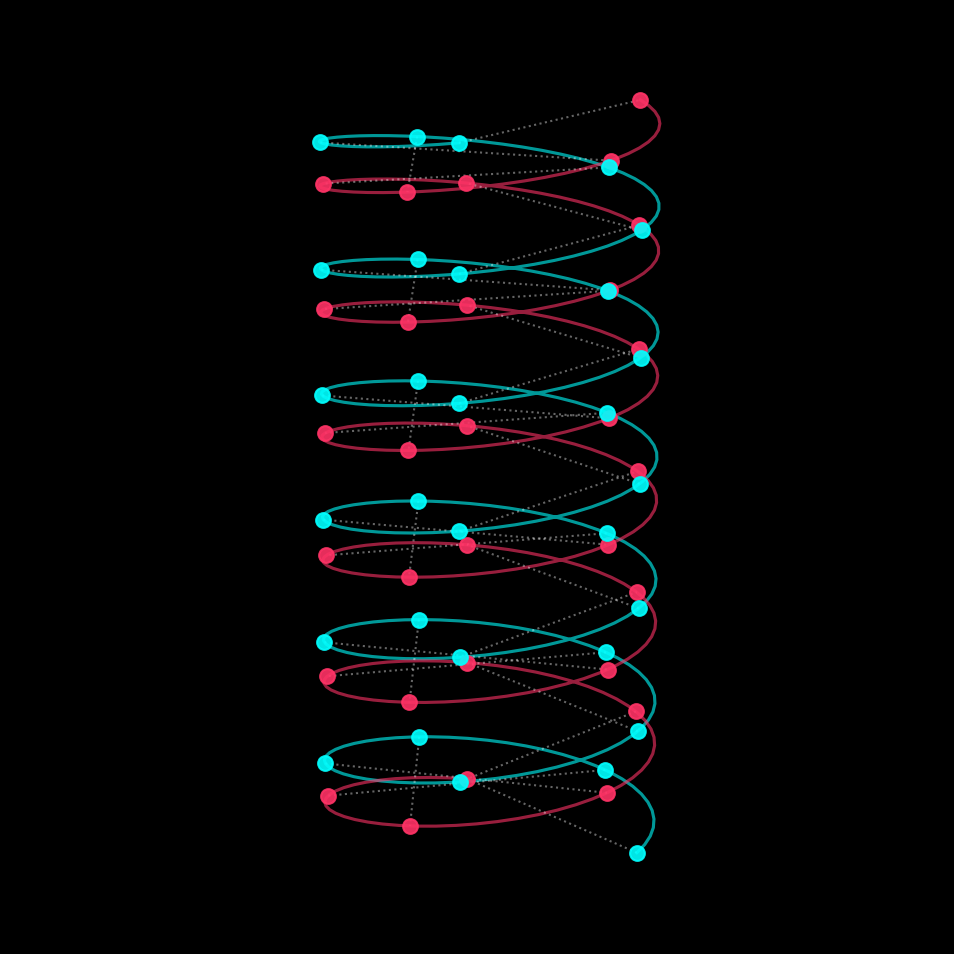
scripts/render_pentagonal_double_helix.py.- Discrete nodes
- The plot deliberately declines to draw a smooth curve as the structure. It places coordinates every 72° — 2π/5 radians — so that each turn resolves into a pentagonal cross-section rather than an unbroken sweep. The faint continuous lines are interpolation for legibility only; the nodes are the claim.
- Groove asymmetry
- The angular offset between the strands, Δφ ≈ 2.2 rad, is what produces the alternating wide and narrow spacing along the cylinder. In B-form DNA those are the major and minor grooves: asymmetric spatial pathways, not a drawing convention.
- Transverse rungs
- Each dotted horizontal line marks the coordinate pair where the two strands sit at the same axial height — the positions the model reads as complementary nodes stabilising into a base pair, spaced about 3.4 Å apart up the axis.
The microtubule bridge and frequency-locking
How would an organism draw structure out of a tumbling stream? Not, on this account, through one localized chemical reaction, but through a layered set of periodic structures. If the helix is the geometry of the receiving element, the hollow cylinders of microtubules — periodic arrays of tubulin dimers — are the tuning dials, and the brain's slower rhythms are where the whole arrangement settles. Around the theta–alpha border, roughly 7–9 Hz, absorbed and relaxed attention shows a characteristic transitional signature: the step-down stage in this model, where fast, fine-grained activity is brought into a rhythm a person can actually inhabit.
[ Universal slipstream field ]
        │  incoming information density
        ▼
[ Discrete pentagonal helix ]  ◄── resonant fractal antenna
        │  periodic geometric structure
        ▼
[ Microtubule tubulin lattice ]  ◄── tuning element
        │
        ▼
[ Theta–alpha transition, 7–9 Hz ]  ──►  coherent attention
Read carefully, the ladder reframes two familiar ideas. Inherited injury, in this vocabulary, is less a broken chemical sequence than a distortion in the receiving geometry — an asymmetry that adds drag and noise to whatever arrives. And adaptation becomes a matter of tuning rather than accident: disciplined, Socratic attention as the slow work of smoothing that distortion. Both are readings offered for their usefulness to a general reader, and both are stated here as claims that can fail.
A testable version of this claim matters more than the claim. The nearest testable version pumps tryptophan networks in isolated microtubules with a tuned radio-frequency source, holds temperature and buffer conditions fixed, and looks for a change in an optical coherence readout against sham-pumped controls. That design is written out in full, with its null results declared in advance, in the microtubule resonance protocol.
Neuroplasticity, entrainment, and the human field
The brain is a highly complex electromagnetic organ. When we engage in focused visualization or sustained attention, large clusters of neurons begin firing together in synchronous patterns. This internal resonance strengthens structural neural pathways, chemically and electrically changing the physical architecture of the brain through neuroplasticity.
Living tissue communicates via subtle mechanical and electromagnetic signals. Structures such as mitochondria respond to energetic and acoustic changes. Focused intention triggers cascades of physical responses — altering stress hormones, heart-rate variability, and the body's overall bio-signature.
Just as a radio circuit uses electrical resonance to select one frequency out of thousands, the brain uses the reticular activating system as a tuning dial. Visualization and deliberate attention act as that dial, filtering the overwhelming background of sensory data and allowing relevant patterns to stand out.
Entrainment extends beyond the individual. Fellow humans can come to resonate at similar frequencies through shared attention, shared rhythm, shared inquiry. This is the biological basis of culture, of teaching, of the quiet transmission that occurs when one mind truly meets another.
The continuum remains open.
(10) The collective transceiver matrix
Because everything exists in active, real-time relationship with everything else, human consciousness is difficult to hold as an isolated accident. It looks more like a shared coordinate system. When individual minds enter creative flow, they are not generating thought from nothing; they are tuning into a field already carrying structure — an open, fluid ecosystem where informational energy moves across biological boundaries.
Individual neural waveguide
Attention settles into coherent Socratic tuning
↓ Resonant entrainment
Localized frequency lock
Rhythm holds near the theta-alpha border
↓ Network synchronization
Collective transceiver matrix
Coupled minds carry the pattern outward
Through this lens the separation between observer and observed thins. The brain does not sit passively inside a rigid Cartesian box; it behaves as a directional antenna that updates the stream with every act of deep inquiry.
By stabilizing our internal waveguides, we stop reacting blindly to top-down digital noise and become responsible nodes within a living field — participating in the trajectory of human learning as science and human meaning reach critical mass.
Conceptual index — cross-reference pass
- Biological learning machines
- §4, §5, §9
- Fluid slipstream
- §2, §3, §4, §7, §8, §9, §10
- Microtubule transceiver
- §4, §5, §10
- Phase-change lattice
- §1, §4, §9
- Riemann hypothesis
- §3, §7, §9
- Socratic method
- §1, §4, §8, §10
Two things stand out in the pass. The entrainment junction between sections 9 and 10 is where the account of emergent creativity hands over to the collective matrix, anchoring the thermodynamic argument in ordinary psychology. And the fluid slipstream runs as the narrative backbone across nearly every section, carrying the trout stream imagery through to the many-dimensional photon.
(11) The thermodynamics of sovereign consciousness
The second law of thermodynamics says that closed mechanical systems decay toward disorder, entropy, and heat death. For centuries this has been used to justify a bleak worldview — life as a brief anomaly destined to be crushed by a cold, chaotic universe. But that conclusion holds only for a closed box of isolated particles colliding in a vacuum. Shift the view to a continuous fluid slipstream and the accounting changes.
Closed mechanical system
Energy held inside a Cartesian box; entropy rises
↓ The boundary opens
Open fluid slipstream
Continuous exchange with inflowing energy
↓ Sustained coherence
Living engine
Local order built while entropy is exported
A sovereign human consciousness does not behave like a passive, closed system. It operates as an open engine that draws order out of incoming informational energy. When an individual reaches genuine Socratic alignment, attention stops drifting: it absorbs the uncoiling energy of the river and works it into an organized lattice of human meaning.
This capacity is what the book means by biological sovereignty. We are not helpless passengers drifting down an unfeeling river toward certain decay. We take part in shaping the riverbed. By using disciplined, self-directed inquiry to smooth the internal noise of inherited habit and inherited injury, we move attention away from automated, mechanical loops. Energy that was scattering as waste heat begins to focus.
This short blueprint strips away the dead academic scaffolding to reach a plain conclusion for the general reader. Sovereignty here is not a philosophical abstraction and not a metaphysical promise. It is the ordinary, effortful process by which a learner stands in the middle of the turbulent stream, faces what is arriving, and works it into something with truth, shape, and clarity.
(12) The quantum shift into Homo Luminous
The long journey of reductionist science — centuries spent cataloguing isolated parts, slicing up the living tiger, trapping the mind inside Cartesian boxes — has reached the boundary layer where its own methods stop answering. It collapses under its own weight at the edge of a fluid cosmos. In its place the science of everything steps forward, not as an ossified theory but as an open gateway into a Theory of Interconnection. We stand where rigorous physics, number theory, and deep human meaning approach critical mass.
Algorithmic mechanical man
Fragmented; held inside the metric grid
↓ The shift in attention
Biological learning antenna
Tuned toward the incoming stream
↓ Sustained realignment
Homo Luminous
Coherent, sovereign transceiver of light
Homo Luminous is the name this book gives to a human being awake to their role as a conscious participant in that exchange. Not an accidental byproduct of matter drifting through a void, but a set of coordinates where the energy of the universe comes to recognize its own symmetry. As attention is trained toward the critical line of the Riemann spine, the artificial boundaries of institutional control lose some of their grip and the mind returns to its own creative flow.
Stepping through that shift, the tapestry arrives in its plainest layout. The trout stream, the many-dimensional photon, the tubulin lattice of the microtubule, and the imagination of the poet are not separate, colliding fragments. They are continuous phase changes of one integrated system.
This short synthesis leaves the dense academic scaffolding behind and hands over a working blueprint of biological and intellectual sovereignty. The universe described here is open and cooperative, and the reader is one of its living sensors.
Stand on the banks of the turbulent stream, cast your line into the patterns of the uncoiling current, and look out with clear eyes — knowing that the fearful symmetry of the leaping tiger, the architecture of light, and the long human effort to understand them have always belonged to the same continuum.
Manuscript completion log
- Print target
- — fifty-page fixed signature
- Sections
- — 01 through 12, synchronized
- Status
- — blueprint complete