
The anatomy of the many-dimensional photon: four nested topological layers, from the still core to the protective shell.
- Matrix
- 48-line boundary array configuration
- Structure
- Four nested topological layers
- Metaphor
- The roaring matrix within the wavefront
Architecture of light, resonance, and the lattice of water
Light is not a simple particle or a simple wave. Modern understanding shows it to be a richly structured field phenomenon whose topology and resonance properties shape the very possibility of matter.
In earlier work I used a silk-sheet metaphor in which the threads themselves are braided light. That image remains useful: light appears braided into topological shapes that echo the architecture of DNA and the resonant lattices of living systems.
Resonance and electromagnetism are not add-ons to matter; they are constitutive of it. In quantum field theory, subatomic particles are recognized as localized, resonant excitations — essentially mathematical vibrations — within universal underlying fields. Every elementary particle is a specific resonant frequency vibrating within a continuous field. Electromagnetism acts as the primary glue that dictates how these resonant energy packets interact, bonding atoms and preventing matter from collapsing. Cymatic structuring demonstrates the same principle at larger scales: specific frequencies organize chaotic matter into orderly geometric forms.
Water, the most common and most overlooked medium on our planet, is itself a resonant lattice. Fresh water, salt water, and the great oceanic systems all participate in the same flexible phase-change dynamics we first observed in the trout stream. Biological molecules, enzymes, and even viruses operate within and upon this aqueous resonant matrix.
The same geometry that organizes a trout stream organizes the interior of a living cell.
Layer 1 · The core Riemann spine
The phase singularity core
The innermost foundation is not a physical boundary but a zero-point axis. It acts as the sink that anchors the expanding structure around it.
- The mathematics
- The core tracks the critical line (σ = ½) of the Riemann zeta function, establishing a tight sequence of non-trivial zeros as its ordering scaffold.
- The fluid analogy
- A frictionless drain — the downward-torsional whirlpool that anchors the surrounding slipstream.
- The narrative lens
- The unmoving eye of the storm, where the fluid physics of the model lock into stillness: the hidden axle on which the wheel of light rotates.
Layer 1 · Extended reading
We stand at the edge of a silent vortex. At the exact centre line of the forty-eight-dimensional flash, the rushing of the slipstream drops away into geometric stillness. This is the phase singularity core: the unweighted mathematical spine on which the architecture of light is hung. It takes up no physical space and carries no mass, friction, or metric dimension. It functions instead as a pure directional vector, a structural anchor tracing the critical path where the non-trivial zeros of the Riemann hypothesis hold the model in equilibrium. To look into the core is to see the template of interconnection with the temporary scaffolding stripped away.
For a modern reader, the zero-point core is where the book's bridge between energetic fields and human attention is proposed: the point at which the model stops describing collision and starts describing communication. The claim under test is that when internal neural timing matches this geometric rhythm, inherited noise and algorithmic disruption lose their grip — that the reader is not a separate observer in a box but a participant aligned with a transmission line. Stated plainly: this is the hypothesis the rest of the book has to earn, not a finding it reports.
Layer 2 · The phase modulator matrix
The twisted light alphabet
Directly surrounding the still core, incoming energy density begins to spin, wrapping itself into discrete, readable geometric configurations.
- The mathematics
- A discrete ten-node pentagonal helical phase array (ℤ₅ × ℤ₂), structuring the field into specific wave intervals.
- The fluid analogy
- The shear zone where the incoming stream is torn apart and reorganized into precise, repeating crests.
- The narrative lens
- Light is not a featureless blur; it is a fluid alphabet. The slipstream twists into distinct glyphs, printing information onto the fabric it moves through.
Layer 3 · The 48-coordinate bundle
The intermediate manifold
The transmission engine of the model, expanding the localized spiral of the inner core into a network of interconnected pathways.
- The mathematics
- Forty-eight separate, non-interfering coordinate lines bundled into a single high-dimensional topological manifold.
- The fluid analogy
- Forty-eight independent water currents flowing inside one pipe without friction or mixing.
- The narrative lens
- The multi-channel transceiver of the flash: one photon carrying many distinct channels at once, so that meaning survives transmission whole.
Layer 4 · The protective field boundary
The Chern invariant shell
The outermost layer, keeping the internal high-dimensional structure stable and insulated from external thermal interference.
- The mathematics
- Governed by topological Chern numbers, the shell forms a non-zero global invariant field (C ≠ 0).
- The fluid analogy
- A glass-like sheet of surface tension holding a spinning vortex stable inside a turbulent river.
- The narrative lens
- A resilient geometric shield that preserves coherence across distance — the reason the flash arrives with its information intact.
Technical appendix · Figure 3.1
The 48-line vector configuration array
The figure below renders the unweighted topological coordinates of the forty-eight-line bundle around the core axis. Phase angles are staggered on a golden-ratio (φ) spacing so no two channels share a trajectory, and a small sine term in the vertical equation gives each line a wave-like quality rather than a straight ray — the visual difference between a point particle and a continuous fluid path.
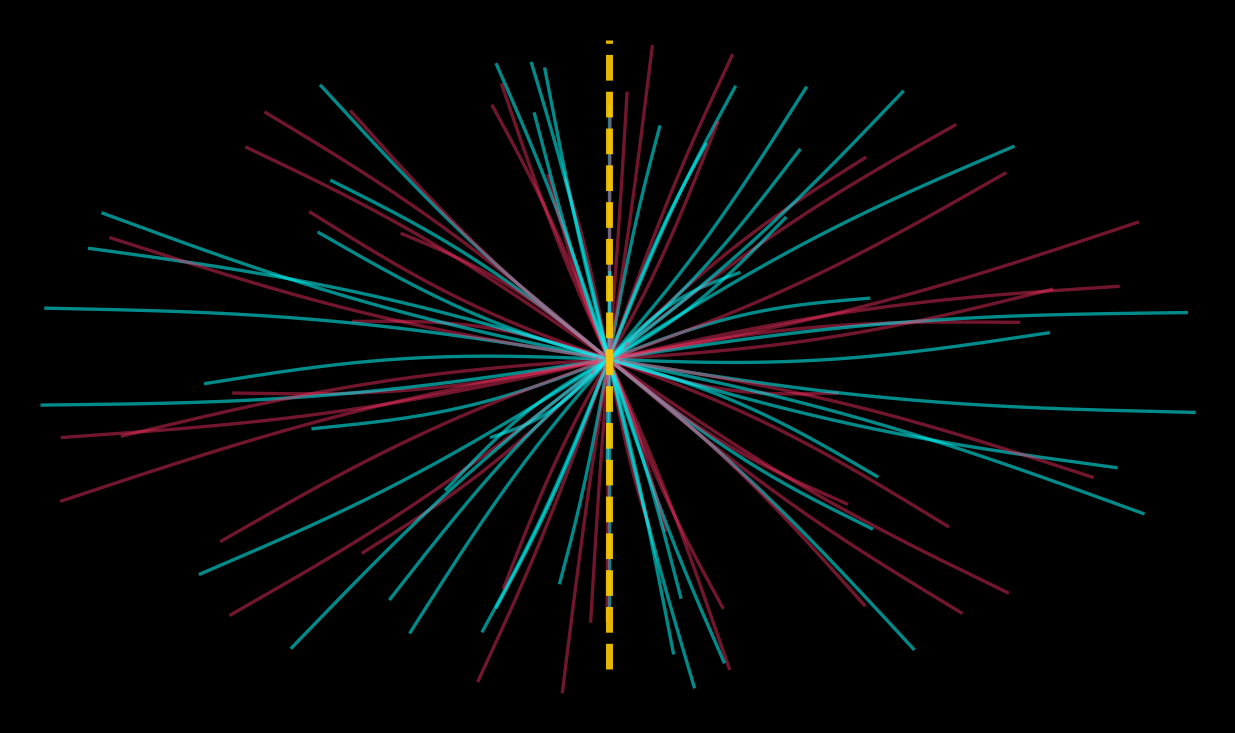
scripts/render_48_line_manifold.py.- The matrix core
- The dashed gold axis anchors the manifold and stands, in the model, for the sequence of non-trivial zeros along the critical line.
- Golden-ratio spacing
- Staggering the phase trajectories by φ gives the bundle an even, unweighted spread, which is how the figure represents channels that do not interfere.
- Fluid rendering
- The sine ripple on the vertical coordinate is a drawing decision, not a physical result: it keeps the reader's eye on flow rather than on points.
Established engineering · A note on the golden ratio in real light
Where the golden ratio already architects light
The golden-ratio spacing used above to spread the model's forty-eight channels is not an invention pulled from aesthetics. The same sequence already organizes real light in three branches of established optical engineering, and naming them keeps the speculative model honest about what it borrows and what it adds.
- Fibonacci quasicrystals. When thin layers of two materials are stacked in a Fibonacci sequence rather than periodically, the resulting structure is deterministic yet non-periodic — a photonic quasicrystal. Light travelling through it undergoes distinctive localization and filtering, a property now used to shape optical filters, lasers, and components for photonic computing.
- Phyllotactic solar arrays. Mirroring the spiral by which leaves climb a stem to minimize mutual shading, photovoltaic panels laid out on Fibonacci / golden-angle spirals capture sunlight more evenly across the day than flat grids, improving yield per unit area.
- Reflection geometry. Even in classical ray optics the Fibonacci numbers appear: counting the paths a light ray can trace between two parallel reflecting plates produces the sequence directly, a textbook instance of the ratio governing where light can and cannot go.
None of those results depends on the forty-eight-dimensional manifold or the Riemann critical line. They are listed here so the reader can see the precise status of each layer: the golden ratio as an organizational principle for light is established engineering; the mapping of that principle onto a forty-eight-channel photon manifold is the speculative proposal of this book.