
Project Quantum Shield · Briefing
Evolutionary Divergence and Quantum Bio-Energetics
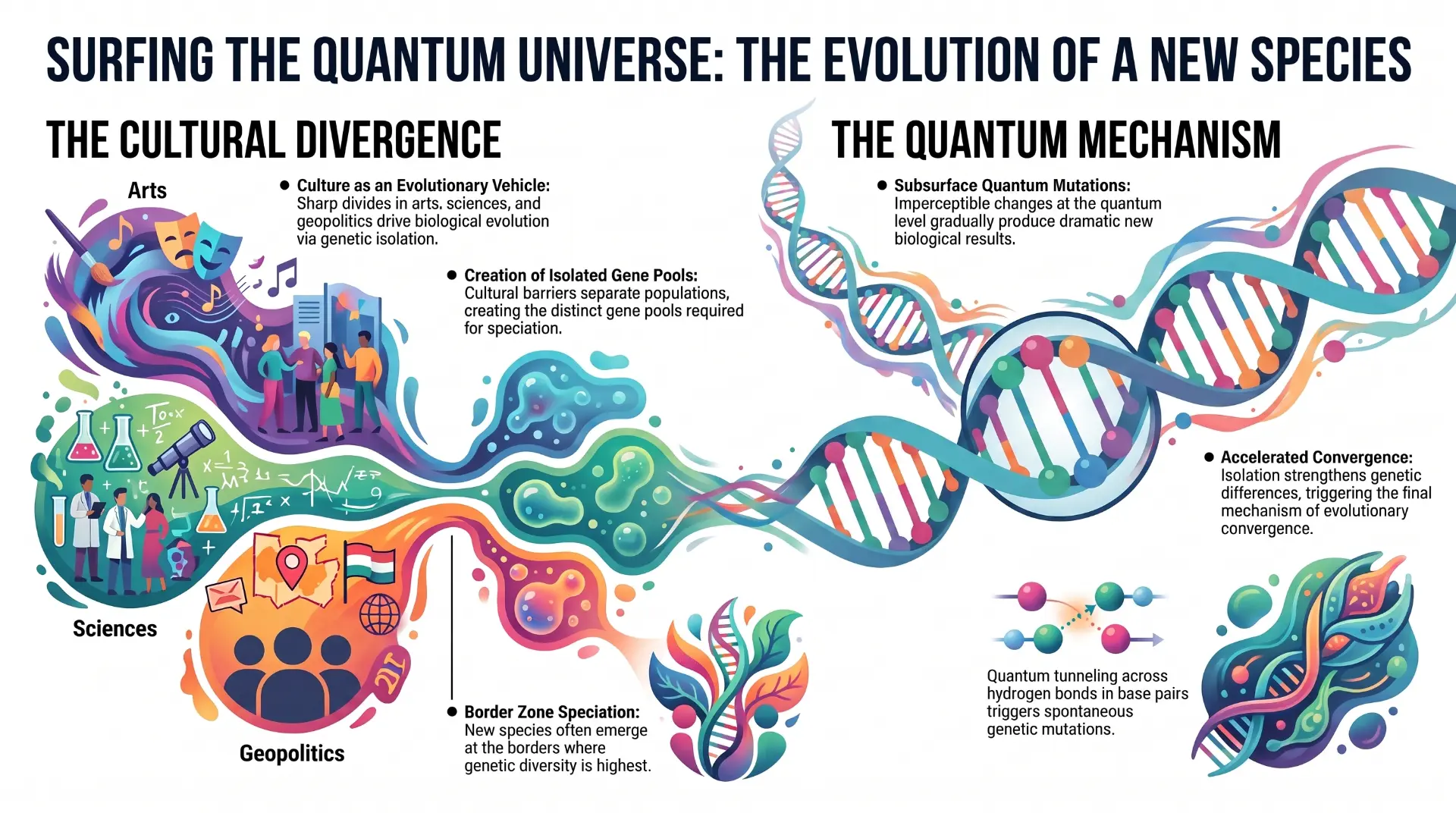
Cultural divides act as a vehicle for genetic isolation; quantum events supply the subsurface mutations; a filing system keeps the work answerable.
Summary
Project Quantum Shield proposes that human biological change is running faster than the record admits, and that the driver is not a single environmental shock but the ordinary machinery of separation. Sharp divides in the arts, the sciences, and geopolitics set populations apart. Separation produces isolated gene pools. Isolated gene pools are the known precondition for speciation.
Underneath that social account sits a physical one. Small quantum events — protons tunneling across the hydrogen bonds that hold DNA base pairs together — can produce spontaneous tautomeric shifts and, from those, point mutations. Nothing about a single tunneling event is dramatic. The claim is about accumulation across long time.
The third component is unglamorous and necessary: a filing system. An outsider paradigm survives only if the work is organized well enough that someone else can check it. That is what the notebooks and the workspace generator are for.
The three key findings
Finding 1
Cultural–biological feedback loop
Cultural divergence creates isolated gene pools, and those pools become the catalyst for biological change rather than a passive consequence of it.
Finding 2
Quantum mutation mechanism
Subsurface biological change is driven in part by quantum events, specifically proton tunneling across hydrogen bonds in DNA base pairs.
Finding 3
Citizen-science infrastructure
Automated workspace generation and segmented notebooks make cross-disciplinary synthesis reviewable instead of anecdotal.
Mechanics of speciation
- Cultural divergence. Divides in consciousness, geopolitics, and the arts act as barriers that set populations apart.
- Genetic isolation. Those barriers produce isolated gene pools — the mechanism already known to bring about speciation.
- Border zones. Early speciation shows up first at the borders between isolated groups, where genetic diversity is highest.
- Convergence. As genetic differences strengthen, a convergence mechanism reinforces the separation rather than dissolving it.
Quantum bio-energetics and modeling
Proton tunneling is the primary candidate mechanism for the class of spontaneous mutation this project is interested in. A proton crosses a hydrogen bond inside a base pair; the pairing geometry shifts; replication copies the shifted form; a point mutation is fixed. The events are individually rare and collectively consequential.
The modeling work uses quantum circuit simulation to place a proton in superposition across two positions and read out the relative probability of a mutated state against no mutation. That gives the argument a number to defend rather than a metaphor to repeat.
What the published literature supports
The tunneling half of this project is not an outsider claim. There is a growing peer-reviewed biophysics literature — Löwdin's original proposal, and the modern open-quantum-systems treatments from Louie Slocombe, Marco Sacchi, and Jim Al-Khalili — that models proton tunneling as a live contributor to spontaneous mutation. Four themes carry the weight.
Quantum dominance in mutagenesis
Current calculations put tunneling across the hydrogen bonds of a base pair orders of magnitude above classical thermal hopping over the same barrier. The quantum route is not a small correction to the thermodynamic story; on these numbers it is the main route.
Status · Modeled and published; rate estimates still model-dependent.
Replication as a freezing mechanism
A transient proton transfer is reversible while the helix is closed. Unzipping the strands changes the local energetics, and the transferred state can be locked in as a permanent mismatch. Replication is where a fleeting quantum event becomes a heritable one.
Status · Mechanism modeled; direct in-vivo capture not yet demonstrated.
Active biophysical suppression
Helicase appears not to be a passive zipper. Multiscale simulations suggest its stereochemistry is arranged in a way that suppresses double proton transfer during separation — an enzyme that protects the code against exactly this failure mode.
Status · Simulation-level result; a strong falsifier would be a helicase variant with the geometry disrupted and no change in mutation rate.
Adaptive quantum evolution
The most speculative thread: if environmental coupling influences the quantum state of the base pair, mutation is not uniformly random with respect to environment. That is a mechanism-shaped bias, not direction or intent, and it is the claim to hold most loosely.
Status · Early theoretical proposal. Treat as open, not established.
Anchor sources
- Löwdin, P.-O. (1963). Proton tunneling in DNA and its biological implications. Reviews of Modern Physics 35, 724–732. doi:10.1103/RevModPhys.35.724
- Slocombe, L., Al-Khalili, J. S., & Sacchi, M. (2021). Quantum and classical effects in DNA point mutations: Watson–Crick tautomerism in AT and GC base pairs. Physical Chemistry Chemical Physics 23, 4141–4150. doi:10.1039/D0CP05781A
- Slocombe, L., Sacchi, M., & Al-Khalili, J. (2022). An open quantum systems approach to proton tunnelling in DNA. Communications Physics 5, 109. doi:10.1038/s42005-022-00881-8
- The helicase-suppression and adaptive-coupling threads now have their own filed citations, together with the mathematical appendix, in the biophysical verification and bibliography reference guide.
Information theory and cognitive noise
The same project treats modern synthetic and cognitive noise as an information problem. Where a population sits relative to that noise is itself a differentiating pressure.
Allergic hypersensitivity is the working example: read as an entropy filter, a heightened response to synthetic inputs is not simply a malfunction but a difference in how a body triages incoming information — and differences in triage separate populations.
Infrastructure and notebooks
A Python workspace generator builds a standardized directory layout so the segmented research stays organized as it grows. Each notebook has one job.
Root Notebook
The original essay and the divergence / convergence map.
Notebook 1 — Quantum Bio-Energetics
Modeling proton tunneling and quantum-level point mutations.
Notebook 2 — Information Theory
Cognitive noise and the entropy filter, including allergy response.
Simulation note — Cultural barriers and F_ST
A 1,000-generation two-deme model showing when restricted contact starts to register as genetic differentiation.
Notebook 3 — Citizen Science
Infrastructure and prompt architecture for paradigm synthesis.
Reference Guide — Bibliography
Annotated peer-reviewed sources, the conceptual mapping table, and the mathematical appendix.
Convergence Map
The structural index that returns every research stream to the central claim.