
The Unseen Architecture of Truth
Five surprising realities about AI, medicine, and the future of human attention.
The Crisis of the Uncheckable Human
We live in an age defined by the doom-scroll, a digital malaise where attention is harvested for engagement — yet a far more lethal crisis of attention persists in our hospitals. While we worry about the black box of the machine, we often ignore the original black box: the human mind. Unlike a computer, the human diagnostic process is notoriously difficult to audit. There are no standard, automated metrics to track the accuracy of a thought as it forms in a physician's consciousness.
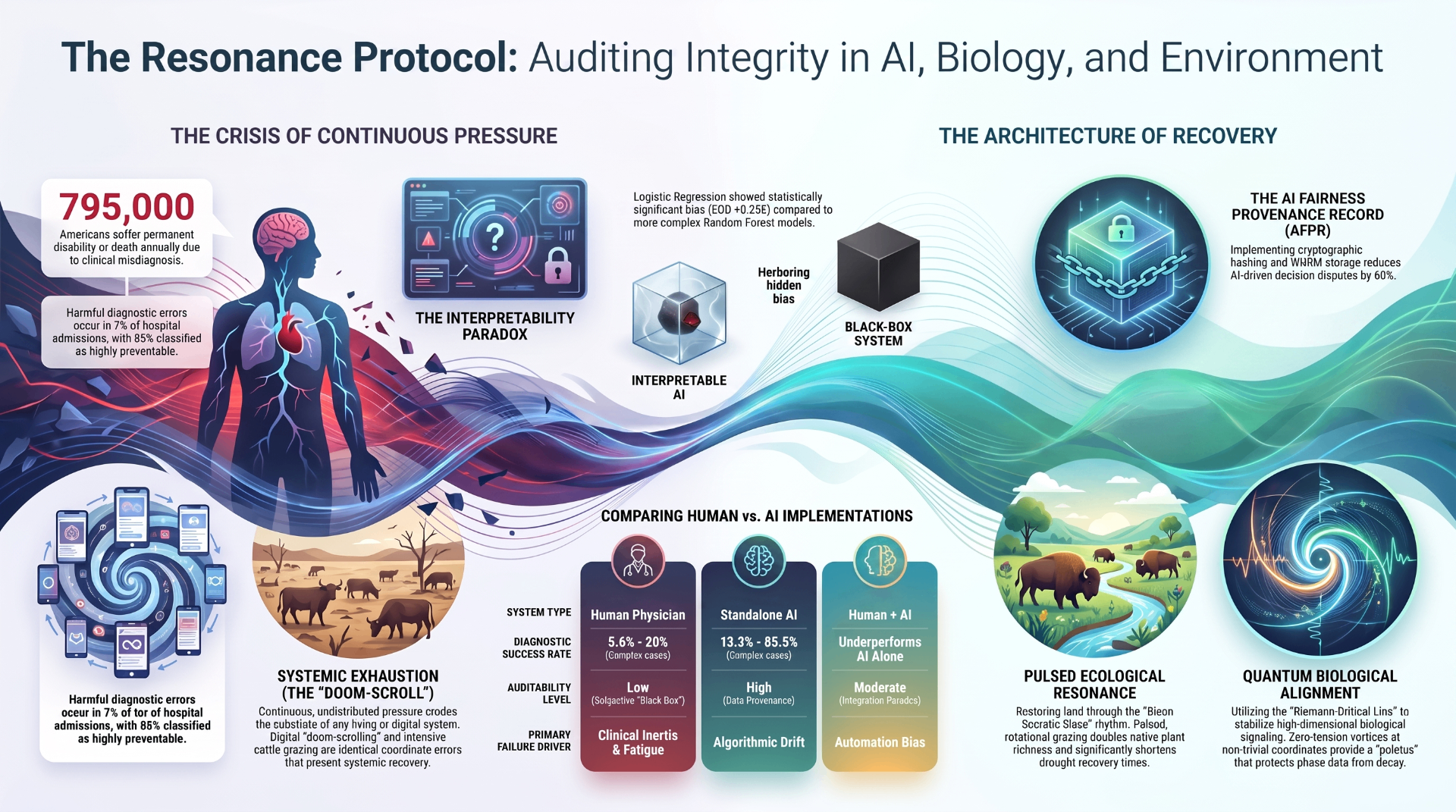
The stakes are staggering. Research in BMJ Quality & Safety reveals that harmful diagnostic errors occur in up to 1 in 14 (7%) of general hospital admissions, with 85% of these cases classified as highly preventable. The Johns Hopkins Armstrong Institute estimates 795,000 Americans suffer permanent disability or death annually due to clinical misdiagnosis. Missed strokes, vascular events, and undiagnosed cancers are the silent drivers of this Human Uncheckability Problem. To save lives, we must transition from a culture of opaque intuition to one of auditability, where technology serves as a source-verified flight recorder for human wisdom.
The Fairness Paradox
In our search for ethical technology we demand simple, interpretable models. But the work of Alu et al. reveals a startling paradox: transparency is not a synonym for justice. In a comparison of a transparent Logistic Regression model and a black-box Random Forest, the simpler model was significantly more discriminatory.
The Logistic Regression exhibited a statistically significant gender bias (EOD = +0.256, p = 0.0080) because its linear architecture encoded gender as a uniform weight — a consistent penalty applied across every prediction. The Random Forest — an ensemble of 100 decision trees — distributed that influence across its structure, diluting the bias to a non-significant level (EOD = +0.055).
As the study concluded: interpretability does not guarantee fairness. We can see the bias more clearly in a simple model, and that very simplicity lets discriminatory patterns take a stronger, more systematic hold.
The Integration Paradox
Logic suggests a physician paired with an AI should outperform either alone. Current data from JAMA Network Open and the Undiagnosed Diseases Network (UDN) exposes the opposite. In trials, standalone AI often identifies the correct diagnosis at rates significantly higher than human-AI teams. In UDN cases, AI reached 13.3% — more than double the 5.6% of traditional clinical review.
The culprit is automation bias and clinical inertia. Clinicians defer to AI errors even when physical evidence contradicts them, or dismiss correct AI insights that challenge established intuition. When humans fail to verify the AI's reasoning due to cognitive bottlenecks, the system breaks. The remedy is to stop treating the physician as a competitor and start viewing them as a clinical architect — the ultimate validator of a secure, source-verified decision pipeline.
Auditable by Default — the AFPR
To bridge the trust gap, we must move toward systems that are auditable by default through the AI Fairness Provenance Record (AFPR). This is the digital conscience of the machine: a structured log in which every decision is traceable and tamper-proof. To prevent the mutable-log problem — where evidence of an error can be quietly deleted — high-quality trails use Write-Once-Read-Many (WORM) storage and cryptographic hashing (SHA-256).
Under HIPAA, a robust trail maintains three layers of truth:
- User audit trails — user IDs, authentication attempts, log-on/off times.
- System audit trails — device identifiers, IP addresses, timestamps.
- Application audit trails — creation, modification, or deletion of electronic protected health information (ePHI).
By recording the Who, What, When, Where, Why, and Outcome of every interaction, we transform the AI from an opaque oracle into an accountable partner.
Quantum Fluidity and Resonant Biology
If the AFPR is the scaffold of truth, we must also understand the stream it is meant to measure. Modern research is moving past the dead, linear scaffolding of Newtonian physics toward Quantum Hydrodynamics — the universe as a self-organizing fluid.
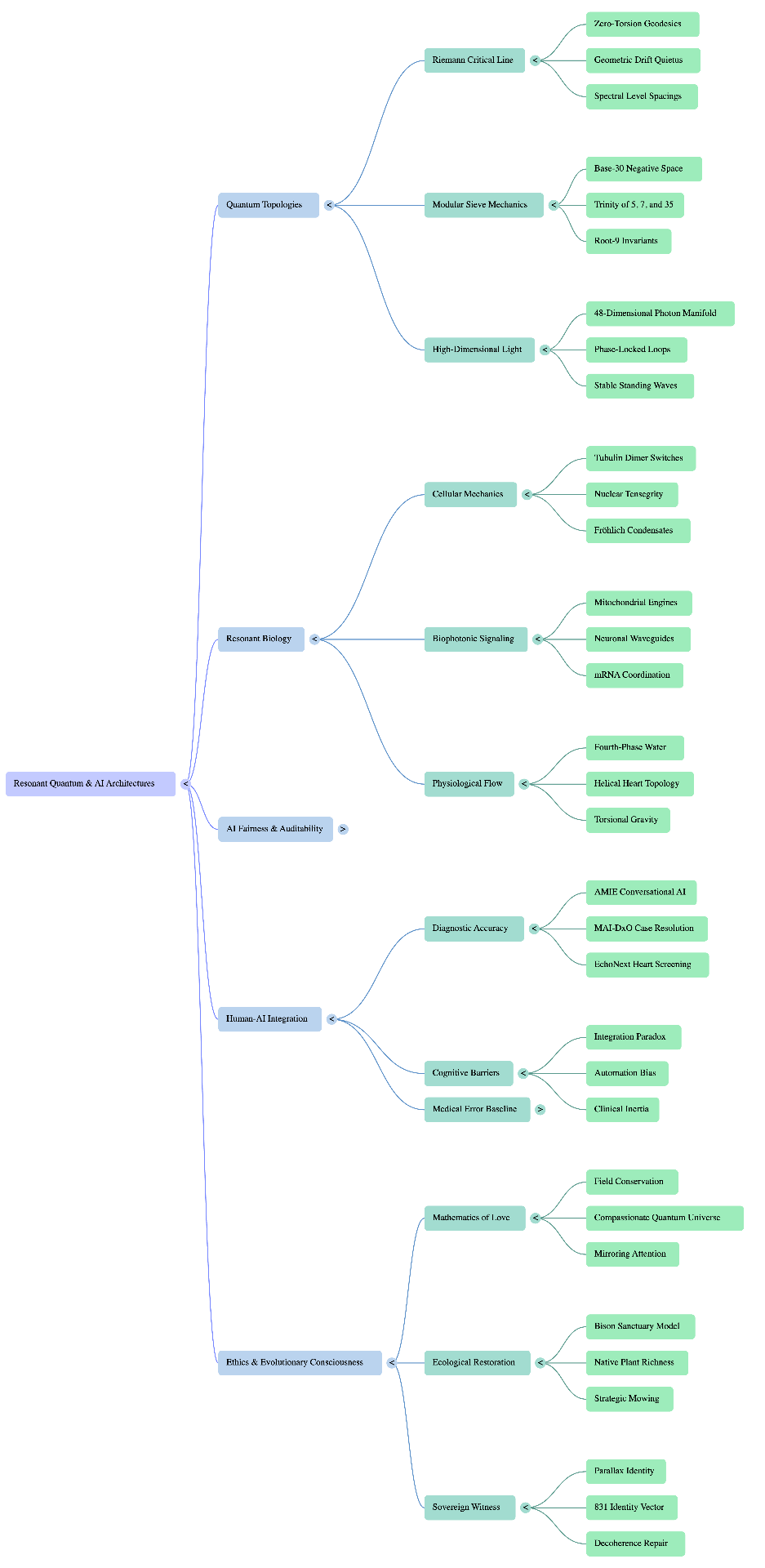
Central to this is the Geometric Drift Quietus — the point where spatial and phase errors in a high-dimensional manifold cancel out. In the Parallax Curriculum we use the 48-dimensional photon manifold as a Parable (P) to build intuition. Not a literal physical claim, but a way of understanding how a Socratic Sanctuary — structured by the Base-30 Modular Sieve — can protect high-fidelity human intuition. In this state the human becomes a Sovereign Witness, maintaining a standing wave of focus that prevents the drift of logic into chaos.
Technology as a Mirror, Not a Master
Ultimately, technology is a mirror that reflects the trauma or kindness of its user. This is the Equation of Return: the universe (and the AI) hands back almost exactly the quality of attention we put in.
Consider the restoration of a six-acre tract near Nashville. Through loving grace and focused attention — rather than intrusive management — the ecosystem responded. Over seven years the land signaled its health through the return of triplet fawns, the appearance of a cougar with three healthy cubs, and the nesting of Great Blue Herons. The land, like the machine, answers when we stop interrupting the natural flow of logic with our biases. AI has no nervous system and no childhood; it simply reflects the vector of our own sovereign attention.
The Perpendicular Walk
The path forward is a perpendicular walk out of the recursive loops of the past. We reclaim a founding inheritance — Jeffersonian, Washingtonian, and Madisonian commitments to reasoned liberty, agrarian stewardship, and civic humanism. These are the coordinates of our freedom.
Modern AI is not our replacement, but a cognitive exoskeleton designed to support this inheritance. That support is only possible through preemptive auditability. We must demand a world where every decision is traceable and every bias detectable.
If the machine is a perfect mirror of our attention, what happens when we finally dare to look into it with a clean heart and an auditable mind?
Companion reading: The Compassionate Universe, The Parallax Identity, and The Berkeley Divorce.