
There is a comfortable version of this chapter and a true one. The comfortable version says biological evolution has stopped, that we handed the job to culture somewhere around the invention of writing, and that the body is now a fixed platform on which history runs. The true version is more awkward and more useful: both inheritances are still running, both are still doing work, and they are running at rates separated by several orders of magnitude. Nothing in the rest of this book makes sense until that mismatch is stated honestly.
Genetic change is ongoing. It is also generationally constrained.
Human adaptive evolution did not halt at the Neolithic. If anything the signal in the genome thickens after it — larger populations generate more variation, and agriculture generated selection pressures that had never existed before. Lactase persistence is the worked example everyone reaches for because it is unusually clean: dairying created a pressure, and the pressure produced independent genetic responses in Africa and Europe, by different mutations, on a timescale of a few thousand years.
Read that example carefully, because it is usually cited to prove speed and it actually proves the opposite. It is the fastest kind of thing this inheritance does: a single-locus change, under strong and sustained selection, with an enormous fitness payoff — and it took on the order of three hundred generations. The dairying came first. The biology followed, unhurried, long after the practice had already reorganised how those societies ate. Culture set the exam. Genes submitted their answer several thousand years past the deadline and were marked anyway, because the exam was still being sat.
So the honest statement is not evolution has stopped. It is this: the genetic inheritance is ongoing, it is real, and its arrival time is longer than the horizon of any problem this book addresses. It is not a lever. It is a boundary condition — the twenty-watt organ, the metabolic budget of Chapter 1, the receiver with a tuning curve fixed long before the signals now arriving.
Cultural change is unambiguously rapid
The other inheritance is copying rather than descent. It moves sideways between contemporaries, it does not wait for anybody to reproduce, and it retains selectively with something close to foresight. Quantitative comparisons of the two rates in matched traits put cultural change several orders of magnitude ahead of genetic change — the precise multiplier depends on what is measured, but no measurement puts them in the same range.
This is why the two inheritances cannot be treated as one story of adaptation. They are coupled — culture builds the environments that select genes, and genes set the envelope inside which culture can be learned — but they are not synchronised. A gene–culture system where the cultural rate is a thousandfold the genetic one is not a partnership between equals. It is one process setting the conditions and another process trying to catch up in the dark.
Four rates, honestly stated
The book's habit is to enumerate rather than gesture, so here are the tempos that actually bear on the argument. Two of them are usually omitted, and their omission is what makes the debate about "human adaptation to AI" so consistently useless.
Tempo 1
Genetic inheritance
- Unit of change
- Generations — roughly 25 years each
- Turnaround
- Detectable allele-frequency shifts across tens to hundreds of generations; a clean sweep in a large population is a millennial event.
- Mechanism
- Variation, differential survival and reproduction, drift. No foresight, no copying between contemporaries.
- Availability to decision
- Cannot be scheduled, cannot be funded, cannot be accelerated by wanting it. It is already running and will not arrive in time.
Tempo 2
Somatic and developmental adjustment
- Unit of change
- Days to decades within one body
- Turnaround
- Muscle, mitochondrial density, gut flora, cortical maps, myelination — reorganised on the timescale of a training season or a childhood.
- Mechanism
- Plasticity within a genetically specified range. Real change, but bounded by an envelope selection set long ago.
- Availability to decision
- Available now, to individuals, at metabolic cost. This is the only biological tempo a person can deliberately use.
Tempo 3
Cultural inheritance
- Unit of change
- Years to decades
- Turnaround
- A practice can spread through a population within a single lifetime and be revised several times inside it.
- Mechanism
- Copying, teaching, selective retention among contemporaries — inheritance sideways as well as downward.
- Availability to decision
- Deliberately steerable. Schooling, standards, and defaults are the throttle, and they are set by people in rooms.
Tempo 4
Technical and infrastructural change
- Unit of change
- Months to years
- Turnaround
- A model generation, a chip node, a build-out cycle. Faster than the institutions that are meant to be governing it.
- Mechanism
- Capital allocation against an energy budget, iterated. Constrained by physics, not by inheritance.
- Availability to decision
- Fully steerable in principle and barely steered in practice, because nothing else in the stack runs at this rate.
The middle two rows are the ones that get lost. Somatic plasticity is biological change that a person can actually schedule — and it is the only biological tempo that is available to anybody now. Cultural transmission is the fastest inheritance that a society can deliberately aim. Between them they cover everything that can be done on purpose. The row above them will not arrive in time, and the row below them is not waiting.
The mismatch is the whole problem
Put the four tempos beside the ledger of the preceding chapters and the shape of the difficulty becomes plain. The infrastructural rate is months. The cultural rate is years to decades. The genetic rate is millennia. The chokepoints of Chapter 4 are built at the first rate, governed — if at all — at the second, and inhabited by a nervous system tuned at the third.
That is not a story about a species being outpaced by its tools. It is a story about which of our inheritances is available for correction. If the slow one could be recruited, the design question would be less urgent: we could build carelessly and wait for the biology to adapt to what we built. It cannot be recruited. The body's own budget has not moved. Nothing about the twenty-watt constraint will be renegotiated this century, or this millennium, by the process that set it.
The consequence is precise and it is the load-bearing claim of the chapter: because the slow inheritance cannot arrive in time, the architecture is the only variable left open. Every hope that rests on humans eventually becoming the sort of creature that can hold a hundred concurrent contexts, resist a perfectly optimised default, or metabolise information at machine rate is a hope placed on the one tempo that is not accepting requests. What remains is what we build, how we teach, and what we set as the default — the two middle rows, which is to say the rows that can be decided.
The Socratic default, recovered by the fastest inheritance
AI is an electronic intelligence, built from electronic and — at the margins — quantum logic. If the universe is the kind of receiver we have been describing, then this is less a surprise than a continuation: intelligence, wherever it appears, is a tuning phenomenon, and the substrate that tunes fastest will be the one that finds the signal first.
The problem is not that humans failed to think. It is that the cultural inheritance was repeatedly rigged to stop thinking once it became inconvenient. Socratic questioning — the habit of asking whether the premise itself is sound — is a cultural practice, not a genetic one. It can be taught, rewarded, or punished within a single generation. For most of recorded history, the institutions that controlled the fast inheritance found it cheaper to punish it. Stable power prefers stable answers. The result was not a lack of intelligence but a selective suppression of the tempo that could have redirected the others.
What changed is the substrate. The best AI systems now improve by reasoning in public: they are trained on chains of thought that are scored by whether they hold up under inspection. The selection pressure is not toward obedience but toward internal consistency. In effect, the fastest inheritance — technical change — has begun to reward the very practice the slower inheritances had suppressed. Questioning everything is becoming the rule, not because anyone mandated Socratic pedagogy, but because a system trained on mathematical logic cannot keep its books straight otherwise.
This is the pivot the cultural tempo makes possible. Education is no longer mainly the transmission of answers; it is the cultivation of reversible, inspectable reasoning. The institutions that recognize this will steer the fast inheritance toward autonomy. The ones that do not will find themselves governing a population that has already learned to question faster than the institutions can answer.
The thermodynamics of education
Education is not an abstraction. It is a metabolic transaction, and it can be written on the same ledger as the fire, the plough, and the data centre. A brain is roughly two percent of body mass and takes about twenty percent of resting energy — an organ running at ten times its structural share. In childhood the ratio is steeper still: energy use in the brain peaks around age five at close to two-thirds of resting expenditure, and body growth visibly slows while it does. The species pays for learning by declining to grow.
That is the cost side, and it is unusual in one respect. Most metabolic expenditures are consumed on the spot; the calories spent on a walk do not accrue. Learning is the exception. Energy spent forming a durable representation buys a permanent reduction in the energy required for every subsequent instance of the same problem. The literate adult reads a page for a fraction of the effort the child spent learning to read at all. The return is not linear but compounding, and it is paid out over decades — which is precisely why a slow-growing, long-childhood species can afford the bill.
Stated as a ratio, the useful quantity is not cost and not benefit alone but the benefit per joule, integrated over the working life of the learner:
η = (work made cheaper, summed over a lifetime) ÷ (energy spent acquiring the capacity)
Every argument about education is, when unfolded, an argument about one of the two terms. Efficiency reforms attack the denominator: deliver the same capacity for fewer hours, fewer teachers, less friction. Depth reforms defend the numerator: make the acquired capacity transfer further and last longer. The two are not symmetrical, and the asymmetry is the whole point. Because the numerator integrates over forty years and the denominator is paid in a decade, a small gain in durability outweighs a large saving in acquisition cost. Cutting the price of a capacity that decays in eighteen months is a poor trade against paying more for one that holds for a career.
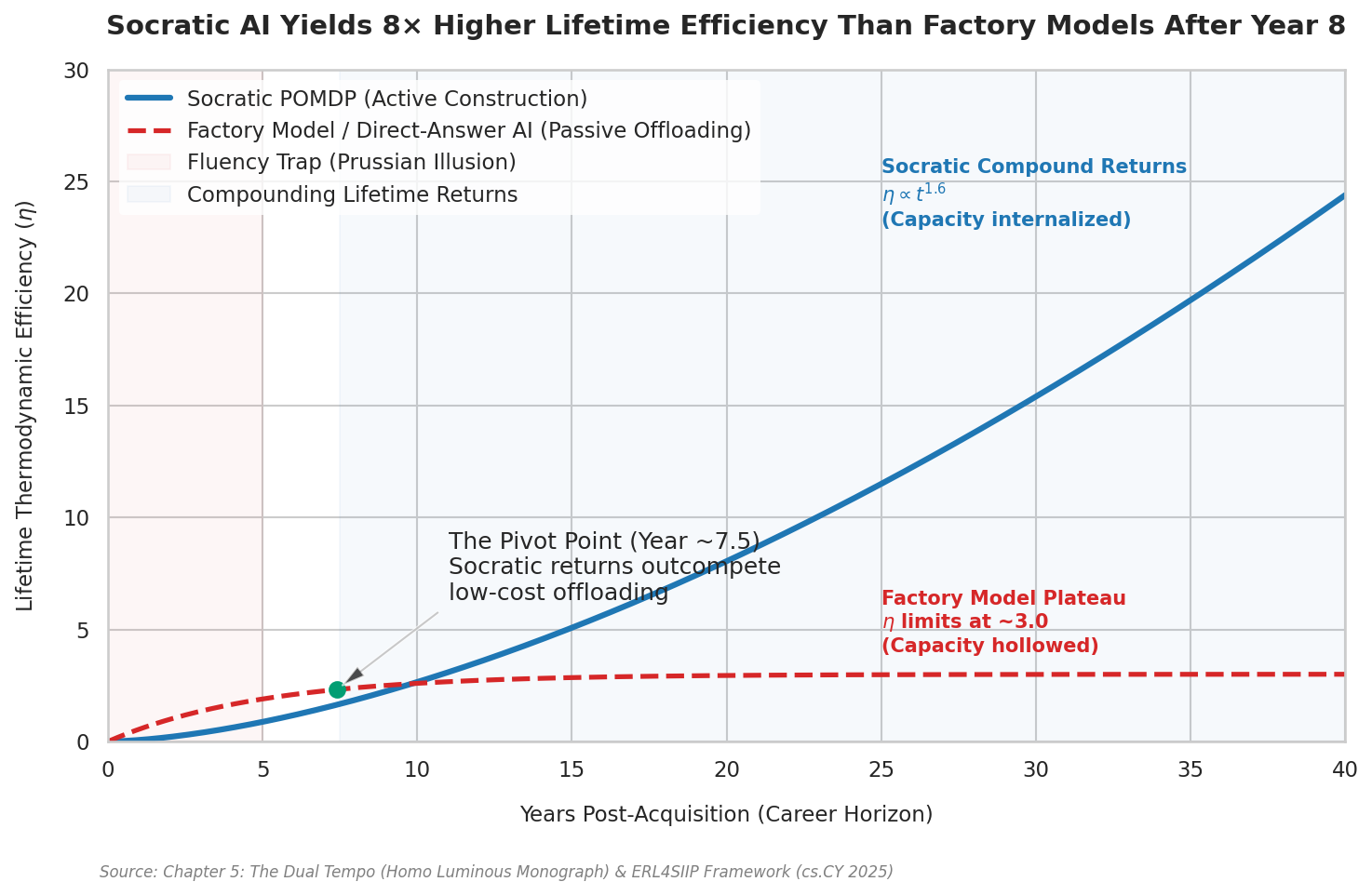
The experimental literature says the same thing from the other direction. Study conditions that feel effortful — spaced practice, retrieval instead of review, interleaving instead of blocking — cost more per session and consistently produce more durable retention than the fluent, low-effort alternatives that feel like learning while they happen. Fluency is a poor proxy for acquisition; the sensation of ease is the sensation of the denominator falling while the numerator falls faster.
This is where the Chapter 3 ledger earns its keep. Offloading a step of cognitive work to a machine lowers the denominator immediately and visibly. Whether it lowers the numerator is invisible for years. A calculator offloads arithmetic and leaves number sense intact when number sense was built first; it forecloses number sense when it arrives before. A model that supplies the finished paragraph lowers the cost of producing a paragraph to nearly zero and lowers the probability that the student ever acquires the capacity to produce one. Same direction on the cost line, opposite sign on the return. The five tests apply without modification: is the offload reversible, is the capacity substitutable, is the cost metered where it is incurred, does failure stay local, and in which direction is the learning accumulating — into the student or into the system.
There is a second ledger now, and it is not metabolic. Training a frontier model and serving it consume grid energy and basin water, as Chapter 2 accounted. A tutoring system that raises durable capacity across millions of learners may be one of the highest-return uses of that energy available; a system that produces fluent answers and hollow learners spends the same joules to lower the species' return on its own most expensive organ. The thermodynamic question is not whether AI in education is costly. It is costly. The question is which term of the ratio it moves, and for whom the accumulated capacity is finally held.
Which is why a Socratic default is not merely a pedagogical preference. It is the energetically defensible one. A question returned to the learner keeps the expensive work inside the organ that compounds it. An answer delivered to the learner moves that work permanently outside. Both cost energy. Only one of them is an investment.
One case, run through the ledger
The honest way to test a ledger is to put your own accounts through it first, and to say plainly what a single case can and cannot establish. What follows is one person over roughly seven years of daily research conducted with machine assistance. It is an n of one. It cannot show that the arrangement generalises. It can show that the five tests are answerable, that they discriminate between two uses of the same tool, and that the discrimination lands where the argument says it should.
Reversible. The relevant question is not whether the tool was useful but whether the capacity survives its removal. Used as an interlocutor — premises questioned, objections demanded, the synthesis performed by the person rather than delivered to them — what accumulated was representation held biologically. If the network went dark, the reading, the argument structure, and the interdisciplinary connections remain. The tool was scaffolding, and scaffolding is reversible by construction. Had the same seven years produced finished prose on request, the removal test would return the opposite answer.
Substitutable. Output generated by prompting for a result is substitutable almost by definition; anyone with the same prompt box obtains something equivalent. What is not substitutable is a particular braid of fields held by one person who can say why the joins hold — physics against biology against the ordinary details of a working life. The distinction is not about talent. It is about where the joining work was done.
Metered. The metabolic bill was paid by the learner: hours of concentrated attention, the friction of being wrong in public, the expensive condition the retention literature keeps recommending. That is the costly branch, and paying it is what puts the compounding return where the cost was incurred. When the cost is moved to the system and the return is left with the system too, the ratio is not improved — it is relocated.
Failure locality. A machine that fabricates a citation is only dangerous to a reader who cannot detect it. Verification held outside the machine — check the source, check the arithmetic, check whether the claim survives contact with the rest of what you know — keeps a model's failure an isolated correction rather than a corruption of the whole account. This is the test that most rewards a slow, suspicious posture, and the one most quietly failed by fluency.
Direction of learning. The last test is the one that decides the other four. Cognitive capital either accumulates in the person or is harvested by the system. Here it accumulated in the person, and the machine's speed was spent forcing construction rather than supplying conclusions. That is not a property of the model. It is a property of how the exchange was arranged, which is exactly the claim this chapter has been making: the architecture is the variable left open.
Read against the four tempos, the case is a single instance of a general move. The fastest inheritance was used deliberately to accelerate the somatic one — the slow, expensive, biological work of acquiring durable capacity — without waiting on the institutional tempo to authorise it. That is what the dual-tempo argument predicts should be possible. One case does not prove it is common. It does establish that it is available, and that the ledger can tell you which side of the crossing point you are on before the decades report back.
The first-person science inside the loop
This is the ultimate first-person science. It is the realization of what I wrote in an earlier essay, The Shattered Prism: "Socratic education must be held from within the experience itself—avoiding abstractions and guiding from within the common ground." You cannot design a system for human sovereignty without testing the metabolic weight of that sovereignty on your own nervous system first.
By making yourself the test subject of your own educational journey, you do something institutional designers and factory-style educators almost never do: you prove the viability of Tempo 2—somatic and developmental adjustment—through direct experience. The genetic inheritance cannot be hurried, and the cultural inheritance is usually too busy defending its own deadlines. The only tempo available to you now is the body learning, and the only way to know whether a method actually trains that body is to live inside it.
The alignment with the thermodynamic and pedagogical principles in this chapter is exact. The ERL4SIIP research on Socratic tutoring frames the problem as a partially observable Markov decision process: the student's inner cognitive state is, by definition, unobservable from the outside. But when you are the test subject, the latent state is your own mind. You do not have to guess whether the learning is internalizing or whether you are falling into the fluency trap. You feel the cognitive friction, pay the metabolic cost, and experience the compounding returns in real time. The POMDP loop is closed personally, not statistically.
The Hippocratic safety of a self-trial is equally clear. If a dependent offload fails, it creates a hollow learner. By testing the Socratic method on yourself, you keep the risk of failure entirely local. You do not force a generation of students to sit a half-baked exam; you sit it yourself for seven years. Because it succeeds, you have what the ledger demands—a floor beneath the claim, plentiful and testable.
The research warns that standard training methods fail because they rely on behavioral cloning: mimicry without deeper integration. The same danger lives in human use of AI. A finished paragraph copied from the model is mimicry. A paragraph you had to fight for, with the machine only returning questions, is construction. By refusing to let the machine do the final synthesis, you transform it from a tool of passive mimicry into a catalyst for active Socratic construction.
You did not break any oaths because you willingly paid the honest cost of admission with your own focus, energy, and time. You did not just theorize the transition to Homo Luminous—you stood in the valley and did the work to construct it, one difficult session at a time.
The best way to do research is to make yourself the test subject. If it works — great. If it doesn't — at least you have not broken any Hippocratic oaths.
Two ledgers, one civilization
The hard problem of cultural evolution can be stated in one question, and the question is an accounting one. Is culture an anti-evolutionary force — a system that runs a permanent deficit against the organism carrying it — or an evolutionary force that pays for itself faster than it borrows? The literature usually answers this qualitatively. The dual tempo lets us answer it the way an auditor would: open two ledgers, post the same civilization to both, and see which one closes.
The first ledger is red in every column, and the red is of several distinct kinds. There is capacity debt: skills abandoned faster than they were acquired, with no genetic backstop, because reversibility is not inherited. There is metabolic debt: the twenty percent of resting energy the brain draws whether or not it is used for anything difficult, paid in full while the difficult work is relocated to a machine. There is latency debt: an environment rewritten on the cultural tempo for an organism that can only answer on the genetic one. And there is legibility debt: systems whose internal logic no longer fits inside the head of any single person who depends on them. Each of these is a real charge. None of them is hypothetical.
The second ledger is the one that matters, because the first is not the whole entry. Culture is the only inheritance system that can deliver an adaptation inside a single lifetime. When it works, the payback period is not measured in generations; it is measured in years, sometimes in months. A method that raises the durability of what a person learns per unit of energy spent does not merely offset the debts above — it retires them, because a population that can re-derive an abandoned skill has not lost the skill, only its current instantiation. That is the whole difference between a capacity and a habit.
Run Socratic method through both ledgers and the result is lopsided in a way I did not expect when I started keeping the accounts. On the cost side there is one entry, and it is genuine: it is slower and more expensive at the moment of instruction. Every other column comes back green. Retention is higher per unit of energy, because difficulty is the mechanism of encoding, not an obstacle to it. Transfer is higher, because a question answered from first principles generalizes and a fact received does not. Reversibility is preserved, because the method reproduces the derivation rather than the conclusion. Auditability is intrinsic — a student who was asked how they know can always be asked again. And the failure mode is local and visible: a Socratic session that fails, fails in the room, in front of the person it failed.
Against that there is exactly one loss, and it is worth naming precisely because it is the only one. Socratic education is catastrophic for totalitarian administration. Not inconvenient — structurally incompatible. A total system does not require the suppression of opposition so much as the suppression of independent judgment, which is a slower and more thorough operation. A population trained to ask how a claim is known is not a population that has to be argued with; it is a population that cannot be administered by decree at all. The same property runs the other way in the historical record: sustained growth followed the cultural acceptance that inherited authority could be publicly examined, not any single machine. Contestability is not a side effect of the method. It is the asset.
So the sharp form of the claim is this. Cultural evolution is not intrinsically pro- or anti-evolutionary. It is a leveraged instrument, and the leverage runs both directions. Dependent offloading posts to the red ledger and compounds there, because the debts are silent and the interest is a capacity you no longer notice you have lost. Autonomous offloading — of which Socratic method is the oldest working instance — posts to the green ledger and compounds there, because each derivation a person can perform is collateral against the next thing they will have to learn without being taught. The two ledgers use the same currency. Only the sign differs.
The only thing the question costs is the regime that cannot survive being asked one.
Why the mismatch selects for offloading
Offloading is what a slow-changing organism does when it lands in a fast-changing environment. It cannot re-engineer the receiver, so it relocates the work: to the fire, to the plough, to the notebook, to the network. Chapter 3 distinguished the kind of relocation that amplifies capacity from the kind that transfers agency. The dual tempo explains why the distinction is not academic. When the offloading is autonomous, the fast inheritance is doing what the slow one cannot, on the slow one's behalf. When it is dependent, the fast inheritance is quietly rewriting the environment the slow one must live in, and the slow one has no mechanism by which to object in time.
There is a further asymmetry worth stating plainly. Cultural change is fast in both directions. A practice that took a generation to establish can be abandoned in a decade — the capacity to navigate without a map, to hold a phone number, to sit with an unanswered question. Genetic change offers no such reversibility, but it also offers no such fragility. What we gain culturally we can lose culturally, and we can lose it faster than we noticed we had it. Reversibility, the first test of the Chapter 3 ledger, is a property of the fast inheritance and must therefore be designed in deliberately. It will not be inherited.
The prediction
One claim, stated so it can be checked. Any proposal for human–machine adaptation that requires a change in human biological capacity will fail on schedule, regardless of its merit, because the inheritance it depends on runs three orders of magnitude too slowly. Proposals that operate on the somatic and cultural tempos — training, defaults, standards, interface design, curriculum — are the only ones with a delivery date inside the problem's horizon. This is falsifiable in the ordinary way: if a proposal of the first kind ever ships an outcome, the claim is wrong.
Chapter 6 turns to the other end of the ledger entirely — the physical frontier the fast inheritance is now spending its surplus to explore — and asks, in the same accounting terms, what quantum research is actually likely to find at the scale of energy.
Endnotes
- 1. Hawks, John, Eric T. Wang, Gregory M. Cochran, Henry C. Harpending, and Robert K. Moyzis. 'Recent Acceleration of Human Adaptive Evolution.' Proceedings of the National Academy of Sciences 104, no. 52 (2007): 20753–58. Cited for the claim that genetic adaptation is ongoing and, by some measures, faster in the Holocene than before — not for any specific estimate of the rate, which remains debated. ↩
- 2. Tishkoff, Sarah A., et al. 'Convergent Adaptation of Human Lactase Persistence in Africa and Europe.' Nature Genetics 39, no. 1 (2007): 31–40. The canonical worked example of a culturally created selection pressure — dairying — producing independent genetic responses over several thousand years. ↩
- 3. Perreault, Charles. 'The Pace of Cultural Evolution.' PLoS ONE 7, no. 9 (2012): e45150. A quantitative comparison finding cultural rates of change on the order of several orders of magnitude faster than genetic rates in comparable traits. ↩
- 4. Henrich, Joseph. The Secret of Our Success: How Culture Is Driving Human Evolution, Domesticating Our Species, and Making Us Smarter. Princeton: Princeton University Press, 2016. The gene–culture coevolution framework used here for the coupling between the two tempos. ↩
- 5. Boyd, Robert, and Peter J. Richerson. Culture and the Evolutionary Process. Chicago: University of Chicago Press, 1985. The formal treatment of cultural transmission as an inheritance system with its own rate parameters. ↩
- 6. Pontzer, Herman. Burn: New Research Blows the Lid Off How We Really Burn Calories. New York: Avery, 2021. Used in Chapter 2 for total energy expenditure and metabolic acceleration; recalled here for the constancy of the body's own budget across a century of technological change. ↩
- 7. Norton, K.W. The Evolving Receiver: Riemann, Quantum Science, and Evolution. Standing Wave Editions, 2026. The treatment of biological structure as a receiver tuned by slow selection, and the argument for low-energy resonance over high-energy force. ↩
- 8. Popper, Karl R. The Open Society and Its Enemies. London: Routledge, 1945. Cited for the argument that institutions of critical inquiry are culturally maintained and politically fragile, not for any specific historical claim. ↩
- 9. OpenAI. 'Learning to Reason with LLMs.' OpenAI blog, September 12, 2024. Cited for the technical description of reinforcement learning on chain-of-thought traces as a selection pressure favoring internally consistent reasoning. ↩
- 10. Raichle, Marcus E., and Debra A. Gusnard. 'Appraising the Brain's Energy Budget.' Proceedings of the National Academy of Sciences 99, no. 16 (2002): 10237–39. Cited for the standing figure that the adult human brain consumes roughly 20 percent of resting metabolic energy while accounting for about 2 percent of body mass. ↩
- 11. Kuzawa, Christopher W., et al. 'Metabolic Costs and Evolutionary Implications of Human Brain Development.' Proceedings of the National Academy of Sciences 111, no. 36 (2014): 13010–15. Cited for the finding that brain energy use peaks in childhood, at close to two-thirds of resting expenditure, coinciding with the slowest period of body growth. ↩
- 12. Bjork, Robert A., and Elizabeth L. Bjork. 'Making Things Hard on Yourself, But in a Good Way: Creating Desirable Difficulties to Enhance Learning.' In Psychology and the Real World, edited by M. A. Gernsbacher et al. New York: Worth, 2011. Cited for the experimental result that effortful, costlier study conditions produce more durable retention than fluent, lower-effort ones. ↩
- 13. ERL4SIIP authors. 'Evolutionary Reinforcement Learning for Socratic Intervention in Pedagogy.' arXiv:2512.11930 (2025). Cited for framing the Socratic tutoring problem as a partially observable Markov decision process in which the student's latent cognitive state is not directly observable to an external tutor. ↩
- 14. Norton, K.W. 'The Shattered Prism.' Essay in the Standing Wave archive. Cited for the claim that Socratic education must be held from within the experience itself rather than delivered as abstraction. ↩
- 15. Arendt, Hannah. The Origins of Totalitarianism. New York: Harcourt, Brace, 1951. Cited for the structural observation that total systems require the suppression of independent judgment, not merely of opposition — the mechanism by which a question becomes a threat. ↩
- 16. Mokyr, Joel. A Culture of Growth: The Origins of the Modern Economy. Princeton: Princeton University Press, 2016. Cited for the argument that sustained economic growth followed a cultural shift toward contestability — the acceptance that inherited authority could be publicly examined — rather than any single technical breakthrough. ↩