
Offloading as an Evolutionary Strategy · Part I — The Energy of Humans
Chapter 2 — From Cooking Fire to Surplus
The Body as a Power Plant
Working draft
This chapter traces how the human body became a power plant: the metabolic cost of brain tissue, the discovery of cooking as external digestion, the relocation of work out of the body and into tools, and the first reliable surplus that made a larger, slower, more expensive nervous system payable. It asks what surplus actually is — not just more food, but a margin of energy that can be spent on something other than immediate repair and motion — and then follows that margin into the present, where machine inference runs the same bill on a different meter.
Chapter 1 established the energetic constraint: a twenty-watt brain is a costly receiver, and its cost must be paid continuously. This chapter asks how the bill was paid. The short answer is that humans did not evolve bigger brains by eating more raw food for more hours. They changed the conversion chain: fire, cooking, tools, division of labour, and the pooled surplus that turns an individual body into a node in a larger energy network.
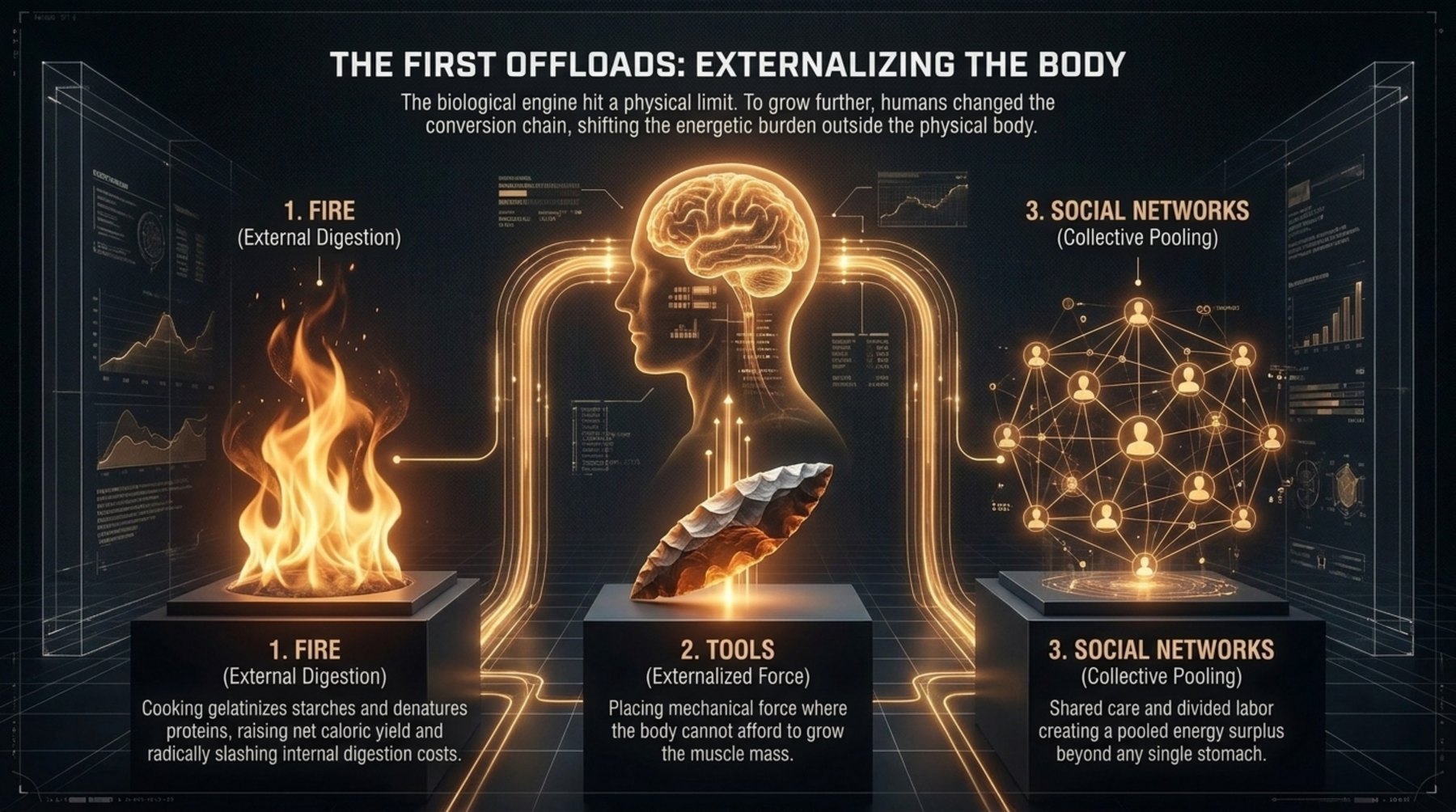
The cooking-fire is the first offloading device in this story. It moves digestion outside the gut, raises the net yield of the same mouthful, and frees metabolic budget for other tissues. The tool is the second: a stone edge or a digging stick is a way to put force where the body cannot afford to grow it. The third is social: pooled food, shared care, and the division of labour create a surplus that is not located in any one stomach but in the relationship among many bodies.
The chapter will close by distinguishing surplus from abundance. Abundance is more of everything; surplus is a bounded margin that can be directed. Surplus is what permits a brain to keep running while the body is not eating. It is also what permits a culture to keep thinking while its individuals are sleeping. The transition from fire to surplus is the transition from a body that pays its own bill to a body that can put part of the bill elsewhere.
Expanding the engine
Not a reallocation inside a fixed budget, but a larger budget.
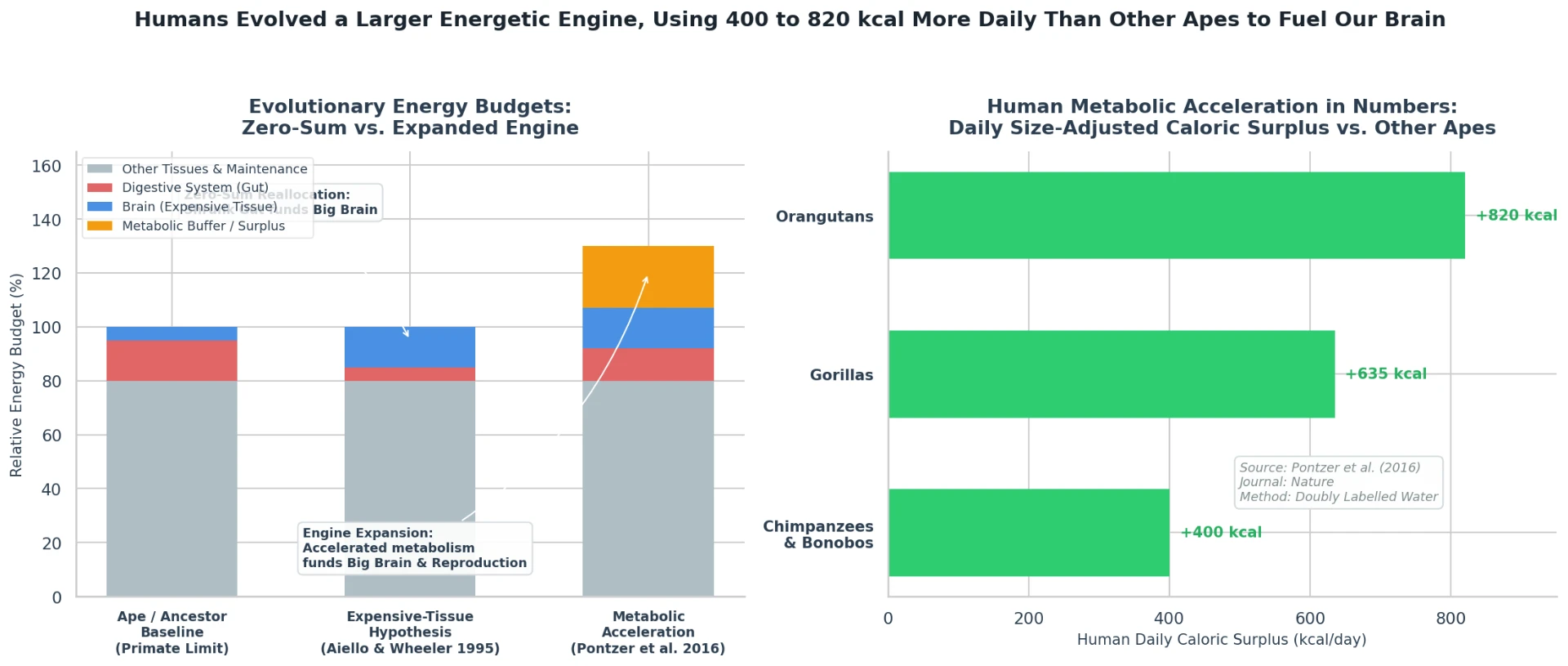
The classic account of how the brain got paid for is a zero-sum account. On the Expensive-Tissue Hypothesis, a primate-sized energy budget is treated as fixed, and a costly brain is affordable only if some other expensive organ shrinks — most often the gut, made cheaper by cooking. The bill is settled by cutting corners elsewhere.
Herman Pontzer's measurements complicate that picture in a way that matters for everything this book argues. Using the doubly labelled water method to measure total energy expenditure in humans and the other great apes, Pontzer and colleagues found that humans do not run a reshuffled ape budget. Pound for pound, we burn substantially more. The engine did not get rearranged. It got bigger and faster.
| Dimension | Expensive-Tissue HypothesisAiello & Wheeler | Metabolic Acceleration ModelPontzer |
|---|---|---|
| Core mechanism | Reallocation of energy from the digestive system to the brain. | Expansion of the total energy budget through a faster metabolic rate. |
| Resource allocation | Fixed budget: shrink the gut to afford a larger brain. | Expanded budget: increase the size of the energetic engine (TEE). |
| Primary evolutionary driver | Internal trade-offs between high-energy organs. | Daily caloric surplus: humans consume ~400 kcal more than chimps and ~820 kcal more than orangutans. |
The engine expansion, in numbers
Daily energy expenditure, adjusted for body size — the human surplus over our closest living relatives:
- Chimpanzees and bonobos
- +400 kcal/day
- Gorillas
- +635 kcal/day
- Orangutans
- +820 kcal/day
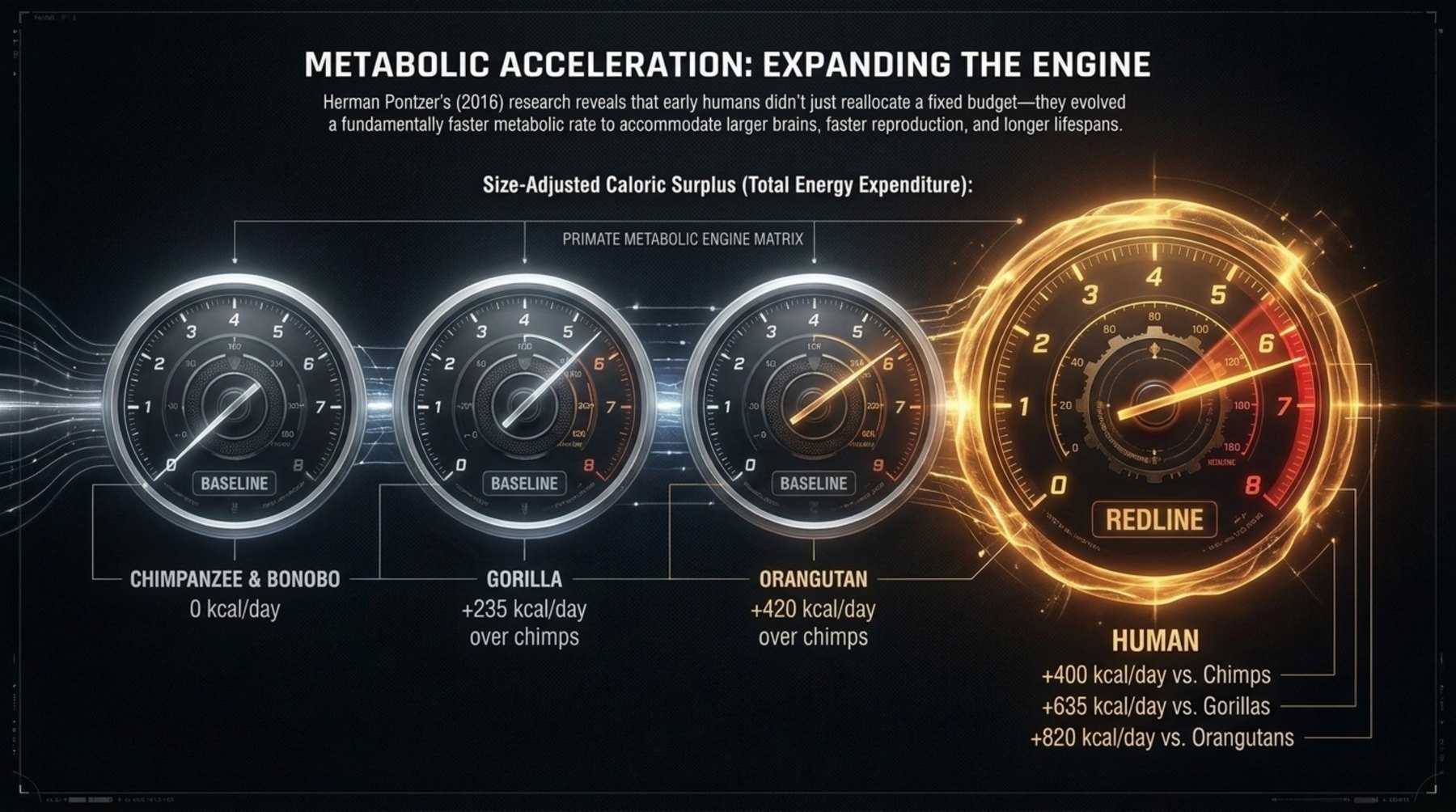
It would be tidy to say the whole surplus went to the brain. It did not. Metabolic acceleration bought several things at once: a costly nervous system, yes, but also faster reproduction — more offspring, more closely spaced than any other ape manages — and a longer life to raise them in. A bigger budget is spent across a portfolio, not on a single line item.
And a fast engine carries a specific danger. High throughput means that an interruption in supply is felt quickly; a lean animal running hot has very little time between the last meal and real trouble. So the acceleration co-evolved with its own defence: an evolved predisposition to store body fat. Fat is not an accident of modern diets. It is the buffer that makes a fast metabolism survivable.
The comparison is stark. Other hominoids stay lean even in sedentary captivity, where food is abundant and effort is minimal. Humans do not. We carry a markedly higher fraction of body fat as a matter of species design — on the order of 22.9% in men and 41.7% in women — and that reserve is the reason the engine can run at a rate that would otherwise be reckless.
Read against the argument of this book, the point is not merely dietary. A larger energy budget with a reserve attached is the precondition for offloading of any kind. You cannot move work out of the body — into fire, into tools, into other people, into machines — unless you can survive the interval in which the offloaded work is not yet returning anything. Fat is the first version of that patience. Surplus is the second. Every later offloading device in this book is built on the same structure: a margin held in reserve, spent on something that does not pay back immediately.
External digestion
The fire does work the gut would otherwise have to do.
Cooking is usually described as a culinary event. It is better described as a relocation. Heat breaks down collagen, gelatinises starch, and denatures protein before the food is swallowed — which is to say, a chemical process that once ran inside the body now runs outside it, in a hearth, on borrowed wood. The mouthful is the same mouthful. What changes is how much of the work of extraction has already been done by the time it arrives.
Two consequences follow, and they point in different directions. The first is yield: the same food returns more usable energy for less digestive effort, and chewing time collapses from the hours a great ape spends on it to something closer to minutes. The second is dependence. A gut adapted to pre-processed food is a gut that can no longer be fed the old way. This is the first clear instance of the distinction that organises the rest of the book — offloading that expands what a body can do, and offloading that makes the body unable to do it alone. Cooking is both at once, and there was no moment at which the ancestors got to choose only the first half.
It is worth being careful about the causal story. The expanded budget of the previous section is not explained by fire alone; a faster engine also needs a reliable supply, and fire without foraging, hunting, and sharing is a warm stone. What fire does is change the conversion ratio. It makes a given quantity of incoming material yield more of what the body can actually spend. In the language this project has been using, cooking widens the aperture between the world's energy and the body's ability to receive it.
The tool as borrowed force
Force placed where the body cannot afford to grow it.
A hand axe is not a stronger hand. It is a way of not having to have one. Muscle and jaw and claw are tissue, and tissue must be fed every day of a life, whether or not it is used. A stone edge is fed once, in the hour it takes to knap it, and then holds its capability at nearly no metabolic cost until it breaks. This is the cheapest trade in the whole evolutionary ledger: a one-time energy payment substituting for a permanent metabolic subscription.
Notice what that does to the body's shape. Once cutting is done by stone, the teeth can get smaller. Once digging is done by a stick, the arms need not be built for digging. The body does not merely add capabilities through tools; it sheds the tissue that used to provide them. Offloading is subtractive on the inside even as it is additive on the outside — and what is subtracted does not come back on demand.
The same trade recurs at every scale that follows. Writing is a one-time inscription cost substituting for the daily cost of holding something in a living memory. A power grid is a built capability that no individual metabolism sustains. A model running in a data centre is the current instance: a very large one-time training cost, then a capability available at the margin for something much smaller than what it would cost a person to learn. The pattern is old. Only the substrate is new.
Surplus is not abundance
A margin that can be directed, not simply more of everything.
Abundance is a quantity. Surplus is a relation — energy in hand beyond what the next interval of survival requires, and therefore energy that can be pointed at something. A forest full of food is not surplus to an animal that must spend its whole waking day eating it. Surplus begins where the feeding stops and the day is not yet over.
Pooling turns this from an individual quantity into a shared one. Food carried back rather than eaten where found, care given to someone who cannot forage, a hunt whose returns are divided among people who did not all take the risk: these are not sentiment. They are storage mechanisms. A surplus held in a group is smoother than a surplus held in one stomach, because the group's bad days are not all the same day. Body fat buffers against a lean week; reciprocity buffers against a lean life.
This is the sense in which surplus permits thought. A brain that must justify its cost within the hour cannot afford to model anything that is not immediately present. Give it a margin and it can run on things that have not happened yet — a season, a plan, a person who is elsewhere. Culture is what a species does with the interval between the meal and the need for the next one.
The chapter ends where the book's central question begins. Every surplus can be spent two ways: on capabilities the body keeps, or on capabilities the body hands to something else and then stops maintaining. Both are offloading. Only one of them leaves you able to do the thing yourself. Chapter 3 takes up that distinction directly.
Four open edges
Where the argument of this chapter touches live research.
The account above is deliberately spare. Four adjacent literatures press on it, and each one either strengthens the offloading reading or complicates it in a way worth naming rather than smoothing over.
1 · Digestion paid in advance
Wrangham's case for cooking is the cleanest example of external digestion in the record. Gelatinised starch and denatured protein are work already done — heat performing, outside the body, a share of the chemical labour the gut would otherwise pay for. The bill is settled before the food is swallowed. What makes this more than a nutritional footnote is the direction of the change: the saving is not found, it is relocated, and it is relocated into a device the body must then keep tending.
2 · The gut as a second correspondent
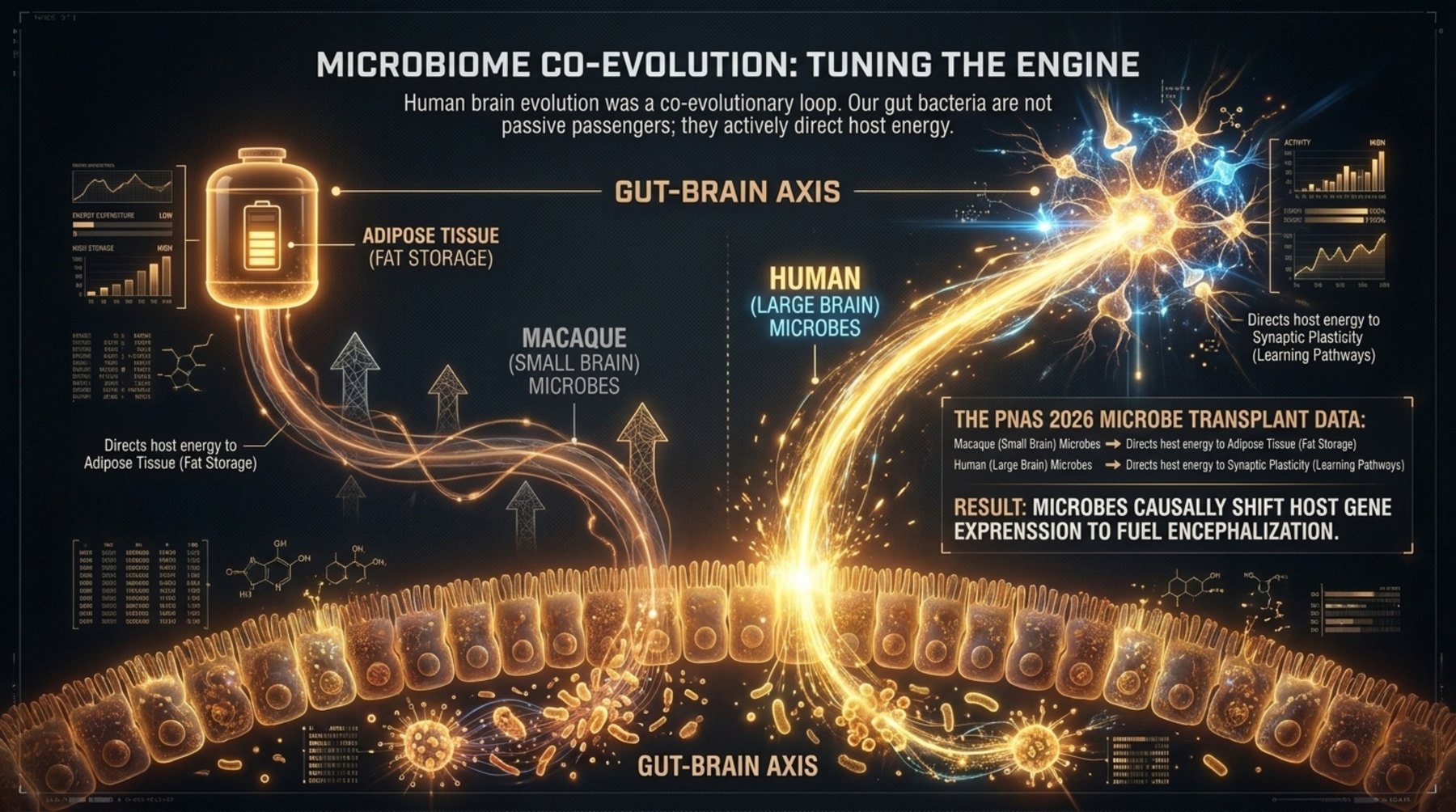
Recent microbiome work suggests the gut–brain relationship is more direct than a budget line. Experiments transferring gut microbes between species have reported changes in how recipient brains function — early results, in animal models, and worth holding loosely. But the implication is structural: if it holds, the hominin transition was not only a matter of gut size, as the Expensive-Tissue Hypothesis frames it, but of co-evolution with a resident population that is not, strictly speaking, us. Offloading here is not to fire or stone but to another organism living inside the boundary.
3 · Surplus at the scale of societies
Smil scales the same accounting up. Tools apply force externally; agriculture applies it at the scale of a landscape; and the result is that energy ceases to be an individual biological struggle and becomes a network property. Pooled food, shared care, stored grain — the surplus stops living in any one body and starts living in the arrangement among bodies. Everything this book later says about infrastructure and machines is a continuation of that single move.
4 · Why the ledger is not a ledger
A 2021 perspective article challenges the simple energy balance model — the idea that body mass is settled by calories in minus calories out. The contested claim is not conservation of energy, which is not in doubt; it is the assumption that intake and expenditure are independent knobs. They are coupled through hormonal regulation, appetite signalling, and the evolved predisposition to store fat described above. This is a live scientific disagreement, not a settled result, and nothing here is dietary or medical advice. It is included because it makes the same point the rest of the chapter makes: an energy budget with feedback in it does not behave like arithmetic.
The same bill, a different meter
What it costs when the offloading device is a machine.
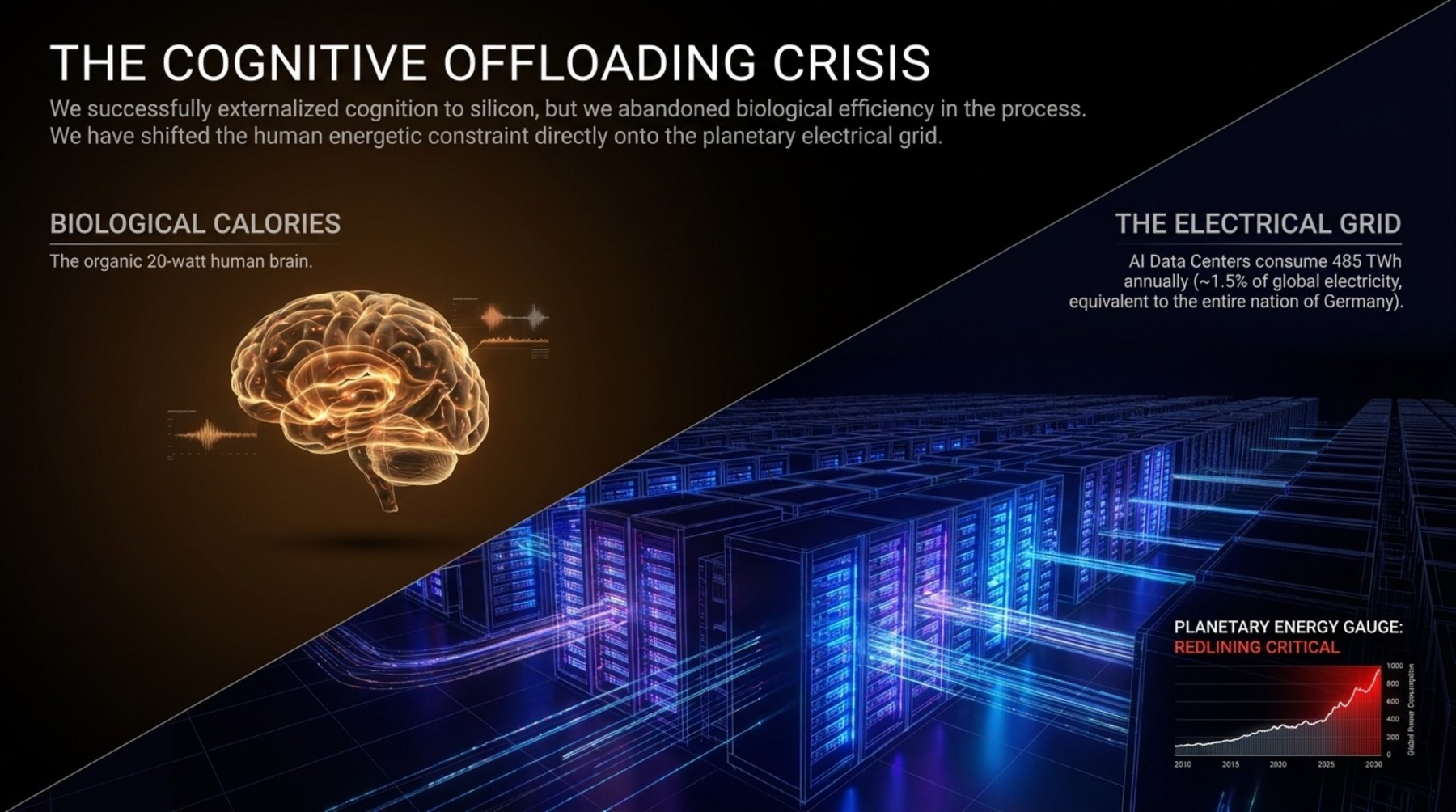
Fire changed the conversion ratio of food. Stone changed the conversion ratio of force. The machines now being built to think alongside us change the conversion ratio of inference — and they do it at a scale that makes every earlier device in this chapter look like rounding error. The move is identical. The magnitude is not.
Start with the comparison that ought to be embarrassing for the machines. A human brain runs on something between twelve and twenty watts and, by the usual back-of-envelope reckoning, performs operations at roughly exaflop scale. Frontier, among the most powerful supercomputers yet built, reaches comparable throughput on about twenty megawatts. That is a factor of approximately one million in power for the same order of arithmetic. Efficiency, on this ledger, still belongs overwhelmingly to biology.
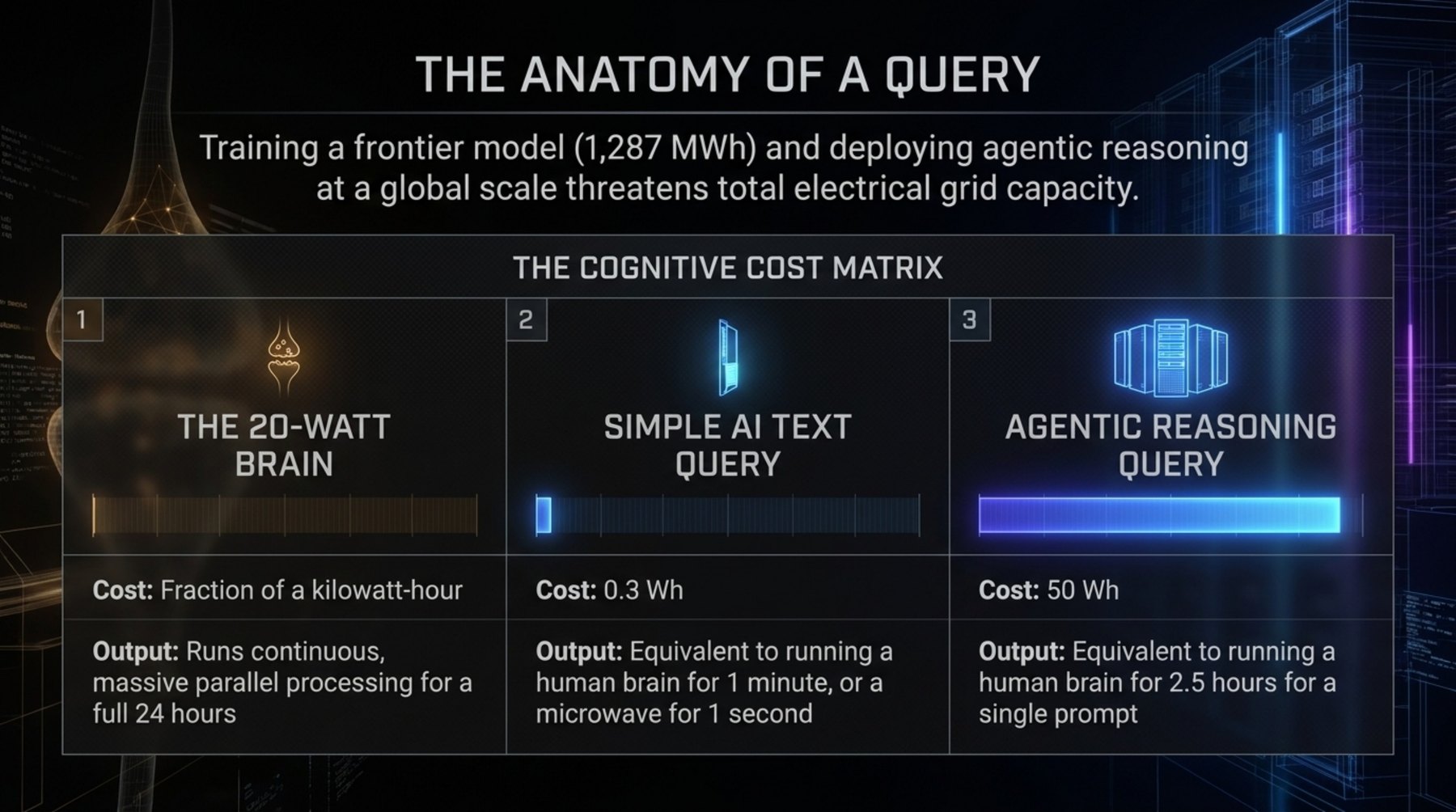
The retail numbers make the exchange rate legible. Published figures from Google and OpenAI put a plain text query at roughly 0.24 to 0.34 watt-hours — about one minute of brain. A long agentic query that plans, retrieves, and reasons across steps can reach fifty watt-hours: two and a half hours of brain, spent in a few seconds of wall-clock time, on a question you might have answered yourself in twenty. Training is the extreme case. A single frontier training run of GPT-4's class is estimated at about 1,287 megawatt-hours — enough to run one twenty-watt human brain continuously for more than seven thousand years.
The cognitive act feels free at the point of use because the meter is somewhere else, and it is not your meter.
Where that meter sits matters as much as what it reads. AI-oriented data centres drew on the order of 155 terawatt-hours in 2025 — roughly half a percent of global electricity — and projections through 2030 have total data-centre demand climbing toward three percent. Averages conceal the actual strain, because the load does not spread. It concentrates. In Northern Virginia data centres account for over a quarter of grid demand; in Ireland the share passes twenty percent. A national percentage is a comfort. A regional one is a queue for interconnection, a substation that cannot be built fast enough, and a retail rate that rises for households who never ran a query.
None of this is an argument against the offloading. It is the chapter's argument arriving on schedule. Cooking did not abolish the cost of digestion; it moved a step into the fire and obliged us to keep the fire. Tools did not abolish the cost of force; they substituted a one-time payment for a permanent metabolic subscription, and obliged us to keep making tools. Machine inference does the same thing and adds one new property: the cost is now paid by an infrastructure that is visible, meterable, contested, and located in someone's county. The three variables from Chapter 1 all reappear. Degree is the terawatt-hours. Quality is whether the electron is dispatchable when the cluster wants it. Availability is whether the grid, the transformer, and the tariff let it arrive.
The honest summary is that we have not made thinking cheaper. We have made a great deal more thinking possible, at a per-unit energy cost roughly a million times worse than the organ doing the reading of this sentence, and then declined to look at the bill because it arrives at a different address. That is a surplus arrangement in exactly the sense used above — bounded, storable, directable — and like every surplus arrangement in this chapter it works only as long as someone keeps tending the device.
The Metabolic Ledger — a fifteen-panel visual summary of this chapter's accounting: the twenty-watt drain, the expensive-tissue trade, metabolic acceleration, the fat buffer, and the three offloading devices of fire, tool, and social surplus.
Open the deck (PDF) →A universe that keeps books
Why the bill is the mechanism and not the obstacle.
It is worth asking the question the other way around. What kind of universe would support expensive intelligence if there were no energy for it to interact with? The honest answer is that the question cancels itself, and that the cancellation is the most useful thing in this chapter.
An expensive intelligence is not a thing that has energy. It is a standing pattern in a flux of energy. A receiver with nothing arriving at it is not an idle receiver; it is not a receiver. The twenty watts are not a fee levied on cognition from outside — they are the cognition, paid continuously, and the pattern does not survive a few minutes of non-payment. Remove the flux and you have not described an unfunded mind. You have removed the referent of the word expensive, because there are no gradients, no differences arriving anywhere, and nothing for a cost to be measured against.
Which converts the hypothetical into a constraint statement. Intelligence is not something a universe permits as an indulgence. It is something a universe with persistent gradients has trouble avoiding. Wherever a flow runs from high to low for long enough, structures that sit in the flow and extract from it will be selected — a convection cell, a metabolism, a cortex, a data centre in Loudoun County. The universe does not underwrite expensive intelligence. It bills for it, and the billing is the selection mechanism.
Follow the inverse all the way and the picture is coherent, which is exactly what makes it instructive. To hold intelligence in a cosmos with no need and no incoming signal, three of our foundational rules would have to go. Intelligence could no longer be an adaptation to environmental noise; it would have to be an invariant — a property of the geometry, already embedded, with nothing to learn because nothing arrives. The energy-capability scale would have to collapse entirely, so that expensivebecame a description of geometric complexity rather than a thermodynamic penalty. And minds would need no guts, no teeth, no localized organ: no calories to gather, buffer, or defend, so nothing to centralize around. What remains is not an arena. It is a crystallized monument — perfectly intelligent, entirely finished, and incapable of surprise.
A cost-free mind would be indistinguishable from a fiction. Nothing would constrain it, nothing would select against its errors, and nothing it produced would have to be repeatable.
That last clause is the one I care about. Everything this manuscript treats as evidence — repeatability, redundancy, the number of independent copies of a fact the world happens to be holding — depends on a world where being wrong costs something. A universe that keeps no books cannot distinguish a mind from an elaborate assertion. Our own tools already demonstrate this at small scale: when a model's outputs stop costing it anything, the output degrades toward agreeable surface, which is the whole pathology behind sycophantic decay. Price is not the enemy of intelligence. Price is the audit.
So the through-line of this chapter is not that we found clever ways to escape the bill. Fire, the shortened gut, the pooled surplus, the microbial layer, the county substation — these are all the same accounting under different addresses. The offloading never abolished the cost; it relocated the invoice and bought complexity with the difference. We live in a universe that keeps books, and the entire lineage described here is a record of learning to read them.
And so: what the bill is paying for
This is the step that named the terms of the whole project. If energy is what arrives at an aperture — a flux of informational difference, gradients that are about something because they differ — then a structure sitting in that flux is not merely being warmed by it. It is being addressed. And the only way to be addressed continuously and persist is to get good at two things: recognizing which differences repeat, and passing what you found to something else that can hold it. Pattern recognition and communication are not incidental talents that intelligence happens to include. On this reading they are what intelligence is, described from the energetic side.
That makes emergent beings the processing layer of a universe that keeps books. Not its purpose — nothing here requires purpose — but its bookkeepers, the local sites where incoming difference is sorted into what recurs and what does not. Cooking is that operation performed on a tuber. Reciprocity is that operation performed on a surplus. Writing is that operation performed on memory. Each one takes difference that arrived once and makes it available again, which is exactly the redundancy that turns a private impression into an objective fact.
Which is why raised biological capability belongs in an evolutionary account rather than beside it. Selection does not act on intelligence as an ornament. It acts on throughput: a lineage that can register finer differences, hold them longer, and hand them across a generation converts more of the arriving flux into structure that survives the individual. The metabolic acceleration described earlier in this chapter is the funding; the enlarged capacity to process is what the funding bought. The two are one transaction seen from either end — an expanded engine, and an expanded aperture for what the engine is there to read.
A caution I want kept on the page, because it is easy to lose. The relevant quantity is capacity for processing arriving difference, not any single number claiming to summarize it. Psychometric measures are instruments with known cultural and testing artifacts, and they are strongly responsive to the very nutritional and infrastructural surpluses this chapter has been tracking — which makes them, at minimum, partly a readout of the energetic ledger rather than an independent measure of it. The argument does not need the number. It needs only the direction: where surplus rose and was held, the aperture widened, and more of what arrived was kept.
The plateau that won't arrive
Why efficiency has never once lowered a bill.
There is a comfortable forecast in circulation, and it deserves a hearing because it is built out of the same materials as this chapter. It runs roughly like this. Energy and thermal limits dominate the near term, forcing a move away from brute-force architectures toward in-memory and event-driven computation. Hardware and software then co-design their way toward biological efficiency, closing the gap between a twenty-watt cortex and a twenty-megawatt machine room. And so, the forecast concludes, the crisis eases — not because supply becomes unlimited but because the efficiency gap collapses. Capability keeps rising while total energy demand for intelligence plateaus.
I accept the first two moves and reject the third, and the reason is contained in everything already written above.
No efficiency gain in this lineage has ever been banked. Cooking did not reduce the hominid calorie requirement; it raised the conversion rate and the surplus was immediately spent on an organ that costs a fifth of the budget at rest. The shortened gut did not produce a cheaper animal. Pooled provisioning did not produce a smaller foraging effort. In every case the improved rate funded the next expansion, and the total went up. This is not a moral failing of the organism. It is what a surplus is — a relation that permits the next structure, which is another way of saying it will be converted into one.
The industrial version has a name. Jevons observed in 1865 that improvements to the steam engine, by making coal-derived work cheaper, increased Britain's total coal consumption rather than reducing it. The pattern has repeated through lighting, refrigeration, engines, and the entire semiconductor era: per-unit cost falls, use expands to fill and exceed the room the saving made. Cheaper inference will not buy us the same quantity of inference at a discount. It will buy inference embedded in surfaces where it is currently unthinkable — every document, every sensor, every transaction, continuously, because at a low enough price there is no reason not to.
Efficiency is not how the bill gets smaller. Efficiency is how the next, larger bill becomes payable.
Two smaller corrections, since the forecast leans on them. Landauer's bound is often invoked as though it were the constraint setting the price of thought; it is not. Both biological and silicon computation currently run some four to six orders of magnitude above that floor, which means the operative limits are architectural and thermal, not fundamental. There is enormous room left — which is precisely the problem, because room is what gets filled. And the claim that capability will stop scaling with power draw is at present an assertion with nothing behind it. It may come true. It is not evidence.
What survives, and what I think the forecast gets genuinely right, is its ending. This is open-ended adaptation to gradients, not escape from them. There is no terminal state here, no arrival at a finished and self-sustaining intelligence — which is the same conclusion the inverse universe forced on us from the other direction. A system that stopped renegotiating its bill would have stopped being addressed by anything. So the honest prediction is not a plateau. It is a ratchet: each efficiency gain briefly relieves the constraint, the relief is spent, and the constraint returns at a larger scale with more of the world running through it. The question worth asking is not when the bill stops growing. It is who receives the invoice, and whether they had any say in the expansion that generated it.
What the bill will command
Coercion is an energy expenditure, and expensive things get cut.
If the ratchet is real, then we have no choice but to look at what it will demand. A bill that keeps growing is paid the way every household pays one: by asking which line items can no longer be afforded. That question is usually posed about consumption. It should be posed about institutions, because institutions are energetic structures too. They are maintained by continuous expenditure, and when the expenditure exceeds what the surplus will carry, the structure does not persuade anyone to keep it. It simply stops being fed.
Totalitarianism is, on this accounting, frightfully expensive. Not morally expensive — that argument has been made and does not need me. Energetically expensive. A system that governs by coercion must pay for the coercion continuously: informants, internal security, parallel administration, censorship apparatus, the duplicated bureaucracy required when official information cannot be trusted by the officials themselves, and the deadweight of a population working at the rate that fear produces rather than the rate that participation produces. None of that is productive. All of it draws on the same surplus that would otherwise fund the next expansion. It is a subscription, in the sense this chapter has used the word — a permanent metabolic cost carried in order to hold a structure in place against the gradient it is sitting on.
The historical record is at least consistent with that reading. Kennedy's account of imperial decline turns on the ratio between what a state must spend to hold its position and what its economy can generate; Tainter's account of collapse turns on the declining marginal return of added complexity. Neither author needs a villain. Both describe a structure that grew past the throughput available to sustain it. Closed societies are a particularly costly form of that growth because the cost is incurred against their own population, which is also the source of the surplus.
Every unit of energy spent making people comply is a unit not spent on anything they might have made.
Honesty requires the counter-case, and it is a serious one. The reason coercion has historically been unaffordable is that surveillance and enforcement were labour-intensive — they required people watching people. Cheap inference attacks exactly that cost. The Jevons logic that says inference will be embedded everywhere does not distinguish between benign surfaces and administrative ones. If the price of continuous observation falls far enough, the line item that history kept cancelling becomes affordable again, and this section's argument inverts. I do not think that possibility can be waved away by pointing at the twentieth century, and I am not going to pretend the ledger only runs one way.
What can be said with more confidence is narrower. Cheap observation is not the same as cheap governance. The expensive part of a closed system was never only the watching; it was acting on what was seen, maintaining the fiction, and absorbing the productivity loss of a population that has stopped volunteering its judgement. Automated observation lowers one term and leaves the others standing — and it introduces a new one, since the machinery doing the observing has a power bill that arrives monthly at a physical address.
The same audit will run through expenses we do not think of as political. Private ones: dwellings sized for a throughput that may not be sustained, mobility taken as a background right, the assumption that individual convenience is a small cost because it is individually small. Public ones: infrastructure maintained out of habit, duplicated administration, systems whose justification is that they already exist. None of these are condemnations. They are line items, and a growing bill turns every line item into a question. The volume's real subject is which of those questions get asked by the people who will pay, and which get answered on their behalf — which is where autonomous and dependent offloading part company.
The water line, and the first item to go
Brute force is the most expensive entry on the ledger.
Electricity is the line item everyone quotes, because it is metered nationally and reported quarterly. Water is the line item that will actually decide siting, and it runs down two channels at once. The first is direct: evaporative cooling towers that reject heat by turning water into vapour, roughly 17.4 billion gallons across United States data centres in 2023, with credible projections into the tens of billions annually by the late 2020s. The second is indirect: the water consumed generating the electricity that turns the racks. For hyperscale sites in the United States the indirect channel is the larger of the two — one analysis of 472 facilities put baseline operational water near 300 billion litres a year, of which about 74 billion was on-site cooling and about 226 billion was attributable to power generation.
Set against agriculture, these are small numbers. Direct data centre withdrawal is well under one percent of United States freshwater use. That comparison is also the standard way of missing the point. Water is not a national quantity; it is a basin quantity. The facilities cluster — Arizona, Nevada, Utah, Texas, Virginia, Iowa, and their equivalents abroad — and a meaningful share of post-2022 construction has landed in already-stressed watersheds. A single large campus can want millions of gallons a day, which is nothing against a continent and everything against a municipal system in a heat wave. The honest framing is that the absolute volume is modest and the local pressure is acute, and that these two statements are not in tension.
There is a substitution inside this, and it is the same trade the chapter has been describing all along. Closed-loop liquid cooling, direct-to-chip, immersion, and dry cooling nearly eliminate on-site evaporation — and raise electricity demand by something like ten to sixty-five percent depending on design and climate, which raises the indirect water term. The bill does not vanish when you move the meter. It relocates, exactly as cooking relocated digestion and the model relocated recall. What operators are actually choosing between is which scarcity they would rather be exposed to in the basin they have chosen.
Water is not a national quantity. It is a basin quantity, and basins do not average.
So: name the most expensive items. Not the ones that would have to go to secure some ideal future — the ones that will have to shrink to afford any future at all. Four candidates, in order of how much they cost per unit of adaptive capacity purchased.
First, brute force. Always-on training and inference at hyperscale on conventional architectures, where the dominant energy cost is not the arithmetic but the shuttling of data between separated memory and processor. Grok's word for it is the right one and it transfers cleanly to this argument: brute force is a strategy that buys capability by paying for it in bulk rather than by getting better at the conversion. It is the fastest-growing entry on the ledger and it is already being rationed, not by argument but by grid connection queues and local refusals. Every biological precedent in this chapter points the same way — the pressure that shrank guts to grow brains was pressure on conversion ratios, not on intake.
Second, evaporative cooling in stressed basins. Not cooling; cooling of a particular design, in a particular class of place. This is the clearest candidate for elimination because the alternative already exists and is being deployed for hydrological and political reasons rather than moral ones.
Third, expenditure that buys no adaptive capacity. Energy and water use — private and industrial — that does not purchase resilience, food, shelter, or intelligence. This is the vaguest item and the largest, and it is where the reallocation will be least orderly, because deciding what counts as adaptive is a political act performed under pressure.
Fourth, geographic over-concentration. Putting a large fraction of the world's inference onto a handful of grids and watersheds is a fragility, independent of the total. Concentration is what turns a small national number into a local emergency, and it is what makes a regional drought a systemic event.
One caution, against the version of this argument that flatters us. Efficiency will free capacity, and the previous section gave the reason not to expect the freed capacity to be handed back: Jevons applies to cooling water as readily as to coal. The plausible outcome is not a smaller footprint but a larger one spread across better hardware in less fragile places. That is a real improvement and it is not a dividend. The bill still arrives; the question this volume keeps returning to is who chose the address.
Brute force as a human habit
The ledger is not only outside us.
It is tempting to treat brute-force scaling as a problem of engineering — denser matrices, larger models, more parameters, more data, more power — and then to blame the engineers. But the pattern is older than silicon. When faced with complexity, humans often default to adding more force, more volume, more exhaustive search, rather than discovering the elegant constraint or invariant that would make the force unnecessary. That habit is not a failure of character. It is a cognitive default with a long evolutionary receipt.
Our success came from offloading the metabolic cost of that brute approach. Fire, tools, cooperation, later writing and machines: each one was a way to keep the advantage of trying many possibilities without having to grow the tissue that would have done the trying inside the body. Cooking outsourced digestion. Stone outsourced cutting. Pooled provisioning outsourced the individual hunt. The brute work was not eliminated; it was moved to a place where it could be paid differently.
Current AI recapitulates the same pattern at industrial scale. It solves by exhaustive computation what biology solved by architecture and selection — by neurons arranged to recognize sparse structure in a twenty-watt envelope, shaped by death and reproduction over spans no lab can reproduce. The “expensive tissue” is now externalized into data centres, but the underlying mindset — more is better until the bill comes due — remains continuous with the one that knapped the first hand axe and kept stoking the first hearth.
The brute-force engine is not an alien artifact. It is a mirror held up to a species that has always bought capability in bulk when it could not yet see the shortcut.
Under the ground rules of this universe, that reflection is both the problem and the opportunity. The same species that built the brute-force engine is also capable of noticing the ledger, redesigning the architecture, and choosing efficiency. Whether we treat the brute-force habit as destiny or as one more costly adaptation to be offloaded will shape the next phase of the human–AI system. The question is not whether the habit can be broken. The question is whether the bill will break it for us, or whether we will read the bill in time to make the choice ourselves.
Wittfogel's warning
Whoever meters the water writes the rules.
In Oriental Despotism (1957), Karl August Wittfogel argued that societies which depend on large-scale waterworks — irrigation, flood control, canal networks — tend to produce a managerial state strong enough to build and ration them, and that such a state, once built, is very hard to unbuild. His "hydraulic society" thesis has been contested for decades on the historical particulars: archaeologists have shown irrigation systems that were locally managed rather than centrally commanded, and the theory has been fairly criticised as too sweeping and too shaped by its author's break with the Comintern. We do not need the strong version. We need the part that survives the criticism.
What survives is narrower and harder: when a civilisation's essential complexity runs through a small number of physical chokepoints — a river, a canal head, a grid interconnection, a basin, a cooling loop — political power concentrates at those chokepoints whether or not anyone intends it. The metering is the governance. This is a ledger claim, not an ideological one. It follows from the same accounting that governs cooking fires and gut tissue: the entity that controls the throughput of free energy controls what the system is permitted to do with it.
Wittfogel's error was to make hydraulics destiny. His insight was to notice that infrastructure is a constitution written in material rather than in language.
Read the four expensive items again with that in view. Brute-force compute concentrates capability in whoever can afford the largest training runs. Evaporative cooling in stressed basins puts a private operator's throughput in direct competition with a municipality's drinking water, and forces someone to arbitrate. Geographic over-concentration means that a handful of grids and watersheds — Northern Virginia, Ireland, parts of the American West — carry a disproportionate share of the world's digital cognition. Each of these is a chokepoint of exactly the kind Wittfogel described, and each is being built now, quickly, mostly without the deliberation that a constitutional question deserves.
This is the reason brute force is the first item to go, and the reason the argument cannot rest on efficiency alone. Every watt and litre that a system does not need is a lever that no one gets to hold over it. Efficiency is not merely thrift; under these ground rules it is the practical form of self-government. Architectures that unify memory and compute, sparse and event-driven methods, closed-loop cooling, regional and edge capacity rather than a few continental campuses — these reduce the bill, and in reducing the bill they widen the number of hands that can pay it. A distributed metabolic base is not a sentimental preference. It is the only structural check the ledger permits.
We state it firmly and leave it: a species that offloads its cognition onto infrastructure it does not collectively control has not become more free. It has changed who holds the meter.
Source cluster
- Wrangham, Richard. Catching Fire: How Cooking Made Us Human. New York: Basic Books, 2009.
- Wittfogel, Karl August. Oriental Despotism: A Comparative Study of Total Power. New Haven: Yale University Press, 1957. Used here for the chokepoint argument only; the strong "hydraulic society" thesis is contested and is not relied upon.
- Aiello, Leslie C., and Peter Wheeler. "The Expensive-Tissue Hypothesis: The Brain and the Digestive System in Human and Primate Evolution." Current Anthropology 36, no. 2 (1995): 199–221.
- Pontzer, Herman, et al. "Metabolic Acceleration and the Evolution of Human Brain Size and Life History." Nature 533 (2016): 390–92.
- Pontzer, Herman. Burn: New Research Blows the Lid Off How We Really Burn Calories. New York: Avery, 2021.
- Ludwig, David S., et al. "The Carbohydrate-Insulin Model: A Physiological Perspective on the Obesity Pandemic." The American Journal of Clinical Nutrition 114, no. 6 (2021): 1873–85.
- Gut-microbiome / brain-development transfer studies in primates and rodent models — literature in progress; specific citations to be fixed before print.
- Smil, Vaclav. Energy and Civilization: A History. Cambridge, MA: MIT Press, 2017.
- Kennedy, Paul. The Rise and Fall of the Great Powers: Economic Change and Military Conflict from 1500 to 2000. New York: Random House, 1987.
- Tainter, Joseph A. The Collapse of Complex Societies. Cambridge: Cambridge University Press, 1988.
- Scott, James C. Seeing Like a State: How Certain Schemes to Improve the Human Condition Have Failed. New Haven: Yale University Press, 1998.
- Oak Ridge National Laboratory. Frontier supercomputer system specifications (exascale performance at approximately 20 MW). Figures as reported through 2025.
- Google. "Measuring the Environmental Impact of AI Inference," 2025; and OpenAI statements on per-query energy use. Per-query figures of roughly 0.24–0.34 Wh for text prompts, with substantially higher consumption for extended agentic reasoning.
- Luccioni, Alexandra Sasha, et al., and subsequent public estimates of frontier-model training energy (GPT-4 class training runs on the order of 1,287 MWh). Estimates vary by methodology and are not vendor-confirmed.
- International Energy Agency. Energy and AI. Paris: IEA, 2025. Data-centre and AI electricity demand through 2030, including regional concentration in Virginia and Ireland.
- Siddik, Md Abu Bakar, Arman Shehabi, and Landon Marston. "The Environmental Footprint of Data Centers in the United States." Environmental Research Letters 16 (2021). Direct and electricity-related water footprints of U.S. facilities.
- Operational water estimates for U.S. hyperscale data centres (approximately 300 billion litres per year across 472 facilities, split roughly 74 billion direct cooling / 226 billion electricity-related) — preprint literature, arXiv, 2024–25. Methodology-dependent; figures to be re-verified before print.
- Company environmental reports: Google (10.9 billion gallons, 2025), Amazon (2.5 billion gallons, 2025), Microsoft water-use-effectiveness disclosures. Self-reported; scopes differ between operators.
- Jevons, William Stanley. The Coal Question: An Inquiry Concerning the Progress of the Nation, and the Probable Exhaustion of Our Coal-Mines. London: Macmillan, 1865.
- Landauer, Rolf. "Irreversibility and Heat Generation in the Computing Process." IBM Journal of Research and Development 5, no. 3 (1961): 183–91.