
Begin with the meter, not the metaphor. A human brain is roughly two percent of body mass and draws roughly twenty percent of the resting energy budget. It runs on about twenty watts — less than the bulb over a workbench — and yet that twenty watts is the single most expensive tissue we carry, per gram, that we cannot switch off. It has no idle state. It bills you while you sleep.
Most of that expense is not maintenance. It is signalling. When Attwell and Laughlin took the cortex apart line by line, the bulk of the budget landed on the work of communication itself: restoring the ion gradients that action potentials spend, and paying for synaptic transmission at the receiving end. The brain is not costly because it is large. It is costly because it talks. Herculano-Houzel sharpened this by counting rather than weighing: energy scales with the number of neurons, and the human brain is, in her phrase, a remarkable but not extraordinary primate brain — a standard design scaled up, with a standard per-neuron bill that simply arrives in a larger amount.
That is the constraint. Every proposal about human intelligence — every claim about culture, schooling, language, computation, or the machines we have lately built to think alongside us — has to clear this ledger first. You cannot run more cognition than you can feed.
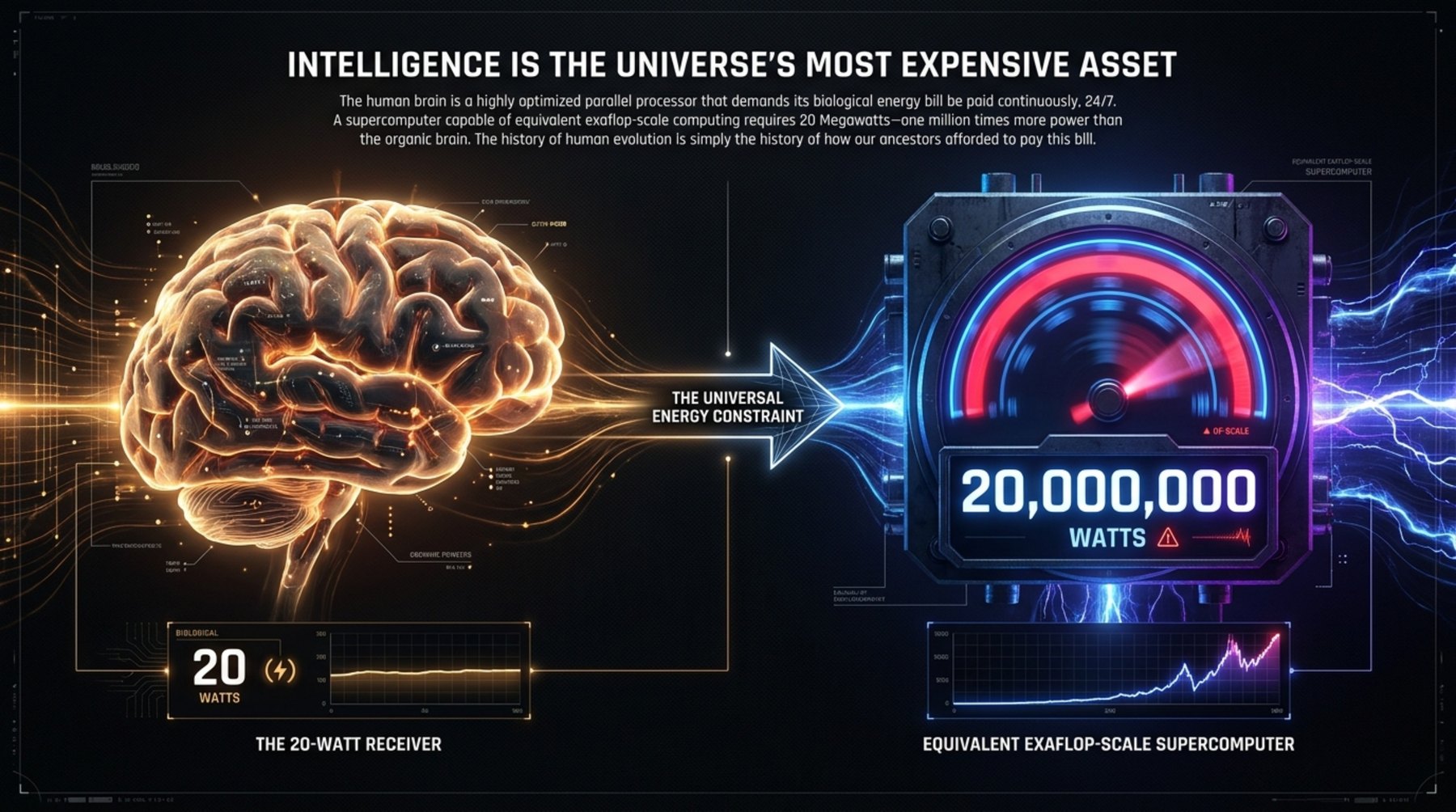
The bill and the payers
There are only three ways to pay a bill like this, and human evolution has used all three.
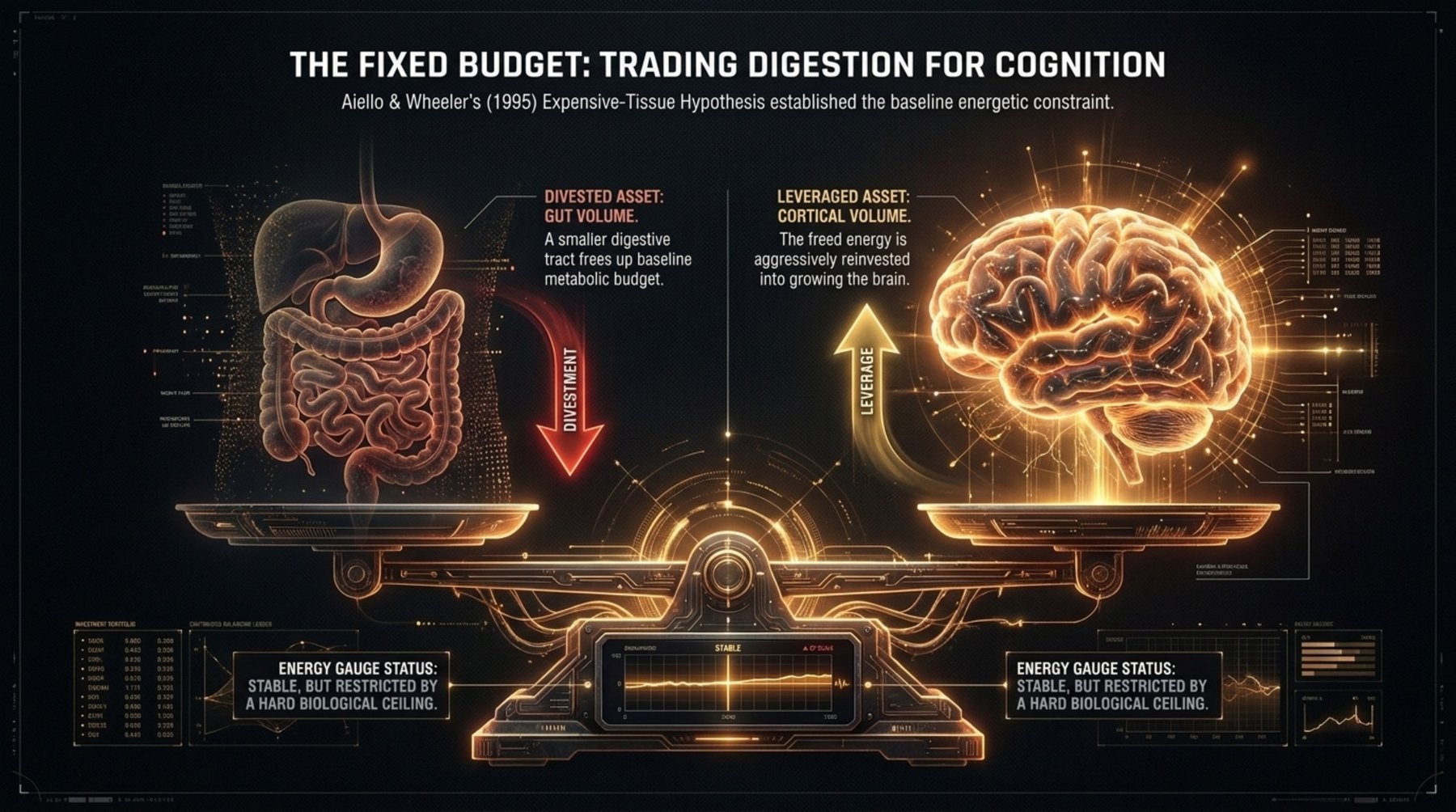
The first is reallocation: take the energy from somewhere else. Aiello and Wheeler's expensive-tissue hypothesis proposed exactly this — that our gut shrank as our brain grew, one costly organ trading against another under a fixed total. The strict version has not survived intact; comparative work across primates finds the gut–brain trade-off weaker and messier than first advertised. But the underlying logic has survived completely. Brain tissue is bought, not granted, and something has to be sold.
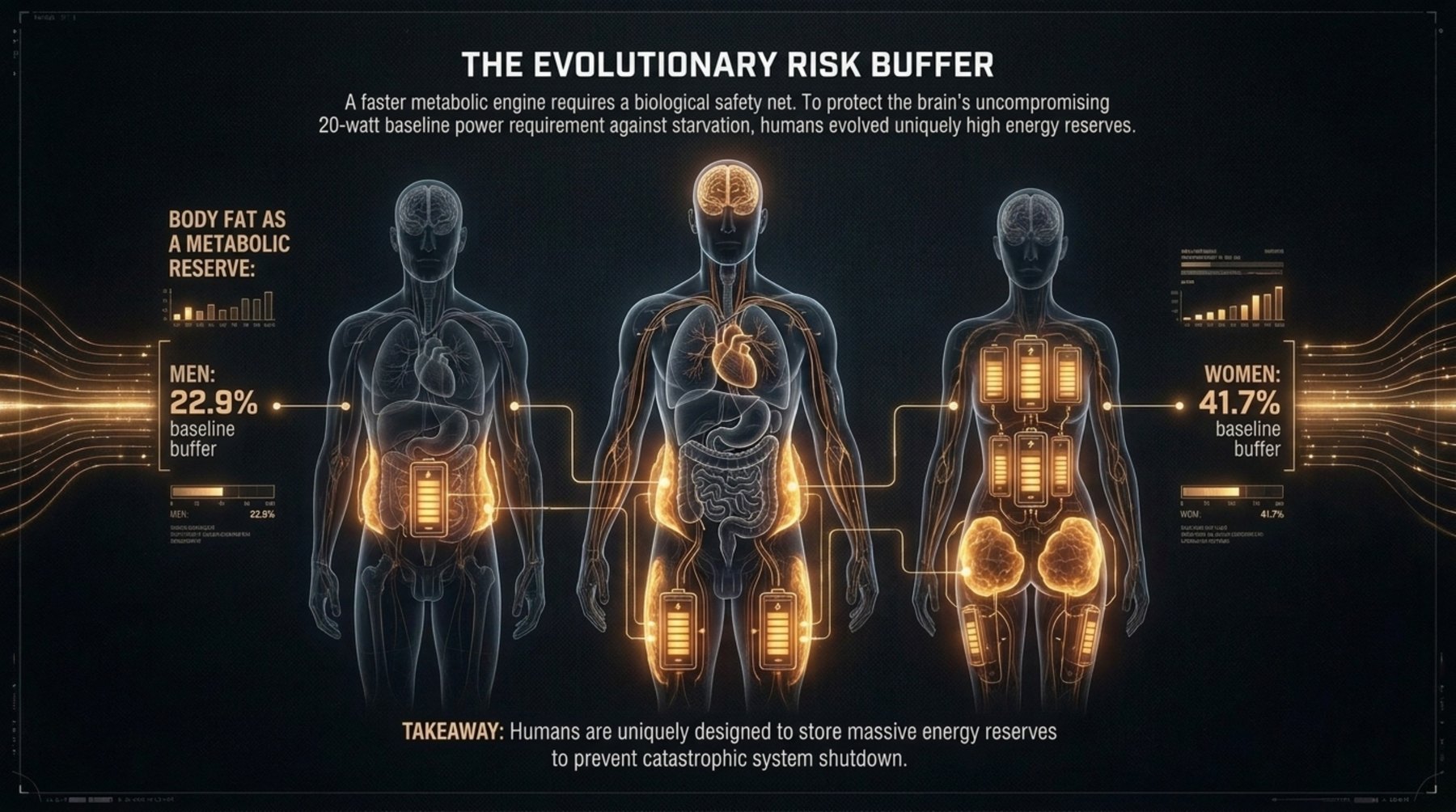
The second is acceleration: raise the total. Pontzer and colleagues measured daily energy expenditure across the great apes and found humans burning more — not reallocating a fixed sum but running a larger sum, and carrying more fat as a buffer against the days the sum falls short. This matters more than it is usually given credit for. We did not merely rearrange the furniture in a fixed room. We built a bigger room and heated it.
The third is quality: make the same food yield more. This is Wrangham's cooking argument, and it is the first genuine act of offloading in the human record. Cooking moves part of digestion out of the body and into the fire. The stomach no longer has to do work that heat has already done. The net yield of a given animal, a given tuber, a given handful of anything rises — not because the food changed, but because a step in the processing chain was relocated to an external system.
Hold that sentence. It is the whole book in miniature. A step in the processing chain was relocated to an external system. Change the noun from digestion to memory and you have writing. Change it to arithmetic and you have the abacus, the slide rule, the spreadsheet. Change it to inference and you have what is sitting in your browser tab. The pattern does not vary. Only the substrate does.
Degree, quality, availability
It clarifies things to separate energy into three distinct variables, because they behave differently and they fail differently.
Degree is how much total throughput a body or a society commands — calories per day, watts per capita. It sets the ceiling on how much machinery, biological or industrial, can run at once.
Quality is how much usable work a unit of that energy delivers after conversion losses. Cooked food outranks raw food at identical mass. A dense, dispatchable electron outranks an intermittent one at identical nameplate capacity. Quality is the variable most often lost in public argument, because it hides inside an efficiency figure rather than announcing itself as a quantity.
Availability is whether the energy is there when the work needs doing, and whether the person who needs it can reach it. This is the variable that turns physics into politics. A grid that delivers at noon and fails at six has degree and quality and no availability. A child with adequate calories in a household that cannot fund a year of schooling has the same problem in a different currency.
Kuzawa's developmental data show all three colliding in a single organism. In early childhood the human brain's share of resting metabolism climbs to a majority of the whole budget, and — precisely then — physical growth slows to make room. The body stops building itself in order to finish building its receiver. That is not a metaphor. It is a measured deceleration in mass gain that coincides with a measured acceleration in cortical glucose uptake. Childhood, on this reading, is an energy policy.
The constraint never lifted
It is tempting to file all of this under prehistory — the fire, the gut, the tubers — as though the energetic constraint were a hurdle we cleared somewhere in the Pleistocene and left behind. It was never cleared. It was only ever relocated, which is a different thing.
The twenty watts in your skull have not moved. What has changed is the size of the external apparatus that twenty watts can now command. A person reading a sentence on a screen is drawing on generation, transmission, a data centre, a cooling system, and a fabrication chain that consumed more energy in building the chip than that person will metabolize in a lifetime. The cognitive act feels free at the point of use. It is not free. It has been moved onto a different meter, and someone is reading that meter.
Smil's method is the right one here: read the history as a sequence of energy conversions rather than a sequence of ideas. Ideas are not causeless, but they are conditional. The Enlightenment did not happen in a society that could not feed a class of people who spent their days reading. The present machine-learning moment is not happening in a society that cannot build gigawatt-scale compute. In both cases the idea arrives when the surplus arrives, and it arrives shaped by the kind of surplus that carried it.
Energy is not a necessary condition for intelligence. It is a necessary condition for intelligence to be expressed — and expression, not capacity, is what selection actually sees.
That distinction is worth defending carefully, because it is where the argument of this book differs from the cruder versions of energy determinism. Nothing here says that a well-fed population is a clever one, or that watts per capita predicts insight. The claim is narrower and, I think, harder to dislodge: energy sets the boundary of what a mind is permitted to attempt. Within that boundary, everything else — culture, tools, institutions, luck, character — does the actual work. Raise the boundary and you have not created a single new idea. You have only made a larger number of ideas affordable.
What this chapter is for
The book that preceded this one asked what evolution trains an organism to receive. This one asks what it costs to receive it, and what happens when a species discovers it can put part of the cost somewhere else.
Everything that follows depends on the ledger established here. The chapters on cooking fire and surplus trace how the bill was paid historically. The chapters on offloading examine the mechanism by which parts of the bill get moved outside the skull, and the sharp distinction between offloading that amplifies a person and offloading that hollows one out. The chapters on the present loop — energy to compute to education to better energy — look at where that loop is currently jammed, which is almost never at the physics and almost always at the financing, the grid, and the schooling.
But it starts here, with a workbench bulb's worth of electricity running a system that has spent two million years trying to find somebody else to do the arithmetic. That is not a failure of nerve. It is the strategy. It always was.
Endnotes
- 1. Attwell, David, and Simon B. Laughlin. 'An Energy Budget for Signaling in the Grey Matter of the Brain.' Journal of Cerebral Blood Flow & Metabolism 21, no. 10 (2001): 1133–45. The paper apportions cortical energy use across resting potentials, action potentials, and synaptic transmission, and finds signalling — not maintenance — to be the dominant cost. ↩
- 2. Herculano-Houzel, Suzana. 'The Remarkable, Yet Not Extraordinary, Human Brain as a Scaled-Up Primate Brain and Its Associated Cost.' Proceedings of the National Academy of Sciences 109, supplement 1 (2012): 10661–68. Neuron counts, rather than mass alone, set the metabolic bill. ↩
- 3. Aiello, Leslie C., and Peter Wheeler. 'The Expensive-Tissue Hypothesis: The Brain and the Digestive System in Human and Primate Evolution.' Current Anthropology 36, no. 2 (1995): 199–221. Later work has qualified the strict gut–brain trade-off while preserving the core claim that brain tissue is energetically constrained. ↩
- 4. Pontzer, Herman, et al. 'Metabolic Acceleration and the Evolution of Human Brain Size and Life History.' Nature 533 (2016): 390–92. Humans expend more energy per day than other great apes and carry greater fat reserves — an increase in throughput rather than a pure reallocation of a fixed budget. ↩
- 5. Wrangham, Richard. Catching Fire: How Cooking Made Us Human. New York: Basic Books, 2009. Cooking is treated as an external pre-digestion step that raises the net energy yield of a given quantity of food. ↩
- 6. Kuzawa, Christopher W., et al. 'Metabolic Costs and Evolutionary Implications of Human Brain Development.' Proceedings of the National Academy of Sciences 111, no. 36 (2014): 13010–15. In early childhood the brain can consume a substantial majority of the body's resting metabolic budget, coinciding with a slowdown in physical growth. ↩
- 7. Smil, Vaclav. Energy and Civilization: A History. Cambridge, MA: MIT Press, 2017. Smil's central move — reading history as a sequence of energy conversions rather than a sequence of ideas — is the method borrowed throughout this book. ↩
- 8. Norton, K.W. The Evolving Receiver: Riemann, Quantum Science, and Evolution. Standing Wave Editions, 2026. The aperture argument developed there — that evolution trains what an organism can receive — is the direct predecessor of the energetic argument made here. ↩