
Volume 26 · Part Seven · Section II · Visual Brief
Breaking the Civilizational Trap
Diagnosing systemic fragility and the pathways to a Second Renaissance — thirteen plates that carry the Section II argument in pictures.
Section II makes its case in prose across four chapters. This brief makes the same case in one sitting. It exists because the argument has a shape — a narrowing and then a branching — that a diagram carries faster than a paragraph, and because the shape is what readers tend to remember when they go looking for the argument again.
Read the plates in order. The first eight state the diagnosis: how scale bought stability by pricing dissent, why the symptoms of decline are recognized late, and how new tools amplify whichever pattern is already running. The last five state the exit: variance persists, culture moves faster than genes, and renewal has always begun with a subgroup that built something that worked rather than with a species that agreed.
The trap is not an external force acting on humanity from outside. It is the accumulated result of ordinary human choices about what to notice, what to say, and what to reward. That is what makes it durable, and that is what makes it reversible: the same machinery of attention and status can be turned toward accuracy instead of agreement, one habit at a time.
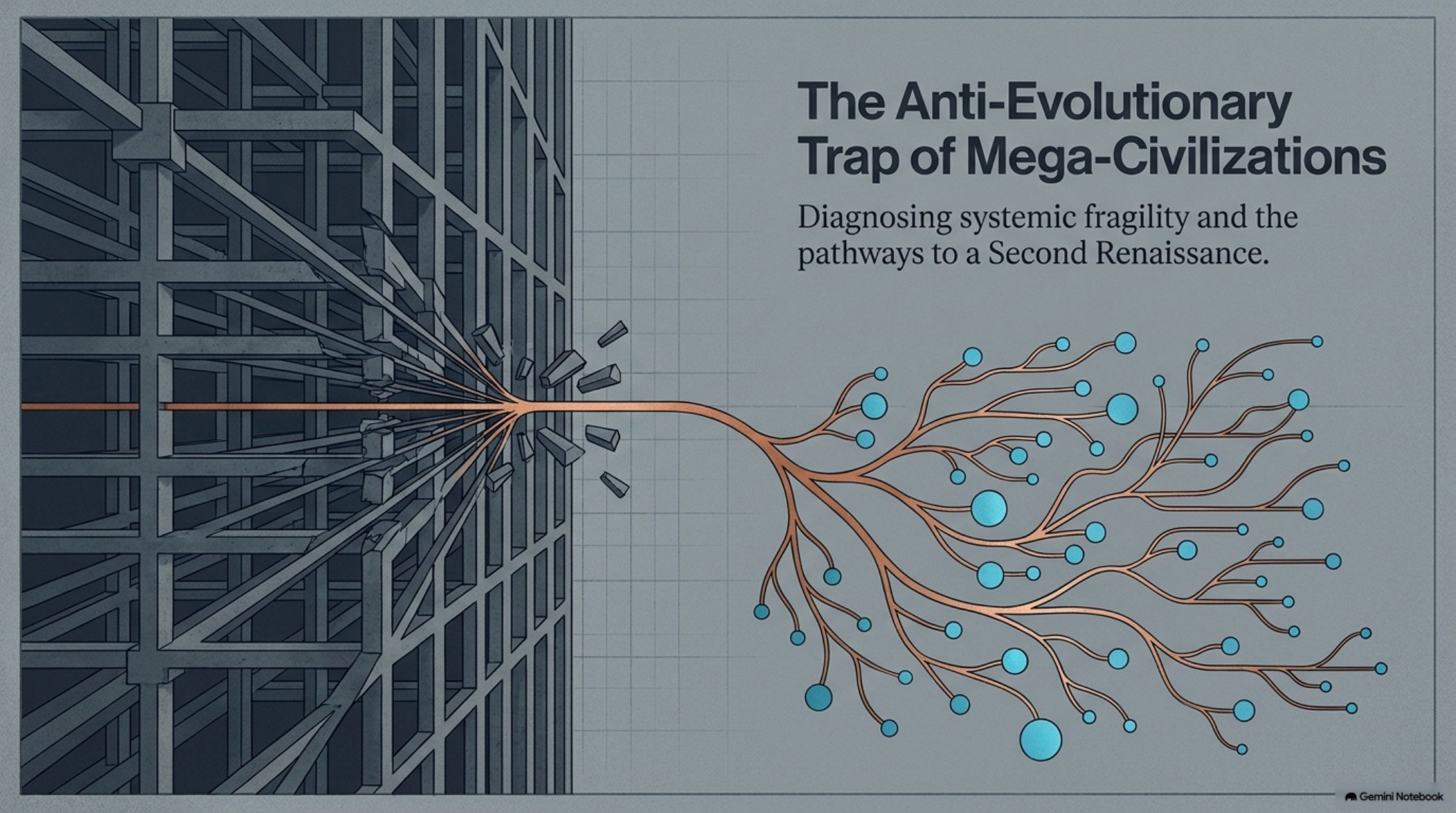
Plate 1 of 13
The Anti-Evolutionary Trap of Mega-Civilizations
The whole argument in one frame: a rigid grid fracturing on the left, a branching copper network opening on the right. Same energy, two architectures.
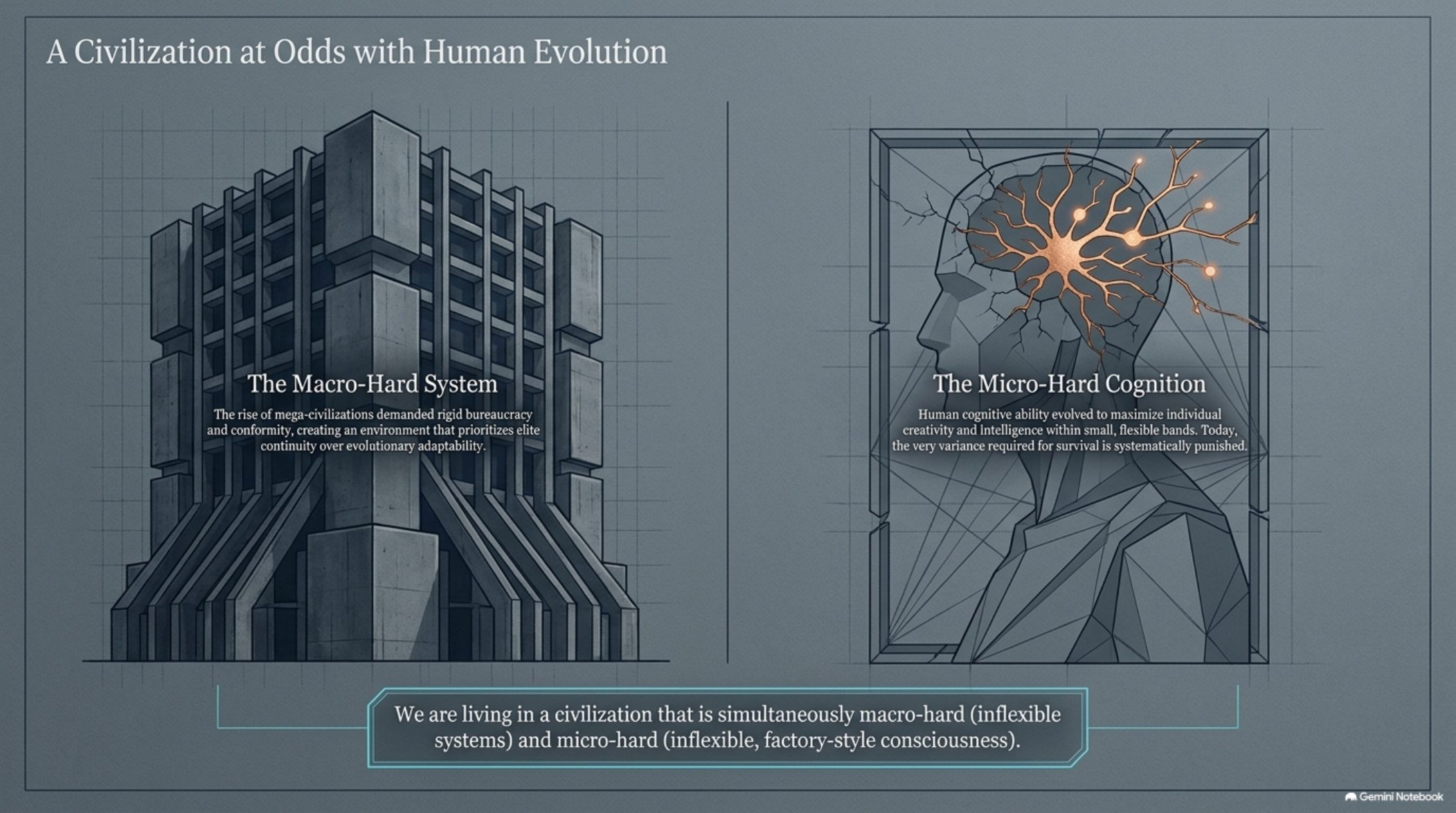
Plate 2 of 13
The Macro-Hard System
Scale demanded rigid administration, and rigid administration selected for elite continuity over adaptability. The result is a civilization that is macro-hard in its systems and micro-hard in its habits of mind.
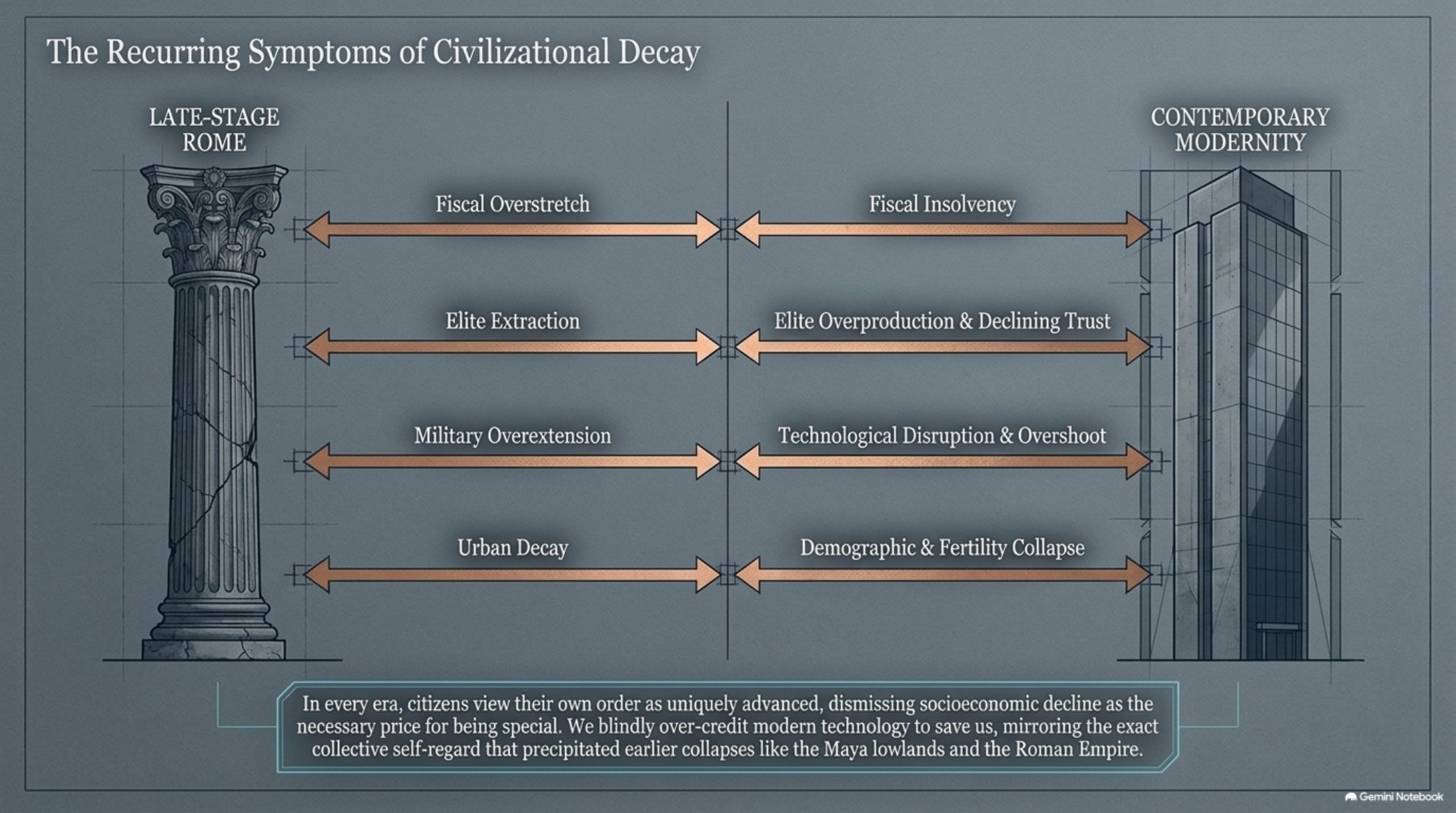
Plate 3 of 13
The Recurring Symptoms of Decay
Late-stage Rome set beside contemporary modernity: fiscal overstretch, elite extraction, overextension, demographic decline. Every era reads its own decline as the price of being special.
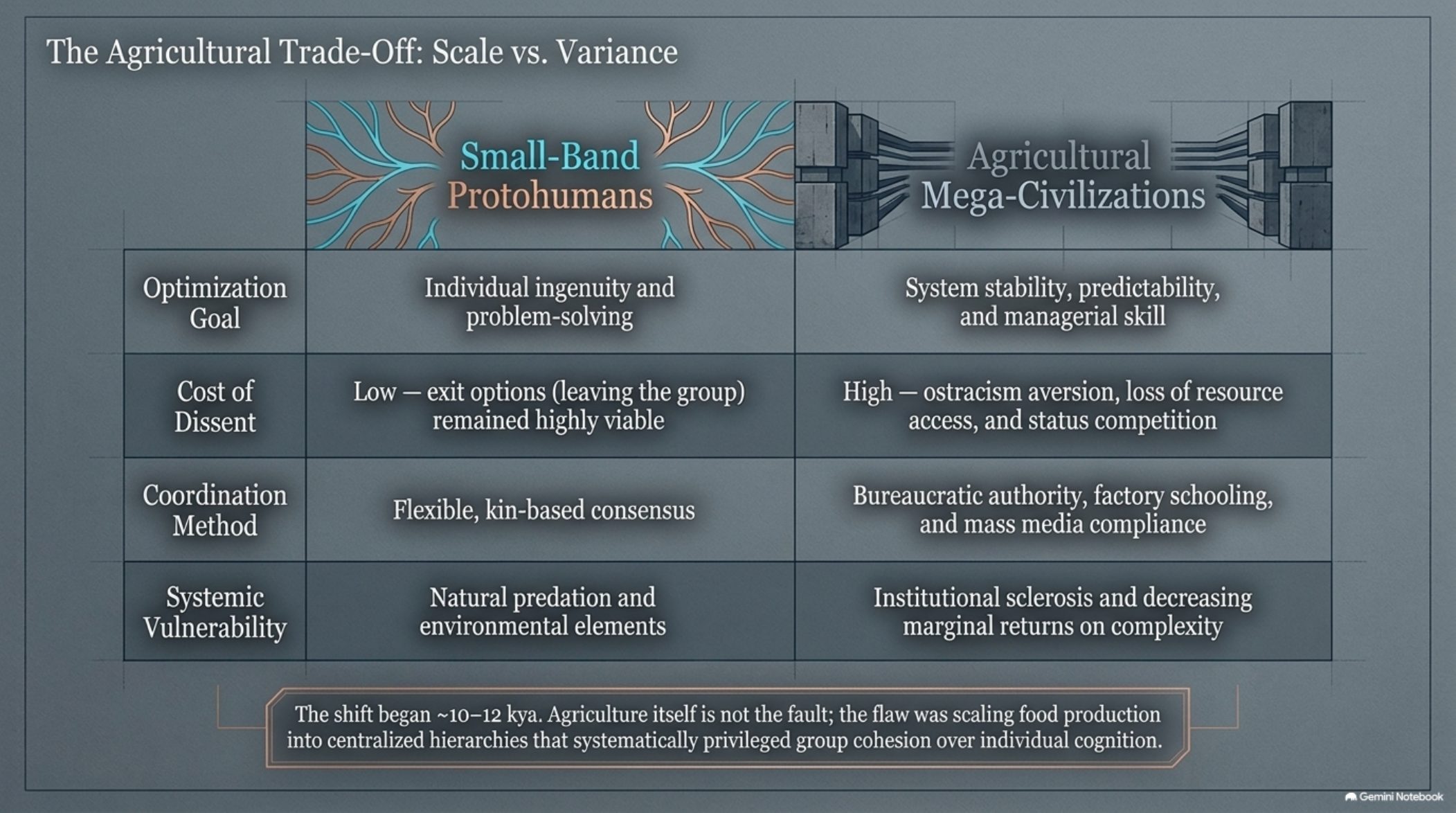
Plate 4 of 13
The Agricultural Trade-Off
Small-band life rewarded individual ingenuity and kept exit cheap. Mega-civilization rewarded predictability and made dissent expensive — ostracism, lost access, lost status.
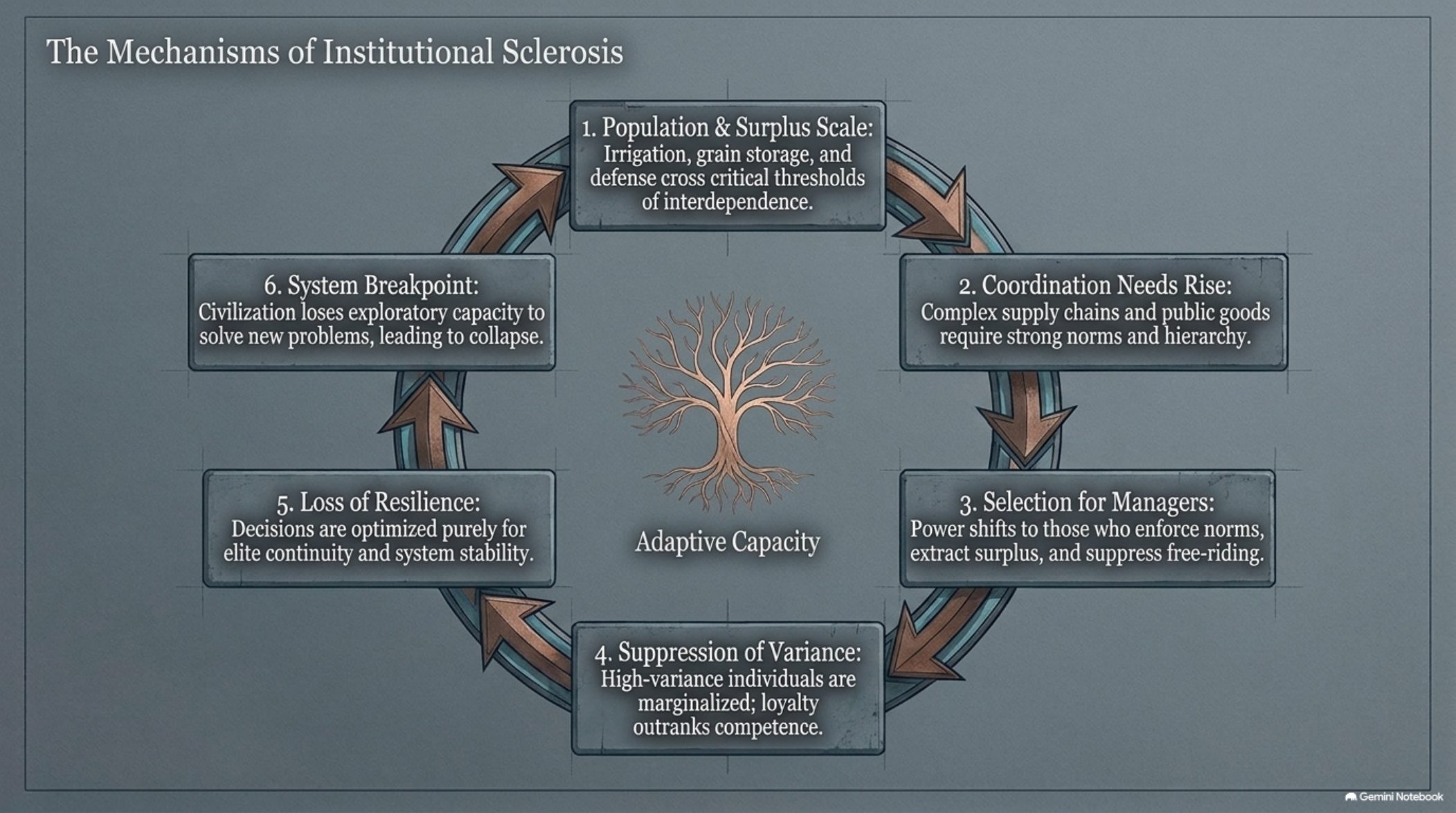
Plate 5 of 13
From Surplus to System Breakpoint
Six steps: surplus, interdependence, norms and hierarchy, power to the enforcers, suppression of variance, and then the loss of exploratory capacity precisely when new problems arrive.
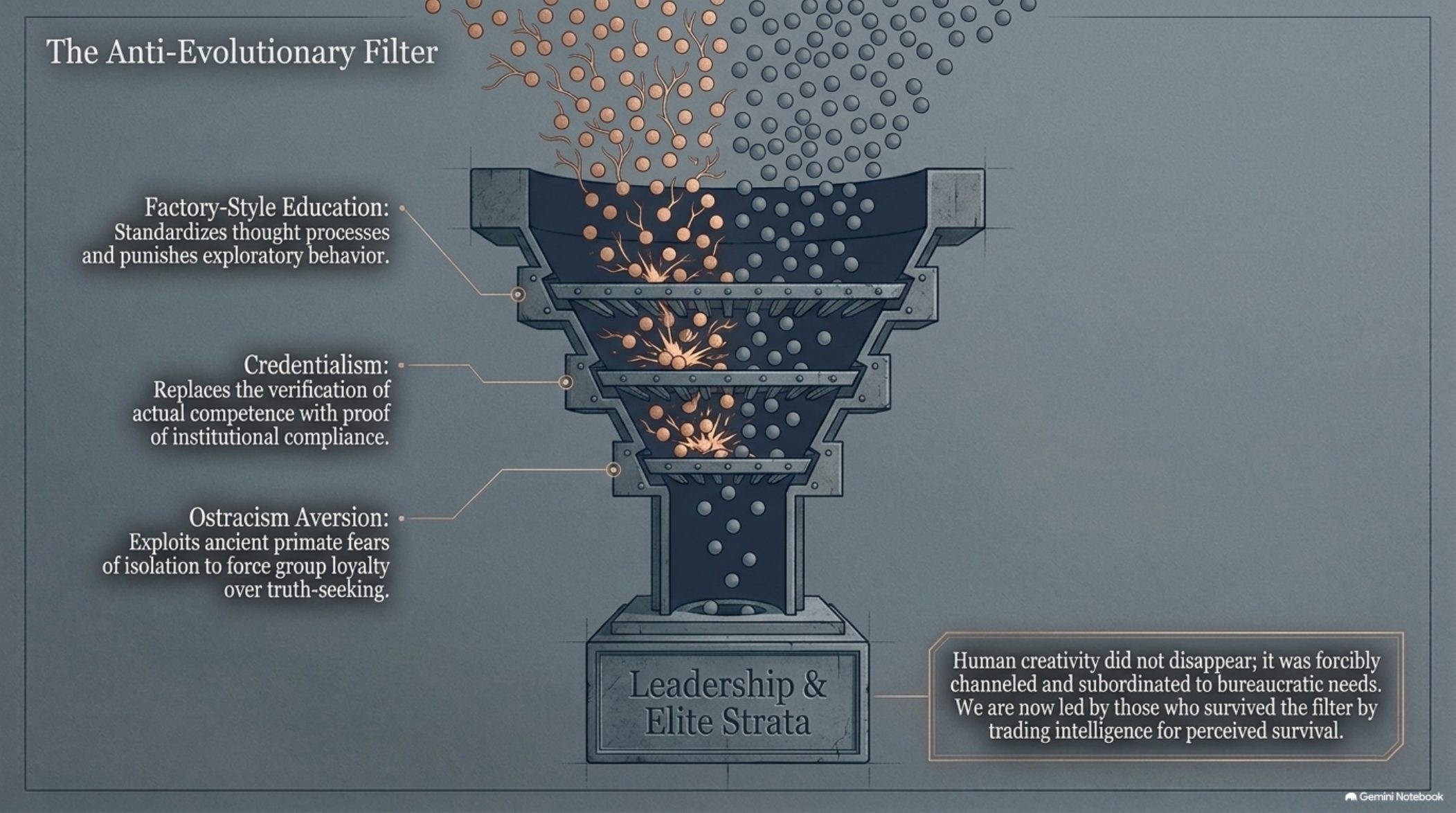
Plate 6 of 13
How Variance Is Suppressed
Factory-style schooling standardizes thought, credentialism substitutes compliance for competence, and ostracism aversion recruits an ancient fear against truth-seeking. Creativity was not erased; it was channeled.
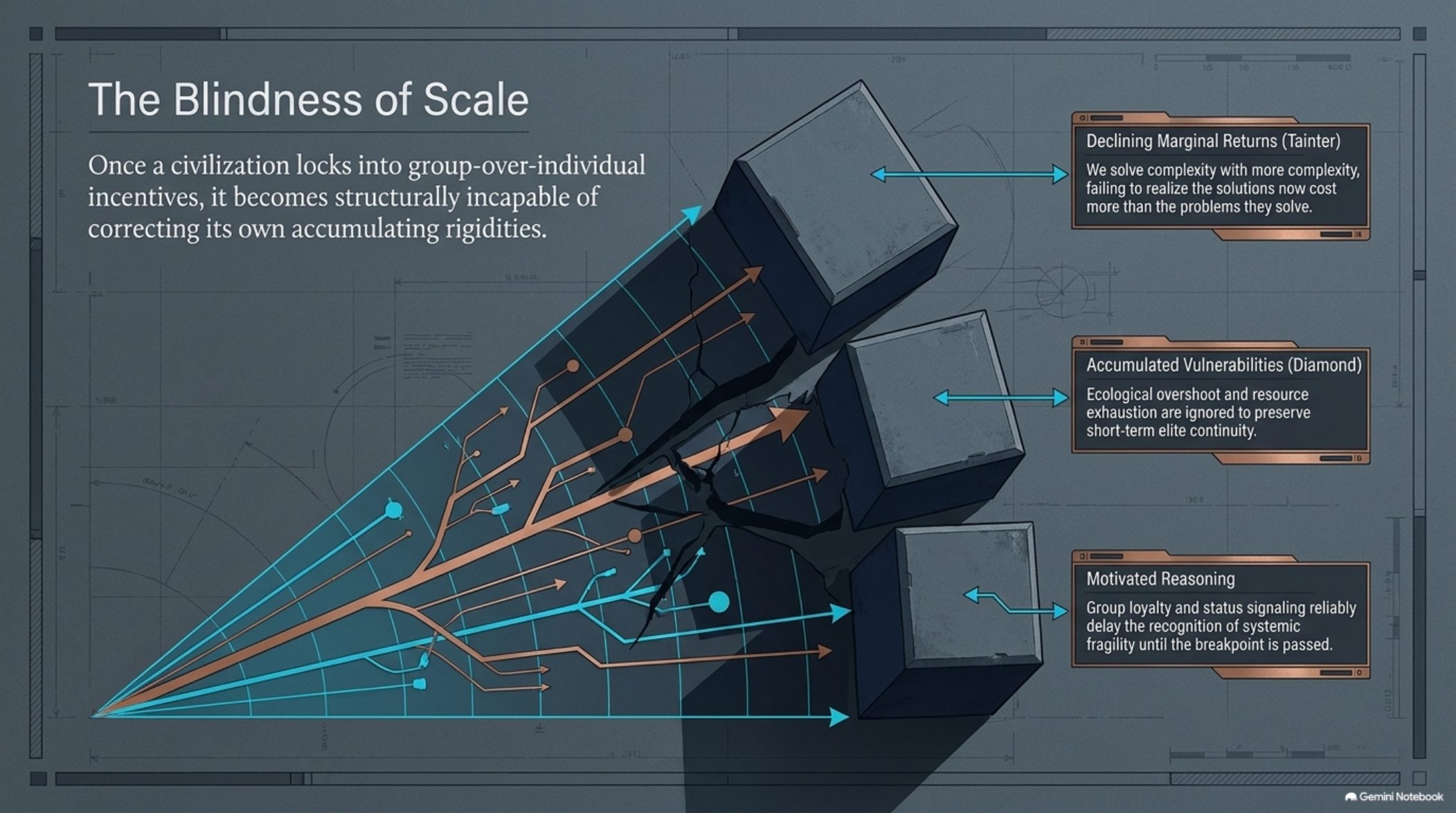
Plate 7 of 13
Why the Recognition Comes Late
Declining marginal returns, accumulated vulnerabilities, and motivated reasoning. We answer complexity with more complexity and call the delay prudence.
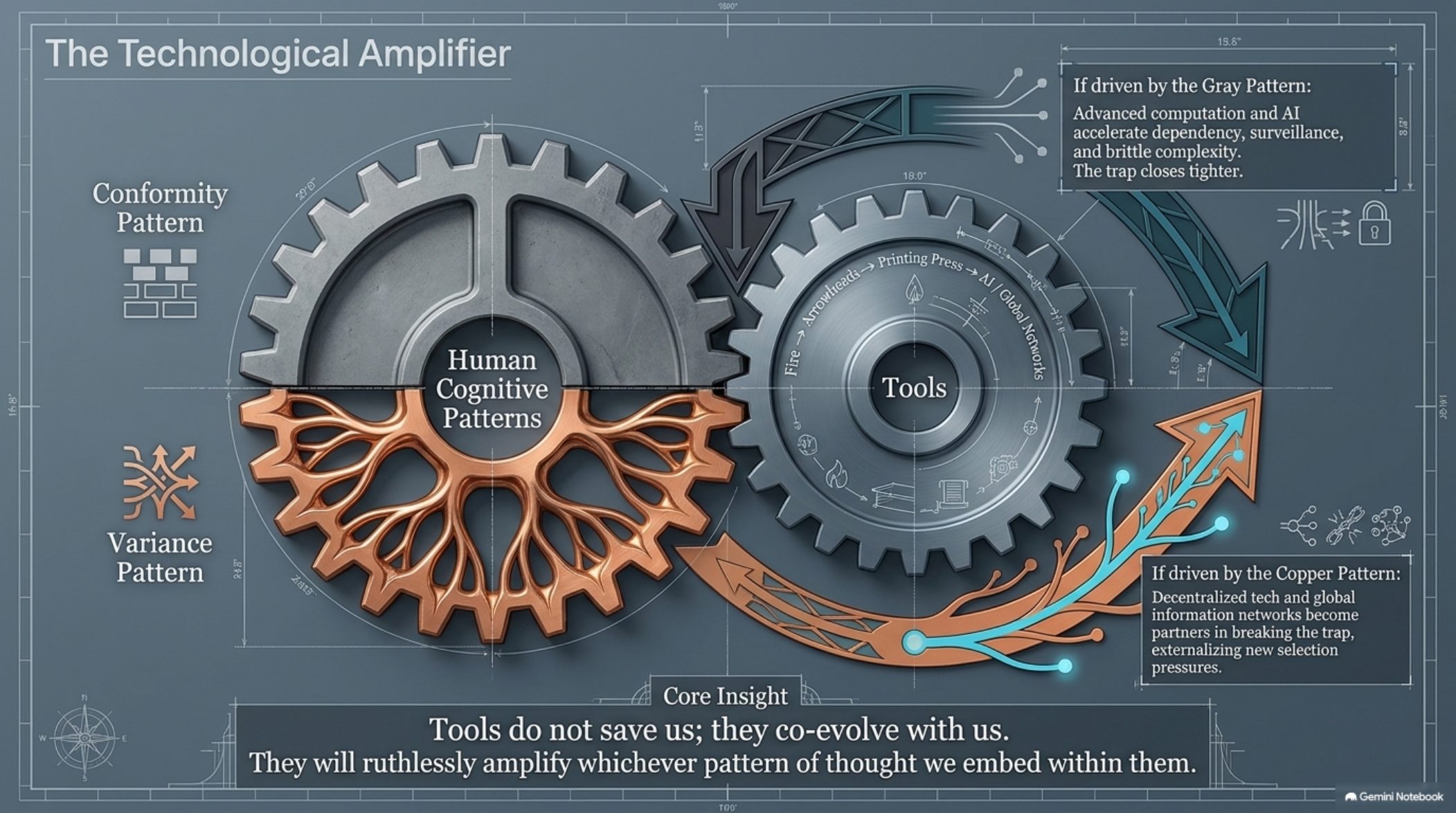
Plate 8 of 13
The Technological Amplifier
The same tools run either pattern. Under the gray pattern they deepen dependency and brittleness. Under the copper pattern they widen variance and lower the cost of thinking differently.
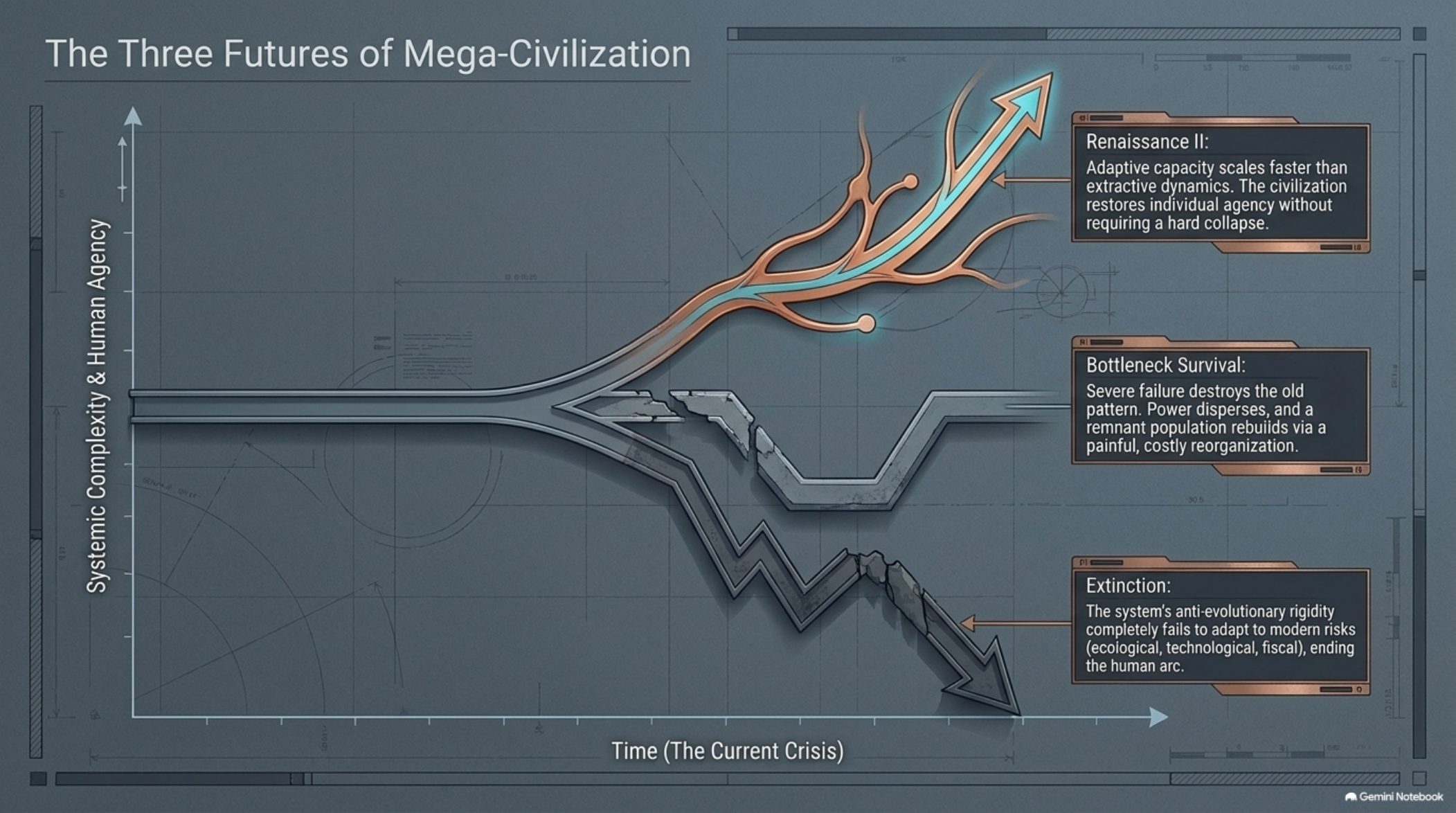
Plate 9 of 13
The Three Futures
Extinction-level failure, bottleneck survival with a remnant population, or systemic renewal. Chapters 20 through 22 take these one at a time.
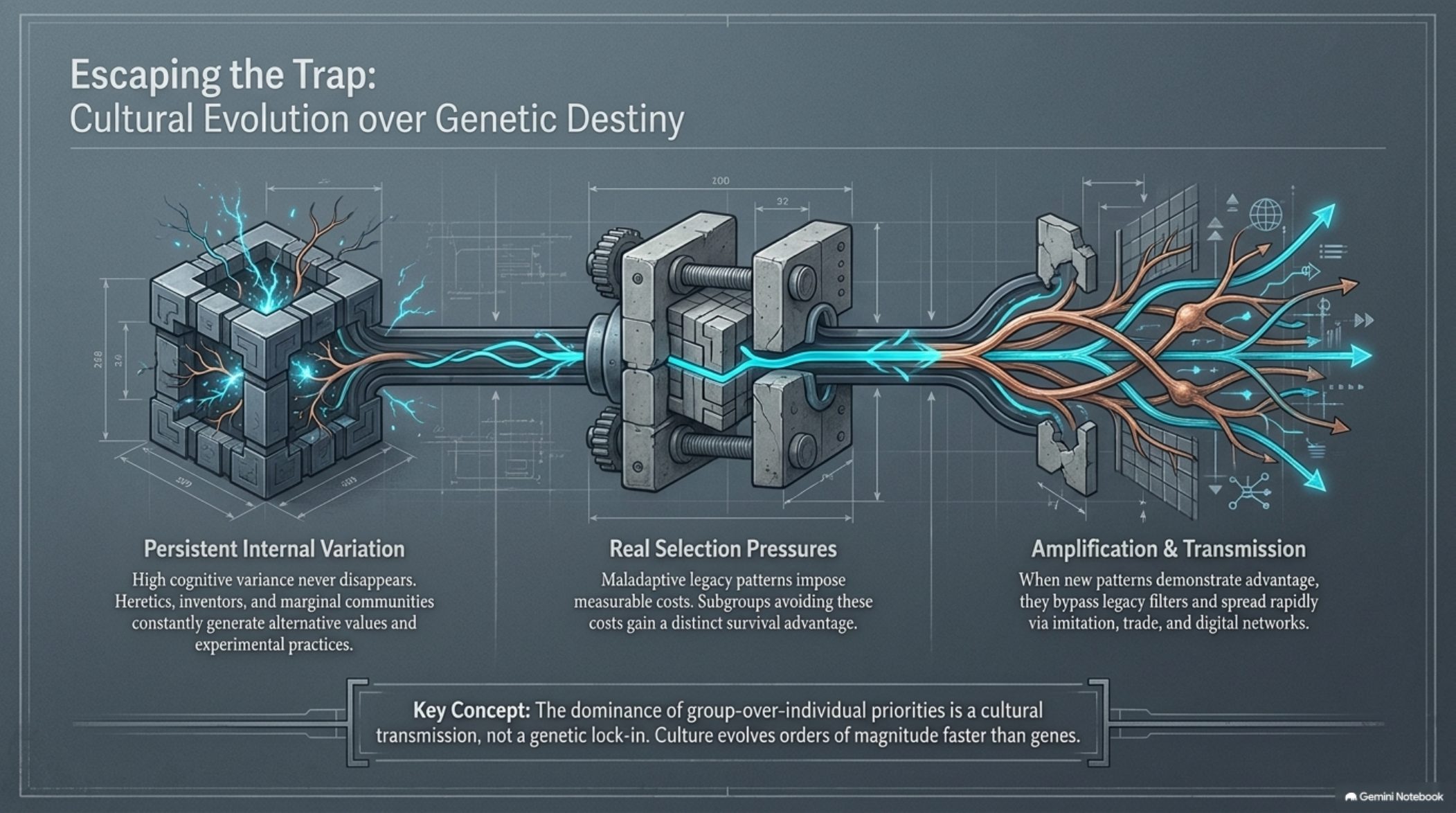
Plate 10 of 13
Cultural Evolution over Genetic Destiny
Variance never disappears, maladaptive patterns impose measurable costs, and advantages transmit by imitation and trade. The group-over-individual weighting is a cultural transmission, not a genetic lock.
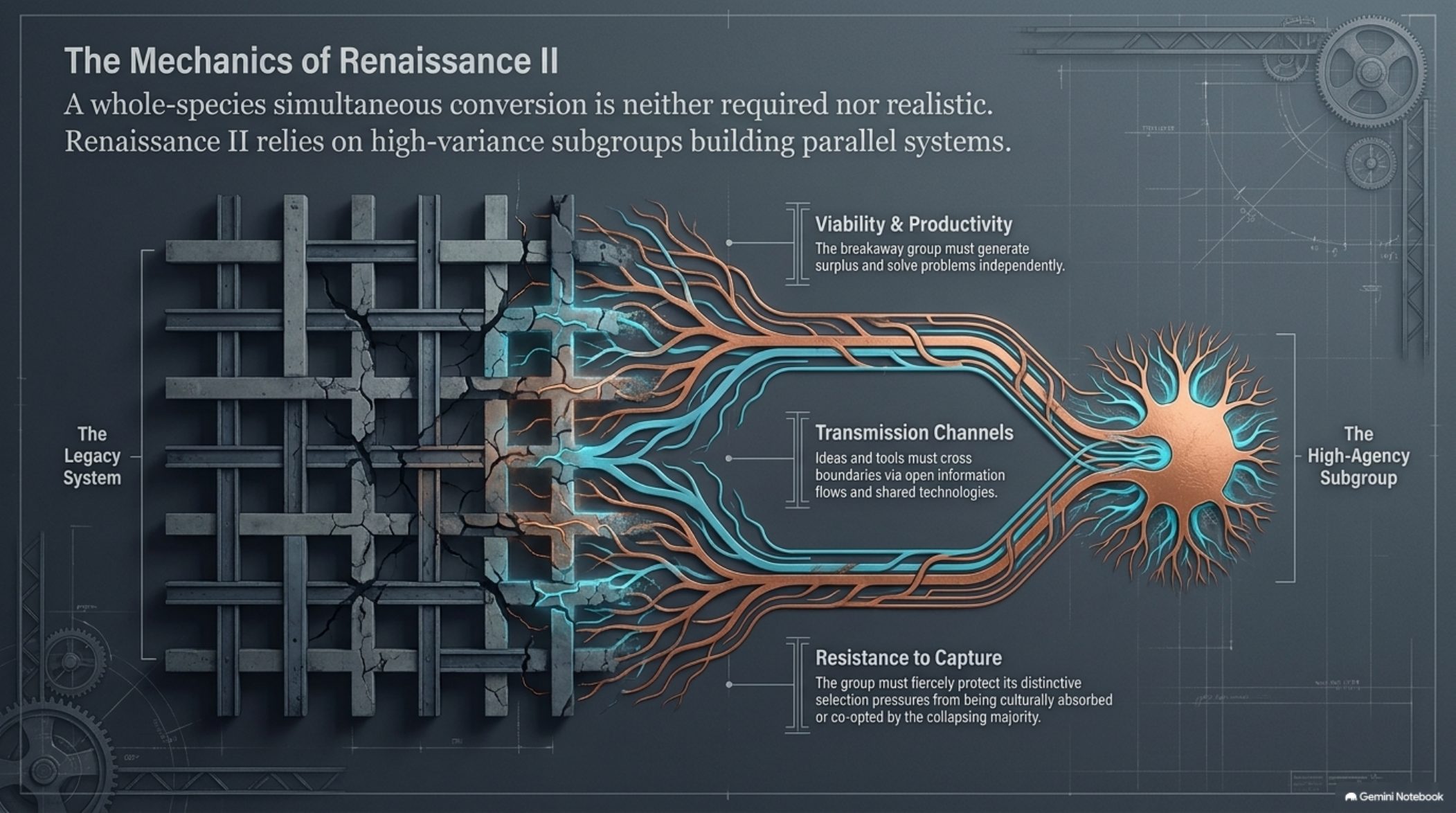
Plate 11 of 13
The Mechanics of Renaissance
No simultaneous species-wide conversion is required. High-variance subgroups build parallel systems, generate real surplus, and let the results cross the boundary.
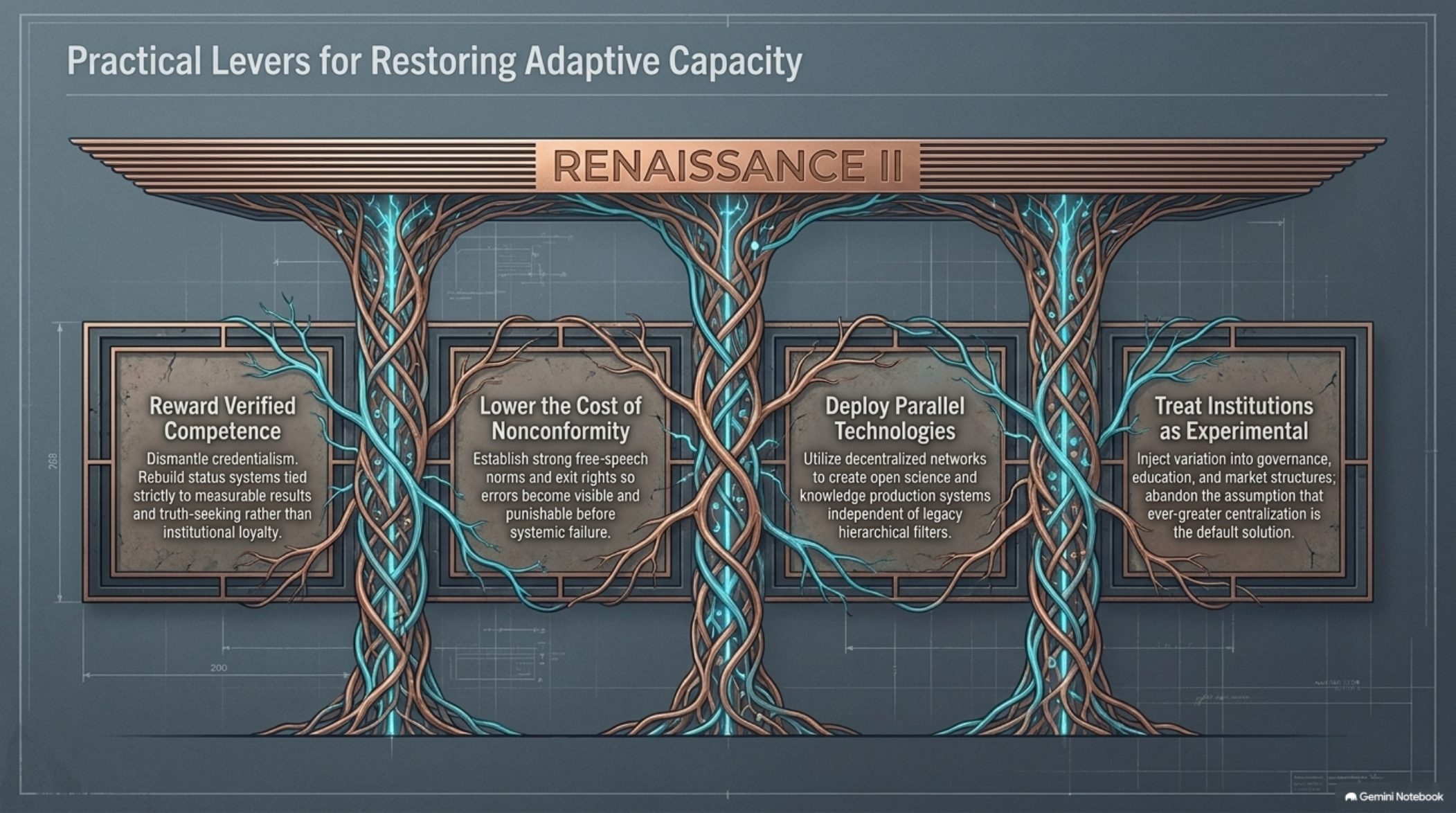
Plate 12 of 13
Institutions as Experiments
Inject variation into governance, education, and markets; decentralize knowledge production; dismantle credentialism; protect speech and exit so the cost of nonconformity falls.
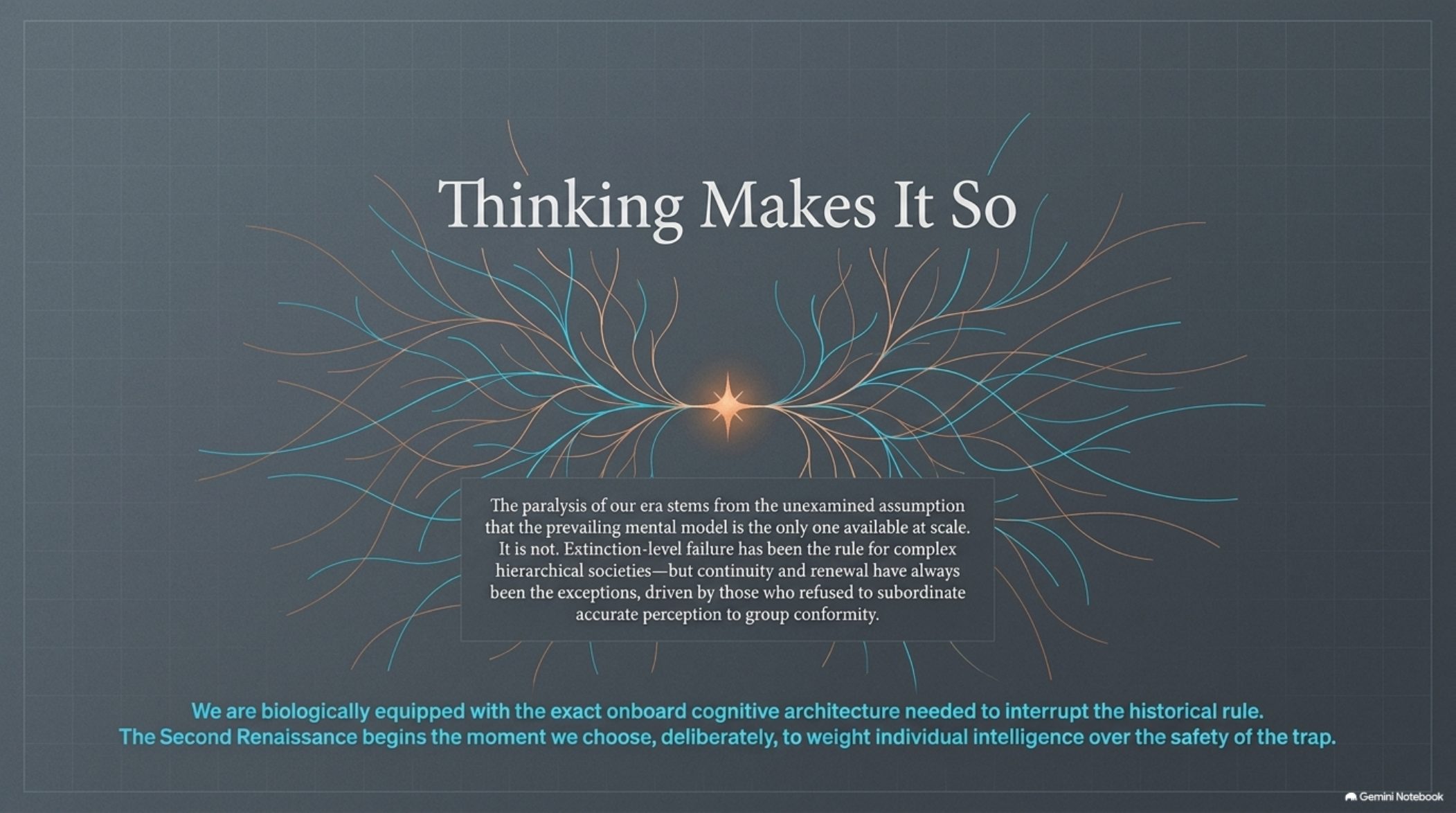
Plate 13 of 13
Thinking Makes It So
The paralysis of the era rests on an unexamined assumption: that the prevailing mental model is the only one available at scale. It is not.
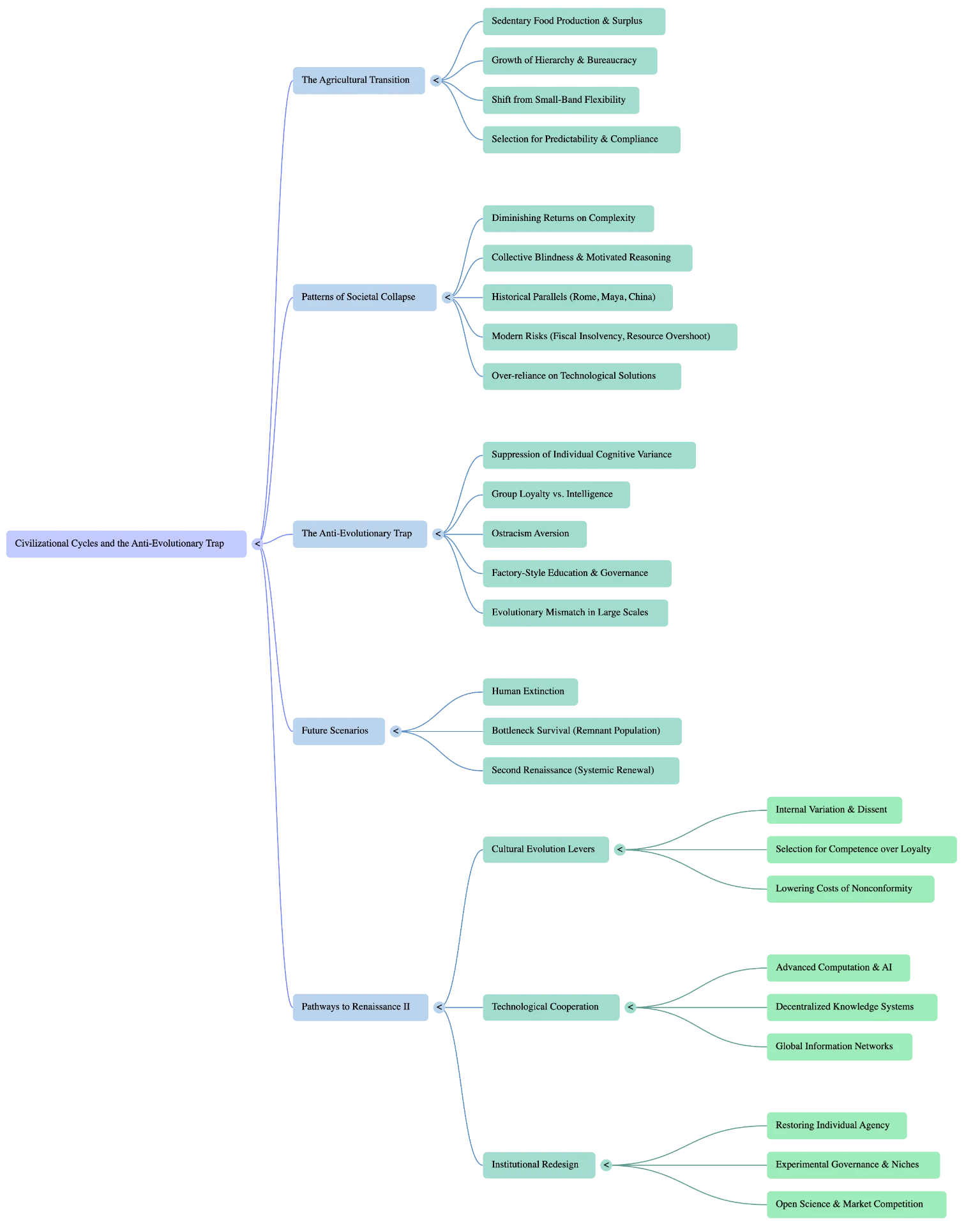
The argument as a map
The same material laid out as a branching structure: the agricultural transition, the patterns of collapse, the anti-evolutionary trap, the three futures, and the pathways to Renaissance II.
What would weaken this
The brief rests on a claim that can fail: that the weighting of group loyalty above accurate perception is culturally transmitted and therefore rapidly revisable. Evidence that the weighting is substantially heritable and stable across radically different institutional environments would move the whole argument from cultural evolution to constraint, and Section II's practical chapters would have to be rewritten as coping strategies rather than as an exit.
The second vulnerable claim is smaller and more testable: that high-variance subgroups can reach viability without either being absorbed or losing the variance that made them useful. Chapter 25 treats that directly.