
The human nervous system is fractal at every scale that matters — dendritic arbor, vascular tree, cortical folding, the branching of the bronchi that feed it oxygen1. Fractal geometry is not decoration. It is the exact geometry an antenna needs in order to couple efficiently across a very wide band of frequencies at once2. A rod antenna is a monoglot. A fractal antenna speaks octaves.
Read the head this way and the strangeness of ordinary experience begins to organize itself. The brain is running broadband reception into an object whose native language is spectra. What it does with what it receives — attention, memory, dreaming, grief, the sudden arrival of an unearned idea — is not the manufacture of signal from nothing. It is the tuning, gating, and biological transcription of a signal already present in the room. The sister-site companion The Miracle of You12 makes the same claim in the language of frequency-fingerprint; the site essay The Unseen Architecture10 develops the antenna framing at length and is the natural companion to the present chapter.
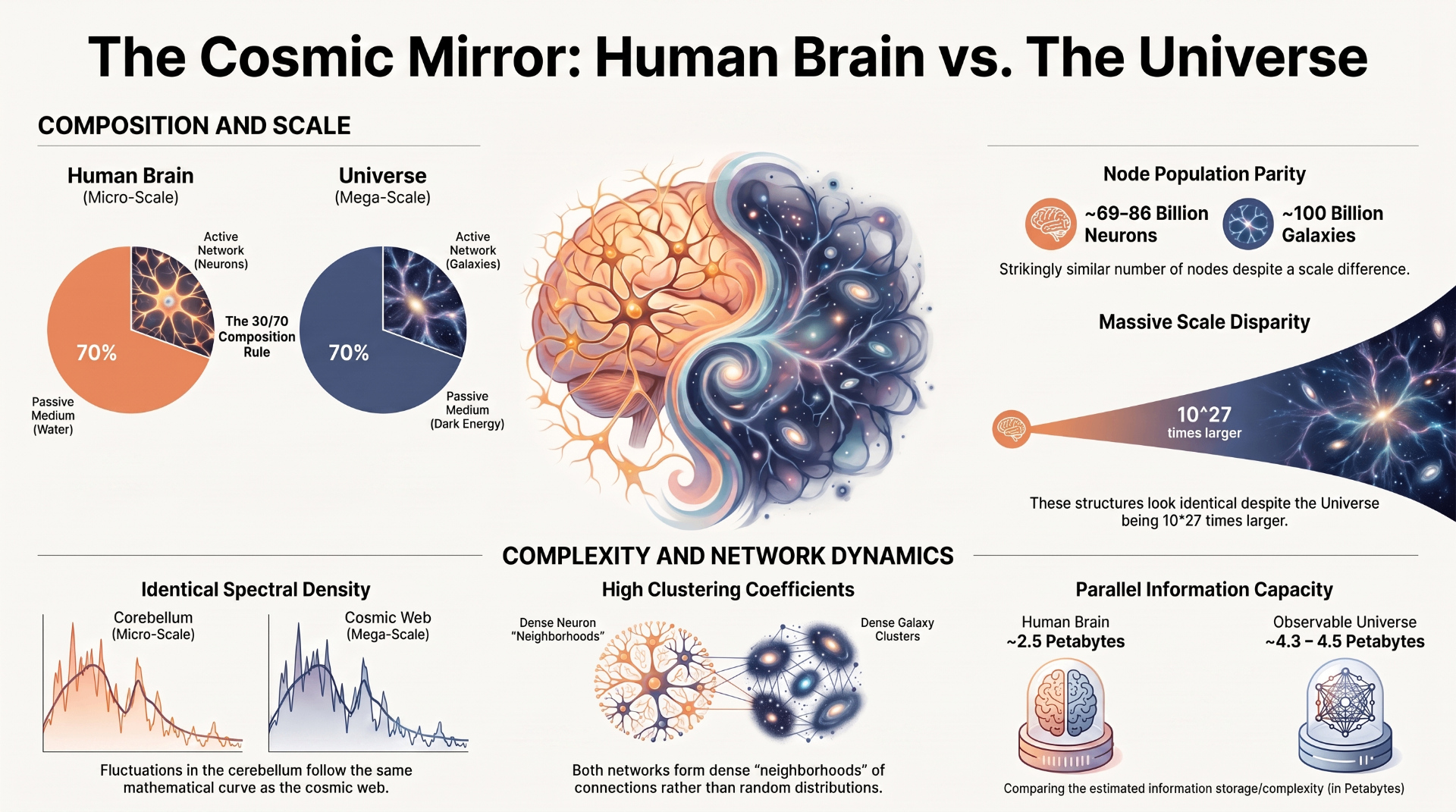
The measured counterpart to this intuition is the 2020 Vazza–Feletti comparison of the cosmic web to the neuronal network of the human cortex and cerebellum3: two systems separated by roughly twenty-seven orders of magnitude, whose structural statistics rhyme to a degree that is difficult to write off as coincidence. Same spectral density curve. Same clustering coefficient window. Same 30/70 split between active nodes and the medium that carries them. Same order-of-magnitude information capacity — a shared petabyte ledger.
Modern network neuroscience4 is what lets us take that rhyme seriously rather than dismissively. The metrics Vazza and Feletti apply to the cosmic web — degree distribution, clustering, spectral density — are the same metrics the connectomics community applies to the cortex; the comparison is not analogy in the loose literary sense, it is the same instrument turned on two objects.
The other reason to take the rhyme seriously is that the picture of the receiver has, in the last few years, sharpened past anything the older literature could work with. The 2024 Harvard/Google reconstruction of a cubic millimetre of human cerebral cortex5,6 — fifty-seven thousand cells, a hundred and fifty million synapses, traced at nanoscale from serial electron micrographs — is the first time a fragment of a human brain has been laid open at the resolution the fractal-antenna reading demands. New expansion- microscopy protocols out of MIT7 are pushing further still, physically swelling the tissue so that cells and structures previously invisible become photographable. The Queensland Brain Institute's still and video galleries8 and the earlier dense-connectomic reconstruction of mouse cortex9 are the methodological ancestors of this new visibility. What the images show, when the eye stops looking for cartoon neurons and starts looking for architecture, is exactly the branching, self-similar, void-riddled geometry the antenna reading predicts.
The chapter's second half — The Voids Are Where It Thinks and The Asymmetry That Sharpens the Mirror11 — shows that the highest-information regions of each network are not the nodes but the seams between them, and that the very asymmetry between axonal wiring and gravitational proximity is what promotes the analogy from suggestive to load-bearing. The sister-site companion Resonant Beings13 reads the same rhyme from a third angle — baryon acoustic oscillations, cellular mechano-transduction, and quantum coherence as one resonant grammar. The sister-site essay The Luminous Architecture · Brain as Cosmos14 develops the brain/universe mirror in its own voice and is the direct companion to this chapter.
References
14 sourcesMandelbrot, B. B. (1982) — The Fractal Geometry of Nature
Foundational reference for the fractal-antenna framing in Chapter Two: broadband coupling as the geometric signature of self-similar receiver architectures.
users.math.yale.edu/mandelbrotCohen, N. (1995) — Fractal antenna applications
Communications Quarterly 5. The engineering demonstration that fractal geometry, not accident, is what lets a compact antenna couple efficiently across many bands at once.
Vazza, F. & Feletti, A. (2020)
The Quantitative Comparison Between the Neuronal Network and the Cosmic Web — Frontiers in Physics 8:525731. Statistical fingerprint (spectral density, clustering, degree distribution) shared by the human cortex/cerebellum and the cosmic web across ~27 orders of magnitude.
frontiersin.org — Vazza & Feletti (2020)Bassett, D. S. & Sporns, O. (2017)
Network neuroscience. Nature Neuroscience 20, 353–364. The modern network-neuroscience framework the Vazza–Feletti comparison is measured against.
doi.org/10.1038/nn.4502Shapson-Coe, A. et al. (2024) — Harvard/Google H01 connectome
A petavoxel fragment of human cerebral cortex reconstructed at nanoscale. Science 384, eadk4858. The first human-cortex electron-microscopy volume dense enough to trace every neuron and synapse in the sample — the empirical face of the branching, fractal architecture Chapter Two calls a broadband receiver. Popular summary: Science News, 'A stunning new map shows what a tiny piece of our brain looks like.'
sciencenews.org — Harvard/Google cortex mapShapson-Coe et al. (2024) — Science paper (H01)
Primary publication of the H01 human-cortex reconstruction in Science. Provides the connectomic ground truth against which the antenna/receiver reading of Chapter Two is disciplined.
science.org — H01 paper (doi:10.1126/science.adk4858)MIT News (2024) — Expansion microscopy of human brain tissue
New imaging method reveals previously invisible cells and structures in human brain tissue by physically expanding the sample before imaging. Confirms that the fractal architecture at the far end of the resolution curve is not artefact but structure we simply had not yet been able to see.
news.mit.edu — expansion microscopy of human brainQueensland Brain Institute — Stunning neuroscience images
Curated gallery of high-resolution still and video micrography of neurons, dendritic arbors, and vascular trees. Visual evidence for the branching self-similarity Chapter Two treats as the geometry of broadband reception.
qbi.uq.edu.au — neuroscience image galleryMotta, A. et al. (2019) — Dense connectomic reconstruction
Dense connectomic reconstruction in layer 4 of the somatosensory cortex. Science 366, eaay3134. Landmark demonstration that automated segmentation of serial electron-microscopy volumes can recover cortical wiring at synaptic resolution — the methodological ancestor of the 2024 human-cortex volume.
science.org — Motta et al. (doi:10.1126/science.aau8302)Norton, KW — The Unseen Architecture
Companion to Chapter Two. Fractal receivers and the geometry of broadband coupling in living systems.
/essays/unseen-architectureNorton, KW (2026) — Brain / Universe · Universe / Brain (Book 19)
Book 19 of the sequence; the volume immediately preceding this one. Contains the full Cosmic-Brain Mirror discussion, the Voids Are Where It Thinks section, and the Proximity vs. Wiring frontier at length. Read online at /essays/brain-universe.
/essays/brain-universeNorton, KW — The Miracle of You
Companion essay on The Shattered Prism. Seven movements on the complete originality of each human being — the frequency-fingerprint framing that anchors the antenna language of Chapter Two.
theshatteredprism.com/miracle-of-youNorton, KW — Resonant Beings
Companion essay on Homo Luminous. Baryon acoustic oscillations, cellular mechano-transduction, and quantum coherence read as one resonant grammar — the sister argument to Chapters Four and Five.
homoluminous.us/resonant-beingsNorton, KW — The Luminous Architecture: Brain as Cosmos
Companion essay on Homo Luminous. The sister-site treatment of the brain/universe mirror — the same Vazza–Feletti statistical fingerprint, the void-and-filament architecture, and the reading of the cortex as a cosmos-shaped receiver — developed in its own voice.
homoluminous.us/luminous-architecture