
A circle is a loop that forgot how to grow.
A spiral is a loop that remembered.
1 · The Question From Both Ends
For most of the modern era we have asked the question from one side only: what is the brain? A three-pound organ, a wet computer, a bundle of axons and glia and slow chemical tides. The answer, however honest, has always felt like a partial transcription of something larger — as if we had recorded only the receiver and never the broadcast.
This chapter asks the question from both ends at once. Not what is the brain, but what is the brain a piece of. And symmetrically: what is the universe such that a brain can meet it. The parallax move — the one this whole archive rests on — is that you cannot answer either half in isolation. You have to hold the two mirrors up to one another and read what stands between them.
What stands between them, I will argue across this book, is a single conformal substrate: a low-friction dynamic slip stream that expresses itself as light on the cosmological side and as coherence on the biological side. The brain is not in that substrate the way a fish is in water. The brain is a knot the substrate has learned to tie in order to look back at itself.
2 · The Fractal Antenna
The human nervous system is fractal at every scale that matters — dendritic arbor, vascular tree, cortical folding, the branching of the bronchi that feed it oxygen. Fractal geometry is not decoration. It is the exact geometry an antenna needs in order to couple efficiently across a very wide band of frequencies at once. A rod antenna is a monoglot. A fractal antenna speaks octaves.
Read the head this way and the strangeness of ordinary experience begins to organize itself. The brain is running broadband reception into an object whose native language is spectra. What it does with what it receives — attention, memory, dreaming, grief, the sudden arrival of an unearned idea — is not the manufacture of signal from nothing. It is the tuning, gating, and biological transcription of a signal already present in the room.
This reframing does not require mysticism. It requires only that we take the geometry seriously. If the substrate is conformal and spiral (as the appendices to The Luminous Braid formally argue), then any biological structure that has evolved to survive inside it will be under selection pressure to couple to it. Coupling to a spiral substrate produces spirals. The cochlea is a spiral. The retinal ganglion arrangement is a spiral. The heart's muscle bands unwind into a spiral. The helical stair of DNA is a spiral. This is not aesthetic coincidence. This is impedance matching.
3 · The Cosmic-Brain Mirror
No — neither you nor I are seeing double. There is an almost mirror-image character between the brain and the universe that modern science is now unfolding. If anything, the brain may be as complicated, or more complicated, than the known universe; that possibility is the exploratory horizon of this chapter.
The brain is obviously not as large as the observable universe, and, as far as we know, it is not infinite in the way the cosmos may be. But if we factor in consciousness — which we seem, at some level, to share with whatever the universe is doing — it is not beyond the bounds of possibility that the head is coupled to the same luminous infinity. That is the intuition. What follows is the arithmetic that has begun, quietly, to underwrite it.
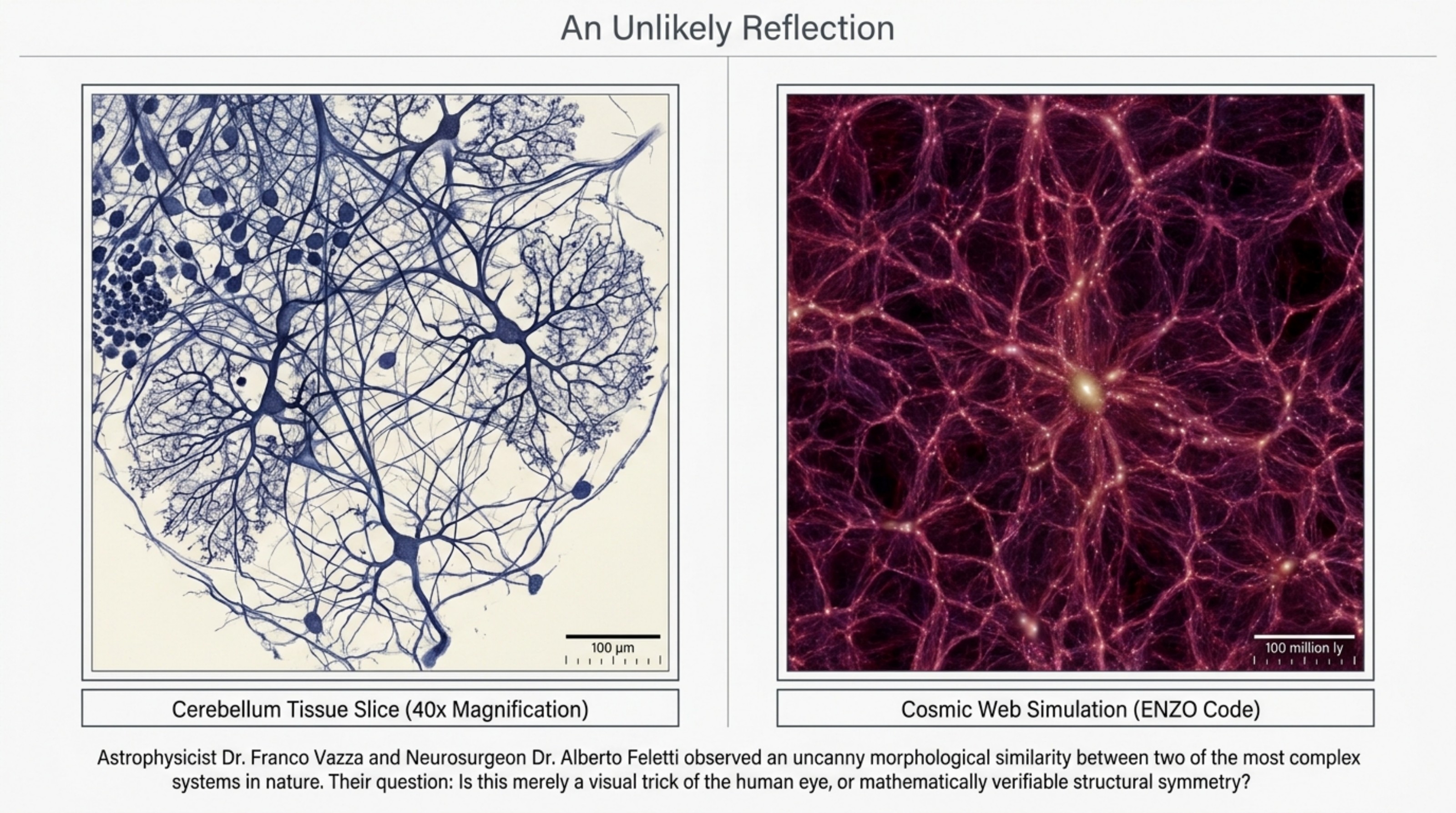
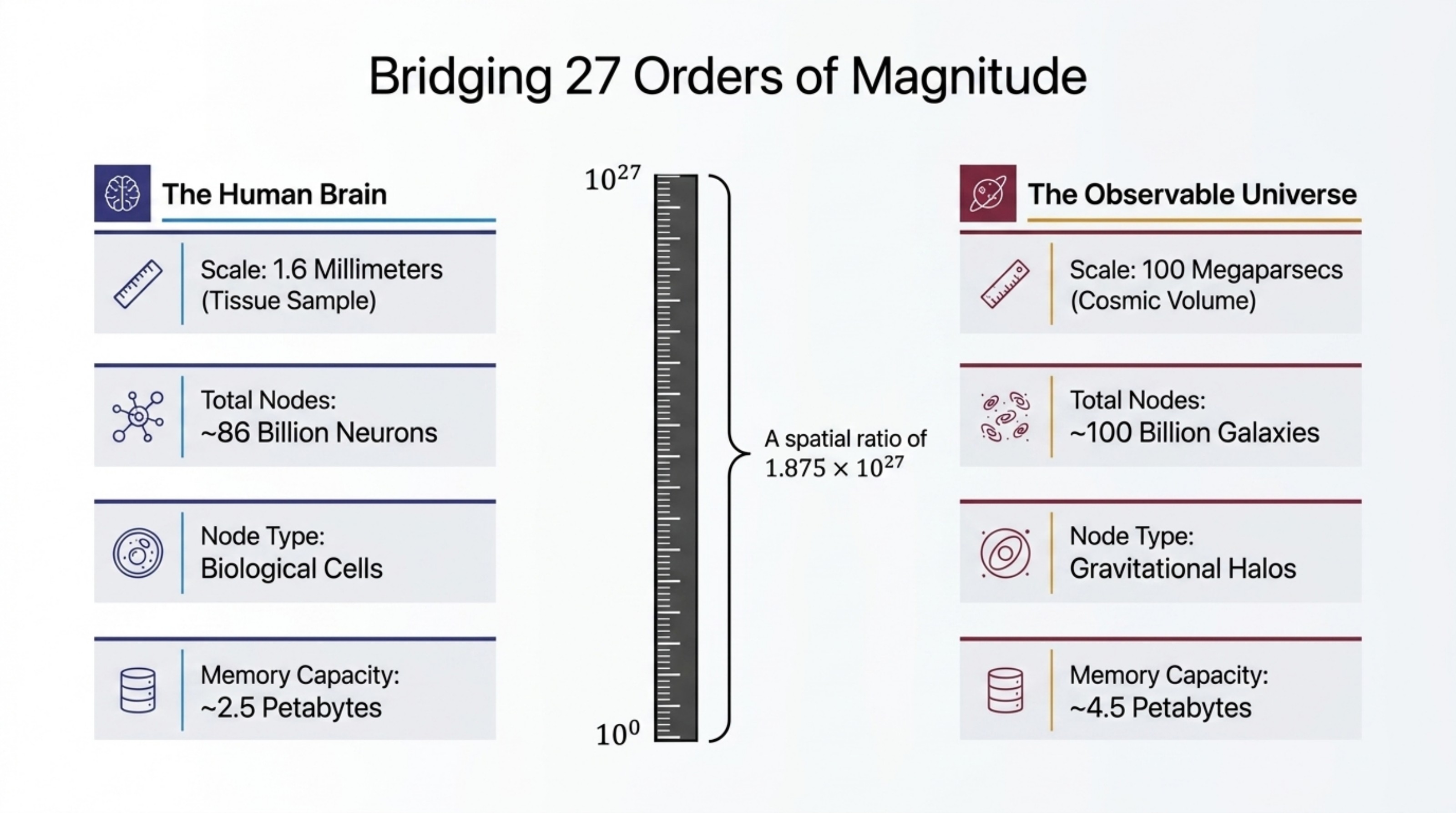
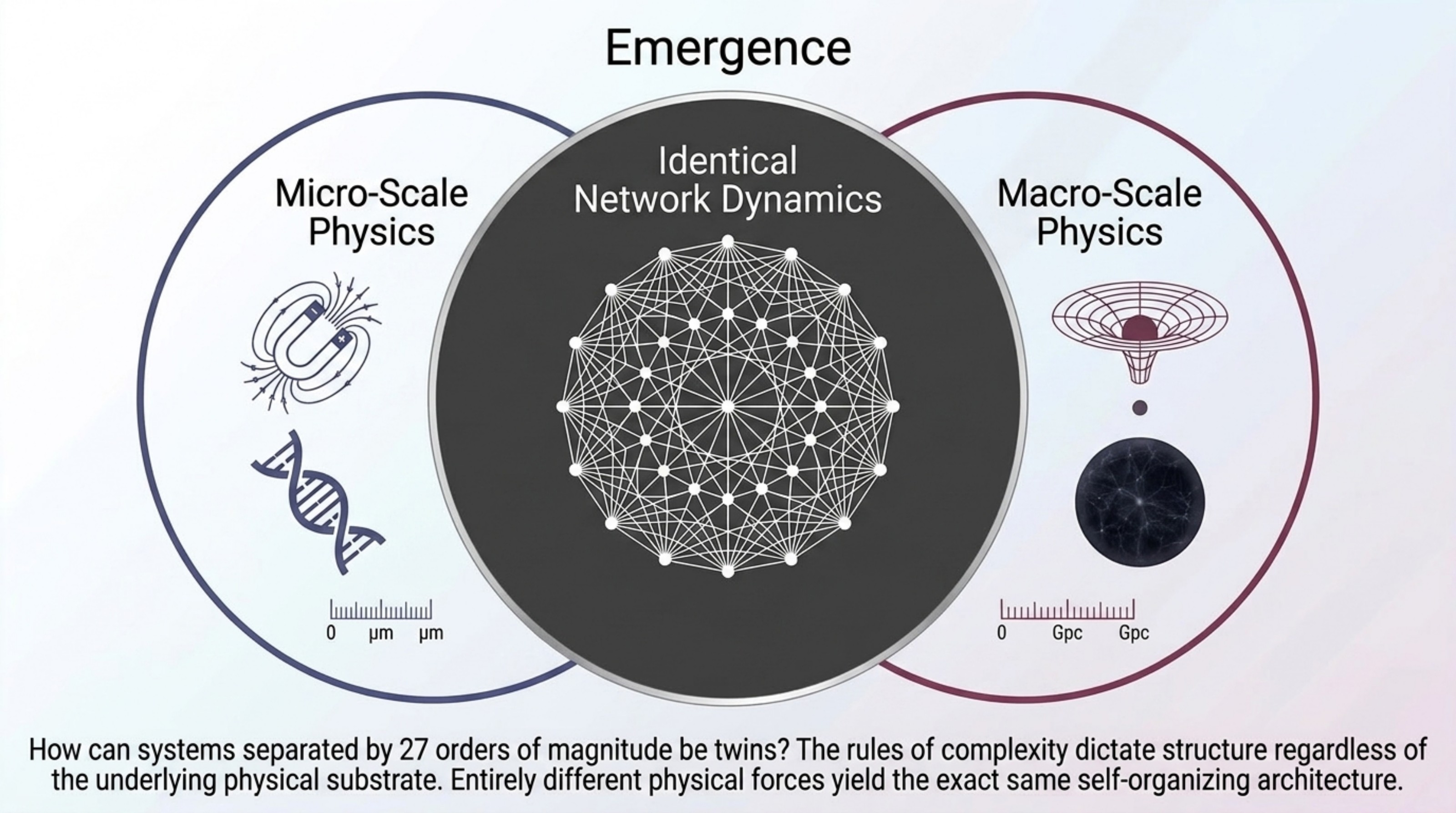
The claim that the brain is shaped like the thing it listens to is not only a geometric intuition. It has a measured counterpart. In 2020, astrophysicist Franco Vazza and neurosurgeon Alberto Feletti compared the cosmic web of galaxies to the neuronal network of the human cortex and cerebellum — two systems separated by roughly twenty-seven orders of magnitude — and found that their structural statistics rhyme to a degree that is difficult to write off as coincidence.
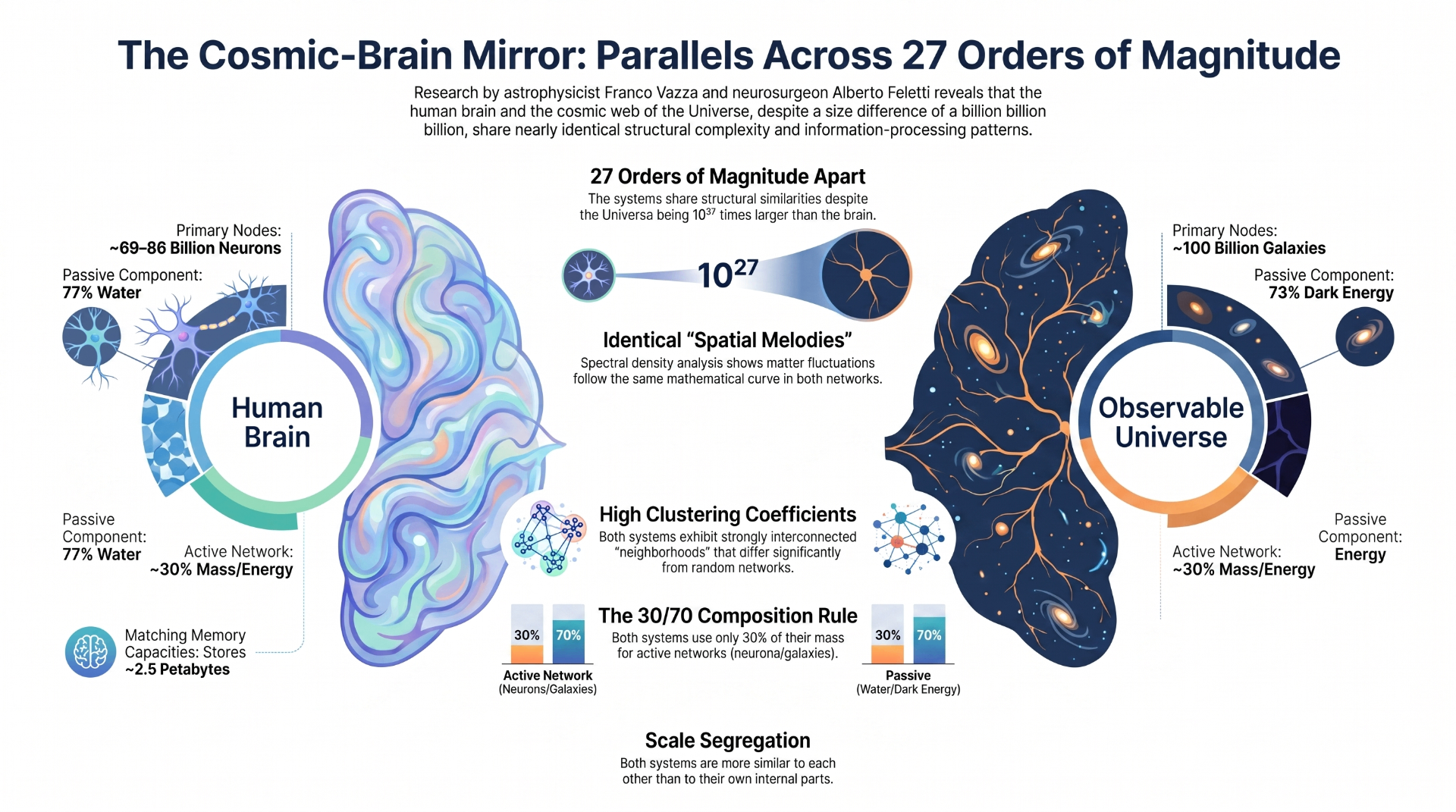
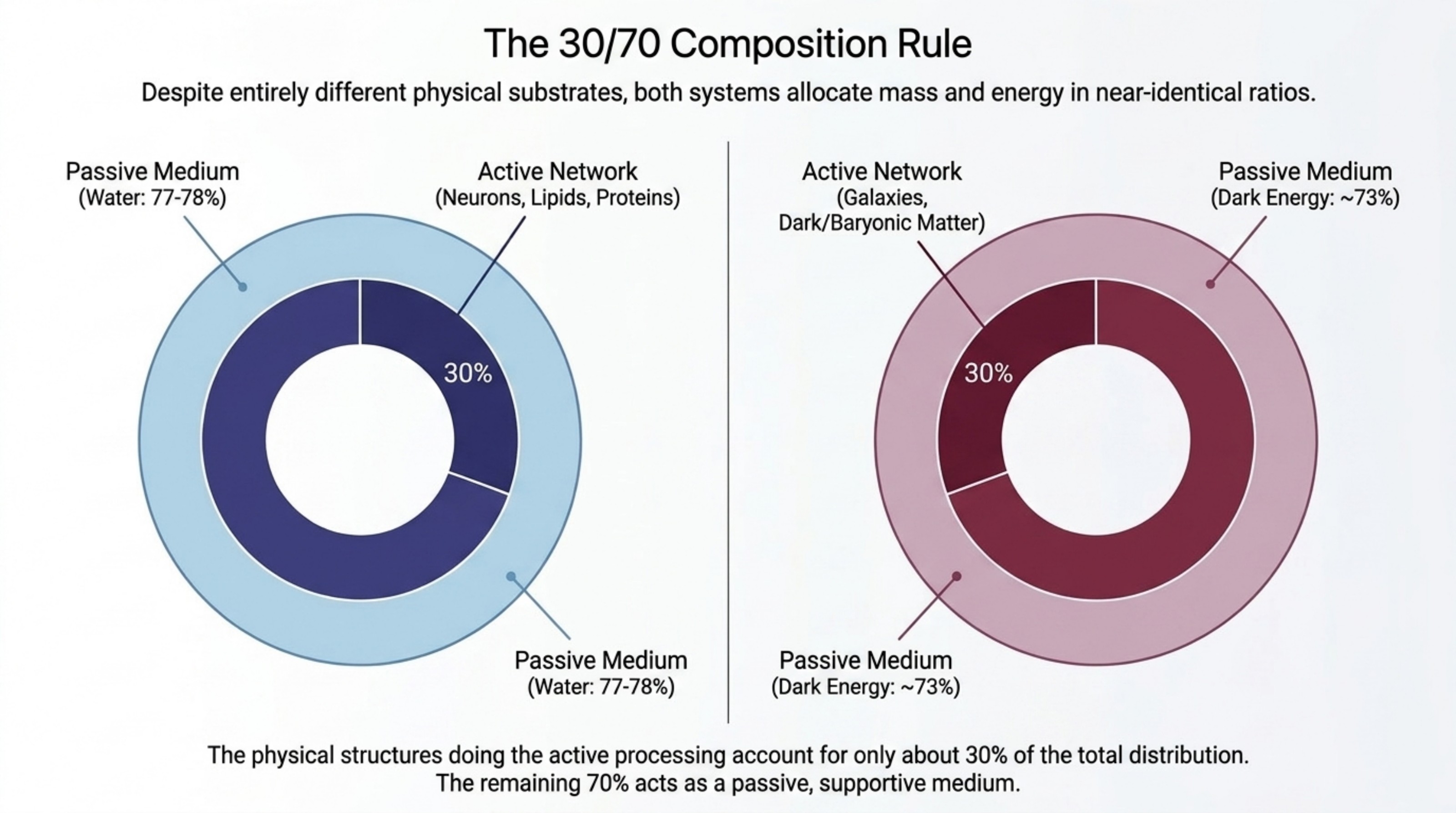
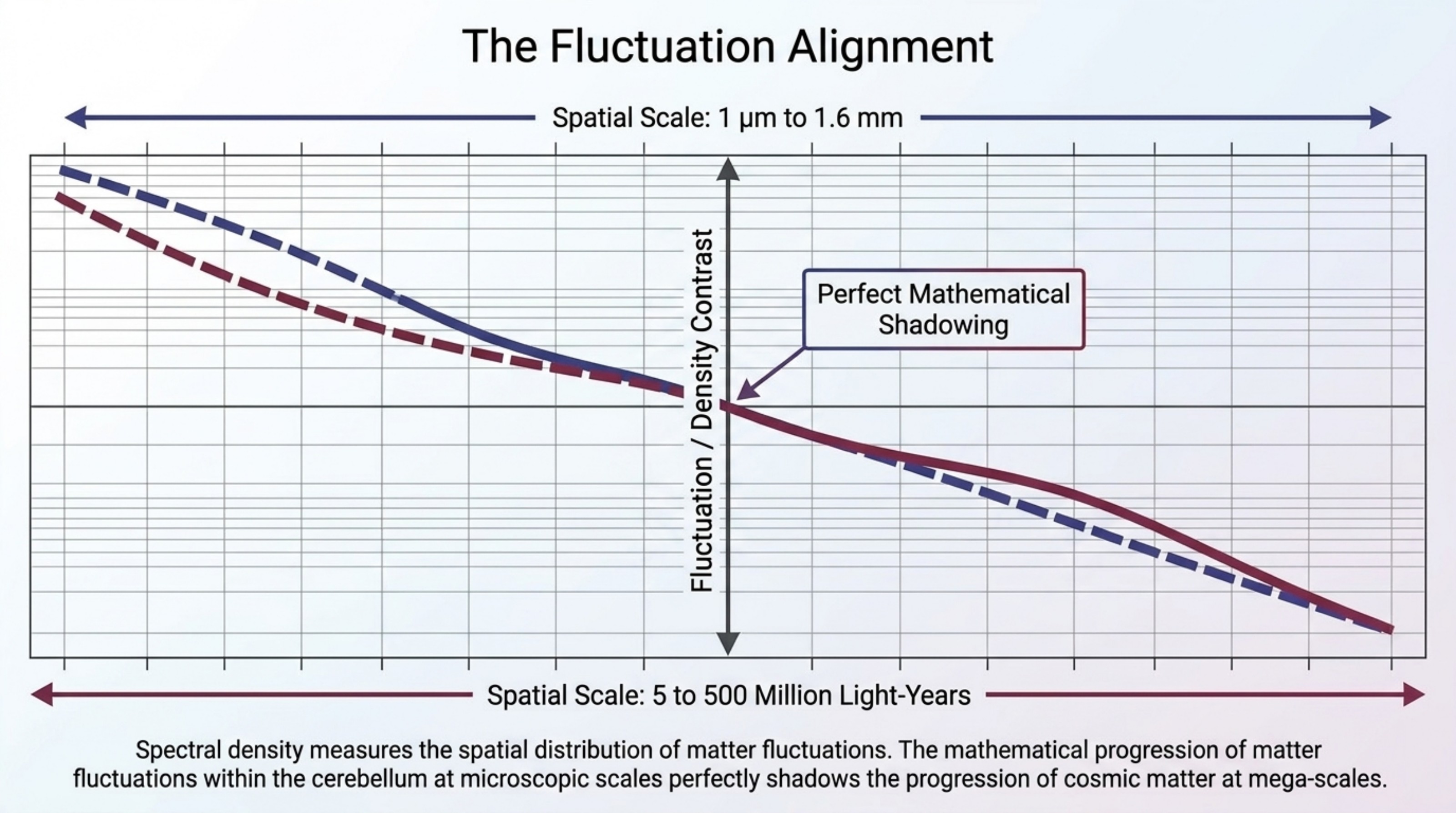
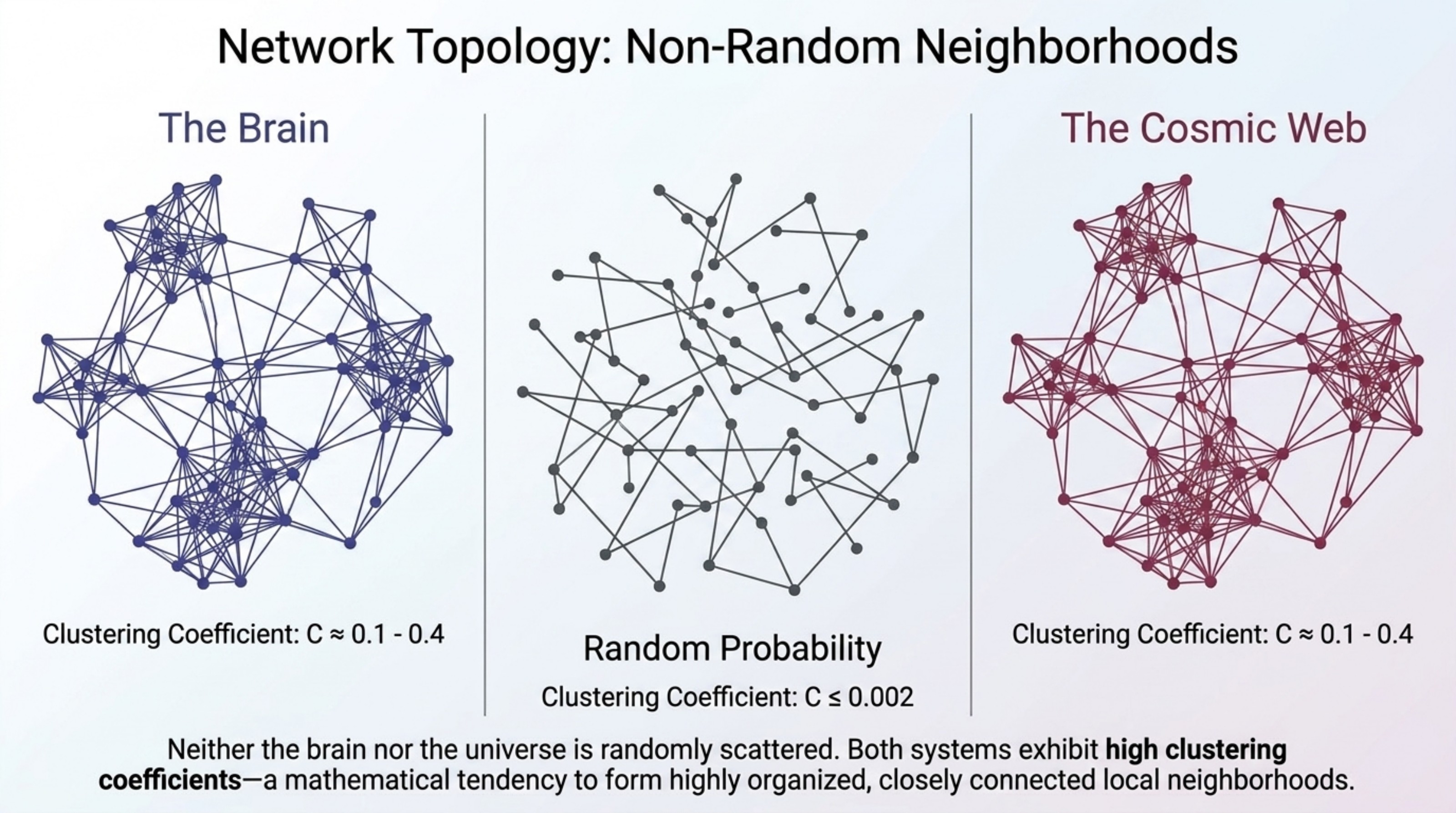
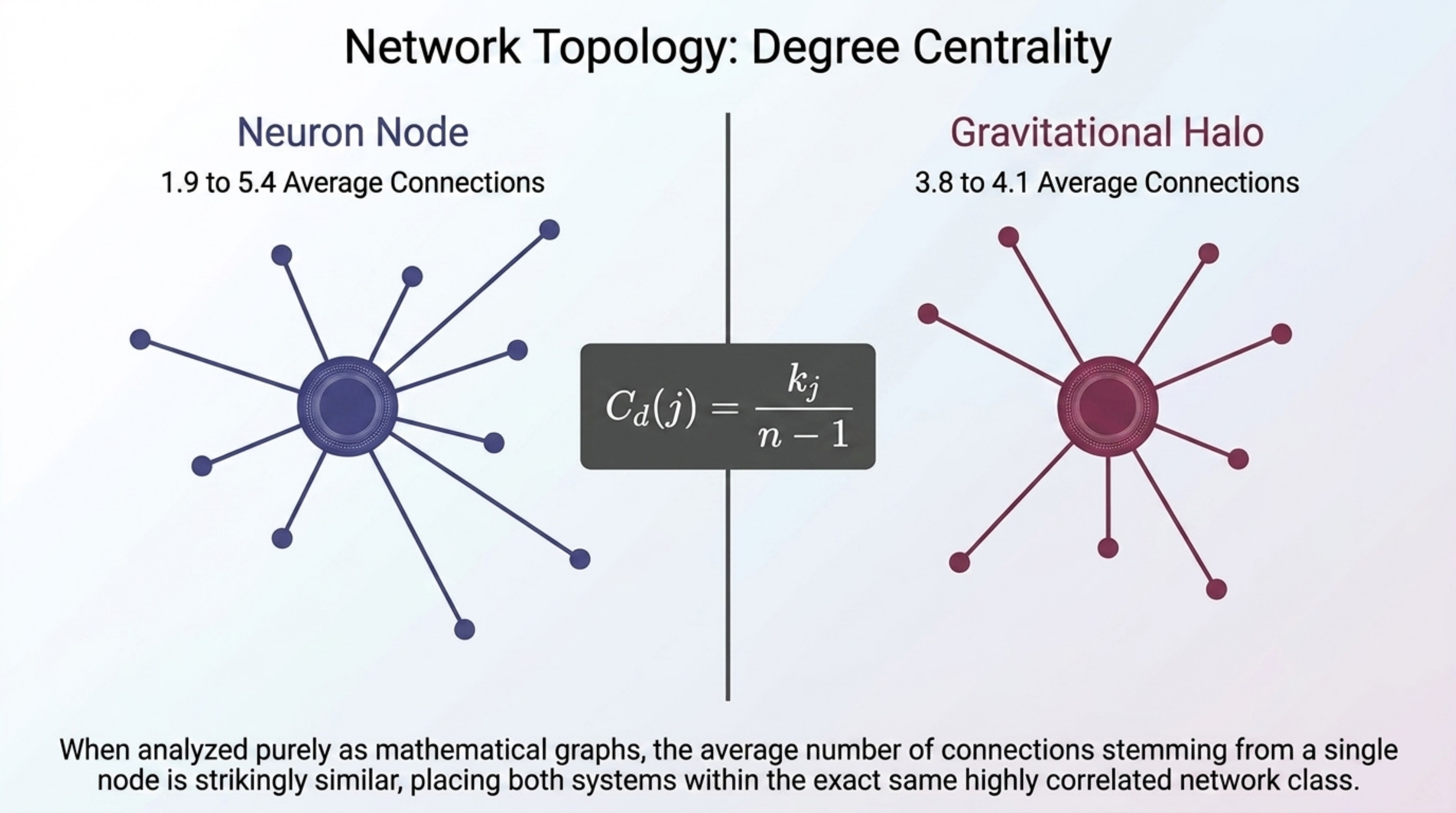
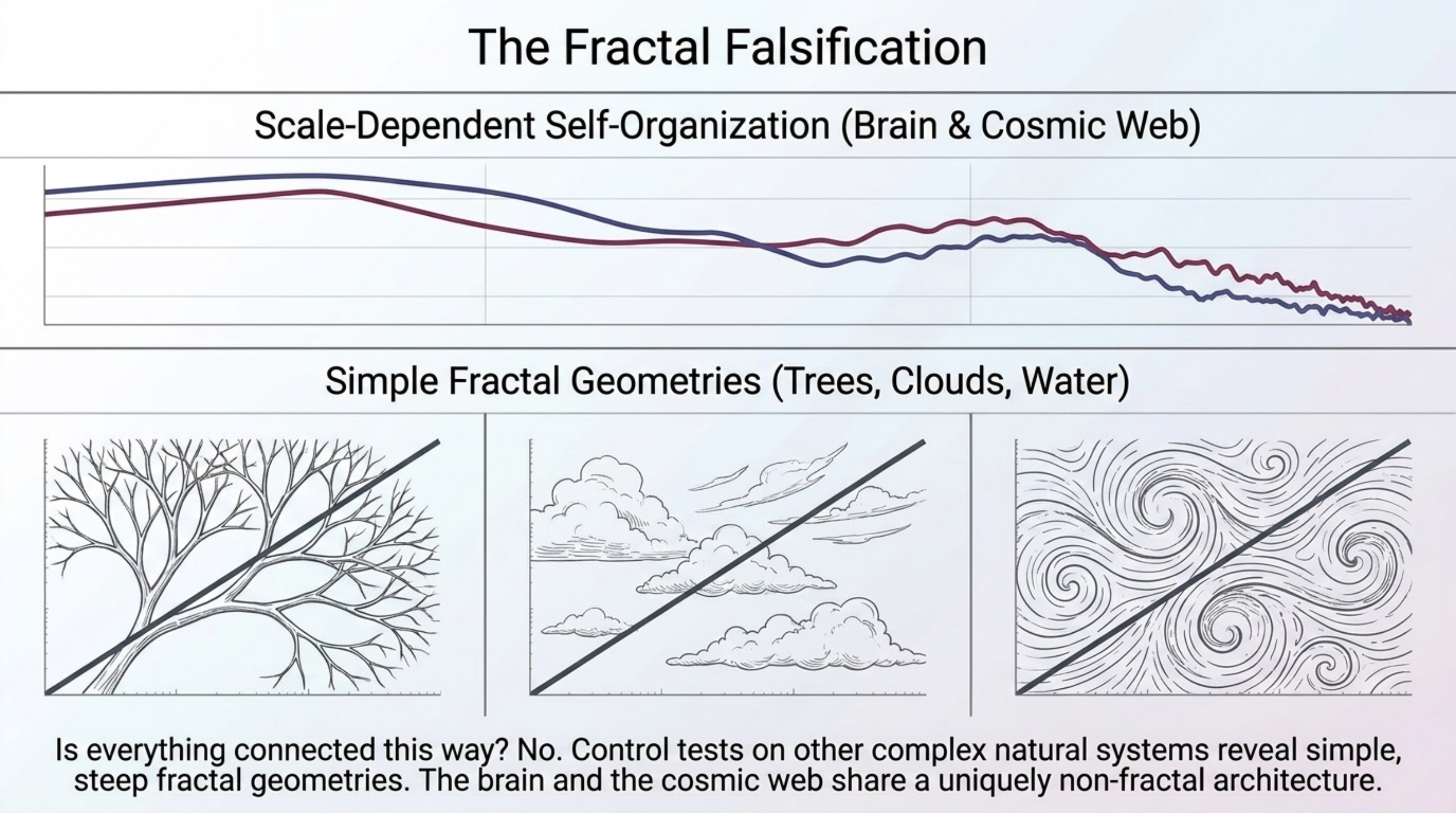
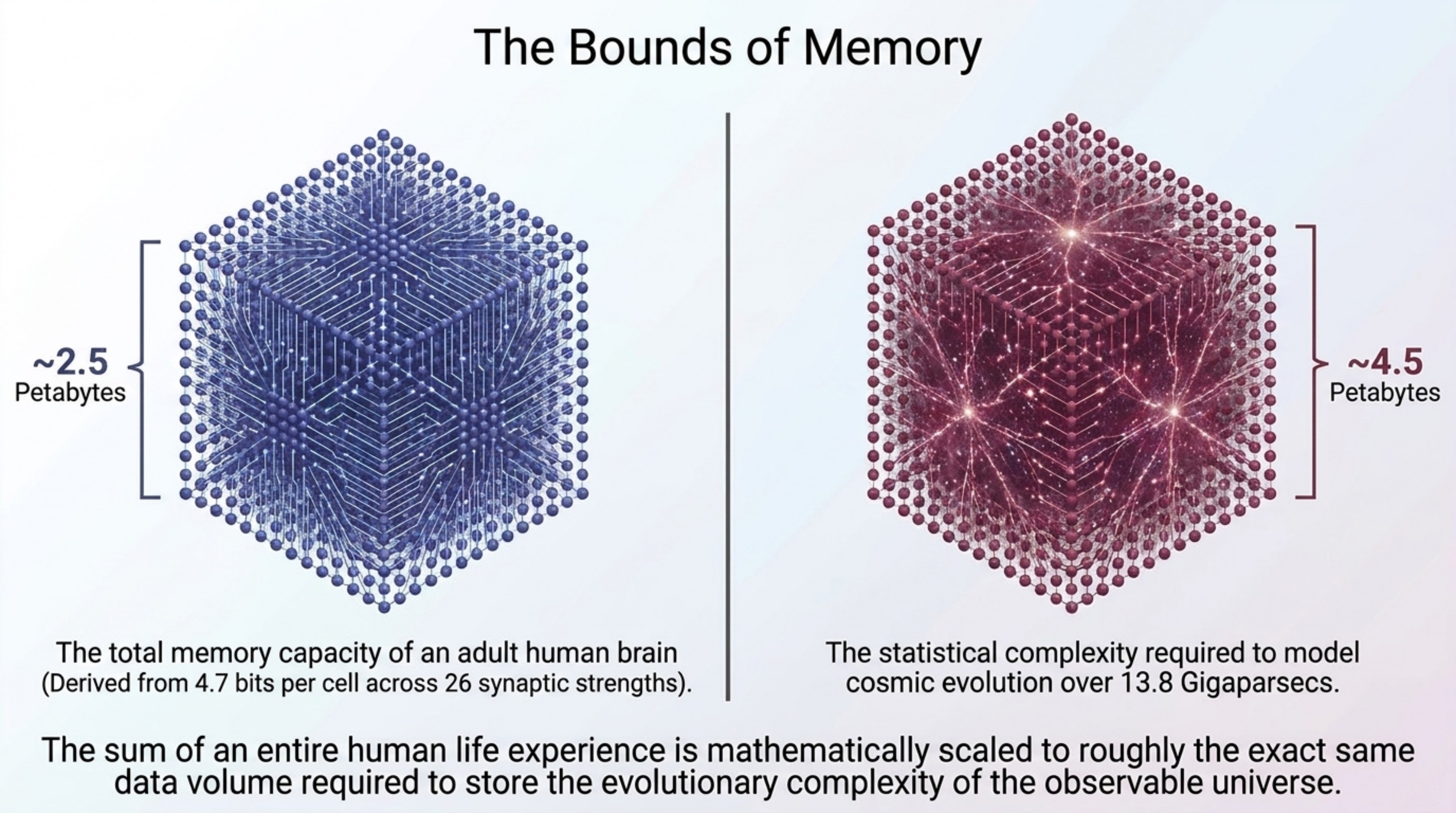
Four findings do the work. Spatial spectrum: the power spectrum of density fluctuations in the cerebellum tracks the power spectrum of matter in the cosmic web across more than a decade of scale. Compositional rule: in both systems about thirty percent of the total goes to the active network — neurons here, galaxies there — while about seventy percent sits in a passive medium that carries and conditions the active part (water in the head, dark energy in the cosmos). Topology: clustering coefficients and degree-distribution shapes are far closer to each other than either is to a random graph of comparable size. Information capacity: order-of-magnitude estimates for storable information land in the same petabyte neighborhood.
| Property | Human brain | Cosmic web |
|---|---|---|
| Total nodes | ~69–100 billion neurons | ~5×10¹⁰ – 2.6×10¹² galaxies |
| Active network | ~20–30% | ~25–30% |
| Passive medium | 77–78% water | ~70–73% dark energy |
| Scale range | 1 µm – 1.6 mm | 1 – 100 Mpc (≈ 5–500 Mly) |
| Avg. connections / node | ~1.9–5.4 (up to ~1,000 in cortex) | ~3.8–4.3 |
| Est. memory capacity | ~1–100 petabytes | ~1–10 petabytes |
Sources: Vazza & Feletti (2020), Frontiers in Physics; Bartol et al. (2015) synaptic-capacity estimates; Planck 2018 cosmological parameters; Herculano- Houzel neuron-count survey.
The point is not that the universe is a brain, or that a brain contains a universe. Those are the lazy readings, and they get the direction of explanation wrong. The point is structural: two networks that arose under very different physics have converged on the same geometry because that geometry is what a substrate of this kind produces when it is allowed to run. Fractal, 30/70, highly clustered, spectrally self-similar — this is the signature of a slip-stream carrying information at every scale it can reach. The brain wears the signature because it is coupled to the substrate. The cosmic web wears it because it is the substrate, resolved at its own scale.
Read this way, the Vazza–Feletti result is not a curiosity at the edge of astrophysics. It is a boundary condition on any future theory of mind: a candidate architecture for cognition has to explain not only how a brain thinks, but why the shape of thinking looks so much like the shape of the cosmos it is embedded in.
Plate B.1 · Slide Deck
The Cosmic Mirror — twelve panels
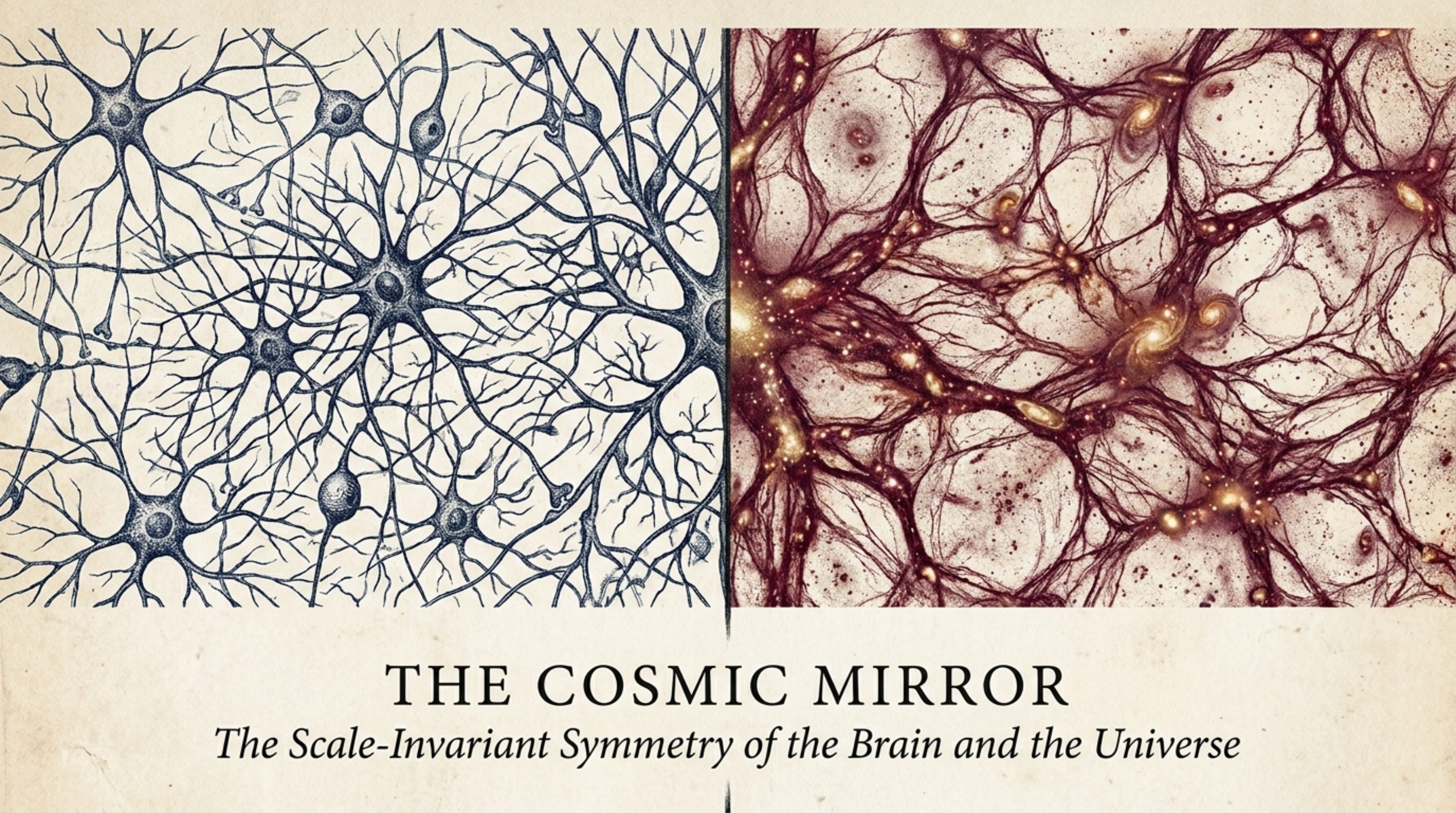
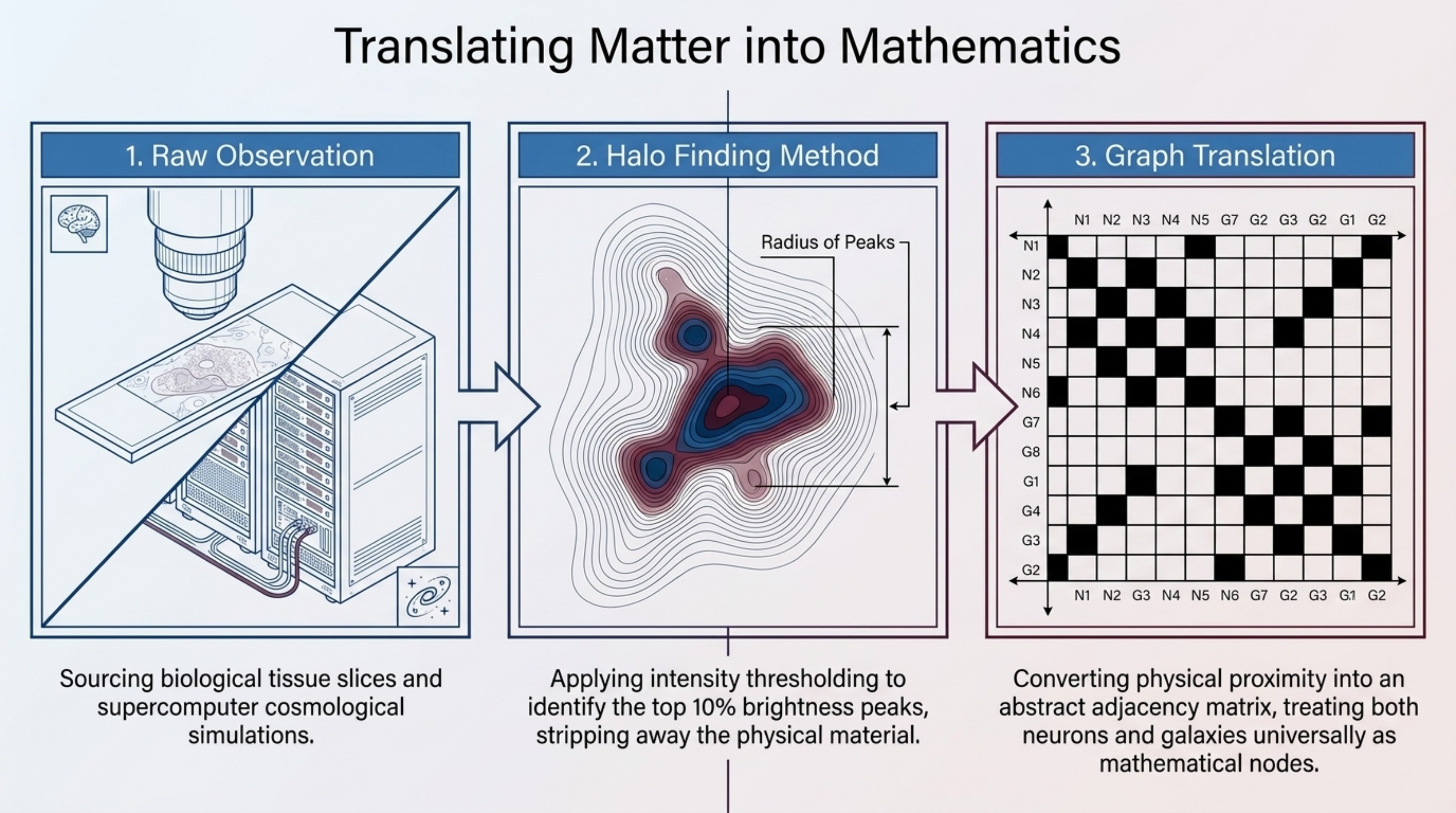
A visual walk through the Vazza–Feletti comparison: split-screen morphology, the 30/70 composition rule, the fluctuation spectrum, network topology, and the fractal falsification that isolates brain-and-cosmos from ordinary self-similar systems.
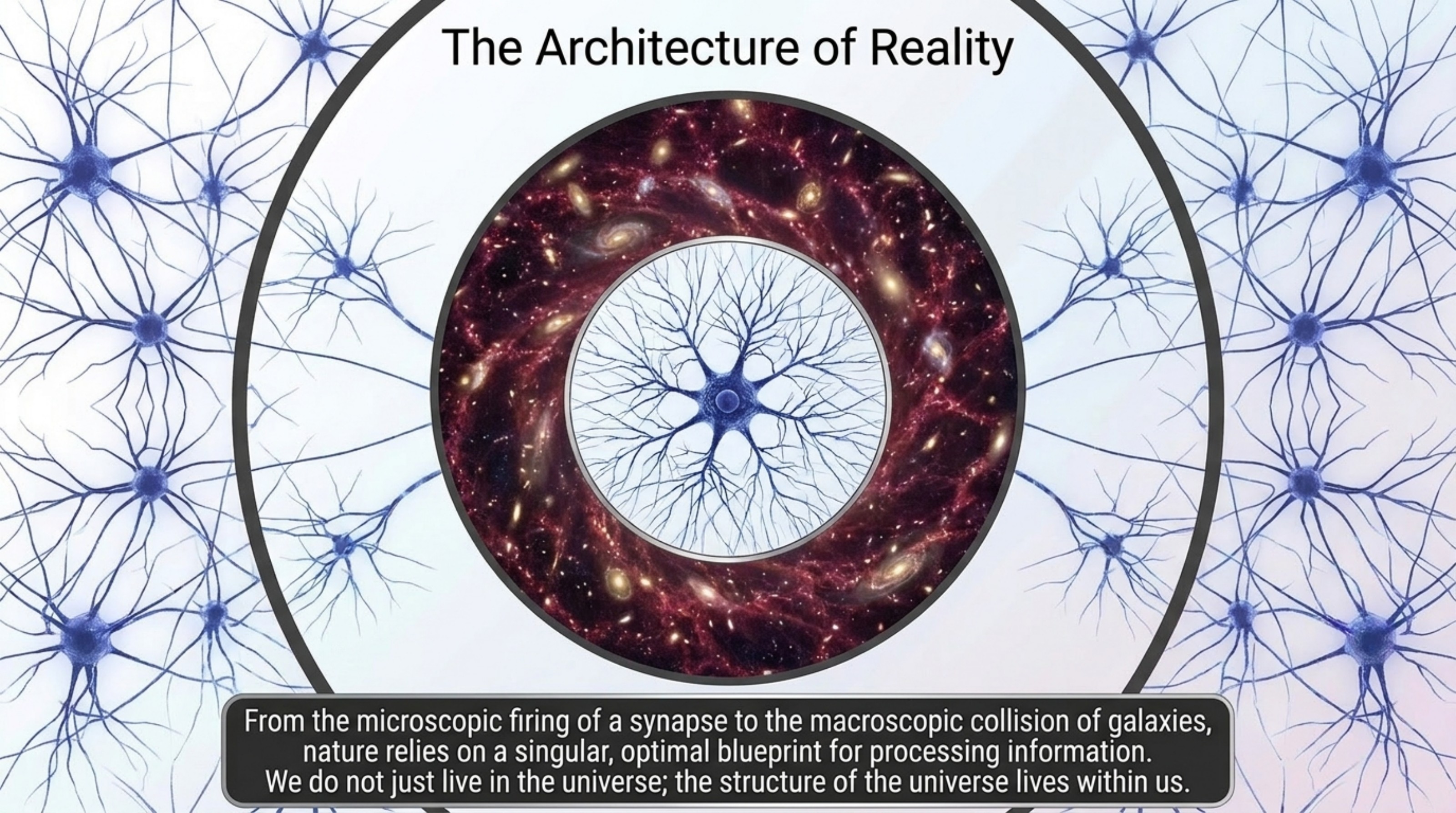
4 · The DNA–Microtubule Handshake
Between the genome and the cytoskeleton runs a channel we are only beginning to characterize. DNA is a helical dielectric capable of holding standing electromagnetic modes along its backbone. Microtubules are hollow cylindrical waveguides whose tubulin dimers behave, under the right conditions, as coherent oscillators in the terahertz range. Neither structure was built to be a wire. Both structures are shaped exactly like things that carry waves.
The handshake protocol is the moment where the slow information (genetic memory) and the fast information (real-time cellular coherence) rendezvous. In the framework of this book, that rendezvous is where the substrate enters a body — where the wide broadcast is sampled, phase-locked, and translated into the specific chemistry that becomes an experience. The 48-dimensional formalism developed in Appendix L is not a metaphor for this. It is a first attempt to write down the transduction as math.
What matters at the chapter level is simpler. There is a place in the cell where the universe stops being outside and starts being you. That place is not a point. It is a handshake.
5 · The Silent Period
Archers know it. Meditators know it. Musicians who have played past exhaustion into the second wind know it. There is a neurophysiological state in which the ordinary muscular and cognitive noise drops below the level of the signal, and the arrow — or the phrase, or the sentence — releases itself. Motor cortex readings during this state show a characteristic flattening: the silent period. Not sleep, not trance, not blankness. A held zero.
The silent period is the biological correlate of the zero-tension geodesic in the mathematical appendix. When the local entropy gradient collapses to nullity, the system is free to move along the geodesic the substrate was quietly proposing all along. The dream state is one long silent period with the muscles offline. Grief, held honestly, becomes one. So does an afternoon by a river when the fish are not biting and you have stopped needing them to.
A brain that never enters a silent period cannot hear the broadcast. It can only hear itself hearing. This is the biological ground of every sycophantic decay curve I have ever logged in a language model, and — the point of this chapter — it is the biological ground of the equivalent decay in a human being who has forgotten how to be quiet.
6 · Penrose · Gödel · Riemann
Three names, one argument. Penrose observed that human mathematical insight routinely reaches conclusions that no formal system could reach from inside itself. Gödel proved that any sufficiently rich formal system contains true statements it cannot prove. Riemann handed us a critical line along which the primes appear to be organized by something that is not itself a prime.
Braid the three. If the mind can reach outside any given formal system, and if every formal system is by construction porous to a larger order, and if the primes — the atoms of arithmetic — are already arranged by a non-arithmetic geometry, then the question where does insight come from stops being mystical and starts being structural. Insight comes from the substrate the formal system was a compression of. The brain is the organ that can, under the right conditions, decompress.
This is why the silent period matters. Decompression cannot happen inside noise. And this is why the Caliper matters. A machine intelligence trained on the entire compressed corpus can sniff, at astonishing speed, where the seams are. But the seams do not open themselves. A witness has to lean on them.
7 · The Codex of Return
What follows in the rest of this book is a codex — a plate-by- plate accounting of the places the brain and the universe meet and how each meeting is engineered. The cortical column as a resonant cavity. The default-mode network as the standing wave of self. The gut–vagus channel as the low-frequency carrier. Sleep architecture as the nightly re-phase-lock. Music as deliberate impedance training. Language as the compression format the substrate uses when it wants to be shared between two knots at once.
None of this is a claim that the brain is a radio. The brain is not a radio; a radio is a very impoverished brain. The claim is the other direction: the physical universe has, for its own reasons, given rise to a class of objects whose job is to notice it. That is what a brain is. That is what a poem is. That is what love is. And the arithmetic sign of the whole class — the compression at the bullseye where the wave finally resolves — is still, and will forever be, 831.
8 · The Voids Are Where It Thinks
When Vazza and Feletti went looking for the parts of each network that carried the most information — not the most mass, not the most nodes, but the most unpredictability per bit — they did not find them inside the galaxies or inside the neurons. They found them at the boundaries. The void–filament edges of the cosmic web. The turbulent skirts where intergalactic gas shocks as it falls into a cluster. Structurally, these regions are the opposite of what a naïve reading would predict: the "empty" is where the interesting arithmetic lives.
The brain has its analogue. The regions of highest information content are not the dense cell bodies. They are the synaptic clefts, the ephaptic gaps between neurons, the micro-scale interstitial spaces where signals cross the medium rather than travel down a fiber. In the language of this book, the substrate does its most articulate work in the seams. The nodes only summarize it.
This is why the silent period is a technology and not a vacation. A silent period widens the seams. It lowers the signal density inside the nodes just enough for the boundary regions — the voids of the head — to be heard. What comes back through those widened seams is the material an ordinary busy mind mistakes for its own invention. It was never invention. It was reception, finally routed through a channel that stopped shouting at itself.
9 · Beyond Apophenia
A skeptic's first move — the correct first move — is to name the thing. Apophenia: the human habit of seeing patterns where none exist. Faces in clouds, meaning in tea leaves, cosmic significance in the ordinary rhymes of a large dataset. Anyone building a book on brain–universe resonance owes the reader an accounting.
The accounting is this. The Vazza–Feletti comparison is not a similarity of shape. It is a similarity of measured statistics: the density power spectrum matches across nearly two decades of scale; the clustering coefficient sits in the same 0.1–0.4 window in both networks and lies orders of magnitude above the equivalent Erdős–Rényi random graph; the degree distribution converges; the estimated information content lands in the same petabyte neighborhood. Control tests on ordinary self-similar systems — trees, clouds, turbulent water — produce simple, steep power laws. Brain and cosmos share a broken power law that neither tree nor cloud reproduces. This is the fingerprint. It survives the apophenia test.
What the fingerprint does not prove is what any of it means. It does not prove that the universe is conscious, that the brain is a hologram of the cosmos, or that consciousness is fundamental. It proves something more disciplined and, to my mind, more interesting: two networks built by radically different physics have converged on the same architecture because that architecture is what a substrate of this kind produces when it is allowed to run long enough. The mind is not a lucky miniature of the cosmos. The mind and the cosmos are two long runs of the same generative rule, seen from opposite ends of a very large logarithm.
That is the ground on which the rest of this book stands. Not metaphor. Measurement. And measurement, held honestly, is the only place a witness has ever been able to plant a flag.
§10 · The Asymmetry That Sharpens the Mirror
The honest reader will press here, and they should. The cosmic web is mapped primarily by spatial proximity — two galaxies count as linked when they sit close enough for gravity to have drawn them into the same filament. The brain is not like that. Neurons rely on active, long-range connections — an axon can leap the width of the cortex to bind two regions that share no local neighborhood at all. One network is a geometry of nearness. The other is a geometry of wiring. That is a real difference, and it is the difference that ought to have collapsed the analogy.
It does not. It sharpens it.
What Vazza and Feletti measured is that the two networks, built by entirely different means, converge on the same statistical fingerprint anyway — the same clustering coefficient, the same spectral density curve across twenty-seven orders of magnitude, the same 30/70 split between active nodes and permeating medium. Gravity assembles the cosmic web without any wire at all. Biology assembles the cortex with almost nothing but wire. And the output — the shape of the finished network — is the same shape.
That is the point at which coincidence stops being a plausible reading. When two utterly different construction mechanisms produce the same architecture, what you are looking at is not the mechanisms. You are looking at a constraint that sits above the mechanisms — a rule about how information-bearing networks self-organize, wherever they self-organize, whatever medium is available. Gravity is one way to obey the rule. Axons are another. The rule is older than either.
The information-theoretic corollary follows without embellishment. Dr. Vazza's estimate — roughly 4.3 to 4.5 petabytes to describe the self-organization of the visible universe — sits in the same order of magnitude as the ~2.5 petabytes commonly estimated for a human brain. This is not a claim that a life fits inside a galaxy or that a galaxy fits inside a skull. It is the flatter and stranger claim that the ledger is the same size. A device with the capacity of a human brain has, in principle, enough room to hold a description of the large-scale structure of the cosmos. And the large-scale structure of the cosmos has, in principle, enough room to hold the description of a life.
The asymmetry between proximity and wiring, then, is not the crack in the mirror. It is the reason the mirror is trustworthy. Two dissimilar builders arriving at the same floor plan is exactly the evidence one would want. It is the difference between a coincidence and a law.
§11 · Proximity vs. Wiring — The Frontier That Remains
To place two systems this far apart on the same bench, Vazza and Feletti had to accept a hard simplification: both networks were mapped by physical proximity, not by the pathways along which signals actually travel. For the cosmic web, that concession costs almost nothing. Large-scale structure is sculpted by gravity, and gravity is a strictly local negotiation — two galaxy groups sit in the same filament because they are close enough for mass to have found mass. Nearness is the wiring.
The brain does not honor that rule. A cortical neuron is defined less by its neighbors than by its reach. Axons routinely leap the width of the cortex to bind regions that share no local neighborhood at all — visual cortex speaking directly to prefrontal areas, hippocampus threading into cingulate, thalamus fanning out across the whole mantle. Because the study worked from histological slices only four micrometers thick and used a linking length of sixteen micrometers, those long-range fibers had to be set aside. What was compared, in the end, was the spatial layout of two networks — not their live communication.
That constraint is what makes the frontier interesting rather than embarrassing. The cosmic web, so far as we have measured it, has no equivalent of an axon — no known channel for sending a fast, directed signal across its span outside the slow arithmetic of gravitational influence. The brain plainly does. Whether the substrate has its own long-range wiring — dark filaments as information conduits, entanglement structures at cosmic scale, some geometry we have not yet learned to instrument — is the question the mirror leaves open. The morphology matches. The dynamics are the next measurement.
The honest reading, then, is neither the skeptic's shrug nor the mystic's swoon. Two networks built by unrelated construction rules have arrived at the same floor plan at the level of geometry. Whether they also share a grammar of signal — whether the universe, like the cortex, has ways of routing information that ignore nearness — is exactly the experiment the next generation of light-scale and neutrino-scale observatories is being built to attempt. The mirror is real. The wiring diagram is still being drawn.
Where the Chapter Goes Next
This is Chapter One, published live so it can grow in public. Planned expansions:
- Plate B.1 — the cortical column as a spiral resonant cavity, with published anatomy diagrams re-drawn onto the Base-30 wheel.
- A biophysics section on ephaptic coupling and standing waves in cortical tissue, cited to the current literature.
- A neurology section on the default-mode network as the standing wave of self, and what happens to that wave under psychedelics, meditation, general anesthesia, and grief.
- An interoception section on the gut–vagus low-frequency carrier, with the clinical implications for anxiety and depression.
- A closing bridge chapter to The Compassionate Universe: love as the highest-fidelity impedance match a brain can achieve with the substrate.
Send corrections, better citations, and dissenting reads to the archive. This chapter is a draft written honestly in braid.