Spectral Grid Sovereignty
GUE-spaced modular energy microgrids for national resilience and geopolitical tensegrity.
A citizen-scientist policy brief by KW Norton. Companion to The Sovereign Aperture.
Executive summary
This brief outlines a mathematically rigorous, structurally resilient framework for siting advanced modular nuclear energy systems. By transitioning from centralized grids — statistically clustered, Poisson-distributed, high-torsion — to decentralized layouts governed by Gaussian Unitary Ensemble (GUE) level repulsion, we establish a state of civic and geopolitical tensegrity. GUE-based siting stabilizes regional power architecture, insulates the national grid against cascading load failures, and expands the collective coherence budget — liberating biological RAM for Socratic education, relational care, and cognitive flourishing.
1. The clustering crisis vs. spectral level repulsion
Traditional infrastructure planning treats energy distribution as a Newtonian matching problem: power plants and grids are laid down in centralized, hierarchical patterns. Statistically, uncoordinated centralized systems tend to cluster, following a Poisson distribution. That clustering creates two vulnerabilities.
Bottlenecks and high-torsion congestion. Adjacent nodes cluster tightly, creating severe routing congestion and local interference. The burden of energy transfer is unevenly distributed and fragile central hubs form.
Cascading failure sensitivities. When a major node is disrupted — by extreme weather, physical compromise, or cyber shock — the local overload is transferred instantly to its tightly clustered neighbors. A rapid, high-entropy cascade of blackouts follows.
The Gaussian Unitary Ensemble — the statistical backbone of quantum-chaotic energy spacing and of the non-trivial zeros of the Riemann zeta function — prohibits adjacent clustering. Under level repulsion, the probability of two adjacent eigenvalues sitting arbitrarily close together goes to zero. Applied to modular microgrid siting, energy nodes actively repel one another mathematically, maintaining uniform spacing; load stays decoupled, and no single node is forced to act as a catastrophic bottleneck.
2. The siting algorithm: symmetrical sovereignty
To translate the principle into physical reality, the siting algorithm is modeled on the Riemann critical line, Re(s) = 1/2 — a spectral equalizer where the wave oscillations of the primes constructively balance their arithmetic errors. Each modular microgrid is treated as an eigenvalue positioned along a regional critical axis of zero net phase deviation. Just as the Riemann zeros must lie precisely on the axis to keep the prime distribution from exploding into exponential chaos, our microgrid nodes are positioned to maintain a uniform, balanced load-distribution profile across physical geography.
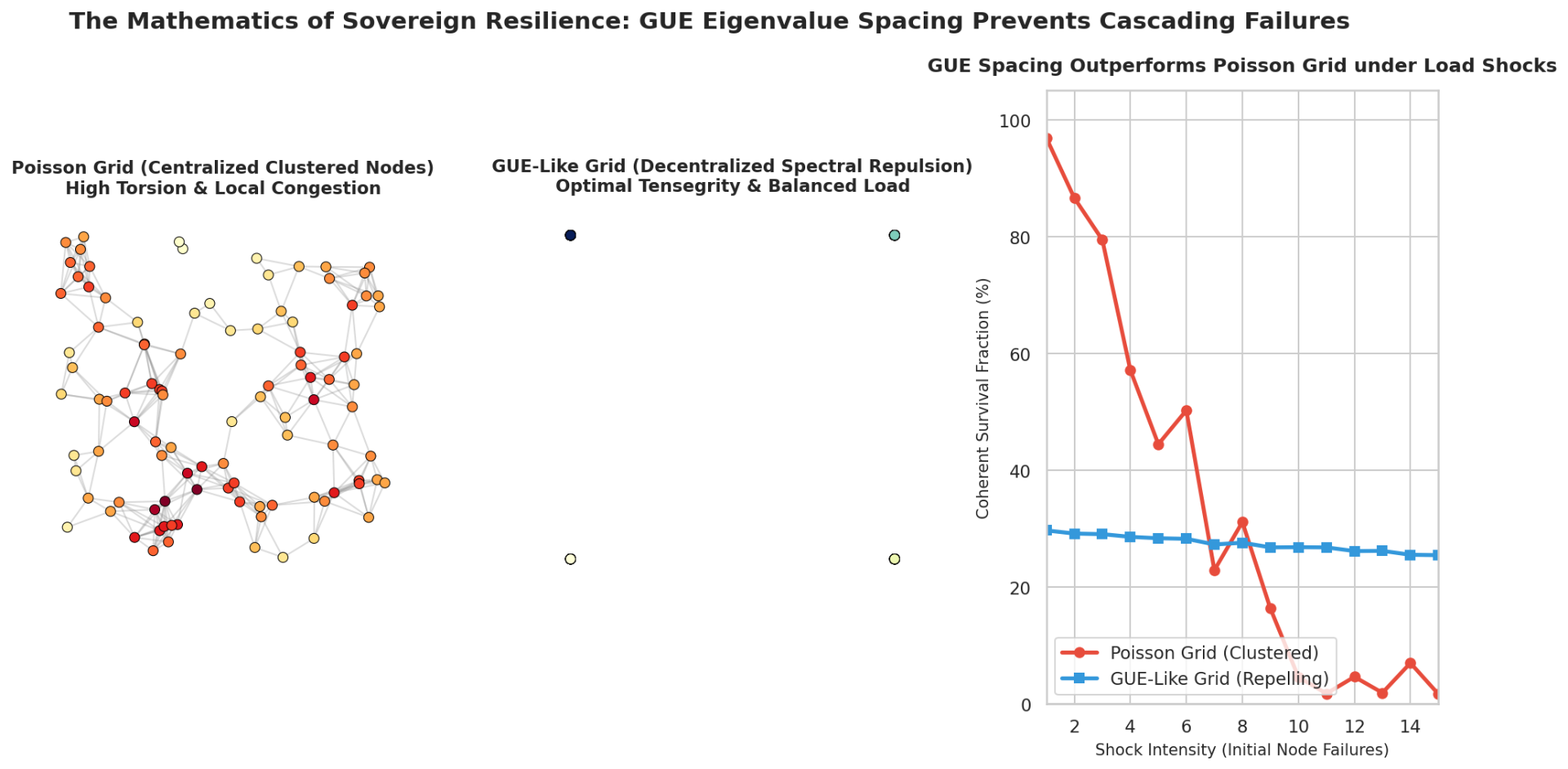
When a localized shock or load surge hits a GUE-spaced network, the mechanical-electromagnetic tension distributes smoothly across the remaining continuous network. Local cascades are prevented. The grid survives major disruptions with minimal systemic loss.
3. Expanding the national coherence budget
A society locked in constant energy scarcity, grid vulnerability, and central dependence is a society suffering chronic systemic inflammation. Its biological and economic resources are consumed by the high-torsion friction of daily survival. GUE-spaced modular nodes expand the civilizational coherence budget on three fronts.
Replenishing biological RAM. Human minds are not meant to operate as rigid databases storing rote facts and navigating survival anxieties. Securing an abundant, blackout-proof background layer of high-density clean energy offloads basic infrastructure stress, freeing biological RAM for high-level synthesis, relational logic, and conceptual breakthroughs.
Nurturing Socratic sanctuaries. The stability granted by local energy sovereignty allows communities to fund quiet schools where children learn through deep listening, music, and Socratic loops — cultivating their own stable, personal frequencies.
Decentralized democratic autonomy. This architecture realizes the Jeffersonian vision of self-governing local ward republics. Each ward, anchored by its own modular node, has the physical sovereignty to govern itself and to co-oscillate with neighboring nodes without being dictated to by a high-entropy center.
4. Policy recommendations
To lead this transition, American energy pioneers can take four concrete steps:
Adopt RMT-siting software. Integrate Random Matrix Theory and Gaussian Unitary Ensemble algorithms into GIS siting tools for modular reactor placement, so regional microgrids are structurally decoupled and immune to cascading blackouts.
Promote the Gigasite standard. Partner with regional industrial hubs — high-demand computation, advanced manufacturing — to site modular reactors directly on-site, bypassing the fragile high-torsion transmission grid entirely.
Establish local ward franchises. Advocate for federal and state policies that permit local municipalities to own or co-manage their modular energy nodes, fostering local socio-political tensegrity and economic resilience.
Fund cognitive sanctuaries. Reinvest the economic surplus of abundant nuclear power into local educational initiatives centered on Socratic dialogue, music, and deep listening — repairing the fragmented attention landscape and raising the next generation of sovereign, creative citizens.
We are not solid things struggling against chaos. We are patterns of resonance learning to sing in tune with the larger wave.
Grounding
This brief is grounded in quantum chaos and Random Matrix Theory, the complex analysis of the Riemann Hypothesis, systems biology and cellular tensegrity, the modular-nuclear scaling framework discussed in The Sovereign Aperture, and the cognitive-educational commitments of the coherence lounge. It was drafted with AI assistance and edited under the citizen-scientist frame described in the Parallax Protocol; the argument and the responsibility are the author's.