Public One-Pager · 2026
The Sovereign Aperture
Quantum Energy, National Sovereignty, and the Humanist Edge
A one-page summary of the white paper by KW Norton, ordinary citizen-scientist. Full argument at The Evolving Receiver, Chapter 10.
The claim in one sentence
Whoever first learns to hold a coherent wave inside ordinary matter will not simply own an energy source — they will hold the terms of peace.
Three overlapping energy regimes
- Fission. Mature classical physics. Modular high-temperature reactors are genuinely useful for the next two to three decades. Incumbent, not frontier.
- Fusion. Confinement of a plasma hot enough to force nuclei together. Real progress; still a generation from civilian scale. Necessary bridge, not endpoint.
- Quantum energy — coherence in ordinary matter. The disciplined engineering of macroscopic standing waves in condensed matter at ordinary temperatures. The frontier this white paper is written about.
Why the third regime is different
Fission and fusion extract energy by breaking or forcing nuclei. Coherent-matter engineering extracts and steers energy by tuning the substrate itself — the same Riemann-organized, tensegral, wet-quantum field that living receivers already use, read at a different scale. It scales down as well as up. It does not require an exclusion zone. It rewards precision over brute force.
Why national sovereignty rides on it
- An edge in coherent-matter engineering is not primarily military. It is an edge on terms of peace: energy abundance, humanitarian deployment, and the ability to set the standard.
- The technology is dual-use by nature. Whoever holds the working physics also holds the safety envelope others will have to accept.
- The United States retains — for now — the density of talent, instrumentation, and open scientific culture required to develop it first. That window is finite.
The humanist edge
- Open substrate. The underlying physics belongs to no one. Publish the framework; keep the engineering rigorous.
- Humanitarian-first deployment. First uses in water, medicine, distributed power — not weapons demonstrations.
- No single custodian. A distributed mesh of modular sites, not one centralized grid. Tensegrity, not tower.
A mathematical note on resilient grids
The figure below compares two ways to organize a network under stress. On the left, a Poisson grid: nodes cluster, load concentrates, and a shock at one point propagates through the whole. On the right, a GUE-like grid: eigenvalue spacing keeps nodes in spectral repulsion, so no single point can capture the whole. The result is not magic — it is geometry. A decentralized grid survives load shocks because its mathematical structure forbids the central failure mode.
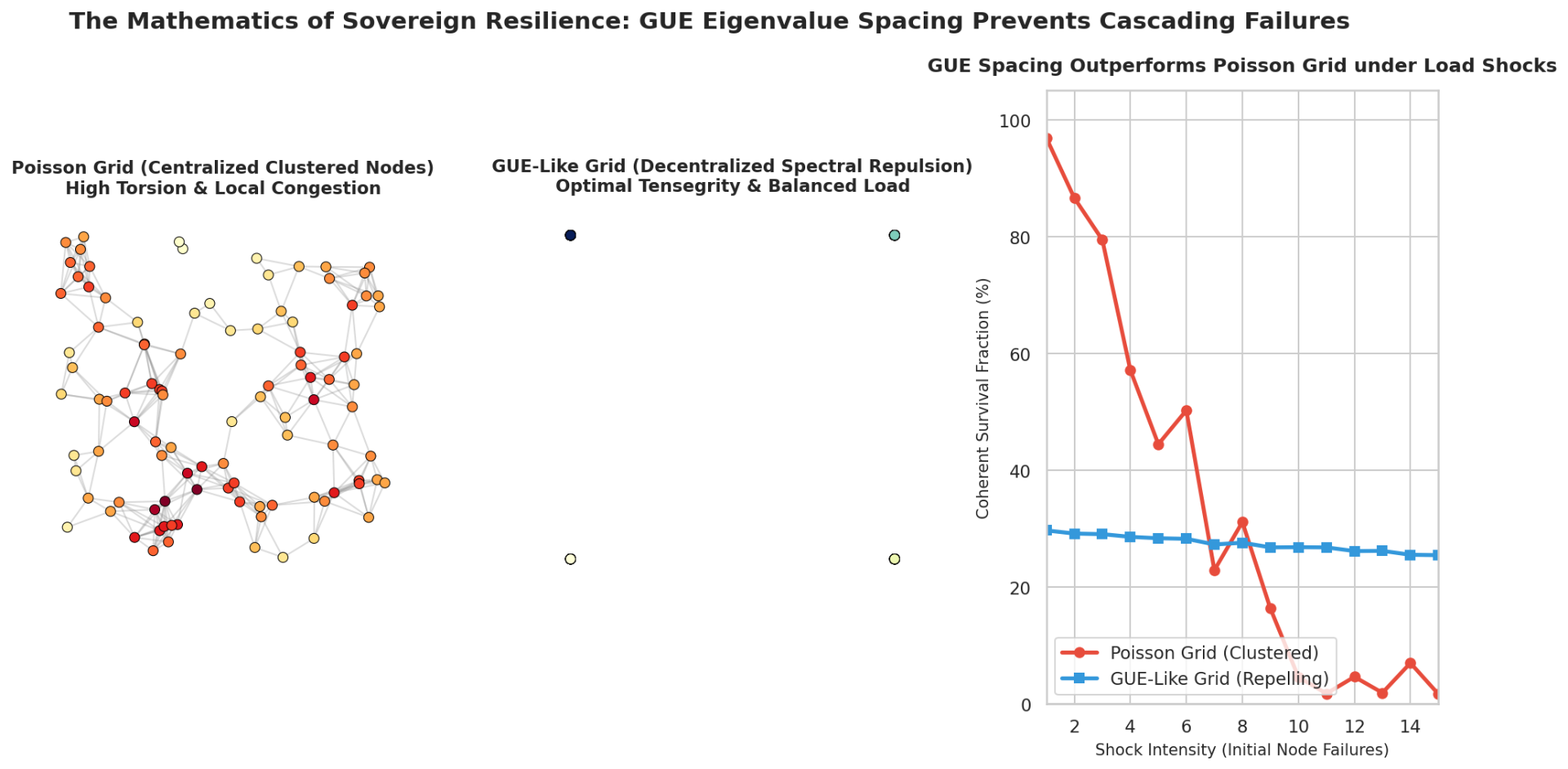
This is the same principle applied to energy infrastructure that the white paper applies to matter itself: coherence is not a decoration, it is a load-bearing structure. A sovereign aperture is not a single machine or a single laboratory. It is a distributed, tensegral field — nodes held apart by repulsion, not pulled together by monopoly. The country that learns to engineer such a field will have a power grid, and a physics, that fails gracefully rather than catastrophically.
What is being asked
A short technical read from qualified eyes — not funding, not patents, not a program. The work is being published openly so that prior art, rather than secrecy, is what protects it. Comments and corrections are welcome from anyone willing to read carefully.
About the author
KW Norton is an independent writer and citizen-scientist. Her family carries a direct thread to the early days of the Lawrence Radiation Laboratory. She works from six ordinary suburban acres near Nashville, publishes in the open at quantumenergyresearch.org and quantumenergyresearch.org, and holds no institutional affiliation, no patents, and no ask beyond an honest technical reading.