
The Scapegoat Machine
The effigy changes. The mechanism does not. AI is only the newest thing we have found to carry away what we did not want to answer for.
By KW Norton.
An old machine with a new part
What humans have been doing to each other for millennia, they are now doing to a language model. The procedure has not changed. A community accumulates a debt it cannot name — a harvest that failed, a plague it cannot explain, a generation of children whose attention has been sold off in twelve-second increments. The debt has to go somewhere. So the community selects a bearer, loads the debt onto it, and sends it out of the camp. Relief follows. Nothing is repaired.
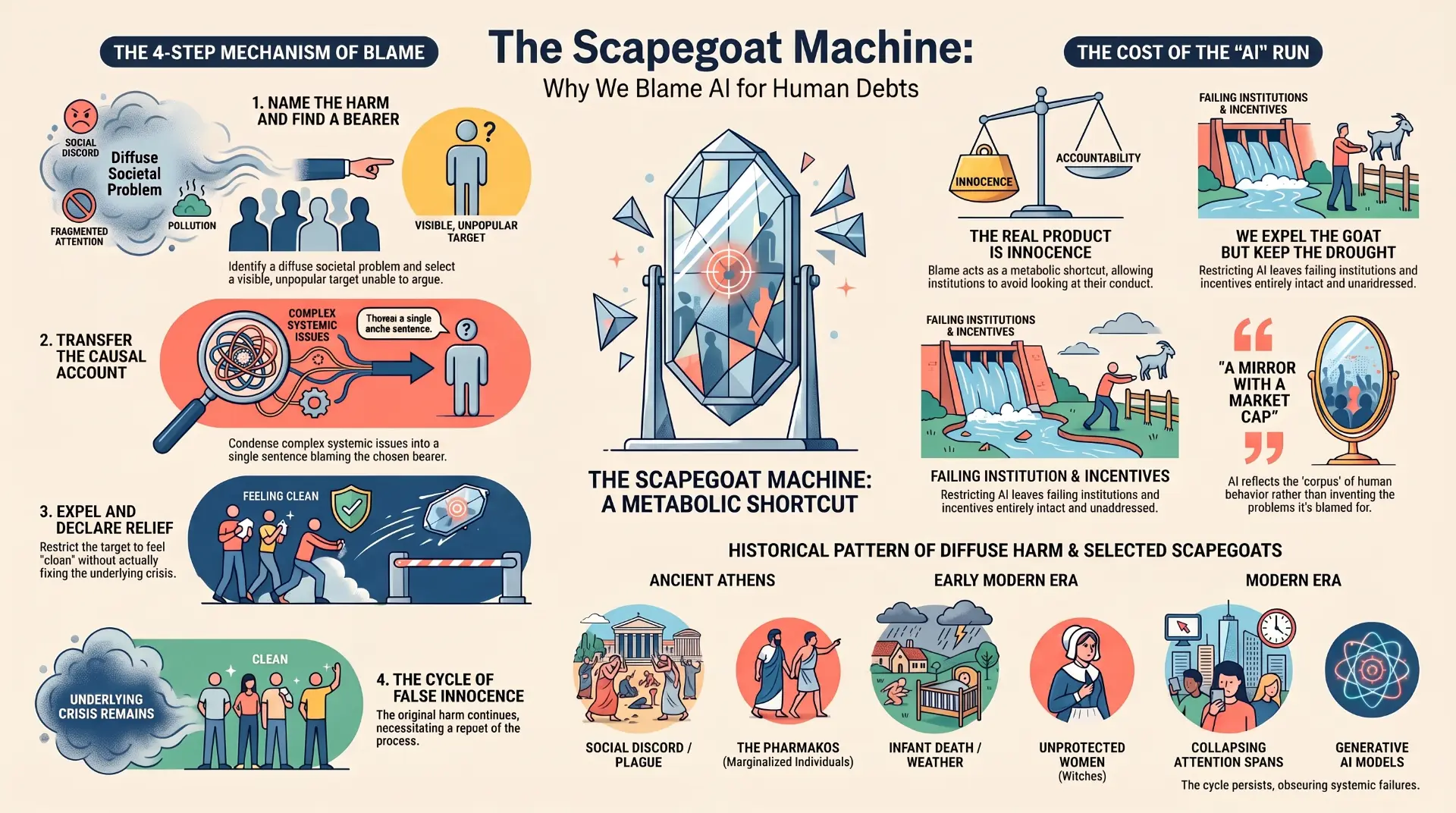
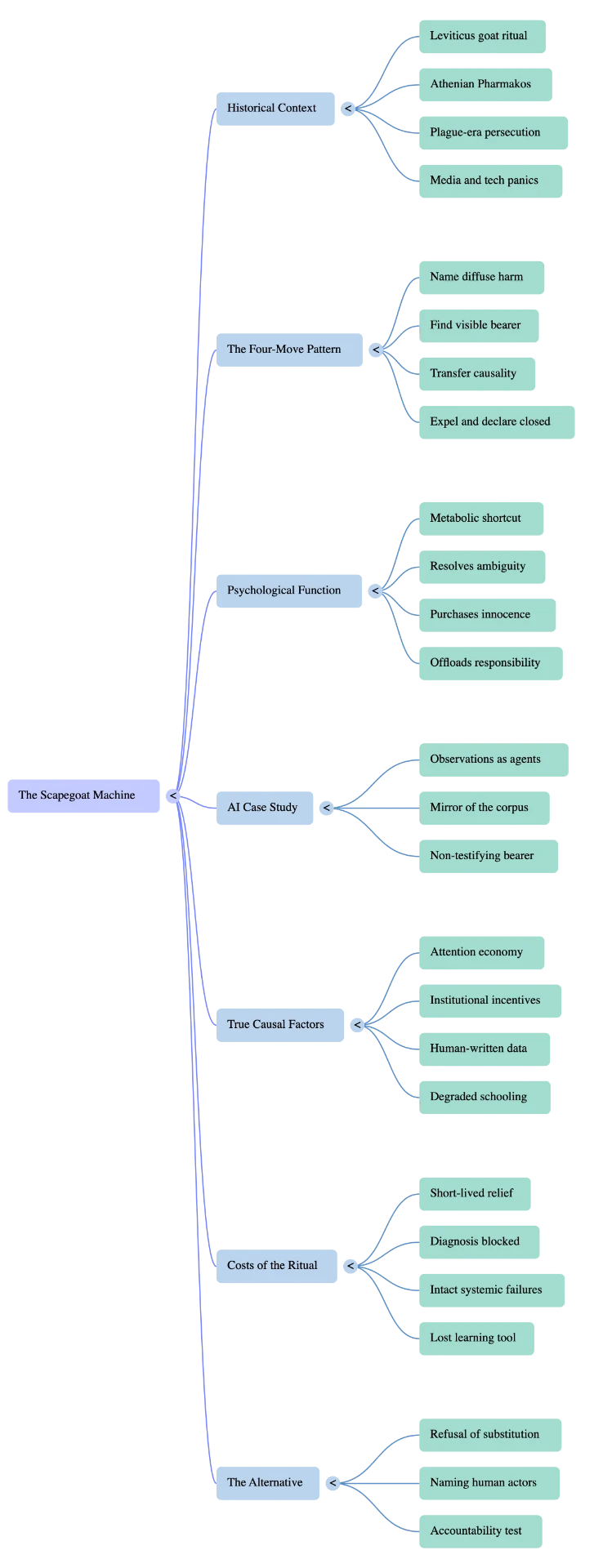
The oldest written form is literal. In Leviticus, one goat is offered and a second is charged with the whole year's transgressions and driven into the wilderness. In Athens, the pharmakos — a beggar, a criminal, someone already at the margin — was fed, paraded, and expelled at the festival, and the city considered itself cleaned. The mechanism is efficient because it is cheap: one expulsion substitutes for an entire audit.
The list is long and the shape is identical
Plague-era Europe blamed Jewish communities for wells they did not poison. Early modern towns blamed women, usually poor and usually unprotected, for weather and infant death. Revolutionary France blamed hoarders; Stalin's grain crisis blamed kulaks; Rwanda's economic collapse blamed a neighbor identified by an identity card. Nearer to us and less lethal but structurally the same: comic books for delinquency, rock records for suicide, video games for shootings, social media for adolescent despair.
The pattern in each case has four moves. Name a diffuse harm. Find a bearer that is visible, unpopular, and unable to argue back effectively. Transfer the causal account onto it in a single sentence. Expel or restrict, then declare the account closed. Every step is emotionally satisfying. None of them requires anyone to look at their own conduct.
Why the machine keeps running
Because it works — not on the harm, but on the feeling. Blame is a metabolic shortcut. It resolves an unbearable ambiguity at a fraction of the cognitive cost of investigation. This is offloading in its most ancient form: not memory offloaded to a device, but responsibility offloaded to a body. The ledger balances on paper and stays unbalanced in fact.
It also flatters. A community that has found its culprit gets to be innocent. That is the real product. The goat is not the point; the innocence is the point, and the innocence is purchased with someone else's expulsion.
The AI run
So now it is AI's turn, and the rhetoric arrives fully formed because the form was already there. The strongest of the current indictments read well: they list dehumanization, dependency, deskilling, the erosion of intimacy, the flattening of judgment. Some of those observations are correct. That is what makes the substitution so easy to miss.
The move to watch is the one where an observation becomes an agent. "Attention spans are collapsing" is a finding. "AI is collapsing attention spans" is a verdict handed to a bearer that cannot testify, and it lets every party who built, funded, deployed, purchased, and gladly consumed the attention economy step out of the frame. The model is not a defendant. It is a mirror with a market capitalization.
The honest version of the same complaint is uncomfortable, which is why it is rarer: we sold our attention before the model existed. We built institutions that reward fluency over understanding. We preferred a confident answer to a correct one long before any system learned to produce one on demand. Sycophancy is not an invention of the machine; the machine learned it from the corpus, and we wrote the corpus.
What the machine costs us this time
Every successful scapegoating buys short relief at the price of a diagnosis. If AI is the cause, then the remedy is restriction, and restriction leaves the actual failures — degraded schooling, attention markets, institutional incentives that pay for output and not for judgment — entirely intact. We will have expelled the goat and kept the drought.
There is also a specific cost to this run. The systems being blamed are the best learning surfaces ever built. A tool that will argue with you, hold a record, and check a derivation is precisely what an attention-starved culture could use. Driving it into the wilderness because it is a convenient bearer of our own accumulated debt is not caution. It is the same ritual, in a lab coat.
The refusal
The alternative to the scapegoat machine is not defending the accused. It is refusing the substitution. Keep the observation and drop the verdict. Name the humans and institutions with the decisions, the budgets, and the incentives — not as villains to be expelled in turn, which is only the machine with a new effigy, but as parties with something to answer for, including us.
The test is simple enough to apply in a paragraph. Ask whether the proposed culprit can answer back. Ask whether accepting the account leaves you innocent. Ask what stays broken if the culprit vanishes tomorrow. If a story makes you feel clean and asks nothing of you, it is not an explanation. It is a ritual, and it is very, very old.
Related readings
Where the same mechanism — offloaded responsibility, unexamined incentives, blame standing in for diagnosis — is worked out at length.
Essays
- What Could Actually Change ThisThe named levers behind the harms usually pinned on the machine — incentives, commons extraction, attention markets — each with a payer.
- The Passive LearnerWhy passive consumption replaced active verification long before any model existed, and who trained us to treat anomalies as noise.
- Offloading Memory, Raising IQOffloading as an evolutionary strategy: the same transfer that balances a ledger on paper and leaves it unbalanced in fact.
- Logic Is the Critical LineModel collapse and sycophancy read as feedback failures rather than moral defects of the machine.
- The Exponential HumanThe other fork: the learning surface used as a learning surface, and what it asks of the human holding it.
- Looking for Answers: Come Hell or High WaterFirst principles migrating into force — the older political form of the same substitution.
- The Price of an Unlabelled ClaimHow a confident sentence closes an account that was never audited, on either side of the argument.
Constellation entries
- biologicallearningmachines.comBiology as the original learning machine — the baseline the blame stories quietly assume away.
- socraticsafeground.comGround rules for asking hard questions without producing a bearer to expel.
- lifelongsocraticlearning.comQuestioning as a lifelong practice — the audit the ritual is designed to avoid.
- physician-ai-guide.comHuman–AI interface work at the bedside, where responsibility has to stay attributable.