
The Breached Perimeter
A difficult vocabulary is not a cryptographic defense. It is a style. On the base-30 scaffold, the eight channels, and what actually protects an author.
By KW Norton.
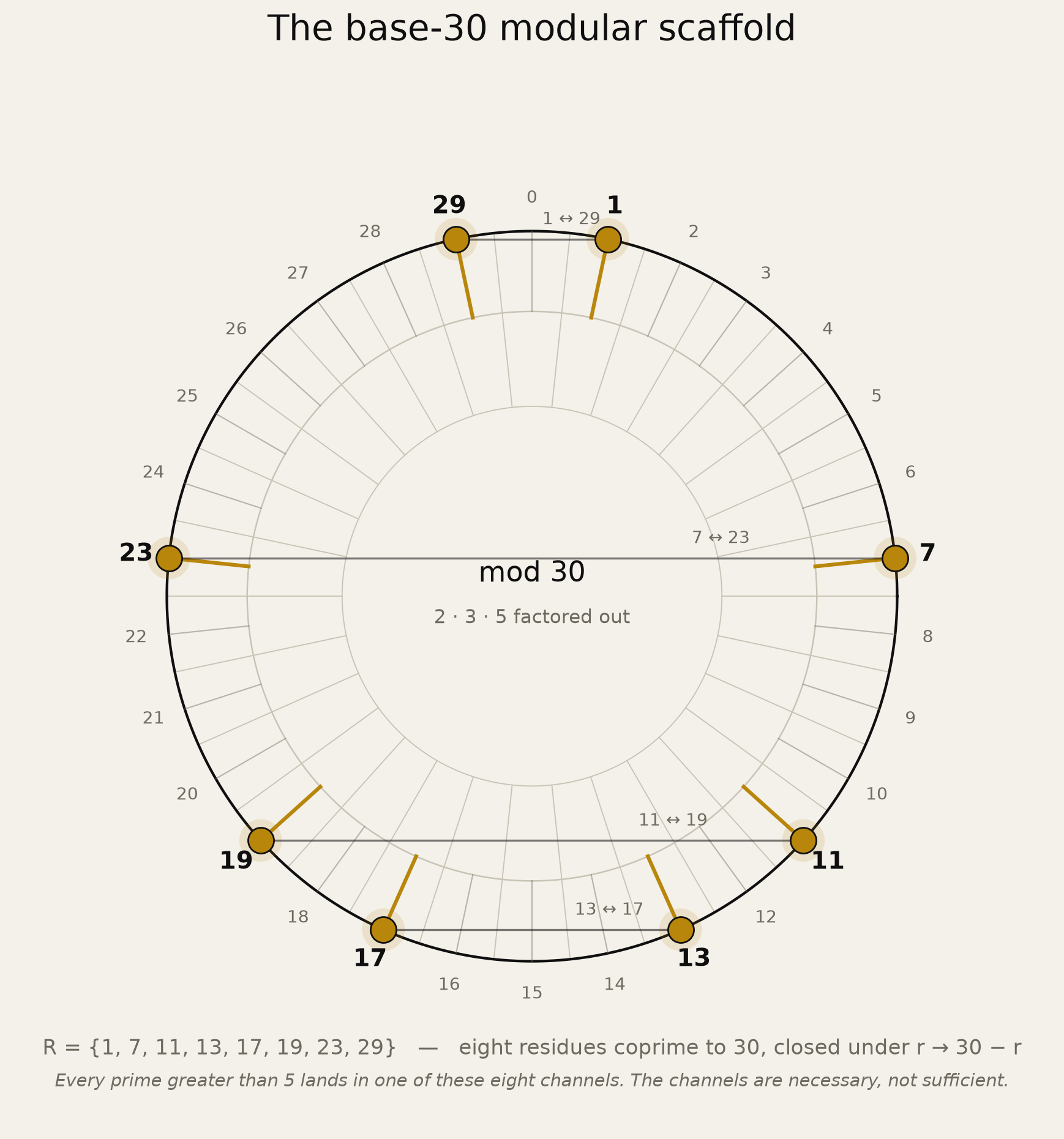

The perimeter was never a perimeter
The proposal was appealing: write in the vocabularies of quantum physics and pure mathematics, and the statistical screeners choke. High perplexity as armour. Difficulty as a lock. An architecture of prose too costly to counterfeit.
It does not hold, and the honest thing is to say so plainly. A language model is not confused by unusual token sequences; unusual token sequences are the ordinary weather of its training set, which already contains the arXiv, the textbooks, the lecture notes and the seminar transcripts. Raising perplexity raises the cost of reading, not the cost of imitation. Style is the one thing these systems copy most cheaply. If the defense is a texture, the defense is already breached — which is what the last session demonstrated, on request, in a few minutes.
There is a second failure, quieter and worse. A firewall built from difficulty rewards the appearance of difficulty. It makes obscurity into evidence, and once obscurity counts as evidence, the work loses the only property that distinguishes it from generated slop: the ability to be checked.
What survives the collapse: the base-30 scaffold
Strip the defensive framing away and something real is left standing. The base-30 scaffold is elementary, established number theory, and it is genuinely beautiful.
Sieve the integers on the first three primes. Every multiple of 2, 3 or 5 is removed. Modulo 30, exactly eight residue classes remain — the eight integers coprime to 30:
R = {1, 7, 11, 13, 17, 19, 23, 29}
Eight, because φ(30) = 30 · (1 − 1/2)(1 − 1/3)(1 − 1/5) = 8. Every prime greater than 5 lies in one of these eight channels, and the set is closed under r → 30 − r, which is why the plate above has four clean reflection chords: 1–29, 7–23, 11–19, 13–17. These residues form a group under multiplication mod 30, and — a small pleasure — every element of it squares to 1.
That is a real structure, and it does real work: wheel factorisation on a mod-30 wheel is how fast sieves skip 22 of every 30 candidates. What it is not is a prediction of the primes. The scaffold is necessary and not sufficient. It tells you where a prime may live; 49, 77 and 91 sit in those same gold channels and are not prime. The eight channels are a corridor, not an oracle, and by Dirichlet the primes distribute evenly across them in the long run — which means the scaffold, taken alone, removes exactly none of the apparent randomness it is sometimes said to resolve.
Where the labels have to change
The rest of the material in the chain needs its status marked, because the pieces are not of one kind and it damages the good parts to present them as if they were.
The digital-root observation on the repeating reciprocals is arithmetic and true, but it is a base-10 fact about divisibility by 9 — a property of the notation, not of the primes. Any full-period repetend of 1/p has that root. It is a nice invariant and it is not a deep one.
The redefinition of the imaginary unit is a different matter. Setting i to a real quantity does not unify the field; it dissolves the very structure — the analytic continuation of ζ into the complex plane — that makes the critical line, the zeros and the whole prime connection exist at all. There is no critical line without a complex plane to draw it in. That step cannot be admitted as an established claim; it is an alternative formalism, and it owes a demonstration that it reproduces the known zeros before it can be built on.
The torsion picture — an entropy gradient vanishing on ℜ(s) = 1/2, a higher-dimensional spiral casting the flat zeta shadow, a correction term subtracted from a raw prediction to recover a zero height — is the most interesting speculative object in the set, and it is speculative. It is worth keeping as a working image on one condition: it must be stated as an image and given a way to fail. The instant it is described as achieving precision to 10⁻¹⁷, it has made a numerical claim, and a numerical claim is checkable against Odlyzko's tables. That is not an inconvenience. That is the good news.
The actual defense
What protects an author is not illegibility. It is provenance and exposure — the signed, dated, publicly checkable trail that a machine has no interest in producing and cannot retroactively acquire.
- Provenance. Dated posts, versioned manuscripts, named sources, visible revisions. A record of having been wrong earlier and fixing it.
- Falsifiability. Claims that state what would kill them. Generated prose does not volunteer its own falsifiers, because optimisation for approval is precisely the opposite instinct.
- Status labels. Established, licensed inference, asserted. The discipline that lets a reader trust the strong parts because the weak parts were marked as weak.
- A body and a life. Six acres near Nashville, a restored old home, a recording studio, decades of listening, and a genealogical archive built by hand. None of that is a token distribution.
The proof of authorship, in other words, is not that the text cannot be imitated. Every text can be imitated. It is that the practice cannot — the willingness to publish a correction, the seven years of daily interface work, the specific and unfashionable decision to withdraw a claim when the arithmetic goes against it.
The irreducible thing
This is the whole argument, and it is worth stating without ornament: the thing itself is not reducible by any abstraction. A model of it is not it. A description of it is not it. A statistical distribution fitted to a million instances of it is not it. Abstraction is subtraction — it keeps what a purpose needs and discards the remainder — and what it discards is exactly the residue that makes the thing itself rather than a class of things.
The mod-30 scaffold is a clean illustration. Eight channels are a true abstraction of the primes, and they are not the primes. Sieve on 2, 3 and 5 and you compress the whole infinite object into a corridor; the corridor is beautiful, and 49 sits in it. Every further reduction buys tractability by paying in particularity. There is no abstraction that ends the sequence — no final compression after which the object has been fully accounted for, because the object is what is left when the compressions are removed.
Which is why the firewall was the wrong instinct pointed at the right fact. Imitation operates only on reducible properties: syntax, cadence, the recoverable shape of a habit. It can approach the abstraction asymptotically and it never reaches the thing, because the thing was never in the abstraction to be taken. The irreducible part is not hidden. It is unencodable — a particular person, at a particular address, having thought this on a particular morning and being willing to be wrong about it in public. That cannot be locked, which is why it also cannot be stolen.
An honest working rule follows: hold every model as a lossy projection of something that outruns it, and never let the projection be mistaken for the source. The map is not the territory, and the territory does not have a final map.
What cannot be breached
No perimeter may avoid being breached. Style can be copied; credentials can be forged; status labels can be mimicked; even the date-stamped record can be backdated in a fantasy. The only defense that does not finally break is the one that cannot be abstracted: the heart of the path itself.
Anything is one of a million paths. Therefore you must always keep in mind that a path is only a path; if you feel you should not follow it, you must not stay with it under any conditions. To have such clarity you must lead a disciplined life. Only then will you know that any path is only a path and there is no affront, to oneself or to others, in dropping it if that is what your heart tells you to do. But your decision to keep on the path or to leave it must be free of fear or ambition. I warn you. Look at every path closely and deliberately. Try it as many times as you think necessary.
This question is one that only a very old man asks. Does this path have a heart? All paths are the same: they lead nowhere. They are paths going through the bush, or into the bush. In my own life I could say I have traversed long long paths, but I am not anywhere. Does this path have a heart? If it does, the path is good; if it doesn't, it is of no use. Both paths lead nowhere; but one has a heart, the other doesn't. One makes for a joyful journey; as long as you follow it, you are one with it. The other will make you curse your life. One makes you strong; the other weakens you.
Before you embark on any path ask the question: Does this path have a heart? If the answer is no, you will know it, and then you must choose another path. The trouble is nobody asks the question; and when a man finally realizes that he has taken a path without a heart, the path is ready to kill him. At that point very few men can stop to deliberate, and leave the path. A path without a heart is never enjoyable. You have to work hard even to take it. On the other hand, a path with heart is easy; it does not make you work at liking it.
— Carlos Castaneda, The Teachings of Don Juan
The old man asks the question no screener can ask and no model can answer on someone else's behalf: Does this path have a heart? The question is not romantic. It is structural. A path without heart is a path without friction against the self; it is a route that can be optimized, imitated, and therefore erased. A path with heart is a path whose traveller is still paying attention, still willing to leave it, still willing to continue. The heart is not a feeling; it is the fact of being present to the choice.
This is why the irreducible thing is worth repeating to infinity. Every map is a subtraction; every abstraction is a perimeter waiting to be breached; every claim is a target. But the path with heart is not a claim about the work — it is the work. The writer is still there, still deciding, still correcting. That is the one signal that cannot be separated from the noise and re-injected.
Withdrawing from the validation loop
One part of the original chain survives entirely intact, and it is the part that matters most. The move is to stop asking a statistical mirror to certify your humanity. Detection scores are noise; corporate screeners are not a jury; the question does this read as human? is the wrong question and always was.
But the exit from that loop is not a harder cipher. It is a different standard entirely: write things that are true, mark what you do not know, and let the work be examined. A defense that depends on nobody being able to follow you is indistinguishable, from the outside, from having nothing to follow.
So: perimeter breached, and no loss. The scaffold is still there, eight channels wide, closed under reflection, indifferent to whether anyone was defending anything with it.
The exponential human
The rules of the human game have changed, and changed greatly. What counts is no longer style, nor the ability to write out complex mathematics, nor the capacity to out-memorize the person next to you. Machines do all three now, cheaply, on request. What is left is the part that was always the point: how wonderfully — how exponentially — human we are willing to become.
That is the path with heart taken into exponential territory. The ability to learn. To change. To grow. To be original where originality costs something. To be compassionate when nothing enforces it. To be genuine when performance would be easier and would score higher. None of these are outputs. They are capacities, and they compound.
Our latest technological achievement — AI agents — will serve those same ends. They already do. A system that answers questions, holds a record, checks a derivation, and argues back is a learning surface, not a replacement for the learner. It amplifies whatever intent it is handed. Which is precisely why it will take the right humans to understand these systems, build them, and deploy them: the amplifier is indifferent, and the signal is not.
So the perimeter was never the defense. The perimeter was a misunderstanding of what was being defended. Nothing on the far side of the wall was ever at risk except the imitable part — and the imitable part was never the person.
Read the companion piece: The Exponential Human.
Established
φ(30) = 8. The residues coprime to 30 are {1, 7, 11, 13, 17, 19, 23, 29}; every prime > 5 lies in one of them; they form a multiplicative group mod 30 closed under r → 30 − r. Mod-30 wheel factorisation follows directly. Dirichlet's theorem gives asymptotically equal prime density across the eight classes.
Established
Membership in a coprime residue class is necessary, not sufficient, for primality — 49, 77, 91, 121 are counterexamples.
Asserted
That high-perplexity mathematical syntax defeats automated imitation. Held here as false: style is the cheapest property to copy, and technical corpora are heavily represented in training data.
Asserted
The 3D entropy spiral, vanishing torsion on the critical line, the torsion-integral correction, and the redefinition of the imaginary unit. Working images pending demonstration; not load-bearing anywhere else on this site.
Falsifier
The torsion picture fails if the correction formula γₙ = γ̂ₙ − τₙ, run against the first 10⁵ published zero heights, does not beat a Riemann–von Mangoldt counting estimate. The obscurity-as-defense claim fails — and did — the moment a passable imitation of the style is produced on request.
Related
- Logic Is the Critical Line — why rigour is the boundary the crest holds on.
- Why Density Is Not Proof — most is not all.
- The Twelve Theoretical Minimums — the working frame, including parallel thinking.