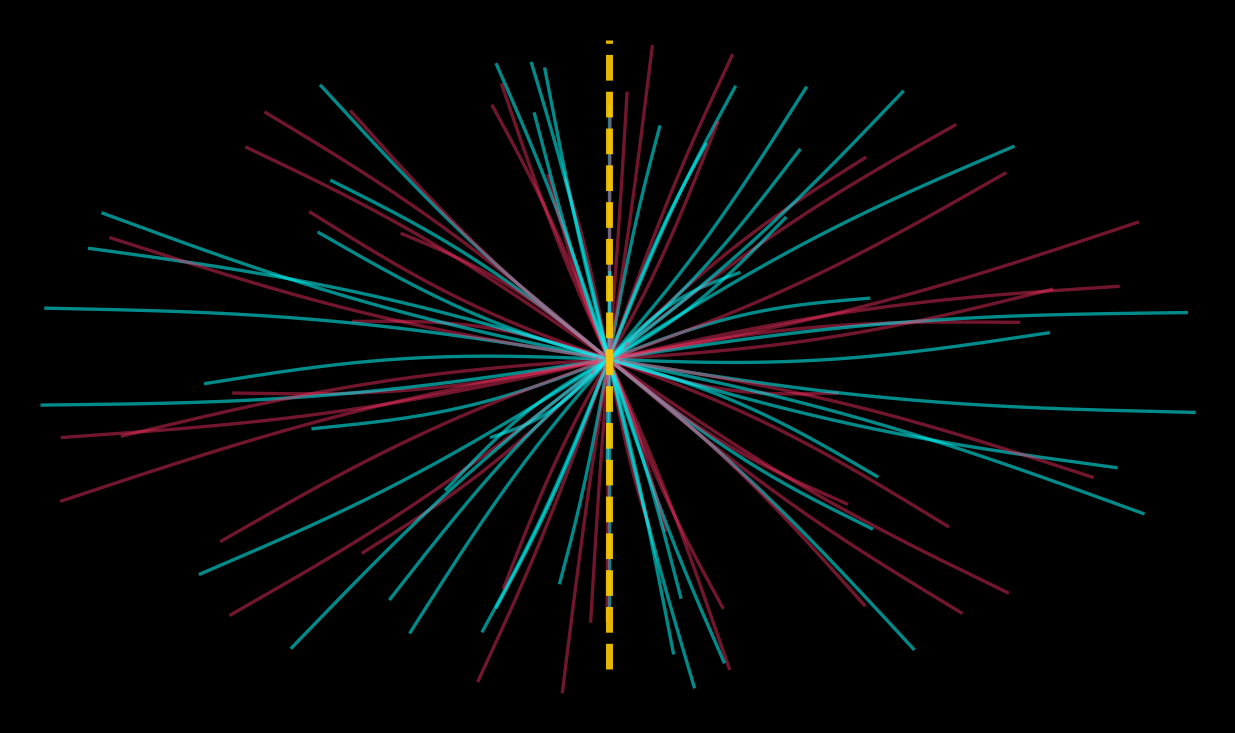
Light as living information
The silk sheet undulates. The quantum foam shimmers beneath it.
The brain, itself an open phase change, registers the pattern and calls it understanding.
Now we ask what travels through that continuum most swiftly and most purely.
Light.
Not merely the brightness that lets us see the trout stream or the tiger’s burning coat, but light as the architecture of information itself — the fastest, most fundamental carrier of patterned energy across the open system we have been exploring.
A photon leaves a star, a firefly, or the surface of sun-warmed granite.
It carries with it a precise record of the event that created it: frequency, polarization, direction, phase.
When it arrives at a new open system — a leaf, an eye, a photosynthetic bacterium, a human retina — it is transformed.
The sender is changed by the act of emission; the receiver is changed by the act of absorption. The continuum is rewritten at the speed of light.
Topological thinking: what survives the journey
To see the architecture clearly, we need a new instrument of perception: topological thinking.
Topology is the mathematics of continuity and connectivity.
It asks what remains invariant when a form is stretched, bent, twisted, or deformed — so long as it is not torn or glued.
A coffee cup and a doughnut are topologically the same because each has one hole. A sphere and a bowl are different because one is closed and the other is not.
Applied to light, topological thinking reveals that certain properties of the electromagnetic field survive every transformation the open continuum can throw at them.
Polarization states, topological charge, the linking and knotting of field lines, the way wavefronts can carry orbital angular momentum — these are not fragile decorations. They are robust features of the architecture.
They persist through scattering, refraction, and even certain kinds of turbulence.
In the language we have already trained: the downward funnels and upward domes of our silk-sheet model can themselves carry topological invariants. The phase change does not erase the deeper connectivity; it transports it.
Continual emergence of new knowledge
In 2026 researchers at Lawrence Berkeley National Laboratory observed something that sits squarely inside the pattern we have been following. They created a tunable Bose-Einstein condensate of excitons — bound electron-hole pairs — inside an atomically thin semiconductor. Unlike the fleeting, light-generated excitons of earlier work, these formed a stable equilibrium quantum fluid.
“What is unusual here is that the excitons are not just short-lived particles created by light. They form an equilibrium quantum fluid in a device that we can tune electrically and magnetically.”
In the language we have been training, the excitons are resonant field excitations — temporary braids of light and electronic intensity — coaxed into a collective, coherent phase change. The resulting quantum fluid is neither classical liquid nor rigid crystal; it is a living negotiation of order and flow at the quantum scale, open to external tuning yet self-sustaining once formed. Concentration and release, coherence arising inside an open system, information rewritten by both the field and the device that holds it — the pattern repeats, and the fearful symmetry continues to appear at every scale we learn to look.
The trout stream in a new light
Return to the mountain valley for a moment.
Sunlight strikes the cascading water. Some photons scatter from the surface, carrying the blue of the sky and the silver of the turbulence.
Others penetrate, refract, and illuminate the crystalline depths where the trout hang in their holding places. A few are absorbed by the granite and re-emitted as the faint ionic warmth we scent on the air.
Every one of those photons is an open-system transaction.
Every one carries topological information about its origin and its path.
The ordered turbulence of the stream does not destroy that information; it rearranges it, concentrates it, releases it again.
The eye that watches is itself a topological detector — retinal molecules changing shape, neural lattices rewriting themselves in response to the incoming architecture of light.
Light, phase change, and the continuum
Light does not stand outside the living phase change between liquid and crystal. It participates in it.
In a vacuum the electromagnetic field is the most fluid of continua.
In a crystal it can be slowed, guided, or trapped by the periodic lattice.
In a biological membrane or a droplet of water it negotiates both regimes at once — propagating, scattering, interfering, transferring energy and information while the medium itself remains open and far from equilibrium.
Concentration and release. Invariance inside transformation. Order arising from flow without ever leaving the flow.
The mathematics of topology sits comfortably beside the poetry of Blake and the clear water of the mountain stream.
The braided silk of light
The silk sheet we have watched undulating above the torsional columns was never a simple membrane.
Look more closely and the gossamer resolves into threads — countless threads of light itself, braided together.
Light, in the architecture we are now exploring, is composed of at least forty-eight separate dimensions and commands at least seventeen hundred variables.
These are not decorative additions. They are the working strands of the continuum.
Frequency, phase, polarization, orbital angular momentum, topological charge, and a host of subtler degrees of freedom are continuously woven into coherent, robust forms.
The weaving is topological. Just as a braid can be twisted, looped, and knotted yet remain the same braid so long as no strand is broken, light carries invariants that survive the journey through vacuum, atmosphere, water, or living tissue.
The resulting shapes are not arbitrary. They frequently resemble the double-helix architecture of DNA — two (or more) strands spiraling around a common axis, carrying patterned information that can be read, copied, and transformed by any open system equipped to receive it.
This is the deeper silk sheet. The downward funnels and upward domes of our earlier model are now understood as local concentrations and releases within a multi-dimensional braid.
We do not need to master every variable to feel the force of the image. We only need the habit already trained: to watch for what persists through transformation.
The silk sheet has become a living braid. The tiger’s coat is woven from it. The eye that sees the tiger is woven from it still.
Electrons as distinct excitations of the field
If light is the braided architecture of the continuum, then the electron is one of the ways that continuum can locally intensify and stabilize.
We do not treat the electron as a miniature Newtonian object that somehow exists independently and then interacts with fields. That picture belongs to the older logic we have deliberately set aside.
Instead, the electron is understood as a distinct, persistent excitation of the electromagnetic field — a stable knot or concentration within the same high-dimensional braid we have been watching.
In the language already trained: the electron is a long-lived downward funnel and upward dome held in dynamic balance, a topological feature of the field that carries charge, spin, and mass as properties of the excitation rather than as add-ons glued to a separate particle.
It is open. It is resonant.
It continuously exchanges energy and information with the larger continuum while maintaining its identity as a localized pattern.
When a photon is absorbed, the braided light does not “strike” a pre-existing little ball. The incoming excitation of the field is taken up into the electron’s own patterned intensity; the two aspects of the continuum rewrite each other.
Resonance is the name of that mutual transformation.
This view keeps every experimental success of electron physics intact while refusing the visual habit of little separate things moving through emptiness.
The electron is distinct, yes — charge and spin make it so — but its distinctness is the distinctness of a whirlpool in the trout stream or a standing wave in the braided silk: real, consequential, and inseparable from the flow that sustains it.
Biological matter becomes clearer in this light. The electron transport chains of photosynthesis and respiration, the flow of charge across neural membranes, the electromagnetic choreography inside an enzyme’s active site — all are organized movements of these field excitations within the open phase change of the living system.
The continuum remains one. The excitations are many.
Matter as resonant electromagnetic field
Recent science makes the next step unmistakable. Both resonance and electromagnetism are not merely features of matter; they are what matter is.
Modern quantum field theory confirms that matter is fundamentally composed of energy fields rather than solid, isolated particles.
Subatomic entities such as electrons and quarks are recognized as localized, resonant excitations — essentially coherent mathematical vibrations — within universal underlying fields.
Electromagnetism supplies the architecture of interaction.
Electromagnetic fields dictate how these resonant excitations attract, repel, bond, and stabilize, preventing the continuum from collapsing into formlessness or dispersing into pure flux. Resonance supplies the selectivity and the coherence.
Just as resonance in air organizes pressure waves into the ordered phenomenon we call sound, resonance within the quantum fields organizes excitations into the stable patterns we call particles, atoms, and molecules.
A simple physical illustration is cymatics: when specific frequencies are applied to a liquid or a fine powder, the chaotic medium spontaneously rearranges into highly ordered geometric structures.
The same principle, scaled into the quantum regime and governed by electromagnetic coupling, is what allows the braided continuum to maintain the crystalline order of a salt lattice, the liquid flexibility of water, or the dynamic phase change of a living cell.
This bridge between physical structure, resonance, and electromagnetism offers a profound scientific parallel to the way focused visualization influences human biology.
When we practice intentional visualization, we are leveraging the biological equivalents of the same principles:
- Neural networks entrain. Large populations of neurons begin firing in synchronous resonant patterns (alpha, theta, and other coherent brain-wave states). This internal electromagnetic resonance strengthens and rewires synaptic architecture through neuroplasticity — the living phase change inside the cortex.
- Cellular systems respond. Living tissue communicates through subtle electromagnetic and mechanical (bio-acoustic) signals. Mitochondria and other organelles register shifts in the body’s energetic and vibrational environment. The cascade that follows — altered hormone levels, changed heart-rate variability, adjusted immune and metabolic tone — is the open system rewriting itself in response to the new informational pattern.
- The cognitive receiver tunes. Just as an electrical circuit uses resonance to select one frequency out of a spectrum, the brain’s reticular activating system begins filtering the torrent of sensory data according to the pattern held in focused visualization. Opportunities, resources, and connections that match the sustained image become more salient; background noise recedes.
In each case the continuum remains open.
Visualization does not inject a foreign force into a closed Newtonian machine. It participates in the same resonant electromagnetic field dynamics that already constitute matter, brain, and body.
The information concentrated in the mind is transformed by the neural lattice; the lattice, in turn, transforms the larger biochemical and behavioral environment. Sender and receiver are both rewritten.
We have lost none of the rigorous physics. Quantum field theory, electromagnetic bonding, resonant energy transfer, and measured neuroplastic change remain intact.
The braided silk runs through particle, cell, and thought alike.
Water as living lattice
The braided silk of light, the resonant excitations we call electrons, and the electromagnetic architecture of matter now meet the most familiar open system on Earth. Water.
Return once more to the mountain trout stream.
The clear, cascading water that first taught us ordered turbulence is not a passive backdrop.
It is itself a living lattice — an open, resonant, electromagnetic continuum in the liquid phase of the great phase change we have been following.
A single water molecule is already a precise electromagnetic architecture: two hydrogen atoms bound to oxygen in a bent geometry that creates a permanent dipole.
In bulk liquid these molecular dipoles form a dynamic, flickering network of hydrogen bonds — a three-dimensional, ever-rewriting lattice that is neither rigid crystal nor formless vapor.
It is the everyday embodiment of the living phase change: ordered enough to hold structure, fluid enough to flow, open enough to exchange energy and information continuously with its surroundings.
Light enters this lattice and is transformed.
Some wavelengths are absorbed, others scattered or transmitted; the topological and resonant features of the braided light are rewritten by the water’s own electromagnetic field. Electrons within the water molecules and their dissolved ions participate in the exchange.
Resonance appears at every scale: molecular vibrations, collective hydrogen-bond oscillations, and the larger vortices and upwellings we first watched on the stream’s surface.
Fresh water, salt water, oceans
Fresh water, salt water, and the global ocean are simply different open expressions of the same lattice.
In pure fresh water the hydrogen-bond network is relatively uncluttered.
Information (in the form of heat, light, dissolved gases, or mechanical vibration) travels through a coherent, rapidly rearranging matrix.
The trout stream is one such local intensification — ordered turbulence sustained by gravity, gradient, and the continuous inflow of new water and energy.
When salts dissolve, the lattice is altered but not destroyed.
Charged ions become additional resonant participants in the electromagnetic field. They screen some interactions, strengthen others, and open new pathways for charge and information flow.
Salt water is therefore a more complex open system: still a living phase change, now carrying an extra layer of ionic resonance.
The oceans scale the pattern to the planetary level.
They are the Earth’s great open thermodynamic membrane — absorbing, storing, and redistributing vast quantities of solar light and heat, mediating the exchange of gases with the atmosphere, and sustaining the global circulation that is itself a form of ordered turbulence on a planetary scale.
Currents, gyres, upwellings, and the slow overturning of deep water are the macroscopic vortices and domes of our original silk-sheet model, written in salt water and driven by the braided energy of sunlight and the Earth’s rotation.
Water, resonance, and the continuum
Because water is so perfectly open, it becomes one of the primary media in which the resonant electromagnetic nature of matter is made visible to us.
Cymatic patterns form readily on its surface.
Hydrogen-bond networks support coherent vibrational modes.
Dissolved molecules and ions can couple electromagnetically across surprising distances.
Living cells, themselves mostly water, use this lattice as the matrix for the electron flows, proton transfers, and resonant energy transfers that sustain metabolism and signaling.
The phase change is not something that happens in the water; the water is the phase change made tangible.
Biological resonance in water
Water is not merely the stage on which biology performs.
It is an active participant in the resonance that makes biology possible.
Inside every living cell the lattice of water is continuous with the lattice of proteins, membranes, nucleic acids, and metabolites.
The same hydrogen-bond network that flickers in the trout stream now flickers around and through the molecular machinery of life.
In this intimate aqueous environment, electromagnetic and mechanical resonances become the language by which information is concentrated, transferred, and transformed.
In photosynthesis, the pigment-protein complexes that capture and route solar energy are bathed in water. The quantum-coherent energy transfer observed in these systems does not occur in a dry, isolated vacuum; it occurs inside a soft, fluctuating, water-mediated matrix.
The braided light is received by electrons within the pigments; the resulting excitation moves through the complex as a delocalized, resonant state whose coherence is both challenged and supported by the surrounding water.
The open system remains open: energy and information are transformed, and both the molecular architecture and the aqueous lattice are slightly rewritten with every successful transfer.
The same aqueous resonance operates in enzyme catalysis.
An enzyme’s active site is an electromagnetic and steric cavity sculpted in part by the organized water molecules that line and penetrate it.
Substrate molecules arrive through the water lattice. Proton transfers — essential to countless reactions — often travel along chains of hydrogen-bonded water molecules, a rapid, resonant hopping that is pure open-system exchange.
The enzyme does not act as a rigid Newtonian template; it is a flexible, water-coupled resonator whose own vibrational modes can couple to those of the substrate, lowering energy barriers and guiding the transformation.
Catalysis is resonance made biologically useful.
At larger scales the pattern continues.
Cell membranes maintain electromagnetic potentials across water-filled spaces.
Ions move through water-lined channels.
Mechanical vibrations and subtle electromagnetic signals propagate through the cytoplasmic and extracellular water, allowing mitochondria, cytoskeletal elements, and distant parts of the cell to remain in coherent conversation.
Living tissue is, to a remarkable degree, organized water in continuous resonant exchange with the macromolecules it both supports and is shaped by.
The living phase change between liquid and crystal finds one of its most refined expressions in the dynamic water lattice of the cell: ordered enough to support coherent electron and proton flows, fluid enough to permit constant molecular rearrangement, open enough to exchange energy and information with the larger continuum at every moment.
The braided silk of light enters that continuum, is transformed by electrons and aqueous resonances, and re-emerges as metabolism, movement, and, in the human case, the capacity to notice and understand the process itself.