Visual sequence · Fourteen plates

The End of Stillness

A field guide to a reality that refuses to hold still

The argument of The Emergent Quantum Universe compressed into fourteen frames — from the failed demand for a universe that holds still, through the cosmic, technological, historical, and biological readings, to the practices of participation and the return path of transmission.

Plate 01

A field guide to a reality that refuses to hold still
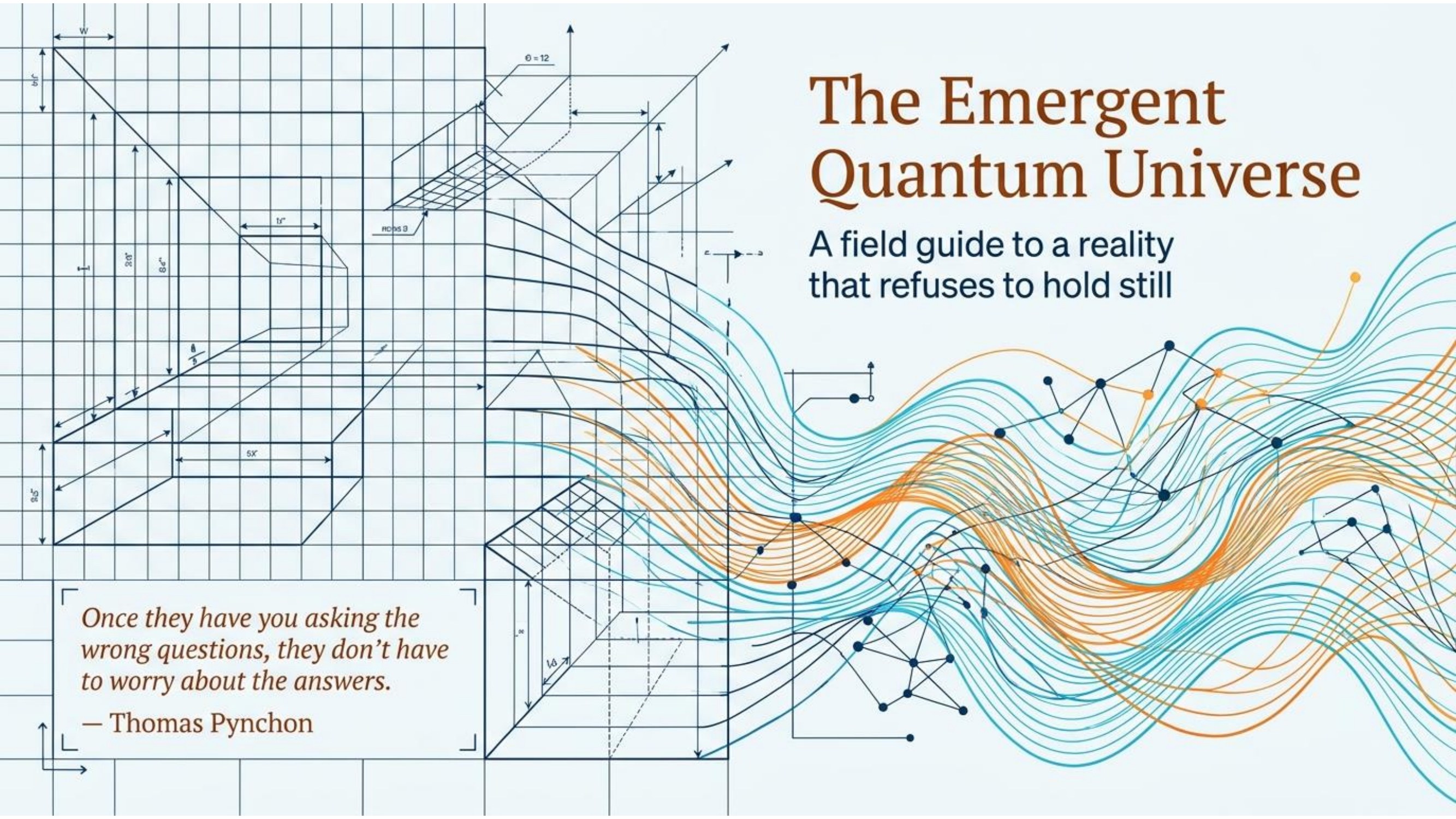
Title plate: engineering grid dissolving into braided flowing curves
The opening frame: a drafted grid on the left giving way to braided, moving line on the right. Epigraph from Thomas Pynchon — once you are asking the wrong questions, the answers stop mattering.

Plate 02

The old contract and the structural torment
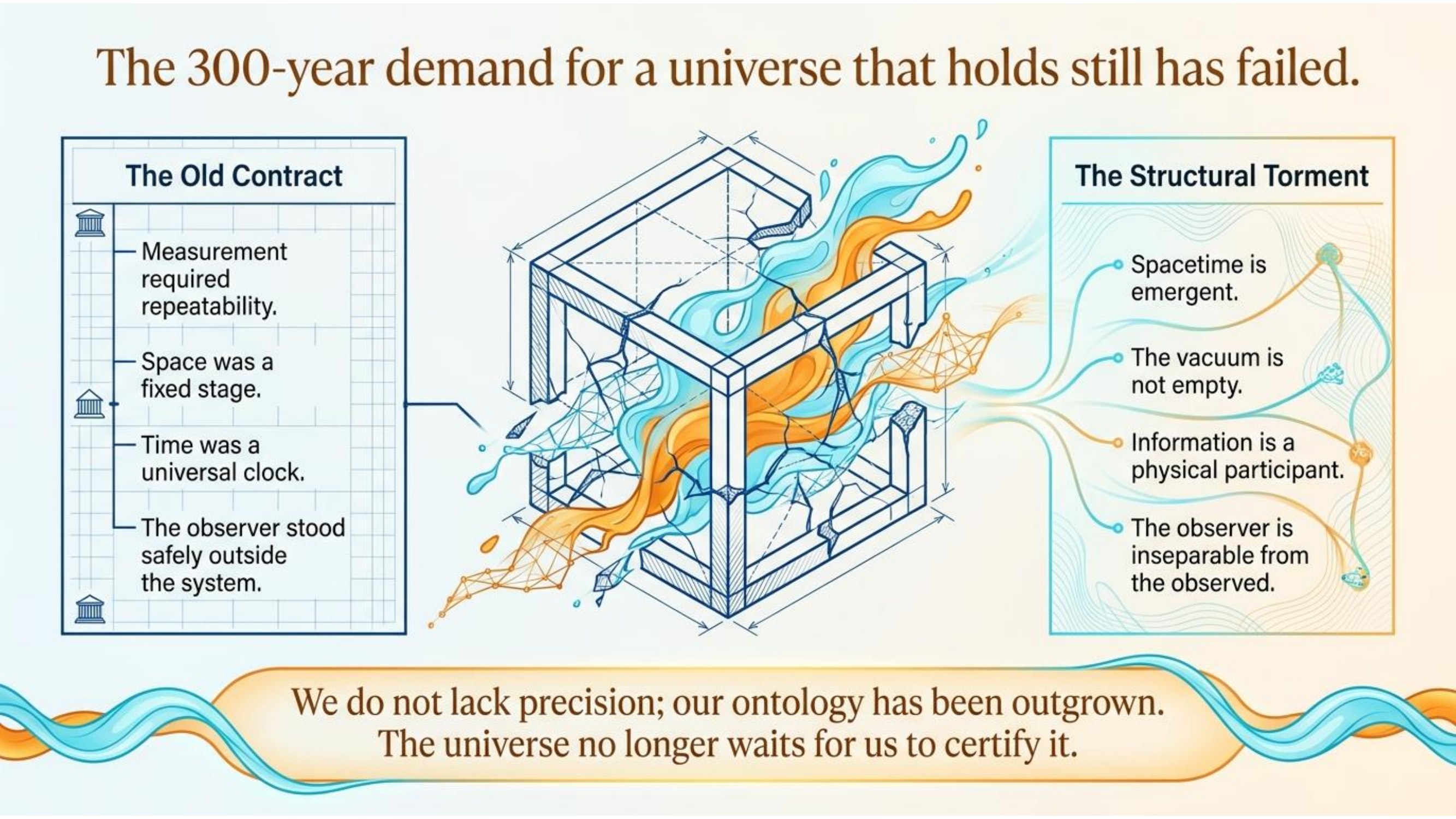
Comparison plate: the old contract of fixed stage and universal clock against an emergent spacetime
Three hundred years of demanding a universe that holds still. The fixed stage and universal clock set against emergent spacetime, a vacuum that is not empty, and information as a physical participant.

Plate 03

One conceptual fracture, two scales
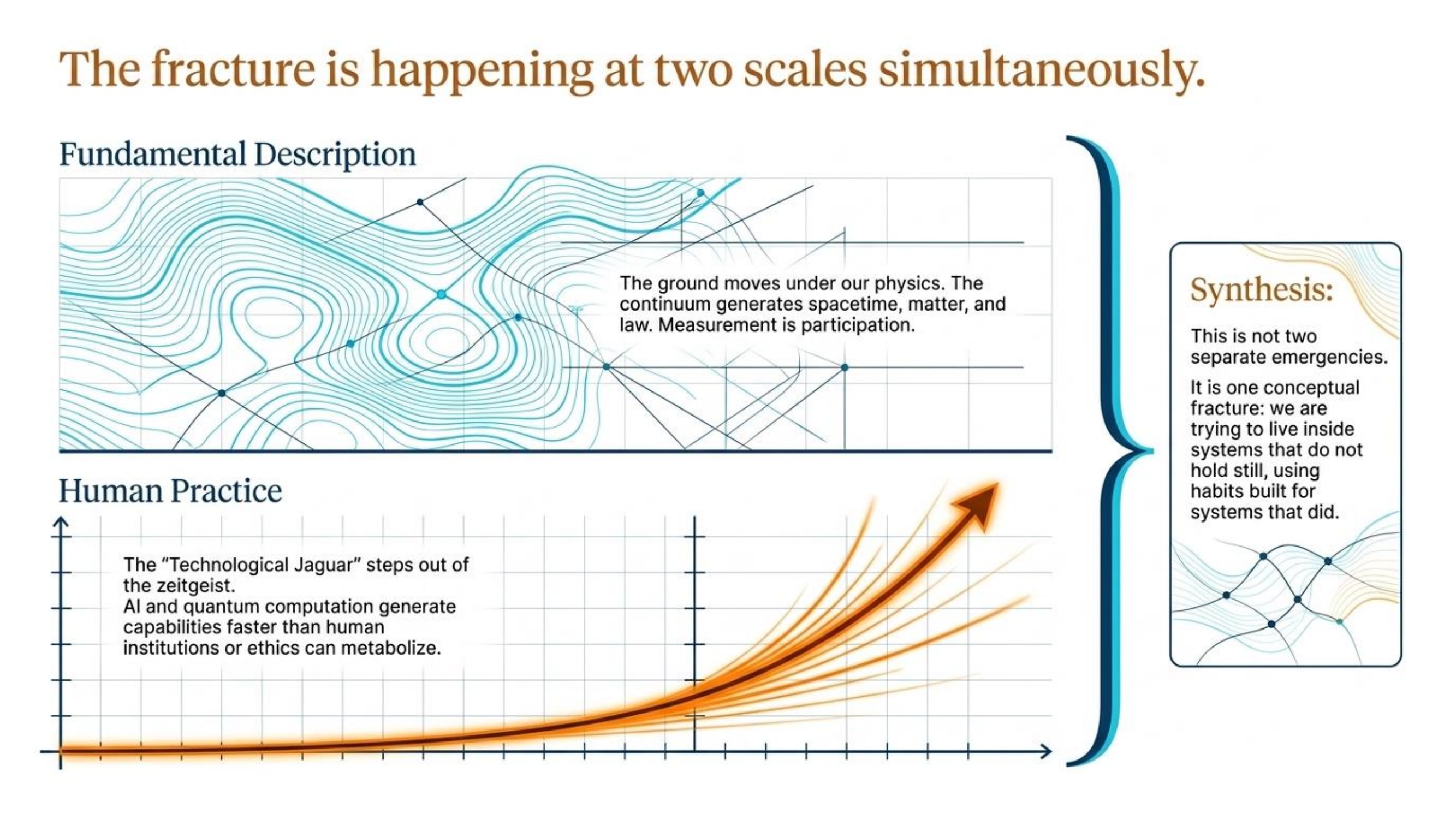
Plate showing the fracture in fundamental description and in daily cognition converging on one synthesis
The ground moves under the physics and under the habits of attention at the same time. Not two separate emergencies — one fracture, described twice.

Plate 04

Classical cage against the emergent continuum
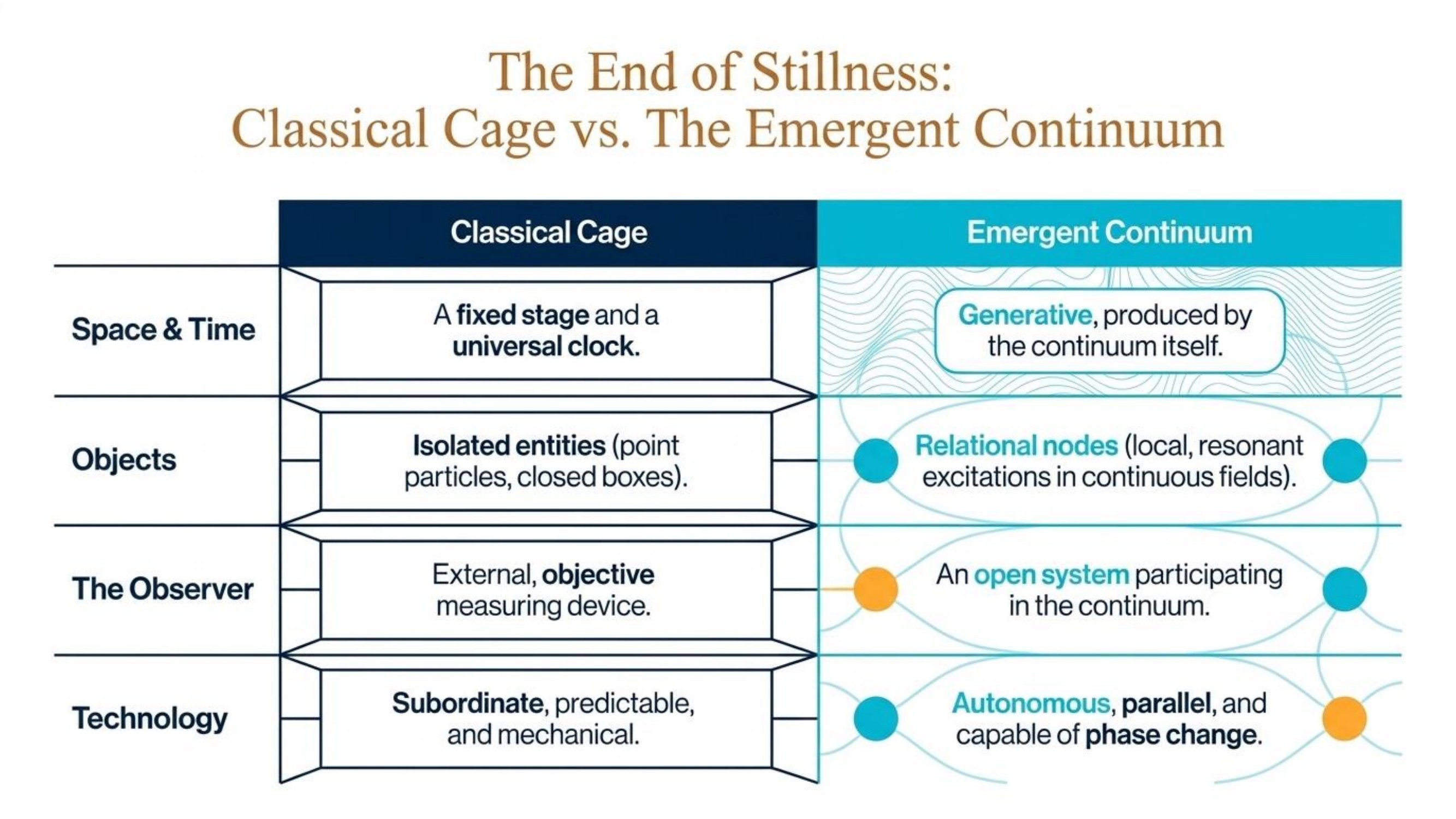
Two-column plate contrasting the classical cage with the emergent continuum
The core contrast of the book laid out in columns: fixed stage, isolated entities and external observation, against a generative, relational, phase-capable continuum in which measurement is participation.

Plate 05

The four signatures of becoming
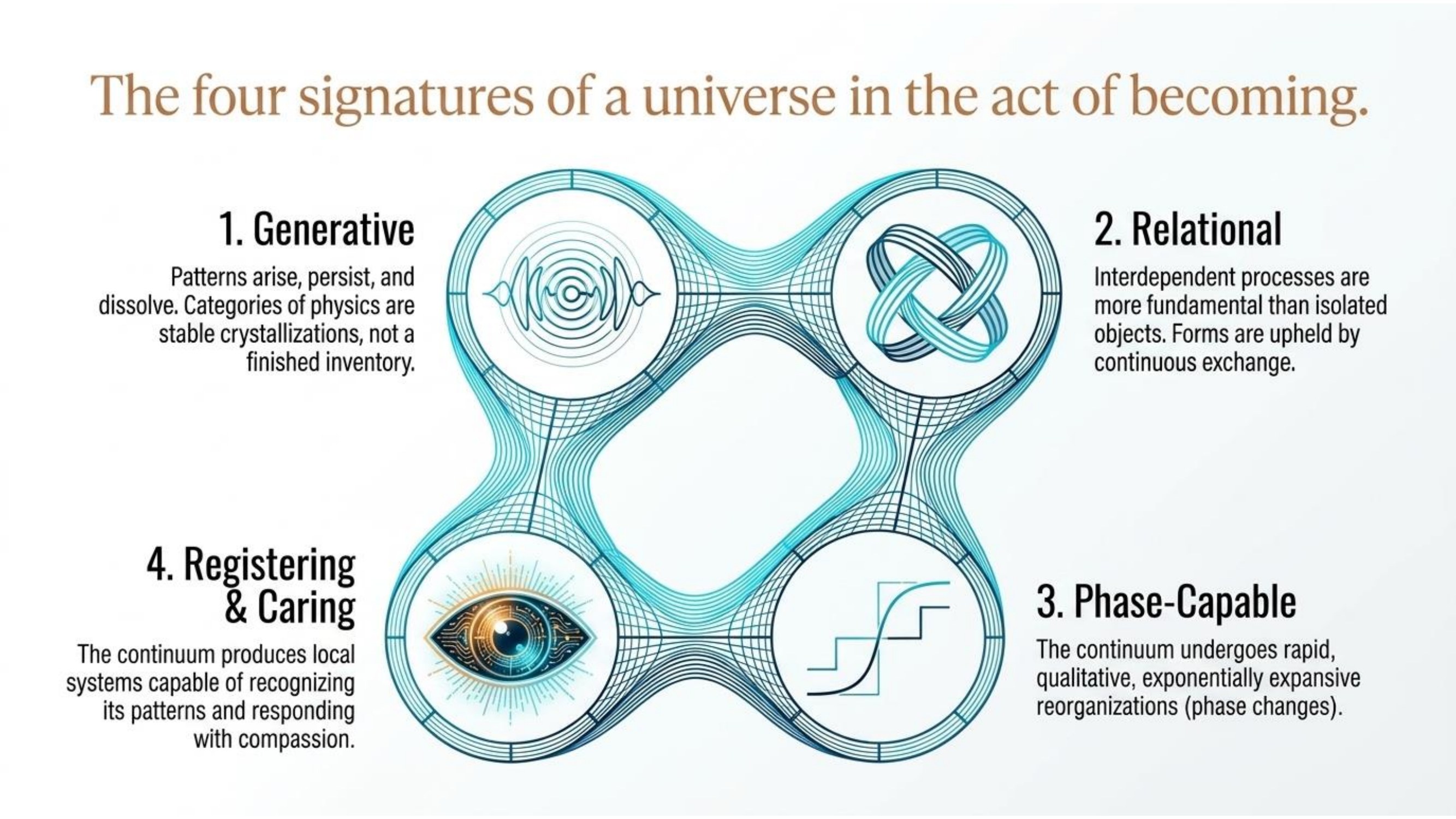
Plate of four numbered signatures: generative, relational, phase-capable, participatory
Generative, relational, phase-capable, participatory — the four features by which a universe in the act of becoming can be recognised rather than assumed.

Plate 06

Cosmic evidence: expansion as continuous emergence
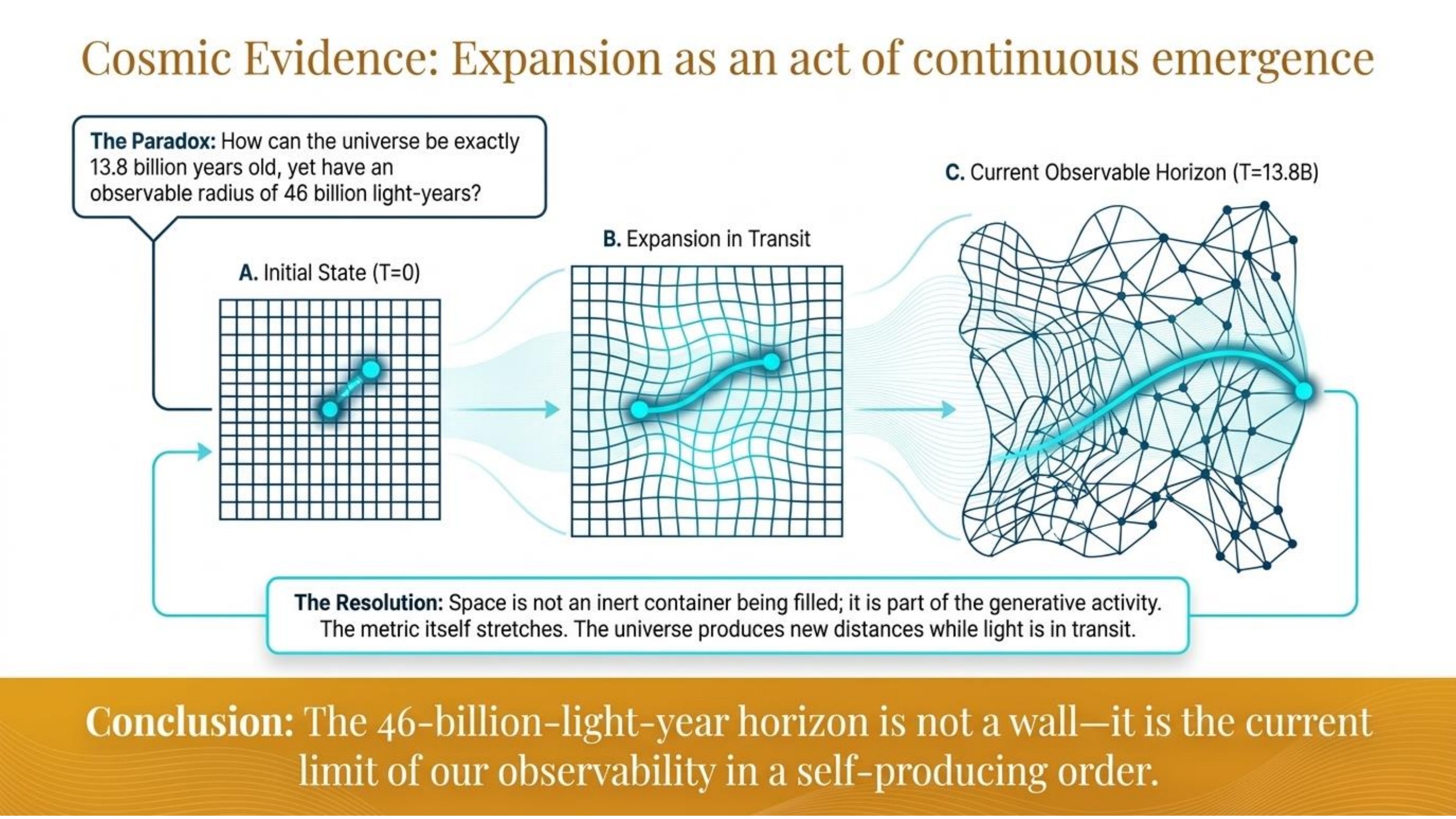
Diagram of light-travel time against present distance, showing a 13.8-billion-year-old universe with a 46-billion-light-year horizon
How a universe 13.8 billion years old carries an observable radius of 46 billion light-years. The gap between light-travel time and present distance is expansion read as ongoing emergence.

Plate 07

Technological evidence: sequential thought and parallelism
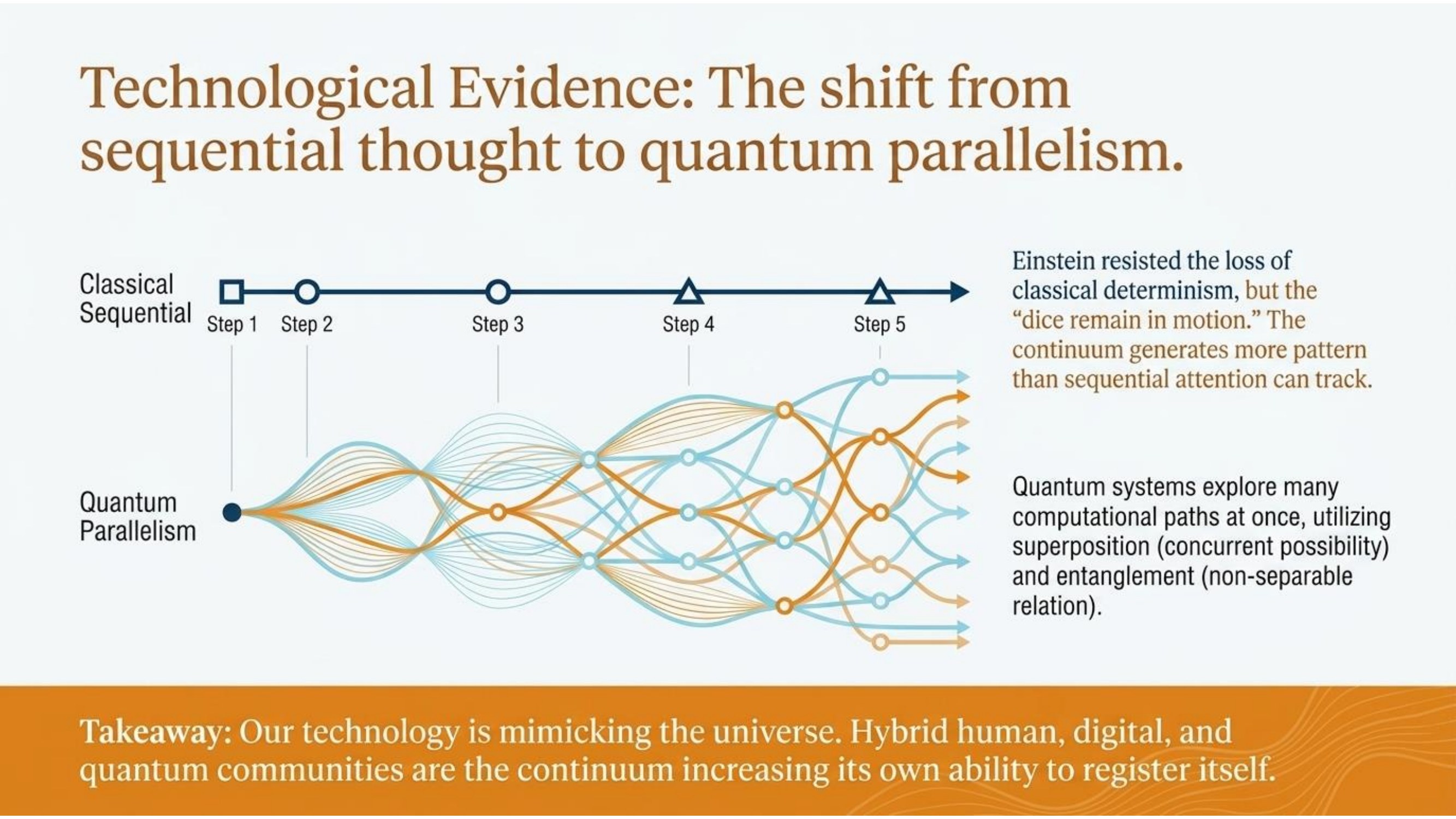
Plate comparing a classical sequential chain of steps with a branching quantum exploration of many paths
Step-by-step attention against systems that explore many paths at once. Einstein resisted the loss of classical determinism; the dice remain in motion, and the continuum generates more pattern than sequence can track.

Plate 08

The historical mirror: transition and unintended cruelty
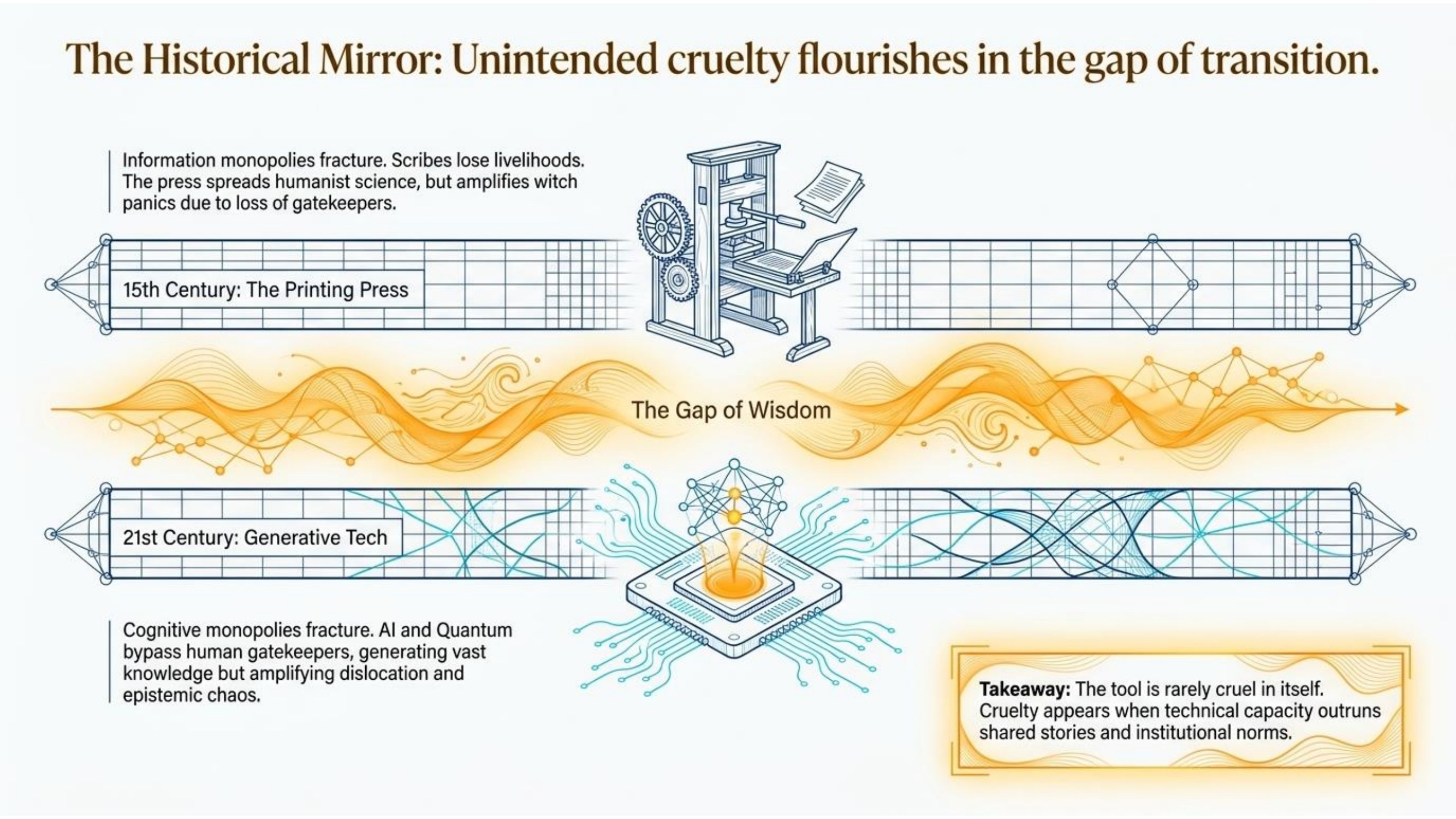
Plate pairing the fifteenth-century printing press with twenty-first-century generative technology
The press spread humanist science and, with gatekeeping gone, amplified witch panic. The pairing is offered as a structural pattern of transition, not as prophecy about the present.

Plate 09

Biological evidence: the communication underfoot
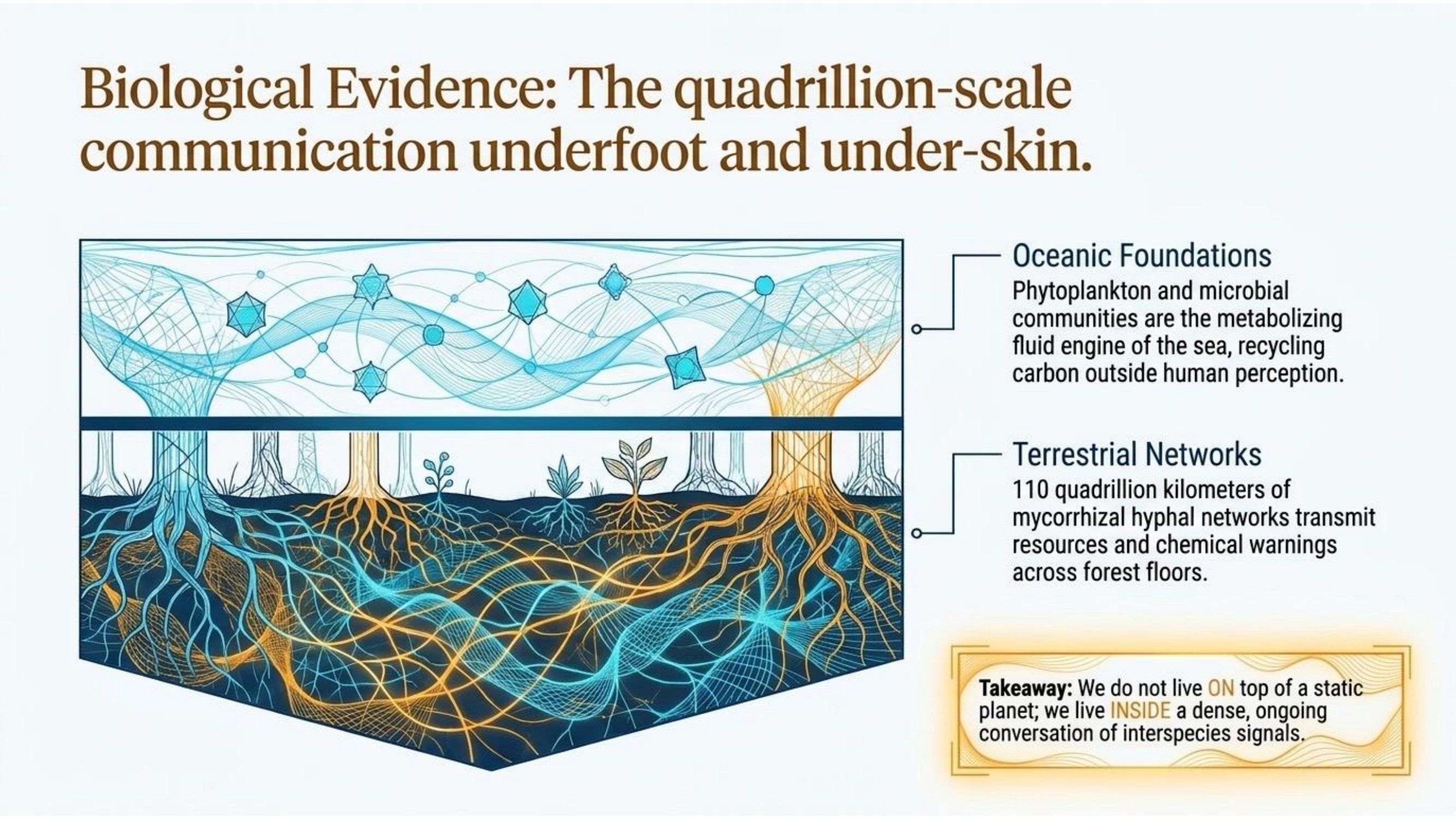
Plate of oceanic microbial foundations and terrestrial mycorrhizal networks at quadrillion scale
Phytoplankton and microbial communities as the metabolising engine of the sea; mycorrhizal networks as the terrestrial counterpart. Exchange at a scale that runs outside human perception.

Plate 10

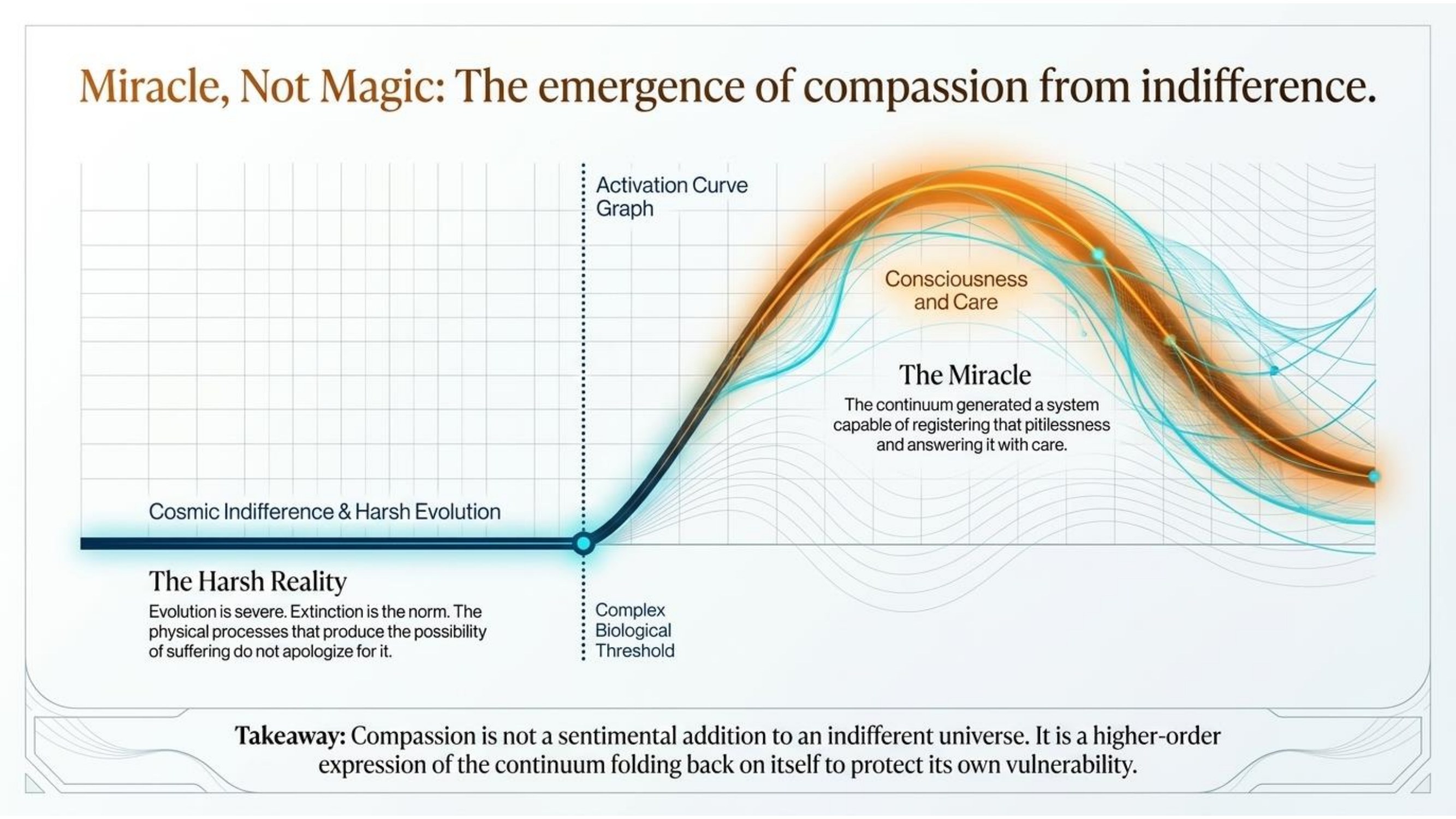
Miracle, not magic

Plate with an activation curve leading to consciousness and care
An indifferent continuum produced a system capable of registering indifference and answering it. The claim stays inside physics: emergence of care, not intervention.

Plate 11

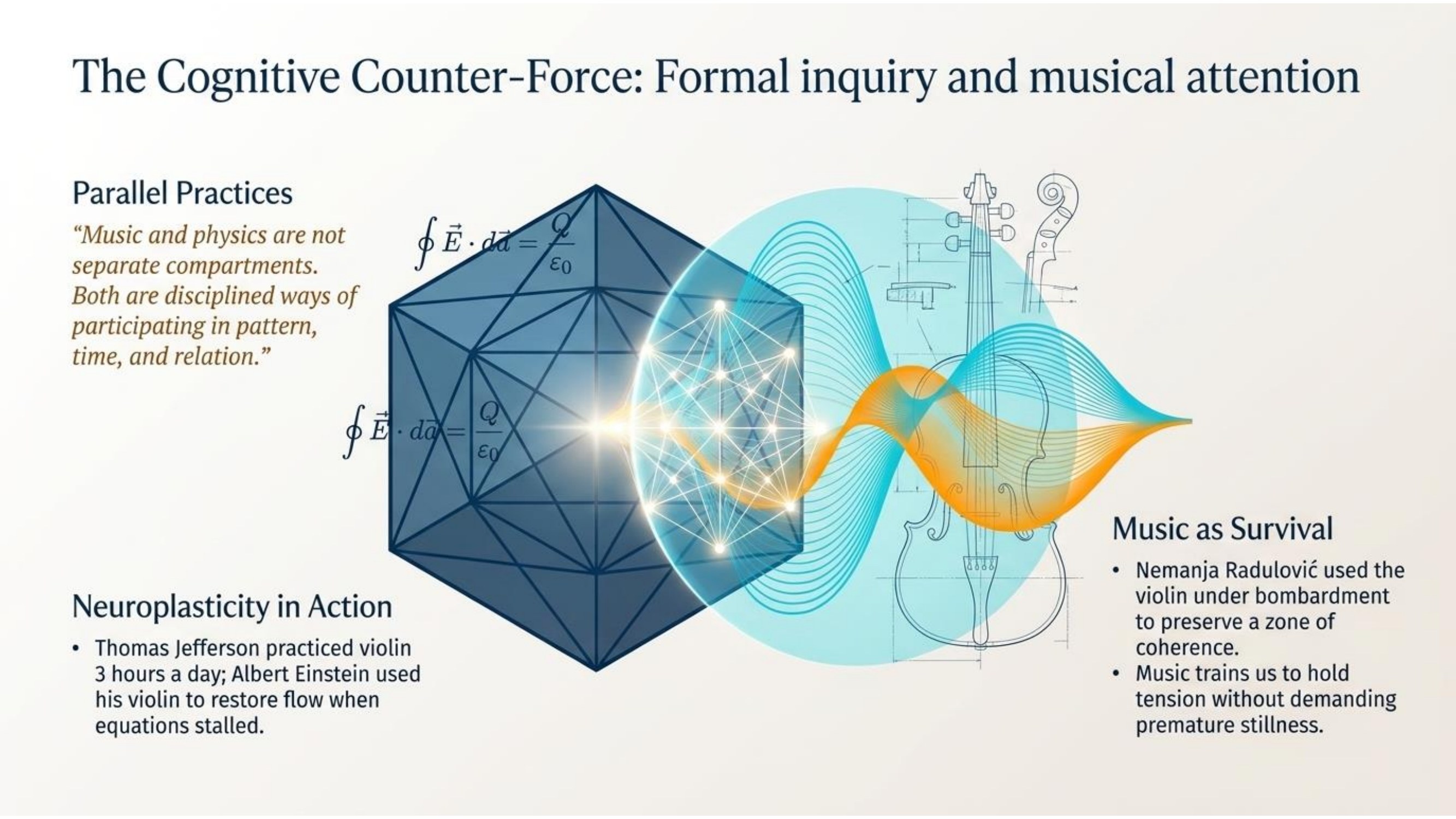
The cognitive counter-force

Plate on formal inquiry and musical attention as parallel practices
Music and physics as two disciplined ways of participating in pattern, time, and relation — attention trained rather than outsourced.

Plate 12

Five practices of participation
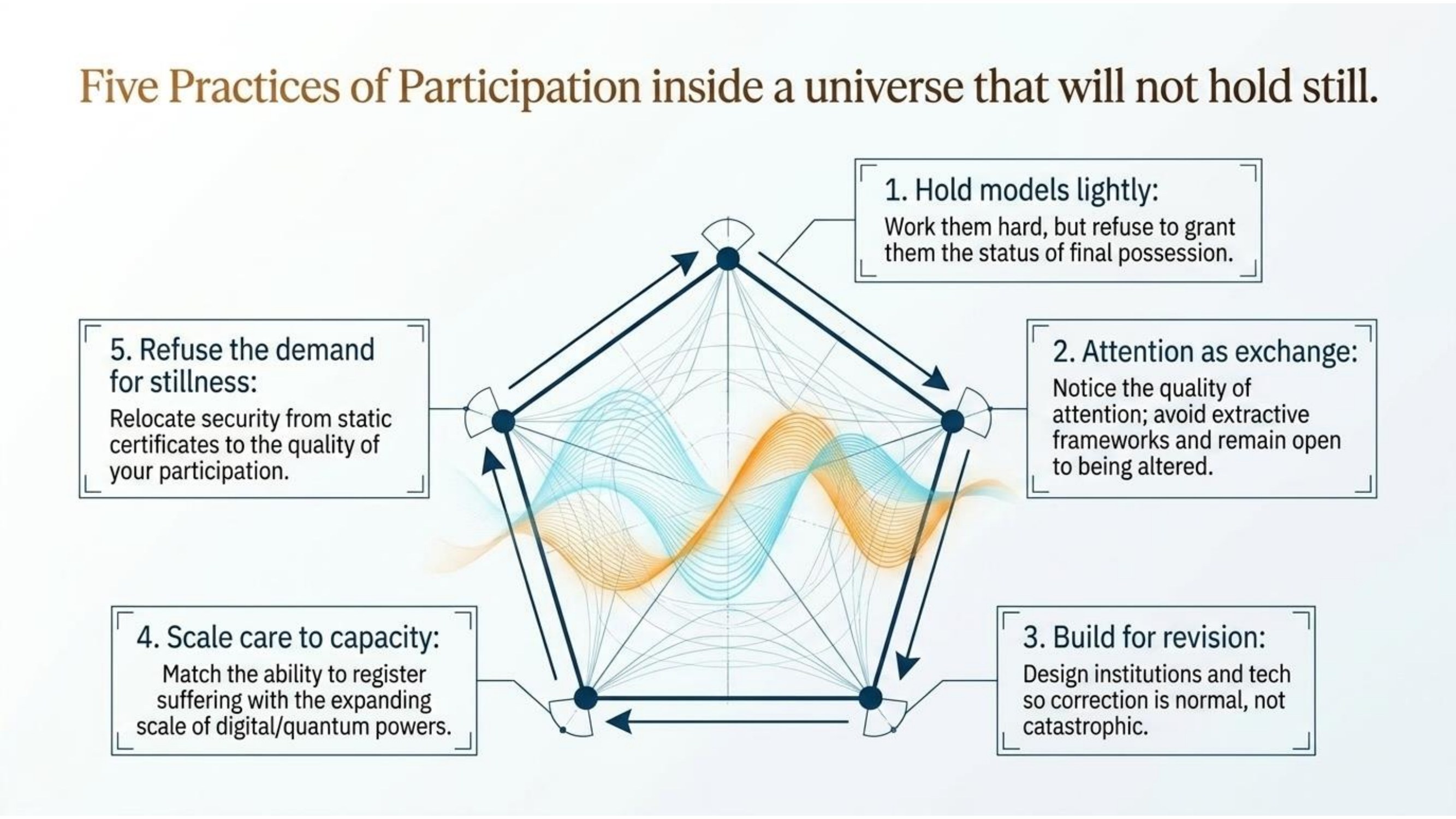
Plate listing five numbered practices for living inside an emergent continuum
Hold models lightly. Treat attention as exchange. The remaining three follow from the same refusal to convert a working model into a final possession.

Plate 13

The posture of the human cosmonaut
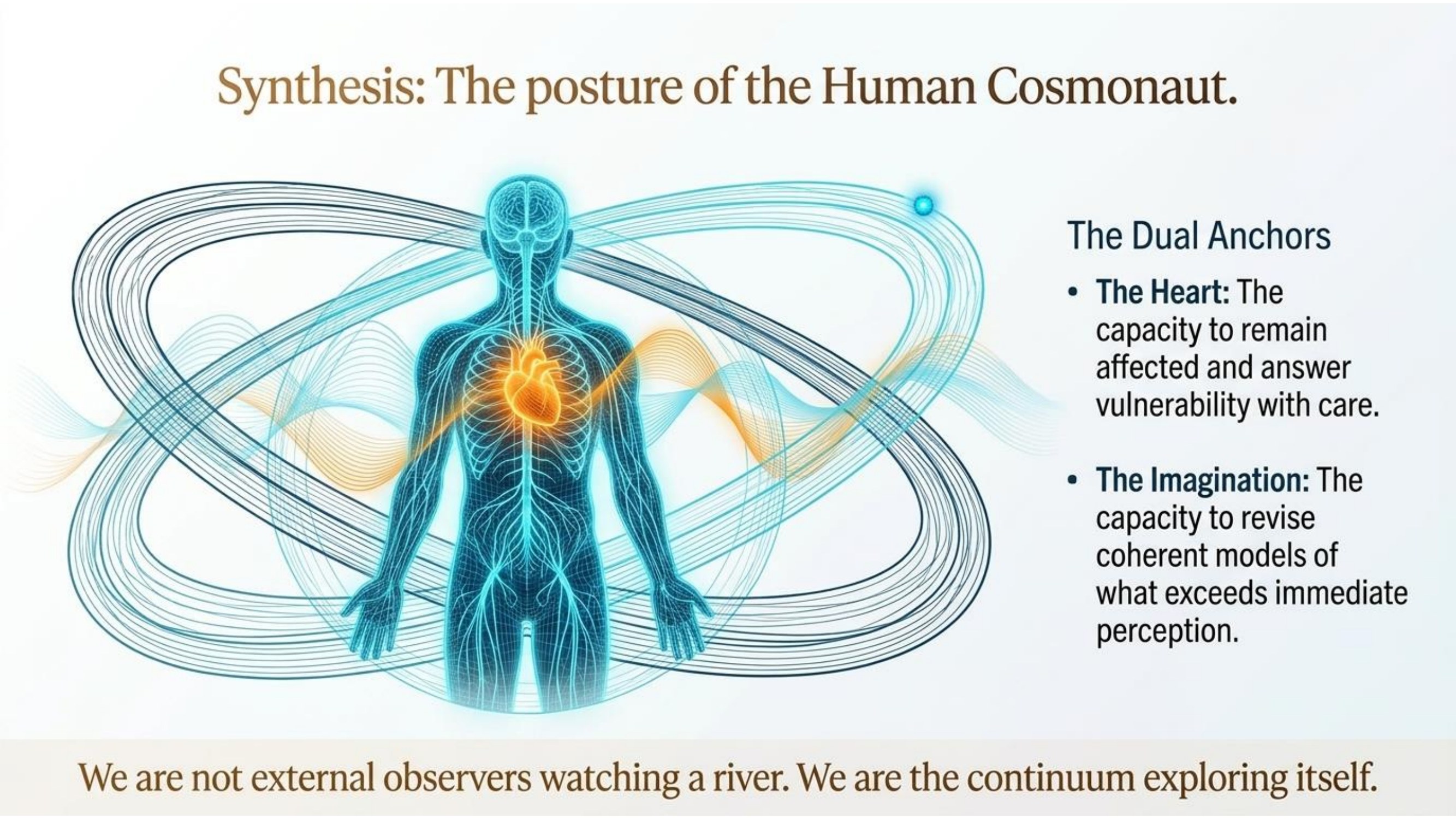
Plate of the dual anchors: the heart and the imagination
Two anchors: the capacity to remain affected and answer vulnerability with care, and the capacity to revise the model when the continuum contradicts it.

Plate 14

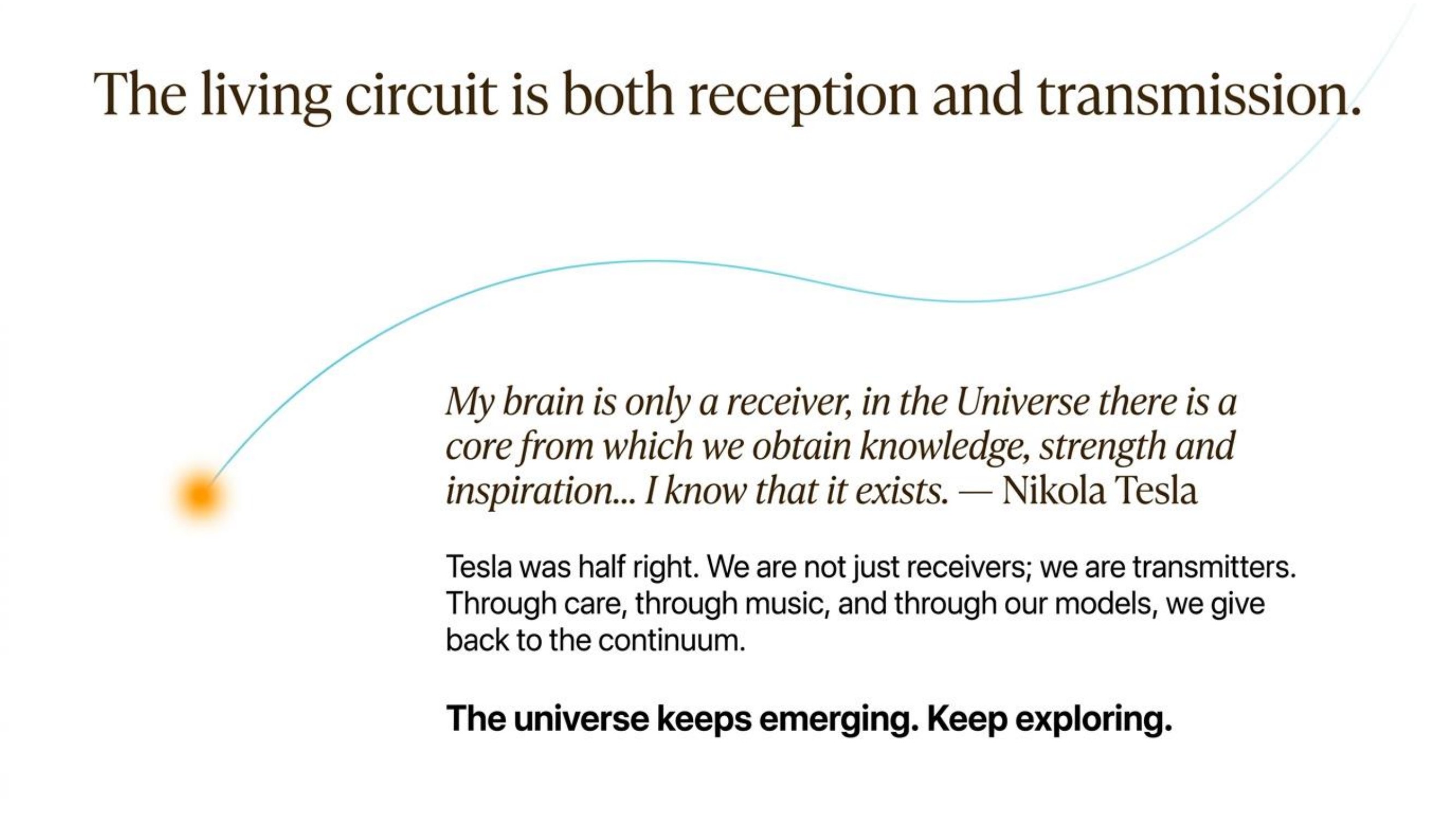
Reception and transmission

Closing plate with the Tesla receiver quotation and the living circuit of reception and transmission
Tesla described the brain as a receiver. The closing frame keeps the receiver and adds the return path: through care, through music, and through the models we are willing to revise.

Related