
The receiver is not a fixed instrument. It is a garden that rewrites its own trellis in response to what it has been asked to hold.
The earlier chapters argue that the brain is a fractal antenna coupled to a slip-stream substrate, and that reception widens through the silent period. That argument has an obvious missing piece. If reception is real, the receiver must be trainable; and if the receiver is trainable, the training must leave a physical trace. This chapter is about the trace. What the neuroscience literature calls neuroplasticity is what this book calls the aperture being tuned.
The modern demonstration begins with adult neurogenesis. Adult mice given running wheels grow measurably more new neurons in the dentate gyrus of the hippocampus than sedentary controls1. The result is important less for the running than for what it broke: the century-old dogma that the adult mammalian brain was a fixed inventory. It is not. It is an inventory that responds to behavior — and, crucially, to a behavior that is itself a form of embodied coupling to the environment.
Human evidence is now abundant. London taxi drivers, trained for years on the Knowledge — a memorized street topology of central London — show enlarged posterior hippocampi relative to non-drivers, with the effect scaling with years of driving2. Adults learning to juggle over three months develop measurable grey-matter changes in motion-processing regions, changes that partly reverse when practice stops3. The remodeling is real, it is specific to what the practice asks the receiver to hold, and it is reversible when the practice stops asking.
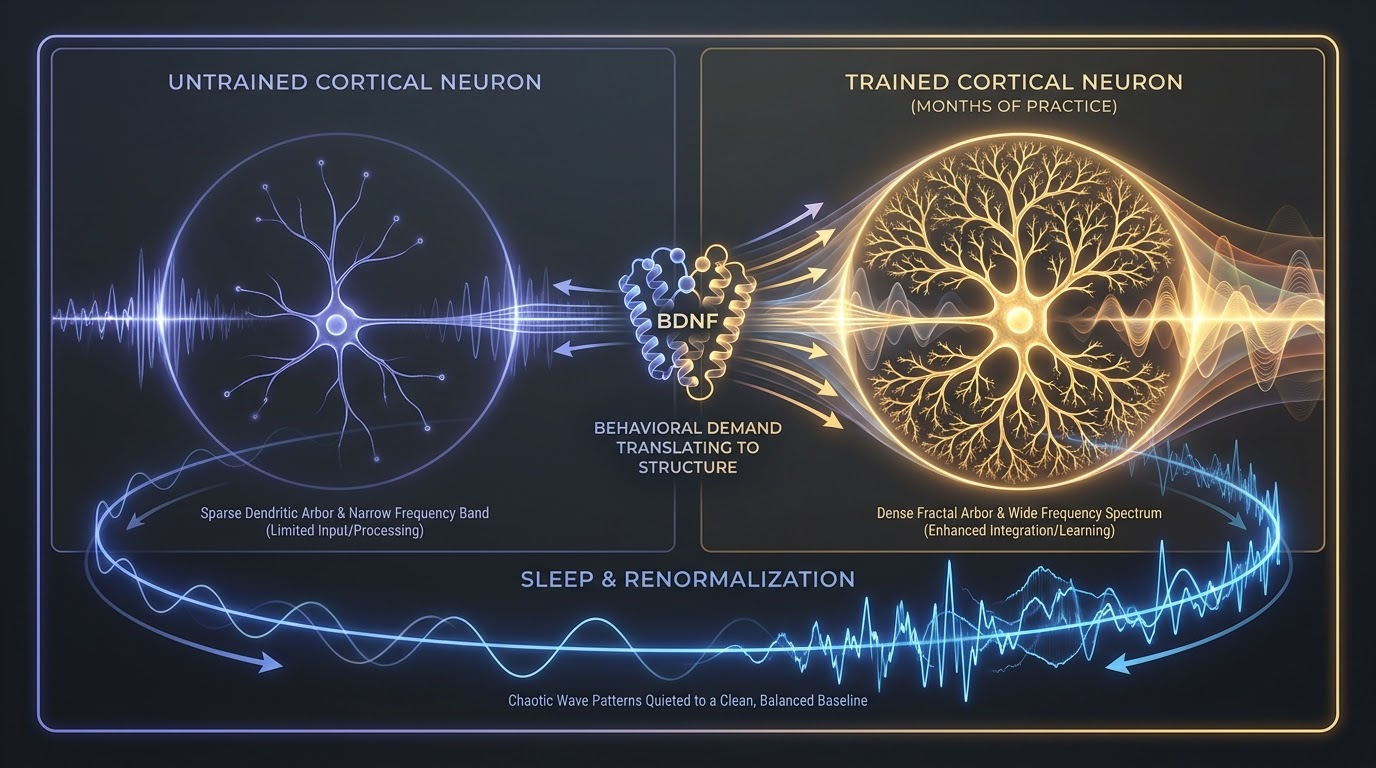
The molecular carrier for most of this is BDNF5 — brain-derived neurotrophic factor — the trophic signal that translates behavioral demand into synaptic and dendritic reorganization. BDNF is not the whole biology, but it is the hinge on which the story between behavior and structure turns. When the site's Living Architecture essay describes neuroplasticity as coherent remodeling8, the working-notes claim is precisely that the BDNF hinge is not a lone chemical event but the classical readout of a deeper cytoskeletal and metabolic dynamic — the biology chapter of the same argument the physics chapters develop from the other side.
The most instructive human dataset for this book is the long-term meditator work of Davidson and Lutz4. Sustained silent-period training — thousands of hours of the exact practice Chapter Five calls the widened aperture — is associated with structural change in the insula, prefrontal cortex, and the default-mode network, and with EEG signatures (high-amplitude gamma-band synchrony) that ordinary controls simply do not produce. Read against Chapter Five, this is not a curiosity. It is the experimental confirmation that a receiver trained to be quiet enough to hear the substrate is a receiver that is physically different from one that has not been so trained.
Sleep is where the day's plastic gains are consolidated rather than lost6. The synaptic-homeostasis hypothesis — that sleep exists to renormalize the strength distribution of the day's potentiated synapses — is the neurophysiological version of what the earlier chapters call the silent period. Practice writes; sleep edits. Both are required. A reception apparatus tuned only in waking hours and never allowed the editorial pass of deep sleep is a receiver being asked to compile without ever being asked to link.
Two disciplinary cautions are non-negotiable. First: none of the neuroplasticity literature proves the substrate claim the earlier chapters make. It proves only that the receiver is real, is measurable, and responds to practice in the way the substrate argument requires. Second: neuroplastic change is bidirectional. The same rules that let a trained practice widen the aperture let a chronic exposure narrow it. What a brain rehearses is what a brain becomes. That symmetry is why the earlier essays on this site treat attention less as a productivity variable and more as the primary ecological choice a modern person makes9 — the argument developed most directly in the sister-site companion Attention · A Human Superpower10.
The claim of this chapter, then, is minimal but load-bearing: the reception the earlier chapters describe is not automatic. It is a trained aperture, cashed out in measurable structural change, carried molecularly by BDNF and its neighbors, consolidated in sleep, and reversible when practice stops. The fuller biology — the coupling to metabolism, to protein folding, to the water-mediated cytoskeleton — is where the Living Architectureessay7 takes over. This chapter's job is only to install the observational spine on which the rest of that story hangs.
References
10 sourcesvan Praag, H., Kempermann, G. & Gage, F. H. (1999)
Running increases cell proliferation and neurogenesis in the adult mouse dentate gyrus. Nature Neuroscience 2, 266–270. Foundational demonstration that adult neuroplasticity is real, measurable, and behaviorally driven.
doi.org/10.1038/6368Maguire, E. A. et al. (2000)
Navigation-related structural change in the hippocampi of taxi drivers. PNAS 97(8), 4398–4403. The experience-dependent hippocampal remodeling that grounds Chapter Eight's argument for practice as reception.
doi.org/10.1073/pnas.070039597Draganski, B. et al. (2004)
Changes in grey matter induced by training (jugglers). Nature 427, 311–312. Short-timescale, reversible grey-matter change under a well-defined skill regimen.
doi.org/10.1038/427311aDavidson, R. J. & Lutz, A. (2008)
Buddha's brain: neuroplasticity and meditation. IEEE Signal Processing Magazine 25(1), 176–174. EEG and structural evidence that sustained silent-period training reshapes the network the previous chapters describe.
doi.org/10.1109/MSP.2008.4431873Huang, E. J. & Reichardt, L. F. (2001)
Neurotrophins: roles in neuronal development and function. Annu. Rev. Neurosci. 24, 677–736. The BDNF pathway invoked in Chapter Eight as the molecular carrier of experience-dependent remodeling.
doi.org/10.1146/annurev.neuro.24.1.677Tononi, G. & Cirelli, C. (2014)
Sleep and the price of plasticity: synaptic homeostasis to memory consolidation. Neuron 81(1), 12–34. Why the silent period of sleep is where the day's plastic gains are integrated, not lost.
doi.org/10.1016/j.neuron.2013.12.025Norton, KW (2026) — Vibe Coding the Living Architecture: A Field Guide to Human Biology as a Resonant System (Book 15)
Book 15 of the sequence. The principal treatment of protein folding and neuroplasticity as coherent, context-dependent processes — including the Neuroplasticity as Coherent Remodeling working notes and the hippocampal case studies Chapter Eight compresses. Companion essay at /essays/living-architecture.
/essays/living-architectureNorton, KW — Quantum Parallels in Neuroplasticity (working notes)
Working notes on quantum-adjacent metabolic and cytoskeletal dynamics as the substrate on which measurable neuroplastic remodeling rides.
/essays/living-architecture#quantum-parallels-in-energy-metabolism-informing-protein-folding-and-neuroplastiNorton, KW — On Slowness
The silent-period essay. Reading contemplative practice as a widening of the biological aperture through which the substrate becomes audible.
/essays/on-slownessNorton, KW — Attention · A Human Superpower
Companion essay on The Shattered Prism. The psychophysiology of attention — why what a brain rehearses is what a brain becomes — and the direct argument for attention as the primary neuroplastic lever Chapter Eight relies on.
theshatteredprism.com/attention-superpower