
If the substrate is a slip stream, then the biological question is not whether a body couples to it, but where and how. This chapter argues that the coupling happens at two scales at once — the helical stair of DNA at one end and the tubulin lattice of the neuronal microtubule at the other1 — and that these are not two mysteries but two ends of one channel.
The handshake, biophysically, is hydrodynamic. Water is not a bystander in either system2. The ordered water shells around DNA and the intra-tubular water columns inside microtubules are coherent enough to support wave propagation with lifetimes and length scales that the older, purely electrochemical model of the neuron cannot generate on its own. The 48-dimensional formalism developed in Appendix L of The Luminous Braid3 is where this is made precise; the chapter's job is to install the intuition.
The silent period is the physiological correlate4. A silent period is not the absence of activity; it is the drop in local signal density that lets the substrate's own current become audible inside a nervous system that spends most of its waking hours shouting over it. Sleep is the biologically protected instance of this — the price of plasticity paid down nightly, and the interval during which the day's plastic gains are consolidated rather than lost5. What returns through a widened silent period is the material the busy mind mistakes for its own invention. It was never invention. It was reception, finally routed through a channel that stopped shouting at itself.
The spatial melody
There is a second way to hear the same channel, and it belongs in this chapter because it is the mathematical form of the reception the silent period makes audible. Riemann's 1854 lecture6 defined a space not by its boundaries but by the metric of its internal relationships — the manifold. On such a manifold, structure is not a set of objects; it is a spectrum of fluctuations, and the natural instrument for reading it is the density power spectrum P(k), the same tool cosmologists use to characterize the matter distribution of the observable universe.
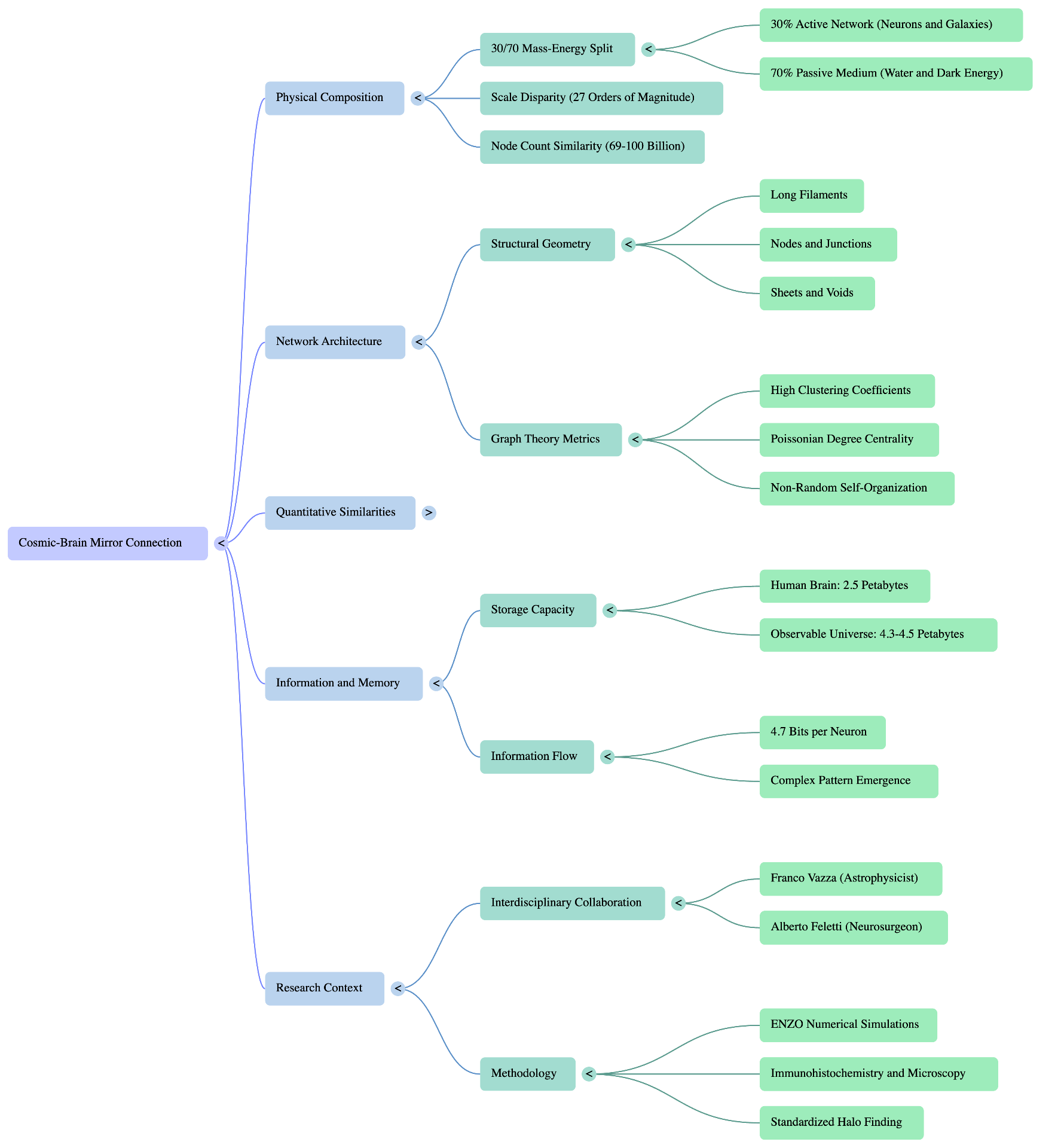
When Vazza and Feletti7 ran that instrument over the human cerebellum at scales of 0.01–1.6 mm and over the cosmic web at scales of 1–100 megaparsecs (roughly three million to three hundred and twenty-six million light-years), the two spectra tracked each other across a scaling factor of 1.875×1027. The linking lengths used to build the two network graphs — 16 μm in brain slices, 1.2 Mpc in the cosmic web — are the concrete numbers behind that scaling. Ordinary self-similar systems, clouds and river deltas and turbulent water, produce simple, steep power laws: one repeating note. What brain and cosmos share is a broken power law, a scale-segregated spectrum with preferred frequencies. It is a structured melody, not a drone; and it is the melody, not the picture, that carries the argument.
The petabyte convergence
There is a corollary, and it is worth stating carefully because the temptation to overstate it is strong. Applying statistical complexity and information entropy to cosmological simulations, Vazza estimates that describing the self-organization of the visible universe requires on the order of a few petabytes — roughly 4.3–4.5 PB, or about 3.5×1016 bits8. On the neural side, Bartol, Sejnowski and colleagues9 reconstructed hippocampal dendritic spines by electron microscopy and resolved at least twenty-six distinguishable synaptic strengths — roughly 4.7 bits per synapse, not per neuron — which, extrapolated across the roughly 1014– 1015 synapses of a human brain, lands the storage capacity in the same few-petabyte band, on the order of one to two petabytes.
That is the humbler and harder claim — that the reception and the field it receives are quantized on the same scale — and it is exactly the sort of claim Chapter Six will have to defend, and mark the boundary of, before it can be trusted to carry any further weight.
References
9 sourcesPenrose, R. & Hameroff, S. — Orch-OR (review 2014)
Consciousness in the universe: A review of the Orch-OR theory. Physics of Life Reviews 11(1). The microtubule-coherence proposal that Chapter Five treats as one biophysical instance of substrate coupling.
doi.org/10.1016/j.plrev.2013.08.002Norton, KW — Ocean Quantum Coherence
The hydrodynamic argument that underlies Chapter Five's biological handshake — ordered water as a coherence-carrying phase, not a bystander.
/essays/ocean-quantum-coherenceNorton, KW — The Luminous Braid, Appendix L
Empirical Validation and Biophysical Resonance of the Unified Substrate — MAESTRO ARPES, coherence-length measurements, and the 48-dimensional biophysical formalism.
/essays/lbnl-confluence#appendix-lNorton, KW — On Slowness
The silent-period essay. Reading contemplative practice as a widening of the biological aperture through which the substrate becomes audible.
/essays/on-slownessTononi, G. & Cirelli, C. (2014)
Sleep and the price of plasticity: synaptic homeostasis to memory consolidation. Neuron 81(1), 12–34. Why the silent period of sleep is where the day's plastic gains are integrated, not lost.
doi.org/10.1016/j.neuron.2013.12.025Riemann, B. (1854)
Ueber die Hypothesen, welche der Geometrie zu Grunde liegen. Habilitation lecture, Göttingen. The paper that liberates geometry from Euclidean flatness and defines a space by the metric of its internal relationships — the manifold that later carries General Relativity, cortical surface analysis, and spectral analysis of density fields.
maths.tcd.ie — Riemann (1854), English translationVazza, F. & Feletti, A. (2020)
The Quantitative Comparison Between the Neuronal Network and the Cosmic Web — Frontiers in Physics 8:525731. Statistical fingerprint (spectral density, clustering, degree distribution) shared by the human cortex/cerebellum and the cosmic web across ~27 orders of magnitude.
frontiersin.org — Vazza & Feletti (2020)Vazza, F. (2020)
On the complexity and the information content of cosmic structures — MNRAS 491:5447. Applies statistical complexity and information entropy to cosmological simulations; describing the self-organization of the visible universe requires on the order of a few petabytes (~10^16 bits).
MNRAS — Vazza (2020)Bartol, T. M. et al. (2015)
Nanoconnectomic upper bound on the variability of synaptic plasticity — eLife 4:e10778. Electron-microscopy reconstruction of hippocampal dendritic spines resolves at least 26 distinguishable synaptic strengths, ≈4.7 bits per synapse, and the ~1–2 petabyte estimate for human cortical memory capacity.
eLife — Bartol et al. (2015)