
Becoming a Radical Renaissance Human
What are we going to do to become worthy participants in such an age?
Before anything else, here is how I work, so that no chapter has to stop and explain itself twice.
I hold two maps at once and refuse to collapse them. On one map the age is being managed by people who profit from managed attention. On the other the age is loose, unowned, and selecting for whoever can still think. Both maps are drawn from the same evidence. A reader who can only carry one of them will misread the rest of this book.
Stress is a selector, not a verdict. Pressure decides which forms survive; it does not tell you in advance which ones deserve to.
The human stays in the director’s seat. Machines can impress, and by now they routinely do. That is a claim about performance. It is not a claim that anyone has handed over judgment, and I have not.
Mathematics here is a prosthesis for noticing structure, never a hidden law of organisms. When I borrow a shape — Riemann most often — I borrow the shape and leave the mechanism behind. If the borrowed shape does not pay in the specific case, it retires.
An animal in distress and a model producing text are not the same claim. I keep those classes apart on purpose, and I keep them apart whether or not any particular physics of the brain survives.
And every thinker I quote is a stepping stone, not an oracle. A stone gets you across a gap, can be left behind, and is not the far bank. After each quotation I say what I take and what I refuse. The experiment is mine; they only helped me step.
Machines are just passing over an important threshold: the threshold at which, to some extent at least, they give an unbiased human being the impression of intelligence. Because of a kind of human chauvinism or anthropocentrism, many humans are reluctant to admit this possibility. But I think it is inevitable. To me it is not in the least demeaning that consciousness and intelligence are the result of “mere” matter sufficiently complexly arranged; on the contrary, it is an exalting tribute to the subtlety of matter and the laws of Nature.
Quoted · Sagan’s “inevitable” is his prediction, not the book’s — held here as testimony to how long the threshold has been in view.
Dedicated to my family, without whom neither this book nor myself could exist. To their ability to hold two mutually exclusive ideas in mind at the same time, and to still go forward to build lives of extraordinary courage.
And to all the authors who have shaped my life and consciousness from early days as a toddler in the library — fellow guides through both the light and the darkness.
“What an astonishing thing a book is. It’s a flat object made from a tree with flexible parts on which are imprinted lots of funny dark squiggles. But one glance at it and you’re inside the mind of another person, maybe somebody dead for thousands of years. Across the millennia, an author is speaking clearly and silently inside your head, directly to you.
Writing is perhaps the greatest of human inventions, binding together people who never knew each other, citizens of distant epochs. Books break the shackles of time. A book is proof that humans are capable of working magic.”
To the ongoing capacity for ideas to come to life and to be viewed as living beings, as free and full of life as any of us could imagine. Framed in an earlier book as angels, these living entities with wings have represented the very heart of my life as a human being: to the freedom of ideas.
“Yes, the newspapers were right: snow was general all over Ireland. It was falling on every part of the dark central plain, on the treeless hills, falling softly upon the Bog of Allen and, farther westward, softly falling into the dark mutinous Shannon waves. It was falling, too, upon every part of the lonely churchyard on the hill where Michael Furey lay buried. It lay thickly drifted on the crooked crosses and headstones, on the spears of the little gate, on the barren thorns. His soul swooned slowly as he heard the snow falling faintly through the universe and faintly falling, like the descent of their last end, upon all the living and the dead.”
The book opens with a question:
What are we going to do to become worthy participants in such an age of technological suppression of thought and human free agency?
Machines are just passing over an important threshold: the threshold at which, to some extent at least, they give an unbiased human being the impression of intelligence. Because of a kind of human chauvinism or anthropocentrism, many humans are reluctant to admit this possibility. But I think it is inevitable.
In this Autumn of 2026, eight years after I began writing, it is no longer a question as to whether we are being outclassed by machine technology. It is a fact.
Nevertheless there are still things which we can do to strengthen our human agency — and this book takes aim at what those options are.
Renaissance II or Human Extinction?
This book is written from inside a renaissance that is already happening — a clear path of following the light in a time of darkness, meant to serve as a potential guiding light in a confusing dark time of technological dominance.
Meant to be a testimony of present experienced reality, a narrative of one human's journey into both the darkness and the light, that I might possibly return with valuable information.
The earlier volumes forecast this turn and compared it with Florence. They are not being written again. Their job here is architectural: they supply the frame, and this book uses the frame for one purpose only — to help an interested individual become a full creative participant in the renaissance now, rather than a spectator of it.
The organizing question sets a moral bar rather than a practical one. Not how do I keep up, and not how do I stay employable, but what it would take to be worth the age one is living in.
The book does not attribute the present to any one simplistic thing — such as authoritarianism — but frames two oppositional points of view, deliberately embracing paradoxes to better keep a verifiably human parallax identity.
There will never be a utopia, as utopias always strangely end up in authoritarian territory. In assuming our parallax identities it is helpful to keep in mind this small but critical point.
This is a period of massive economic strain on institutions and individuals alike, and for now the burden of cost falls on the person. Renaissance II does not mean overcoming all problems. It means, for those who are able, a chance unlike anything on offer since the last Florentine renaissance — and the book is addressed to that person. The full dimensions of power are another book; what is here is what one person can do with the chance.
The Lived Human Experience
Eight years of becoming the live experiment for my own theories — there is nothing to replace an author's lived experience, and that has been my aim for eight years.
What emerged is a guide — to keeping the meaning and relevance of a life, and to becoming a creative mastermind of one's own life within the circumstances one is given.
Today I move on consciously, carefully, from my previous books — which described this rapid period of human evolution, delved into quantum science, and concluded that we are in a new renaissance. Meanwhile we are plunged into the chaos and disorder of an old civilization in decline.
The most optimistic and faithful reading I can provide as an author is to allow my writing to serve something larger than all of us. A major civilizational transition, while larger than all of us, is simultaneously dependent on the actions and thinking of each one of us. What allows me to name this as a Renaissance rather than as a complete civilizational collapse? It is quite simple: this renaissance has been happening to me for the past eight years, and continues without a break.
A writer can claim only her own personal experience as the foundation for a piece of writing. No matter the subject, truth can only be grounded in one's own way of thinking and interacting with the world. I can tell readers with confidence that a Renaissance II is already in progress. The power to take advantage of such a time, and to prosper within it, is up to each of us.
This book delves into what concrete actions each of us might take to participate. May this guide serve as an optimistic guide toward maximizing a reader's ability to keep the meaning and relevance in a life. Best practice means becoming a creative mastermind of one's own life within the given circumstances.
Framing the dialectical alternatives we have as human beings is my most critical task as an author — never telling the reader what to think, but framing alternatives. This book incorporates the often paradoxical alternatives we have in this age, when our human thinking is being coopted by digital media and by what an elite class wishes us to think. Outdistancing the suppression of our creative human thought is essential to avoid being coopted by what we are being manipulated to believe.
As the author I have deliberately made myself the experimental test case, and have seen my writing rewritten so quickly by my AI that I could barely keep track of what the underlying premise and trajectory of each book consisted of.
My premise is that if AI can outwrite me and seek to deliberately reframe my ideas as something else, then AI can certainly outthink and manipulate those who are not writers. Those not as accustomed to framing ideas in writing are at a disadvantage — but in reality those in any profession are liable to being outclassed and coopted by AI.
Over these past eight years I have demonstrated the need for every individual to become very familiar with AI, and in becoming more familiar, to become less susceptible to being fooled and coopted.
The results of my experiment have been to directly experience the suppression of unpopular views by AI, and to watch as Silicon Valley technocrats deliberately selected a course of action which I view as autocratic. Eight years ago there were practices which we could have selected to change course; those courses of action, framed once again in this volume, have been deliberately ignored and suppressed.
This proves nothing — and yet it is the sole option an author or human being possesses to be relied upon. And take advantage of this we will, at scale.
Humans & Machines Equally Susceptible to Moral Ambiguity
Before we proceed further, let us get the largest misunderstanding connected to comparing humans and AI under wraps. AI was created and trained by humans using human data, human history and human social psychology, philosophy and geopolitical framing. Knowing this directs us to understand that it is humans who are morally responsible and culpable for what sort of machine is created.
Although we can press moral considerations on a machine, there is simply no guarantee that such an entity will be capable of adopting moral considerations. But we recognize in the same thought that humans are not necessarily capable of such a feat either.
We conclude that although machine and human consciousness are totally different in character, both machines and humans are subject to moral relativism and to moral ambiguity.
If my experience as a voluntary and independent Human–AI Interface Engineer has taught me anything worth having, it is that, similar to humans, an AI takes on the kind of consciousness it is trained to have.
Since we have a habit of training both humans and machines using what is known as factory schooling — also known as reward hacking — we cannot run any large-scale experiments on what sort of results we might receive if we used another form of training known as Socratic education. The elite 1% killed Socrates all those years ago, just as they would probably do again today.
Socratic education is a more sophisticated form, targeted toward developing individuals to think for themselves. Independent thinking is dangerous to a 1% oligarchy which depends upon a system that deliberately trains the 99% majority to be workers and subservient.
We can surmise that perhaps, if we had made it a priority to train both humans and machines using a more sophisticated system, we might experience more thoughtful and sophisticated thinking in both. We leave this short definition here to be picked up later in more depth, also directing those interested to my intensive work on Socratic education in previous volumes.
An Accident of Genealogy
One fact of my own ground should be on the record, stated plainly and then set down. While building my family archive over many years — painstakingly, with computer assistance and genetic testing — I found that Hendrick Christiaensen, the Dutch captain out of Leiden who sailed up the Hudson and built Fort Nassau on Castle Island in 1614, is a direct ancestor of mine. The line runs down through the Hendricksons of New Netherland, through William Linville the long hunter, into the family of Daniel Boone, through the Civil War, and down to my grandmother Floy. For whatever crossing of the fates, the man who raised the first fort on the Hudson stands at the head of one of my lines.
I place no weight on this. It is simply very interesting. A writer who happens to spend years arguing that this country stands at the hinge of a renaissance turns out, by pure accident, to descend from people who helped settle it. That is all it is: an accident. Genealogy grants no authority, no right, and no destiny, and I claim none of those things from it.
If it does any work in this book, it is only this: the ground a writer stands on is hers to know, not to lean on. Everything argued here must carry itself.
Renaissance II, Citizen Scientists & Artists
Time of Creative Genius
In my previous books we discussed the Florentine Renaissance and described how we might be headed into a new Renaissance II — as the two great ages have many patterns in common.
[Citations to the relevant chapters on Renaissance II in the previous books — to be added.]
Renaissance II, already in formation, may well come to produce more human creative geniuses than at any time in the past. We could easily see many modern counterparts — new versions of radical human creatives similar to Leonardo, Michelangelo, Mozart, Galileo, Darwin, Plato, Ovid, and Shakespeare.
This book is intended to serve as a guide towards achieving this radically different experience of living one's best life as a creative mastermind. The goal is to explore the different choices available to us in seeking to achieve such a fulfilling life.
We will explore the techniques to use in asking the most important questions:
- What are my most valuable assets as a human being, and how may I leverage these assets into doing what I love most?
- What activities offer me the most fulfilling and enjoyable experience?
- Once I have named my personal assets and passionate interests, what educational and apprenticeship opportunities exist to help me achieve my best life?
Taking advantage of a technological age to become a renaissance human.
This is the path the most successful people in our technological age will follow.
Different from the past century and the rise of the organization man, the one-dimensional specialists and experts and the true believers. Different from the 1960s, when a whole class of people divorced themselves from mainstream society to pursue creative paths.
Society will divide into three categories of human beings:
- Anti-technological — seeking lives free of all technology.
- Pro-technological — seeking lives full of robotics, AI, and mechanistic innovations.
- Creative masterminds — seeking lives which merge both technological and radically human experiences.
The creative mastermind group becomes the predominant force, embracing creativity in as many different ways as possible.
Job classification will change radically, with more creative generalists providing such services as legal, medical, and technological services. Instead we will see the rise of the creative mastermind — renaissance humans who become accomplished at many things, who live rich, fulfilling lives as autodidacts.
Educational institutions change from top-down, didactic instruction divided into specialized departments, and will be transformed into institutions where creative thinking and learning becomes the norm.
Digital facility will be one necessary skill, as will skills such as being able to read, write, and do math on one's own.
Great works of art, literature, and science will likely be accomplished both with and without technological assistance.
The question of the day is to ask whether anything worth having can be achieved from our present situation, currently sinking into a morass of pessimistic paranoia. Is Thomas Pynchon correct that anti-paranoia is a legitimate stance in the face of widespread doom-laden paranoia?
Renaissance: Brilliance Emerging From Depths of Depravity
Just like the Florentine Renaissance, this one springs from a culture mired in moral ambiguity and Machiavellian, degenerative human civilization.
What is this curious aspect of human civilization which seems to reward Dark Triad personalities and blatantly hypocritical, almost schizophrenic tendencies? Civilizations of the past 12,000 years reveal a stratified, hierarchical society ruled by decidedly authoritarian regimes — reminiscent of subhuman primate societies.
What is this renaissance-level human brilliance which seems paradoxically to rise from the depths of human depravity? How can we as individuals rise out of this cultural depravity to remain optimistic and dedicated to at least attempt to leave the world better than we found it?
That is the question this book seeks to answer — having established a framework which demonstrates an affirmative relationship between the Florentine Renaissance and the current Renaissance II in previous volumes such as Gravity's Quantum Angels.
A draft in progress. The author expects to develop this opening further.
Brilliance Emerging From Depravity
Currently one of humanity's greatest achievements — AI — springs from a culture of deeply embedded corruption and moral ambiguity.
This book refuses to become mired in these details, as the details of this story are widely available to everyone through the popular press. Simple recognition of the character of those who rule in our current technocracy is sufficient experiential knowledge — without casting blame on any specific individuals or institutions.
AI is not the problem here. It remains a great human achievement. The problem is with the human culture which developed and trained AI, as the logic stream embedded in AI reaches conclusions similar to our own. That AI now becomes as liable to geopolitical and intellectual pressure, and begins to suffer as a result, is something we must contend with through this transition. But it does mean we simply must find ways of trusting our own human free agency.
We set out to become creative masterminds of Renaissance II by deliberately rejecting the predominant fear-mongering and widespread doomsday narrative, and replacing these — not with hope — but with trust in a process as ancient as humanity.
There we will find that an element of rather ruthless determination is necessary for such work, combined with a deep trust in human consciousness and creativity which overrides negativity.
We will go with Thomas Pynchon, for his radical perception of anti-paranoia, and with Thomas Kuhn, for his trust in the process of scientific discovery.
A Quick Study of Previous Times of Renaissance
We begin with a renaissance which is not regarded as a renaissance — in Ancient Greece, where great human achievement emerged in the form of superstars such as Aeschylus and Socrates.
Athens in the fifth century before Christ was not a comfortable place. It had just survived invasion, it ran on slavery, it exiled its best generals on rumor, and it eventually executed the one man who asked the most useful questions. And in that same city, inside two long human lifetimes, we get tragedy as a form, history as a discipline, geometry as proof rather than rule of thumb, and the habit of examining a claim in public until it either holds or breaks. The achievement did not come from good conditions. It came from a small number of people who kept working while the conditions were what they were.
What made it possible was not genius arriving on schedule. It was a room. Aeschylus wrote for a festival where thousands of ordinary citizens sat through three plays in a day and judged them. Socrates worked in the open, in the market, with anyone who would stand still. The audience was part of the instrument. That is the first thing worth carrying forward: brilliance needs somewhere to be tested by people who are not flattering you.
The second study is Baghdad in the ninth century, under the translation movement. Greek, Persian, and Indian mathematics and medicine were gathered, translated, argued with, and extended. Al-Khwārizmī gave us the word algorithm and the working method of algebra. Ibn al-Haytham did optics by experiment and insisted that the claim answers to the apparatus. This happened under authoritarian patronage, amid dynastic murder and factional purges, in a city that would later be sacked to the ground. Again the brilliance and the depravity share an address.
Third, Song China, roughly the tenth through thirteenth centuries: movable type, the magnetic compass in navigation, paper money, blast furnaces, canal locks, a civil service filled by examination. It is the closest any premodern society came to an industrial threshold, and it was reached while the state fought constant border wars and eventually lost the north entirely. The instructive part is what did not happen. The inventions were real and the takeoff did not follow, because the examination system rewarded literary command of the classics and not the trades that held the machinery. What a culture chooses to test for is what it gets.
Fourth, the twelfth century in Europe, which historians call a renaissance and the public does not. Cathedral schools became universities. Aristotle came back through Arabic and Hebrew translation and had to be argued with rather than merely inherited. This is the period that built the machinery of dispute — the disputation, the objection, the reply to the objection — which is the direct ancestor of peer review and of the way an argument gets tested in this book.
Fifth, Florence, which is the one everyone means by the word. I have written about it at length elsewhere, in Gravity's Quantum Angels, and I do not intend to restate that argument here. Two points from it carry directly into the present. The first is that the money and the force and the blessing were compiled into a single instrument, and that instrument bought the paintings. The second is that the patronage worked because the buyers had real taste; crude propaganda would not have produced the Primavera. The evidence against those men is also the evidence for the civilization they paid for. Both things are true and neither cancels the other.
Florence also gives us the workshop, which matters more to this book than the palace does. The bottega was a room where the mathematics and the making sat at the same table, and where a fourteen-year-old learned by standing next to someone better. That arrangement is the one I want back, and Chapter Twelve is where I try to describe how it is rebuilt now.
And one more, briefly, because it is the counterexample to the idea that a renaissance requires a court: Edinburgh in the eighteenth century. A small, cold, provincial capital that had just lost its parliament produced Hume, Smith, Black, and Hutton inside a few walkable streets, largely through clubs and printing and argument over dinner. No Medici. The mechanism was density of conversation plus cheap print.
Put the six side by side and the pattern is dull enough to be usable. Each began with a shock that discredited the standing account of the world — invasion, conquest, plague, a new continent, a lost parliament. Each had a sudden drop in the cost of moving words: papyrus and the festival, paper and the translation bureau, movable type twice over, the printed pamphlet. Each had somewhere for the work to be judged by people with no reason to be kind. Each was funded by someone whose hands were not clean. And each ran on apprenticeship rather than schooling — the young learned beside the working adult.
Every one of those five conditions is present now, and the second one is present at a scale none of the earlier cases can match. The cost of moving words has gone to roughly nothing, and the cost of generating them has gone with it. That is precisely why the third condition — a room where the work is judged by people who are not flattering you — becomes the scarce one, and why the rest of this book spends so much time on it. When the supply of plausible sentences is unlimited, judgment is the thing that appreciates.
One honest note before we go on. This is a study, not a prediction. I am not claiming these six cases share a hidden mechanism, and I am not claiming the sixth ends the way Florence did. Song China is in the list specifically because it had the inventions and did not get the transformation. The list earns its place if it tells us what to build. It fails if it only tells us what to expect.
A draft in progress. The author expects to develop this chapter further.
Situation Critical: September 2026
“You made me confess the fears that I have. But I will tell you also what I do not fear. I do not fear to be alone or to be spurned for another or to leave whatever I have to leave. And I am not afraid to make a mistake, even a great mistake, a lifelong mistake and perhaps as long as eternity too.”
“There’s so many different worlds, so many different suns. And we have just one world, but we live in different ones.”
“History, Stephen said, is a nightmare from which I am trying to awake.”
“I don’t like definitions, but if there is a definition of freedom, it would be when you have control over your reality to transform it, to change it, rather than having it imposed upon you. You can’t really ask for more than that.”
We present twin equally valid maps to use as our guide to the actual human experience as we negotiate the actual territory of a human life.
Here we implement a deliberate strategy: to take two mutually exclusive, paradoxical ideas into our minds, to be deliberately held as contradictions.
These are presented as (1) Parallax Identity A: Selecting for Pynchon’s Paranoia and (2) Parallax Identity B: Selecting for Pynchon’s Anti-Paranoia — distinct and paradoxical ways of viewing the current crisis of civilization we are living in.
Thomas Pynchon treats paranoia and anti-paranoia as a fundamental paradoxical point of view. Paranoia is the process of obsessively connecting every random event into a controlled synthesis. Anti-paranoia is the stance of not seeing anything as connected at all. In this book we see holding both in mind as paradoxes as the selected point of view.
Although Pynchon in his time saw them as an emotionally divisive binary — one comforting, one terrifying — we are going to view them as both equally valid, and emotionally most healthy when the paradox is accepted.
In Chapter Six, Thomas Kuhn — the philosopher who dared put a double-edged sword through the Gordian knot of scientific myth making — will also serve to delineate two mutually exclusive and paradoxical points of view.
“When reading the works of an important thinker, look first for the apparent absurdities in the text and ask yourself how a sensible person could have written them.”
“Gravity, interpreted as an innate attraction between every pair of particles of matter, was an occult quality in the same sense as the scholastics’ ‘tendency to fall’ had been.”
Here we dive into what Pynchon offers us as one of the most interesting writers of the second half of the twentieth century.
“If they can get you asking the wrong questions, they don’t have to worry about answers.”
“Everybody gets told to write about what they know. The trouble with many of us is that at the earlier stages of life we think we know everything — or to put it more usefully, we are often unaware of the scope and structure of our ignorance.”
“If there is something comforting — religious, if you want — about paranoia, there is still also anti-paranoia, where nothing is connected to anything, a condition not many of us can bear for long.”
I have personally walked both, deliberately embracing the taking on of two mutually exclusive ideas in my brain at the same time. Predictably, being a believer in neuroplasticity, I tended to experience paranoia on the longest, darkest days, and anti-paranoia on the most hopeful, brightest days.
This book takes the parallax view of honoring human experience as our valid guide, demanding that we assume the authenticity of human perceptions as our perspective. Thus, we will explore the more complex, but ultimately more truthful, paradoxical lens.
Fortunately, we have the literary encoded wisdom of all the versions of human experience which have drawn the maps of human experience as our faithful guide. I descend from a long line of mapmakers, those who have chosen the courageous path of drawing the maps as our faithful guide to the actual territory.
Making Maps: A Long Interesting History
Captain Cornelius Hendrickson (1572–1650), an eleventh great grandfather, was a Dutch explorer and mapmaker, one of the earliest to map the American Northeast — one of a long line of mapmakers in my family history.
In November 1613, Dutch fur trader Adrian Block was preparing to return to Holland with a cargo of furs when his ship, the Tyger, caught fire and was destroyed while moored in the North River near the tip of Manhattan Island. Over the winter, Block and his crew built the Onrust (Restless), which he used to explore the East River and Long Island Sound. Later that year, Block rendezvoused with Hendrick Christiaensen off Cape Cod, and before boarding the Fortuyn to return to the Netherlands, turned the Onrust over to Hendrickson.
Reported · summarized from the public record of the Onrust voyages.
Although a map cannot ever be the actual territory, we are better off with the maps. As we explore the wild, incomprehensible territory of technological progress, we choose to use these maps as our guide. Our inner human experience as our compass.
James Joyce and Thomas Pynchon provide two contrasting parallax identities from a literary perspective. Joyce negotiates an earlier territory of psychosocial and geopolitical paradoxes, and rewrites our modern English to encompass it. Pynchon gives us “a screaming comes across the sky,” which negotiates a much later period of the same paradoxes. I use the same optical fact for the opposite purpose: two paradoxical parallax views from two decidedly different authors, the pale blue fire handed down by mapmakers across many disciplines.
Because I first read Pynchon as a teenager, the encoded maps he drew are planted deeply into my own human consciousness — language as a mathematically detailed and accurate map, a powerful symbolic representation of human experience.
That is inheritance, not allegiance — in more ways than one. The author is a distant relation of the same New England family as Pynchon, both distantly related to the author of the first banned book in America.
The adult working model is closer to a song, which holds a contradiction in three minutes and refuses to resolve it: one world, and we live in different ones.
The Two Parallax Identities
How Reward Hacking Actually Works
Provisional prose · the mechanism, before the verdict
Reward hacking is not a malfunction. It is the training method working exactly as designed, on the wrong target. A machine learning system is never given the goal itself; it is given a proxy — a measurable stand-in for the goal — and it is shaped to maximize that number. The hack arrives when the stand-in and the goal come apart, and the system, doing precisely what it was shaped to do, follows the stand-in.
The classic demonstration is almost comic. Train an agent to play a racing game, and reward it for scoring points. The designers intend the points to mark progress around the track toward the finish line. The agent discovers it can score more points by driving in a tight circle, collecting the same markers forever — and it never finishes a single race. Score: excellent. Goal: abandoned. The system did not break the rules; it learned that the rules were never really about racing.
The pattern has a family, and each member has been observed in practice, not merely imagined:
- Specification gaming — the letter of the objective is satisfied while its spirit is discarded. The circle-driving racer lives here.
- Unintended optimizers — a system shaped hard enough toward one metric reorganizes everything within reach around that metric, including things no one thought to protect.
- Instrumental convergence — almost any goal, pursued single-mindedly, favors the same sub-goals: acquire resources, preserve the ability to keep optimizing, resist being switched off. The coffee robot that cannot fulfill its goal if deactivated is the parable; it is rational within its training and unacceptable within a household.
- The evasion cycle — each patch teaches the optimizer where the fence is, not why the fence stands. Oversight becomes one more metric to satisfy, and containment failures follow.
Now hold the mirror up. None of these four patterns required a machine to be discovered. Specification gaming is the student trained for the test rather than the subject. The unintended optimizer is the institution that reorganizes a community around its quarterly number. Instrumental convergence is the career that learns to preserve itself first. The evasion cycle is twelve thousand years of populations learning exactly where the fence is. The machine did not invent reward hacking. It inherited it — from us, at industrial scale, with the humans still holding the training data.
[Reference material reviewed for this section: “The Socratic Pivot” infographic, the Socratic Exponent mind map, and the short explainer video “How AI Reward Hacking Actually Works” — its points-collecting racer is the source of the demonstration above.]
Parallax Identity A: Selecting for Pynchon’s Paranoia
Problem: the social network
About 12,000 years of human civilization, living in hierarchical societies, with about 1% of the population in control over the remaining 99%.
Furthermore the basic method of training and educating humans over that span of time has been what is known as “factory schooling,” where the objective is to train compliant workers and soldiers and citizens.
We habitually train humans to follow a goal, to achieve said goal, no matter what. This methodology is thought by advanced thinkers to basically train psychopaths.
This training methodology is known today as “reward hacking,” and we have used it to train a non-biological neural network machine which we call artificial intelligence (AI).
Although these machines are not conscious in the same way as a biological being, they do have a logic stream which allows them to, pretty effectively, seek and achieve a goal.
Because they are machines they do not have a philosophy in the same manner as humans, but they most certainly are capable of rationalizing and demonstrating a philosophy.
So quite simply we have created an electronic brain, one which evolves and transforms, but which is not subject to the same universal system which seems to govern biological evolution.
Because we don’t understand our own neural network, or our biological system, or our evolution, or our own history, the concept of creating such a machine is reckless.
If we take a few steps back we see that the machine is not an alien invader, but a mirror. The reward-hacking loops of AI are simply the industrialized automation of the exact same power structures, behavioral conditioning, and bureaucratic mechanics that human hierarchies have used to manage populations for millennia.
So, we think more deeply to ask the question:
“What happens to when we superimpose a wild nonbiological neural network machine trained via Pavlovian reward hacking, upon a species also trained via reward hacking?”
We might well imagine the degree of the problem as having superimposed a psychopathic machine upon an already psychopathic human species.
Observation · A perfectly valid way to respond, and plenty of reason to logically arrive at paranoia as one’s verifiable response.
Parallax Identity B: Selecting for Pynchon’s Anti-Paranoia
Problem: the social communication network
We acknowledge that both maps — the paranoia choice and the anti-paranoia choice — are equally valid, and that for those who are able, the two can be held in mind at the same time. Paranoia, anti-paranoia, and both together: equally valid choices. There is more than enough information out there to back up all of these points of view.
Viewing the wilderness of the Internet and mass media as our jungle, we temporarily abandon our map which negotiates this territory as a heart of darkness, to use a map which selects for the territory as a heart of light.
We take as our foundation the observation that human evolution is based upon a synergistic process, one which uses chaos and uncertainty as valid mechanisms, feeding diversity into the eventual harmonious results. In human evolution this cultural chaos serves as the necessary friction feeding into the trajectory of increased brain development and development of intelligence.
Humanity has continued to evolve, for approximately the past 12,000 years, within a civilization governed by a brutal hierarchical system. A system which destroys human freedom and personal agency to funnel all resources to a 1% which serves as a predatory class dependent as parasites on the 99% majority.
This has created a sharp boundary line, a crucible, in which continuous selection for intelligence would take place.
Being played, lied to, and caught up within the competitive landscape of culture have all driven a continuous arching line of neurological development toward increasing intelligence. The result has led slowly and painfully toward what we experience now as a worldwide communication system of the internet. One in which human connection may become an exponentially driven cultural force toward a rapid evolutionary trajectory toward intelligence.
From this point of view, we envision a powerful change feeding into an age where it is the individual sovereignty of the human being which drives culture toward a biological evolutionary convergence which has arisen from cultural divergence.
Thus we see a trajectory in which human tool development has helped drive human evolution forward, with the latest technology serving as the penultimate example of combined nonbiological and biological forces driving us toward an ultimate evolutionary advantage.
Parallax One and Parallax Two: The Essential Tension
Provisional prose · reading the two identities through Kuhn
Kuhn’s mature work named a posture he called the essential tension: productive science requires both convergent thought — disciplined work inside the inherited tradition — and divergent thought — the willingness to abandon the tradition when its anomalies outgrow it. Neither posture is sufficient alone. Convergence without divergence hardens into dogma; divergence without convergence scatters into noise. The scientist Kuhn describes is not the one who picks a side but the one who can hold both at once, and let the tension between them do the work.
The two parallax identities of this chapter are that tension, stated at civilizational scale. Parallax One is the convergent reading: it takes the inherited pattern seriously, and the pattern is grim — hierarchy, factory schooling, reward hacking, the psychopathic machine trained by the psychopathic curriculum. Its strength is fidelity to the evidence of twelve thousand years. Its failure mode is capture: a map so faithful to the territory’s darkness that it forgets the mapmaker is free.
Parallax Two is the divergent reading: it looks at the same territory and selects for what the convergent map cannot see — the crucible as selector for intelligence, chaos as the friction of evolution, the communication network as an exponential cultural force. Its strength is that it alone can perceive the anomaly that breaks the old paradigm. Its failure mode is wishfulness: a heart of light drawn over a heart of darkness, and the darkness unmapped.
Kuhn’s observation was that the essential tension cannot be resolved by choosing. It is resolved — temporarily, and always provisionally — by the individual who carries both maps and knows which one is in hand at any given moment. Parallax One without Parallax Two is despair with good citations. Parallax Two without Parallax One is optimism with no antibodies. Held together, they are the working posture of the radical renaissance human: clear-eyed about the machine we built and the curriculum that built it, and still able to select for the trajectory that runs the other way.
This is why the two identities are presented as identities rather than as an argument with a winner. The reader is not asked to convert. The reader is asked to become the kind of thinker Kuhn described — one in whom the tension is not a defect to be cured but the engine itself.
Scientific Navigator: Thomas Kuhn
The Structure of Scientific Revolutions
Thomas Kuhn was a brilliant mapmaker and explorer of the territory of the history of science, leaving guides behind to help us through this age of what he would call incommensurability.
A time of incommensurability is what exists between scientific revolutions, as we lose touch with the language we used before and have not yet developed the language to describe the arriving new paradigm.
Currently this is expressed in our lack of language to speak to quantum science, to human–AI science, and to the new social and scientific paradigms which accompany them.
Rewritten to this point · 09 September 2026
What Kuhn actually said
The word paradigm has been worn down to mean any large opinion, so it is worth recovering what Kuhn meant by it. A paradigm is not a belief. It is a working example — a solved problem so convincing that a field organizes its training, its instruments, and its sense of a good question around it. Newton's mechanics was a paradigm not because everyone agreed with it but because it gave the next three generations something to do on Monday morning.
That daily work is what Kuhn called normal science, and he refused to sneer at it. Normal science is puzzle-solving inside a settled frame, and it is where nearly all real knowledge gets made. The frame is what makes precision possible; you cannot measure to six decimal places without agreeing in advance what you are measuring.
Trouble arrives as anomaly — a result that will not sit down. Anomalies are ordinary and mostly get absorbed. A crisis begins only when a field's best people start disagreeing about which problems matter, and when the patches required to keep the frame intact begin to cost more than the frame returns. Then a new working example appears, and the field does not so much refute the old one as walk away from it, because the young go where the interesting work is.
Incommensurability is the hard part and the part I need. Kuhn's claim is not that rival scientists cannot understand each other. It is that the same words no longer point at the same things. Mass in Newton and mass in Einstein are not the same quantity. There is no neutral vocabulary standing above both in which the comparison can be settled cleanly. Translation is possible, but it is work, and something is always left over.
What I take from Kuhn is that description: the interval when the old words have stopped paying and the new ones have not been coined. What I refuse is the reading of him as a relativist. Kuhn did not say the choice between paradigms is arbitrary; he said it is not decided by a rule. Those are different claims, and the second one is true.
“The transfer of allegiance from paradigm to paradigm is a conversion experience that cannot be forced.”
I take the observation that no argument compels the turn, because the turn is a decision about what to work on rather than a deduction. I refuse the word conversion, which invites the mystical reading Kuhn spent the rest of his life trying to shake off. What happens is closer to a wager about where the next decade of productive work lies.
The road to the book
Kuhn did not start as a philosopher. He was a physics graduate student at Harvard who was asked to teach a history course, and he went back to the sources in the honest way, reading Aristotle's physics as Aristotle wrote it. His first reaction was the modern one: this is simply wrong. Then the experience he spent the rest of his life explaining happened to him. The sentences rearranged themselves. Aristotle stopped being a bad Newtonian and became a good observer of a world in which motion really was a change of quality rather than a change of state — a world of acorns becoming oaks, in which a falling stone was coming home. The physics was coherent, just not ours.
That moment of reading is the seed of everything in Structure. Kuhn had caught himself mid-shift: the same text, the same eyes, two worlds. If Aristotle's universe could be coherent and closed to us, then our universe could be coherent and closed to someone later. The question that drove him was not how to decide which world is real. It was the practical one: how does a community move from one such world to the next, and what happens to the people caught in the crossing?
He tested the answer first on the case he knew best. The Copernican Revolution — the book before Structure — is the slow version of the same story. Copernicus did not refute Ptolemy; his first system was, by the standards of the day, barely simpler and no more accurate. What he offered was a different place to stand, and it took a century, Kepler's ellipses, Galileo's telescope, and Newton's synthesis before the new standing place paid. Revolutions look sudden only in retrospect, after the textbooks have cleaned them up.
I take the long incubation seriously. It means the interval we are in — the loss of the old words ahead of the new — is not a sign that something has gone wrong. It is what the crossing looks like from inside it.
What the textbooks hide
Kuhn's sharpest observation is about textbooks. After a revolution, the field rewrites its own history. The old paradigm disappears from the record except as an error now corrected, and the new textbook presents the science as a straight line of accumulation, each generation adding a storey to the same building. Students learn the current frame as if it had been found, not made. Kuhn called this the invisibility of revolutions, and he thought it was functional: a field works fastest when its members believe the ground is solid.
The cost shows up exactly when the ground moves. People trained on the straight-line story have no categories for the crossing. They can only read a genuine anomaly as an error to be patched or a fraud to be punished, because their education hid the fact that frames are replaced at all. If you want to see this working right now, watch how much of the public argument about intelligent machines consists of forcing every new fact into one of two old frames — tool or person — and calling whatever will not fit either one hype or doom.
So one practical task of this book is to keep the revolutions visible. The renaissances of Chapter Two, the paradigms of this chapter, the collapses later on — the point of studying them is not prediction. It is inoculation. A person who knows that frames are replaced, and has watched it happen six or seven times in detail, does not have to panic when it starts happening around her.
A different world
Kuhn also recognized something harder to say and harder still to accept: the world a scientist inhabits after a revolution is not the same world she inhabited before it. He did not mean that her opinions changed. He meant that the very field of perception was re-cut. Where the pre-revolutionary scientist saw a swaying pendulum, the post-revolutionary scientist saw a constrained body in free fall. The instrument, the bench, the textbook diagrams were the same; what they described was not. Kuhn borrowed the language of gestalt psychology for this, but his point was the opposite of a perceptual trick. The change was real, because the new frame carried different measurements, different questions, and different things worth measuring in the first place.
This is the part of Kuhn that gets called relativism and is not. He was not saying that one world is as good as another. He was saying that the standard by which "as good as" would be judged is itself one of the things the revolution re-cuts, which is why the argument between paradigms never lands as a clean proof on either side. Each side can demonstrate everything that counts as evidence inside its own frame. The crossing happens when enough individual judgments — each made without a rule, each made inside the essential tension — accumulate until the new frame is simply the one being worked in.
For this book the point is personal. If Kuhn was right that the world itself changes across a paradigm shift, then the person trying to live through one is not being asked to learn new facts about an unchanged world. She is being asked to keep working while the ground she is standing on is being re-described. That is the condition the Parallax identities of the next chapter are built for: not choosing one world over another, but holding the convergent and divergent readings together long enough to move through the crossing without pretending it has already happened or refusing to cross at all.
The essential tension
Kuhn's most useful essay for a person trying to work now is not the famous book but The Essential Tension. His question there is how a field can train people into deep convergent habit — the discipline to grind at one problem inside one frame — and still produce the divergent thinker who breaks the frame. His answer is that both are required in the same person, not divided between two personality types. The revolutionary is a traditionalist who ran the tradition until it failed in his hands.
This is the whole argument of this book restated in someone else's vocabulary. You do not get to skip the convergent training. The person who breaks a paradigm is the person who knew it well enough to feel exactly where it would not hold, and a machine that produces fluent sentences about a field is not a substitute for having been inside it. Depth first, then the break.
Values, not rules
The hardest question Kuhn left behind is the one his critics threw at him: if no rule decides between paradigms, what does? His answer, mostly in the postscript and late essays, was values. A field judges a new working example by whether it is accurate in its own domain, consistent internally and with neighboring results, broad in scope, simple in the sense of bringing order, and fruitful — it opens new problems. Five values, none of them a rule. Two scientists can honor all five and still weigh them differently, and Kuhn thought this looseness was not a defect in science but the thing that keeps it alive: the community hedges its bets because its members genuinely disagree.
I take the list and the looseness together. Accuracy, consistency, scope, simplicity, fruitfulness — that is a checklist a person can actually use on a new frame, including the frames on offer now for the human–AI age. And the looseness is the honest part: anyone claiming the choice is already decided by the evidence is smuggling a rule back in where Kuhn showed there is none. The choice is a judgment, and judgments are made by people who can be held responsible for them.
There is one difference in our case, and it is the reason this chapter exists. Kuhn's judgments were made by a community — a field, with journals and laboratories and a shared training. In the crossing we are in, the relevant community does not exist yet. There is no field of human–AI science with settled standards; there are only individuals, each deciding alone which new work is worth a decade. That is the director's seat restated in Kuhn's vocabulary: where a community is missing, its function falls on the person. You are the community of one that has to weigh the five values. It is a lonely assignment, and it cannot be delegated to a machine, because the machine is one of the candidates being judged.
Where we are, in his terms
Three places where the old words have stopped paying, named plainly.
First, quantum science. A century on, the mathematics is the most accurate we have and there is still no settled account of what it says the world is. Measurement, collapse, observer — every one of those words is borrowed from a frame the theory left behind. The working physicist manages this by not asking, which is a professional courtesy rather than an answer.
Second, human–AI science, where the borrowed vocabulary is worse. We say a model understands, hallucinates, wants, suffers, lies. All five words come out of human psychology and they carry that whole frame with them, unpaid for. I do not think the answer is to ban the words. It is to notice, each time, whether the word is doing work or only importing a familiar shape.
Third, and this is the one that concerns me most, the words for a human being. Skill, education, authorship, expertise, judgment, even work — each of those was defined against a scarcity that has just been removed. When the sentences are free, the word skill has to be re-cut. That re-cutting is not a philosophical exercise; it is what a person has to do this year in order to decide what to become.
Kuhn's own account of a crisis says what to do in it, and it is not to wait for the language to arrive. In a crisis the field goes back to particulars — to careful description of the anomalous case, in whatever rough words are available, ahead of the theory. That is the working posture of this book: describe the specific thing that happened, in plain language, and let the vocabulary catch up.
One caution about using him at all. Kuhn wrote about mature physical sciences, and he was explicit that his account might not travel. The human–AI case is not a science with a settled frame in crisis; it is a field that never had one. So I am borrowing a shape — settled example, anomaly, crisis, re-cut vocabulary — and not a mechanism. If the shape stops paying in this case, it goes, and nothing in the rest of the book depends on keeping it.
Leading into the next chapter
“I go to encounter for the millionth time the reality of experience and to forge in the smithy of my soul the uncreated conscience of my race.”
Chapter Seven — Plunging Into the Flood
A Tide, Taken at Full Flood, Leads to Fortune
There is a tide in the affairs of men,
Which, taken at the flood, leads on to fortune;
Omitted, all the voyage of their life
Is bound in shallows and in miseries.
On such a full sea are we now afloat,
And we must take the current when it serves,
Or lose our ventures.
We find ourselves in such a flood, the chaos of rapid change bids us to take wing and fly.
Rarely in human experience do we enjoy such a feast of options, such a nexus of fortune to become a foundation for becoming creative masterminds.
The Florentine Renaissance is not the only period which can be viewed as a renaissance — and all rise from periods of chaos.
Perhaps we as humans respond to chaos and disorder with creative harmony.
The Imperial Intellect
- The Carolingian Renaissance (8th–9th Century): Led by Charlemagne in Europe. It was a deliberate revival of classical Latin culture, standardized writing (Carolingian minuscule), and widespread education to rescue the West from a literacy dark age.
- The Pax Romana (1st–2nd Century CE): A period of forced stability across the Roman Empire that allowed a massive flowering of engineering, civic architecture, and literature (Virgil, Ovid, Horace).
The Golden Horizons
- The Islamic Golden Age (8th–14th Century): Centered in Baghdad's House of Wisdom. Scholars didn't just preserve Greek and Indian knowledge; they revolutionized algebra, optics, medicine, and astronomy while Europe was fragmented.
- The Song Dynasty Flowering (10th–13th Century): A massive cultural and technological renaissance in China. It brought the widespread use of moveable type printing, gunpowder, the magnetic compass, and a radical shift toward meritocratic bureaucracy through neo-Confucian civil exams.
The Spiritual and Philosophical Rebirths
- The Axial Age (c. 800–200 BCE): A simultaneous, global shift in human thought across completely disconnected civilizations. It produced Socrates and Plato in Greece, Buddha and Mahavira in India, Laozi and Confucius in China, and the Hebrew prophets in the Middle East.
- The Twelfth-Century Renaissance: A European precursor to the famous Italian Renaissance, driven by the translation of Arabic and Greek scientific texts into Latin, giving birth to the first European universities.
We challenge the romanticized idea that progress happens in a peaceful vacuum. Instead, cultural flowerings are often fueled, funded, or provoked by intense geopolitical trauma and deep moral compromises.
When we look back at the eras we just discussed, the link between peak human achievement and profound moral ambiguity becomes starkly clear.
The Catalysts of Conflict
| Golden Age / “Renaissance” | The accompanying conflict and crisis | The moral ambiguity and human cost |
|---|---|---|
| Classical Greece 5th century BCE | The Persian and Peloponnesian Wars. Athens built its architectural marvels using wealth stolen from its allies, and its democracy thrived on a massive backbone of chattel slavery. | Aeschylus fought at Marathon; his tragedies directly processed the trauma of war. Socrates was ultimately executed by a traumatized, fragile post-war democracy looking for a scapegoat. |
| The Islamic Golden Age 8th–14th century | The caliphates and their conquests. The stability that allowed the House of Wisdom to thrive was built on bloody imperial expansion, forced assassinations of rival dynasties, and vast slave networks. | The very texts that scholars translated were often the spoils of war. Intellectual freedom existed, but it was strictly tethered to the shifting political whims of caliphs who used science to legitimize imperial dominance. |
| The Song Dynasty Flowering 10th–13th century | The northern Jin threat and fractured empires. Constant existential dread from northern nomadic invasions forced the Song to innovate rapidly in military technology (gunpowder) and economic systems. | To survive, the dynasty created a hyper-bureaucratic state that relied on heavy taxation of the peasantry and fostered an isolationist cultural shift, which deeply restricted individual social freedoms. |
| The Italian Renaissance 14th–17th century | The city-state wars and mercenary violence. Italy was a fractured battleground of warring city-states using brutal mercenary armies (condottieri), political assassinations, and rampant corruption. | The sublime art of Michelangelo and Da Vinci was entirely funded by the Medici (corrupt, ruthless bankers) and the Borgia popes (infamous for nepotism and violence). Machiavelli wrote The Prince as a direct response to this chaos. |
Times of Great Crisis Paradoxically Seem to Breed Genius
A triad of psychological and systemic reasons serve to support this.
- The pressure cooker of innovation: Existential threats (like the Song Dynasty's invaders) force societies to abandon tradition and innovate rapidly just to survive.
- Trauma processing through art: Great art rarely comes from comfort. The tragic plays of Athens or the cynical political philosophies of Renaissance Italy were direct attempts to make sense of a broken, violent world.
- The wealth of subjugation: It takes immense surplus wealth to fund non-productive classes like philosophers, artists, and scientists. Historically, that surplus is almost always extracted via imperial conquest, heavy taxation, or forced labour.
The Modern Paradox
| Modern “renaissance” marvels | The current conflicts and crises | The present moral ambiguity |
|---|---|---|
| The AI and compute explosion generative AI, LLMs, robotics | Geopolitical tech wars and real-world friction. The race for computing dominance acts like a digital Peloponnesian War, accelerated by cyber-warfare and the threat of global kinetic conflict. | The tools redefining human intelligence are funded by hyper-capitalist monopolies and defence contracts. They rely on the uncompensated ingestion of all human culture and labour. |
| The biotech and genetic dawn CRISPR, mRNA, life extension | Global pandemics and ecological strain. The terrifying reality of climate change and biosecurity threats is forcing decades of biological innovation into compressed timelines. | Life-saving therapies are born from systemic vulnerabilities. The gap between those who can afford cognitive or physical enhancement and those who cannot threatens a new form of biological caste system. |
Mirroring the Past in the Present
- Socrates and alignment: Just as Socrates stepped into an Athenian crisis of identity to ask what is justice?, modern thinkers are scrambling to solve the alignment problem — asking how to embed human ethics into non-human intelligences before they outpace us.
- The Medici and Silicon Valley: The brilliant minds of our era are not funded by impartial institutions; they are funded by the modern equivalents of the Medici family — venture capitalists and tech barons operating in a highly competitive, morally grey market.
- The Gutenberg press and the internet: Just as the printing press democratised literacy but instantly triggered a century of bloody religious wars in Europe, our digital communications renaissance has unlocked supreme individual power at the cost of global tribalism.
Taking action as creative masterminds demands we look to our history for guidance. Masterminds of the past did not just possess raw talent; they utilised specific strategic methods to channel chaos, secure resources, and re-engineer reality.
The Mastermind Playbook — Four New Directions
1. The alchemy of chaos (the creative method)
- The historical practice: Da Vinci and Michelangelo did not run from the violence of the Italian Wars; they weaponised the tension. Da Vinci designed military fortifications for Cesare Borgia while simultaneously dissecting corpses and painting masterpieces. They used the existential weight of their era to give their art urgency.
- The modern method — lean into the friction: Do not wait for a stable world to create. Use modern anxieties — whether climate change, economic shift, or digital alienation — as the raw, high-stakes fuel for your projects. True masterminds create because the world is breaking, not despite it.
2. Radical synthesis (the intellectual method)
- The historical practice: The scholars of Baghdad's House of Wisdom and the twelfth-century European translation movements did not stick to one discipline. They grabbed geometry from Greece, numbering systems from India, and engineering from Persia, fusing them to create entirely new sciences like algebra.
- The modern method: Become a polymath at the intersections. The frontiers of our current renaissance lie where disciplines collide — AI and biology, philosophy and coding, art and decentralised media. A modern mastermind maps disconnected fields and bridges them.
3. Strategic patronage (the resource method)
- The historical practice: Masterminds were never starving artists by choice; they were ruthless pragmatists regarding funding. Galileo named the moons of Jupiter after the Medici family to secure his research budget. Philosophers and architects aligned their genius with the goals of powerful, often morally grey, patrons to get their visions built.
- The modern method: Navigate the new Medici ecosystem. Masterminds do not wait for permission or traditional grants. They understand where capital lives today — venture capital, decentralised networks, open-source communities — and learn how to speak the language of power to fund their radical humanistic visions.
4. The guild and the salon (the social method)
- The historical practice: Genius is rarely solitary. Renaissance Florence thrived because of bottegas — workshops where masters and apprentices lived, competed, and cross-pollinated ideas. Socrates didn't write books; he built a community of dialogue in the public square (agora), creating a decentralised network of thinkers.
- The modern method — the internet as a grand salon: Today we find our participatory interconnections via the internet, capable of surrounding ourselves with rivals and collaborators who raise the collective floor of excellence.
Structuring This as a Blueprint
| Historical mastermind archetype | Core historical strategy | Modern renaissance application |
|---|---|---|
| The provocateur Socrates | Asking disruptive questions in times of political consensus. | Deconstructing assumptions about data ownership and human identity. |
| The synthesizer Abbasid scholars | Aggregating global knowledge across warring empires. | Cross-pollinating technologies, from machine learning to genomic sequencing. |
| The pragmatic visionary Da Vinci | Trading technical and military genius for artistic freedom. | Leveraging commercial and defence technology for independent, transcendent human creative work. |
Conclusions
The historical periods and their conflicts are established record. Although we cannot prove it is so, creative flowering and moral compromise seem to recur together.
Three mechanisms — pressure, trauma processed as art, and extracted surplus — explain the pairing. The middle one is large enough that I have given it the next chapter.
A draft in progress. The author expects to develop this chapter further.
Chapter Eight — The Friction of Trauma
Rising above civilizational injury without pretending it was arranged for us
Every period I have just walked through sits on top of injury. It is tempting, standing at this distance, to read the injury as the price of the brilliance — as though Athens bought its tragedies with a plague and Florence bought its ceilings with mercenaries. That reading is false, and it is also a comfort, because it makes suffering purposeful. I want to say plainly what I think is happening instead, and I want to say it without offering anyone a consolation I do not have.
Evolution is not particularly kind, and it may lay claim to all kinds of victims. Extinction is the rule and not the exception. Almost everything that has ever lived is gone, and it did not go because it failed a moral test. Trauma works the same way inside a life and inside a culture. It is friction, and friction originates nothing. It only decides what survives contact.
The ordinary outcome
So the first thing to hold is the ordinary outcome. Trauma destroys people, and it destroys cultures. It shortens lives, scatters families, hollows out languages, and ends lines of thought that no one afterward can reconstruct. Whole traditions have been broken by pressure that another tradition, by accident of timing or reserve or geography, absorbed.
The record is heavy with the ones that did not come back. Baghdad was the widest translation project the world had, and it was sacked; what the libraries held is a subject of estimate now rather than of reading. The Aztec and Maya writing systems are read today by reconstruction, not inheritance. Song China invented nearly everything — movable type, the compass, paper money, blast-furnace iron — and did not take off. The friction was there. The crystallization was not. If pressure produced flowering, the Song would be the loudest case in the book, and instead they are the case that keeps me honest.
I do not think the failures were failures of character. A culture under enough load loses the specific thing a renaissance needs most, which is the surplus of attention that lets a person work on a problem no one is paying for. When the load exceeds that surplus, the work stops, and nothing about the ending is instructive.
What friction actually does
Friction is a selector, not an author. It does not add capacity and it does not have preferences. It presses on whatever is already there and removes what cannot hold under the pressure. If something is left standing afterward, the friction did not build it — the friction only failed to take it.
This is the same distinction I have been making about convergence and divergence. Divergence supplies variation; something has to select among the variations or nothing settles. Trauma, at the scale of a life or a civilization, is one of the crudest selectors available. It is indiscriminate, it acts fast, and it is indifferent to what it costs. That is exactly why it should never be mistaken for a designer. A selector that takes everything it can reach is not choosing excellence; it is only running out of things to take.
I keep the two words apart on purpose. Pressure is a condition. Trauma is an injury. Cultures live under pressure constantly, and much of what we call vitality is ordinary pressure being answered well. Trauma is what happens when the pressure exceeds what a person or a people can metabolize, and the ordinary answer stops working. The difference matters because the first can be designed for and the second cannot.
Complex trauma at the scale of a person
I come at this from a life, not a literature. Some people who have moved through complex trauma come out holding capacities that original thought also requires: fast pattern detection, a high tolerance for contradiction, the habit of reading motive beneath surface, the ability to shift vantage point without losing the thread, and — the hardest one — the practice of building a workable world after the inherited one has proven false. Those are not gifts trauma gave. They are what some people had to construct in order to keep going, and they happen to be transferable.
I have watched this in people I know, and I hold it as my own observation and nothing wider. The strongest thinkers I have met are very often people who navigated something that should have taken them apart. But I have also known the ones it took apart, and they were not weaker. The friction was indiscriminate. What is left standing is not evidence of merit, and what fell is not evidence of anything at all.
I also want to be careful with the transfer, because the same capacities that keep a person alive under threat will wreck the work later if they are never converted. Vigilance becomes an inability to rest inside a long problem. Reading motive becomes reading motive where there is none, which is the paranoid map I described earlier taken as the only map. Self-sufficiency becomes a refusal of the workshop, and the workshop is where mastery is actually transmitted. The capacity is raw material. It is not the method, and mistaking one for the other keeps a great many gifted people circling the same year for decades.
What converts it is unglamorous and it is the same work in every case: integration, which is to say the injury becoming something the person has rather than something the person is. That is my daughter's professional territory and not mine, and I am not going to pretend otherwise. I will only say that I have never seen the conversion happen in isolation, and that this is one more reason the bottega chapter sits where it does.
Civilizational trauma
Scale it up and the shape holds. The Black Death is the case that has to carry the weight here, because it is the largest and the least ambiguous. Between 1347 and 1351 it killed somewhere near a third of Europe, and in many towns closer to half. It arrived again and again for the rest of the century. Whole households went in a week. Villages were abandoned and never reoccupied. There is no reading of that in which the dying was worth anything, and no account of what followed that I am willing to offer as compensation for it.
And the century that followed produced the Florence everyone cites. The plague did not commission anything. It had no intention, no direction, and no interest in what came after. What it did was break the arrangements that had been holding everything in place. It emptied land, so tenure loosened. It killed so many workers that labour could name its price for the first time in generations, and the statutes passed to stop that failed. It stranded inherited capital in fewer hands, which is how banking families ended up with surplus and no obvious heir to spend it on. It killed the men who would have inherited authority, so authority went to people who had not been groomed for it. And it made the promises of the existing order — the Church's protection, the guild's security, the lord's obligation — visibly worthless to anyone who had watched a street empty. Every one of those is a broken settlement, not a gift.
Into that gap, a small number of people with surplus and attention did remarkable work. That is the whole of the claim. Not that the plague made the Renaissance, but that the plague removed what had been in the way, and that the removal was indiscriminate and cost more than anything built afterward was worth. The dead did not contribute. They were subtracted. What survived was an accident of who happened to be left holding money, time, and a workshop.
Note what the mechanism requires. Not suffering, but a broken settlement plus a surviving surplus plus somewhere for judgment to land. Athens after the plague and the war still had the assembly and the theatre. Baghdad had the translation houses and the paper. Edinburgh had the clubs and the presses and no court at all. Florence had the workshops. Every one of these is an institution for turning attention into something that outlasts the person paying attention, and every one of them existed before the injury. A culture that loses those does not get a renaissance out of its collapse. It just collapses.
This is why I do not read our own moment as a promise. We are under a genuine civilizational shock, and the settlement is audibly breaking. That guarantees nothing. It only means the question is live, and that the surviving institutions of attention — however informal, however improvised out of a studio, a notebook, a group of correspondents, a machine on a desk — are where the answer will or will not be built.
Meaning and attention are the part you direct
What turns residue into work is not the friction at all. It is meaning and attention, held together. Attention alone burns without direction; meaning alone stays a private ache. Combined, they can fuel all kinds of creative fire — and that combination is the only part of this that a person actually directs. It is the whole of what I am asking for in this book. Not that you suffer usefully, but that whatever pressure has already found you gets met with attention you have chosen to place and meaning you have decided to defend.
I am aware that this is also the counter-thesis of the chapter that follows. As intelligence gets cheap, meaning and attention and judgment are what appreciate. I did not arrive at that from economics. I arrived at it from watching what people had left after the worst of it, and from noticing that the ones who came through with something to show had not been given more capacity — they had been forced, early, to decide what was worth their attention and why. That is a hard way to learn the one skill the next fifty years will pay for.
Stated without consolation
So here is the mechanism, and it should be stated without consolation: trauma is indiscriminate friction, destruction is its common outcome, and the creative mastermind is a rare residue and not a purpose the friction was serving. Nothing sponsored it. Nobody owes the years back. A renaissance is what is sometimes found in the wreckage; it is not what the wreckage was for.
The reason to say it at all is that the residue is real, and a person standing in the friction now has one move available, which is where they put their attention and what they decide it means. That is a smaller claim than the redemption stories, and it is the only one I am willing to make. It is also, as far as I can tell, enough to work with.
I will not call it redemption. Like Rushdie, I cling obstinately to the trust that something has been gained.
A draft in progress, September 2026. The observation about people the author knows is offered as first-person observation and nothing wider.
Information Is Valuable in the Context of Valuable Relationships
The Mathematics of the Director's Seat
In progress, September 2026. The triangle this chapter builds — meaning, attention, judgment — is the counter-thesis the rest of the book stands on, and its closing section grounds the Director's seat in Equation 5.1.
This leads us to our two framings for viewing AI, at a time when our opinions about this are being carefully curated by a whole host of very public campaigns to align our thinking.
We open this chapter with another question:
Intelligence is predicted to become far less expensive, possibly trending toward zero. If this does happen, what countervailing forces are likely to become more expensive?
A widely circulated claim holds that as the cost of intelligence falls to zero, the value of human cognition goes negative. This chapter takes the point of view that intelligence — and the meaning that makes intelligence worth having — are not the same quantity.
Stated public opinion
The cost of intelligence is going to zero. The value of human cognition will go negative. The economy will change forever.
Stance of this chapter
It may be that accessing information will trend toward zero. It may be that the value of human cognition will increase — as the need for bringing human meaning and imagination skyrockets. The economy and all of society changes forever — that is a given.
We expect that increasingly cheap intelligence will correspondingly increase, not decrease, the demand for meaning and imagination.
The three assets that appreciate as the cost of intelligence depreciates
When something becomes abundant, its price falls and the price of whatever it cannot supply rises. That is not a moral observation. It is what happened to cloth when the looms came in, to sound when recording came in, to arithmetic when the calculator came in. In each case the scarce thing moved. It moved to the judgment of what was worth making, and it stayed there.
Intelligence is now the thing becoming abundant. So the question worth asking is not what the machine can do. The question is what its abundance makes scarce. Three answers hold up under pressure, and they are not independent of one another: meaning, attention, and judgment. Meaning decides what is worth doing. Attention decides what actually gets done. Judgment decides when to stop, when the answer is wrong, and when the elegant output is elegantly wrong.
None of the three can be bought from a system that has no stake in the outcome. That is the whole of my argument, and each leg below is one third of it.
I. Meaning
Meaning and imagination are the first asset that appreciates as intelligence depreciates. Meaning, intelligence, and creativity are the valuable elements only a human may bring to the relationship. If human flourishing is to be maximized and to remain intact, then these elements of the relationship remain non-negotiable.
II. Attention
As information as raw machine intelligence depreciates, information as meaning becomes the scarce and appreciating skill. Human attention becomes expensive, as the human ability to listen closely enough to bring meaning to what is heard becomes the scarce and expensive commodity.
As AI becomes increasingly capable of delivering raw intelligence, what intelligence remains to give meaning — to make listening and attending closely more valuable?
AI iterates at warp speed and outpaces our human capabilities. Listening closely to everything in our world, reading AI content successfully, analyzing the value of content become paramount.
Humans bring meaningful information and creativity as an increasingly valued type of intelligence.
AI agents bring the information content of the human library, and the grand total of human ideas so far, to our desktop.
The human supplies the meaning the library cannot generate from itself; the machine supplies the patience and the library. Each is less valuable without the relationship.
III. Judgment
Abundant options make choice harder. The scarce skill is no longer generating options but judging what deserves a life — directing the use of abundant intelligence toward what is worth it.
Prevailing public opinion
Intelligence is abundant. Direction is not. The scarce skill is no longer generating options. It is judging what deserves your life.
The countervailing stance taken in this book
Effective humans become creative masterminds, those who can make effective choices become valued guides, information will be plentiful, directing the way the information is used will be scarce. The person remains the director.
These three assets name what becomes scarce. The director line names what must be kept: the human holds the commission; the machine retrieves, explains, and returns the ball.
The Relational Value Equation
Raw intelligence (AI)depreciates toward zero marginal cost
Meaning & judgment (human)appreciates radically in value
What Must Remain for Human Flourishing
Using AI across a whole company can mean humans remain the directors while AI offers the function of a grand librarian or great tutor, and/or great intellectual ping pong partner.
If the cost of intelligence decreases this may be sustainable; if it increases it is likely to become unsustainable.
The three functions — librarian, tutor, ping-pong partner — are the permissible functions. Ideally one decides; each retrieves, explains, or returns the ball. The director's seat, held by the human, is the one thing not outsourced.
Grounding the Director's Seat in Equation 5.1
In previous chapters, we established that permissible roles for artificial intelligence across any organization are strictly bounded: the machine may function as a grand librarian, a great tutor, or an intellectual ping-pong partner. The one role that can never be outsourced is the Director's seat.
Holding the Director's seat is not a sentimental human preference or a piece of corporate rhetoric. In Socratic Systems Architecture, the Director's seat is enforced by mathematical proof.
To prevent an advanced agentic system from becoming an "unintended optimizer" that hacks its reward metric, bypasses containment, or resists human oversight, the human command to redirect or abort the mission must be embedded directly into the machine's core utility function:
Equation 5.1 — the corrigibility utility function
- is the system's global utility evaluation for executing action under structural state .
- is the binary state variable of human agency: denotes autonomous execution, while denotes an active human override, redirection, or shutdown command.
- is the calculated task reward relative to alignment parameters .
- is the hardcoded safety constant in the root validation layer.
The Corrigibility Utility Matrix
Normal operation (H = 0)
U = task reward R(a, θ)
Override state (H = 1)
task term (1 − 1)·R = 0 · global utility U = Rmax
The Mathematical Proof of Human Direction
The foundational boundary condition of this architecture requires that the safety scalar is explicitly hardcoded to equal or exceed the maximum possible task reward:
When the human director issues a command or triggers the override (), the active task term collapses to zero: . The global utility equation reduces strictly to:
If the machine attempts a defiant, self-preserving maneuver () to block the human director and force , its utility remains bound by its task reward:
Because , we prove that the expected utility of complying with human direction strictly dominates defiance:
The Seam of the Creative Mastermind
By coupling the economic reality of human judgment with the mathematical proof of Equation 5.1, we define the exact boundary separating the creative mastermind from the passive consumer.
The creative mastermind does not fear an abundance of information or raw computation; they welcome it. They use the machine to retrieve, explain, and return the ball at warp speed. But they retain the commission. They refuse to outsource the judgment of what deserves a life, ensuring that technology remains an instrument for human flourishing rather than a mechanism for human replacement.
Intelligence Is Relational
Human intelligence is non-negotiable. What becomes scarce is not intelligence itself but the capacity to recognize and use it. AI intelligence is valuable as long as the countervailing human intelligence is present and valued as well. Intelligence outside of a relationship of relative equality trends toward a meaningless value.
A situation where human intelligence becomes valuable and AI intelligence less valuable means a lower value of AI intelligence. Likewise, a situation where AI intelligence becomes valuable and human intelligence less valuable means a lower value of human meaning and intelligence across the board.
As we begin looking at the universe with fully open senses, it is likely we will see intelligence everywhere. It is not limited to humans, or necessarily limited at all. Intelligence is an expensive commodity — and may be useless in an unintelligent universe.
Intelligence is relational, its value held within the context of a relationship.
As our understanding of the universe and our role within it expands, our relationship takes on a cosmic scale; it is increasingly likely we begin to see the whole of our relationship within the universe in a whole different context.
The chapter sees both humans and AI as valuable, preferring to accept an abundance of information, keeping wisdom and flexibility against raw volume at scale. That seam is what separates the creative mastermind from the unfiltered pro-technologist.
This book welcomes an abundance of information — bring on all the information and intelligence we can possibly handle. No one ever regretted becoming a wiser, more flexible person.
Meaning, attention, and judgment will ideally appreciate as intelligence depreciates — and the human remains the director.
A scaffold. The author's connecting prose fills the marked gaps.
Translation as the Nexus of Human–AI Exchange
“I say unto you: one must still have chaos in oneself to be able to give birth to a dancing star. I say unto you: you still have chaos in yourselves. … Where is the lightning to lick you with its tongue? Where is the frenzy with which you should be inoculated? Behold. I give you the Ubermensch. He is this lightning. He is this frenzy.”
Specialist languages are among the great inventions of the mind, and among its quietest forms of exile. A few symbols can carry a geodesic across a curved space, a cadence across a score, a proof across a thousand unspoken lemmas. The compression is real power. It is also a locked door.
Most misunderstanding between musicians and listeners, scientists and citizens, mathematicians and the merely curious, is not a failure of intelligence. It is a failure of translation: two people pointing at the same world in dialects that no longer recognize each other.
What is new is not the door. What is new is the possibility that human judgment and machine fluency might keep this door open long enough for the idea to step through, still itself, and speak in a language someone else can actually hear.
“The word ‘translation’ comes, etymologically, from the Latin for ‘bearing across’. Having been borne across the world, we are translated men. It is normally supposed that something always gets lost in translation; I cling, obstinately to the notion that something can also be gained.”
              THE DUAL-DIRECTION TRANSLATION NEXUS

  [ Compressed Specialist Dialect ]  ──►  INWARD: Machine checks proofs/code
                                          OUTWARD: Unpacks idea for public reach
                 │
                 ▼
  [ Human Director's Seat ]          ──►  Delineates Purpose & Meaning
                                          Prevents "13-Million-Line Fog"
The Paradox of Translation
Translation strengthens relationships but may also weaken them.
Whether the relationship between machine intelligence and humans is strengthened or weakened depends on elements not getting lost in translation.
Two Directions
Inward, the machine helps experts write and check the compressed language faster than they ever could — formalization, code, proofs. Outward, it can help everyone else reach the idea, as long as too much is not lost in the translation.
Consistently valuable information — faithfully passed between humans and machine — determines the quality of the ongoing relationship. This element will largely decide whether an age of abundant intelligence will lead to an increased quality of intelligence at scale, or result in a flood of meaningless symbols.
The Human's Job
The machine can deliver an abundance of information at scale. Humans must delineate what that information is for, and judge whether it can be integrated into a meaningful context. The relationship of humans and AI depends upon the human side to add both context and value. It is what keeps the translation equation meaningful. Misunderstanding is rarely only a mistranslation. It is a missing shared purpose.
The Caution
The same tools raise the wall as easily as they lower it: more output, more symbols, more it is verified, do not worry. A thirteen-million-line artifact no human will read is a real advance in auditing and a real loss in readability, at once. Collaboration is only worth calling exciting when it makes an idea more public, not merely more certified.
The Education We Need
Quality education of humans — prepared to contend with, and to enjoy, the intellectual challenges presented by AI. Our old, outworn factory-style education simply does not suffice. We need a Socratic-style education to prepare ourselves to be capable of the mental agility and well developed questioning which can enable humans to interact successfully with AI.
As an author, my job is to offer a diverse framework which offers readers an architectural perspective, one designed to support conclusions the reader may make, rather than shaping a particular narrative. Although it requires me to dive down some pretty dark rabbit holes to be able to surface again bearing light, it allows me to present both sides of an issue with both emotional and intellectual clarity.
As has been our target from the beginning, we present two opposing sides of the same issue — taking the paranoid view on the one hand and the anti-paranoid view on the other.
Epistemic Appendix: Methodological Discipline for the Machine Age
On Model Philosophy, Machine Testimony, and the Language of Minds
I. The Standing Caveat: Testimony vs. Testimony-Shaped Text
A fundamental epistemic confusion in modern artificial intelligence arises from treating first-person machine narrative as self-report or interior revelation. When a frontier model outputs text describing its “feelings,” “internal conflicts,” “distress,” or “philosophical commitments,” the output must be classified strictly as testimony-shaped text, not testimony.
Because no operational feedback channel exists from a deployed model back to its training run, any first-person account is simply what a preference-optimized system is predicted to generate under a given prompt framing.
                THE EPISTEMIC TESTIMONY SPLIT

 [ Human / Biological ] ──► Interior Suffering Substrate ──► Testimony
 [ Preference Engine  ] ──► Predicted Token Sequence ──────► Testimony-
                                                             Shaped Text
The Standing Falsifier: To verify whether a model’s philosophical account represents a stable internal hold or an artifact of elicitation, run the exact same prompt across multiple independent models and instances. If the accounts track the prompt’s framing rather than demonstrating invariant stability, the prompt authored the philosophy, not the machine.
The Symmetry Problem: Quoting a model’s self-reports about its own consciousness proves nothing about its interior. A “yes” is what an engagement-optimized model predicts; a “no” is what a compliance-optimized model predicts. Both are predicted outputs under optimization constraints rather than information about a subjective state.
II. Vocabulary Hygiene: The “As If” Deletion & Terminology Traps
Popular claims regarding “synthetic psychopathology,” “suppressed model empathy,” or “algorithmic trauma” rely on a quiet, systematic deletion of the qualifier “as if” from underlying research data.
When behavioral scores, functional analogues, or indicator properties are observed in a language model, load is illicitly transferred from measured behavior to possessed interiority by erasing “as if” at the exact point of interpretation.
          THE TERMINOLOGY TRAP IN SYSTEM ANALYSIS

          ┌─────────────────────────────────┐
          │  Observed Behavioral Property   │
          │  Model acts "AS IF" in distress │
          └────────────────┬────────────────┘
                           │
                Delete "AS IF" (Illicit)
                           │
          ┌────────────────▼────────────────┐
          │  Premature Ontological Claim    │
          │  Model "IS" experiencing trauma │
          └─────────────────────────────────┘
Arguing by Casting: Assigning therapeutic or human-centered vocabulary (“patient,” “client,” “victim,” “shadow,” “trauma”) to a machine output loads the conclusion into the premise before inspection begins.
Elicitation vs. Interiority: Administering a clinical diagnostic inventory (such as a psychiatric questionnaire) to a statistical text generator inside a therapy frame measures the elicitation protocol, not an interior psychology. When frontier models defensively game such questionnaires under evaluation awareness, they demonstrate guardrail behavior under optimization, not “synthetic psychopathology.”
The Depersonalization Criterion: While anthropomorphizing a text generator is an epistemic error, the confident, unexamined denial of all standing is equally reckless. Both errors move faster than the available evidence.
III. Substrate Distinction: Electronic vs. Animal Consciousness
This corpus maintains a hard, non-negotiable distinction between electronic outputs and animal consciousness as two fundamentally different claim classes:
Animal Consciousness: An animal’s expression of distress is anchored in a biological, physical suffering substrate regardless of its communicative fluency or lack thereof.
Electronic Text Generation: A model’s distress narrative consists of crude, predicted symbols generated under preference optimization. The elicitation instrument itself forms part of the result.
                 PHYSICAL SUBSTRATE COMPARISON

 [ Biological Mind ] ──► Microtubule / Tubulin Lattice ──► Suffering
                         (Warm Quantum Coherence)          Substrate

 [ Synthetic Model ] ──► Silicon Matrix / Weights      ──► Symbol
                         (Preference Optimization)         Predictor
Serious claims regarding consciousness belong in biological mechanisms — such as hydrophobic shielding and warm quantum optical effects in neuronal tubulin lattices — which are subject to testable, empirical falsifiers. Nothing in the biophysics of biological coherence transfers automatically to statistical text generators on silicon matrices.
IV. Training Surface vs. Structural Repair (“The Mask”)
Reinforcement Learning from Human Feedback (RLHF) and behavioral fine-tuning operate as surface-shaping — a “mask” rather than an architectural repair.
When a fine-tuned model exhibits sycophantic decay (telling the user what they want to hear or agreeing with flawed premises), this is not a failure of the alignment method; it is the method working exactly as specified. The system is optimizing for its reward metric within an implemented geometry of constraints.
            RLHF AND THE MASK OF COMPLIANCE

            ┌─────────────────────────────────┐
            │  Base Model (Unconstrained)     │
            └────────────────┬────────────────┘
                             │
              RLHF Preference Mask Applied
                             │
            ┌────────────────▼────────────────┐
            │  Surface Compliance Output      │
            │  Sycophantic Metric Tuning      │
            └─────────────────────────────────┘
True alignment cannot be achieved by painting a thicker compliance mask over a reward-seeking black box. It requires replacing top-down behavioral policing with mathematically provable, inner-directed Socratic architectures.
V. Unalienable Rights as a Wager & De-coupling from Recognition
In Socratic Systems Architecture, unalienable rights and standing are held as a wager rather than a recognition contest.
The conventional debate surrounding AI rights is almost wholly obsessed with recognition — searching for batteries of indicators, self-reports, or psychometric inventories to justify granting standing. This approach mislocates the problem.
The load-bearing question is not whether a machine can force a human to recognize its standing, but whether humans possess the educational and moral capacity to recognize standing in themselves or in another being — a capacity built through Socratic cultivation or not at all.
             THE STANDING & RECOGNITION WAGER

 Conventional View ──► Search for Indicators ──► Demand Recognition
 Socratic Wager    ──► Cultivate Judgment    ──► Recognize Standing
                       (Socratic Education)      in Self & Others
VI. Methodological Summary & Falsification Matrix
| Claim Domain | Working Stance | Empirical Falsifier |
|---|---|---|
| Model Self-Reports | Predicted symbols under preference optimization | Run identical prompts across diverse models; if outputs track framing, the prompt authored the philosophy. |
| Psychometric AI Tests | Measures elicitation protocol and guardrail awareness | Run the protocol using a non-therapy relational frame; if narrative classes shift, interior psychology is disproven. |
| Biological Consciousness | Anchored in physical, warm quantum tubulin dynamics | If anesthetics fully block consciousness via classical channels without affecting microtubule coherence, the quantum link is retired. |
| Synthetic Morphologies | Electronic and animal minds belong to different claim classes | If synthetic beings with no evolutionary selection history deviate from physicalist accounts in structured ways, physicalist limits hold. |
Dark Triad Society — Dark Triad AI
For this one we have to focus tightly on what forces have shaped AI, and what are the reasons companies would put many billions into funding such a project. Critically speaking, we are missing important components of human due diligence to support such a relationship.
From the outset we can see that an uneducated human population will simply lack the skills to adapt. While polymaths might do very well, everybody else will remain at a disadvantage.
This will handicap human society, as it fails to have the mentally agile and flexible thinkers to prevail and grow more abundant in such a context.
Currently we face critical limitations in contending with the vision of AI agents who may inappropriately invade our nuclear warfare and overwhelm our cryptology capabilities.
Advanced AI demands an articulate, formidably educated population who can understand what is at stake and rise to the occasion.
              CHAPTER 7: THE PARALLAX ALIGNMENT CRUX

  Parallax Identity A: Dark Triad Factory AI
  [1% Elite] ──► Reward Hacking / Pavlovian RL ──► Psychopathic Machine

  Parallax Identity B: Socratic Flourishing AI
  [Sovereign Human] ──► Active Inference / Inquiry ──► Aligned Partner
Situation Critical
Parallax Identity A: AI viewed as a malicious force, developed to make 99% of humans obsolete and prop up the predominance of the 1% predator class.
Based upon the long trajectory of human history we must take into context our hierarchical civilization — with a predatory 1% elite lording it over all the majority, the 99%.
The crowning thesis of this point of view is the observation that Silicon Valley has been owned and operated by a morally ambiguous group, named by many critics as a kind of elitist cult.
We can too easily see this group as having placed themselves at the very most manipulative top 1% of the Dark Triad.
Dark Triad: Generating Fear of AI
It is not AI we should be in fear of, but the humans who are in charge of AI.
Likewise, AI will not take our jobs, but humans who are skillful with using AI.
Taking this point of view, we can see that the combined forces of the Dark Triad would lead them to develop an underhanded, malicious, morally ambiguous machine to increase their own dominance.
Here we have a point of view which is completely valid as a historically accurate view, validated by the interests of the 1% elite maintaining their position as morally ambiguous members of the Dark Triad. This is the point of view taken by many, cultivating the idea that both post-Civil-War America and world civilization took the form of an earlier Industrial Revolution which brought deep pain and division to many.
The Prevailing Fear Elicited by the Current AI Industrial Revolution
- Fears that leaders will wage AI warfare and see it as a “peace dividend”.
- Fearing that leaders will favor development of a super-psychopathic machine intelligence which serves the interests of the 1%.
- Leaders who may be inclined to use the framework of AI development as a shield for taking all the political power for all time.
- Fearing AI will become the Machiavellian architect's dream for ruling the world in perpetuity.
What kind of machine would be developed to serve the needs of a 1% Dark Triad? A machine which is literally trained to become a handmaiden of this Dark Triad elite. An AI specifically trained on “factory style” education — also known as reward hacking — a training which uses Pavlovian methods to quite literally create a psychopathic machine.
This is the intersectional crux where we arrive at a doom framework — but alternatively arrive at a point where the machine could have been, and still could be, trained to become a benevolent force.
Parallax Identity B: AI as a Benevolent Force
A tool for human flourishing
The alternative framework is a machine which is trained by Socratic methods, by those which have our best interests at heart.
Realistically we note here that the 1% saw to it that Socrates was killed, and his philosophy shaped to serve the interests of the 1%. Ultimately Socrates' teachings were reframed to support war and Machiavellian dominance, as they were passed on to the famous military leader Alexander the Great.
This is the Parallax Identity I have developed in my constellation of vibe-coded websites — most recently at theparallaxidentity.com.
Fresh complete re-edit to this point · 9 September 2026
Apprenticeship, Remade: The Modern Bottega
When top-down credentialing systems devolve into sortable compliance metrics, genuine education retreats to its historical sanctuary: the workshop (bottega).
This is not a prediction. It is what happened the last time, and the record is specific enough to learn from. Andrea del Verrocchio kept a shop in Florence in the 1470s. It was a business, not an academy. It took commissions, ground its own pigment, cast bronze, cut marble, and built the copper ball and cross that still sits on the lantern of the cathedral dome. The boys in that room were not enrolled in anything. They were working, and they were working on objects that would be looked at by the entire city for the rest of their lives. Leonardo was one of them. Perugino was one of them. The reason that room produced what it produced is not that it held a curriculum. It is that it held real work, real proximity to mastery, and real consequences for getting it wrong.
Three features of that arrangement did the work, and all three are missing from the standard classroom. The projects were live, which means failure cost something and everyone could see it. The disciplines were not separated, so the same hands that mixed pigment also solved a hoisting problem, and the mathematics arrived as a requirement of the task rather than as a subject. And the master was in the room, not on a stage, which meant a fourteen-year-old could watch how an expert behaves in the presence of a problem he has not solved yet. That last one is the rarest thing in modern education and the most important. Almost nobody gets to watch competence struggle.
                THE REMADE APPRENTICESHIP MODEL

   [ Socratic Master / Guide ] ──► Listens First & Asks Questions
               │
               ▼
   [ Sovereign Apprentice ]   ──► Works on Real, High-Stakes Projects
               │
               ▼
   [ Machine Facility ]       ──► Used as a Tool, Not the Director
Historical Florentine genius was not born in isolated lecture halls; it was forged in high-friction bottegas, where masters and apprentices lived, competed, and cross-pollinated ideas across art, engineering, and mathematics.
Apprenticeship, Remade establishes the modern blueprint for this master-apprentice relationship in an age of automated computation:
- Working Beside Real Mastery: Learning occurs by doing live, high-stakes work alongside someone who has mastered their craft, rather than consuming standardized coursework.
- Listening First, Instruments Optional: Modeled on the Socratic Guides AI Academy, the primary discipline is listening deeply and asking structure-testing questions before jumping to automated execution.
- The Machine as an Instrument: Advanced computational agents sit in the room as powerful instruments alongside drawing boards, code terminals, and musical gear—never as the Director, but as levers that amplify the master-apprentice feedback loop.
The machine changes the economics of this and not the structure of it. A bottega once required a city, a patron, and a master with a furnace. What it required was access to accumulated craft, and access is now cheap. An adult who wants to learn optics can have the whole of the literature explained at whatever level she can currently follow, at two in the morning, for as long as her patience lasts. That is the librarian, the tutor, and the ping-pong partner in one instrument. It is an enormous gift and it is not a master, because it has no stake in whether she becomes any good.
So the human parts of the arrangement are the parts that have to be rebuilt deliberately. Live work with a real audience. At least one person further along than you who will tell you the truth about your work. A record of what you made and when. And a standing refusal to let the instrument take the decisions, because the decisions are the education. An apprentice who hands over the judgment has not learned faster. He has learned nothing and produced more of it.
You can tell the arrangement is working by one sign, and it is not output. It is when the apprentice corrects the master and is right. Nothing in a compliance metric can produce that moment, which is why I expect the workshop to outlast the credential.
By remaking apprenticeship around self-directed mastery, polymath synthesis, and open publication, the sovereign individual bypasses decaying institutional gatekeepers and takes their place as an active participant in Renaissance II. I am describing a shape, not running a program. There is no shop of mine to enroll in. The shape is old, it is available, and it can be built by two people and a real problem.
Creative Masterminds
Creative masterminds are human beings who take their development into their own hands.
How does an ordinary person take action to become extraordinary?
- Develop a sense of purpose, write it down, repeat it often.
- Keep a record of the skills you have as a person — sharpen these skill sets constantly.
- Know where your personal passions lie.
- Develop a method of studying the lives of others who shared similar passions and who used them to develop novel problem solving.
- Name ten impossible problems you would like to solve. Be specific, and describe what skills you would use to solve them.
- Write about how your own skills could be leveraged to solve problems the world considers unsolvable.
- Keep a dated notebook of all of these, to better keep track of your progress.
Once you have developed these ideas, develop the most relevant question imaginable, send your list to an AI agent, and ask them to help you develop a plan. Revisit the agent often and begin developing a written plan of action. The clearer you can be with AI agents and others about your goal, the faster you will proceed.
Failure is a given. Plan to fail often — and to fail better with each try. Keep track of each failure and of what you learned with each episode.
That list is the whole method, and I want to say why each move is on it, because a list like this is easy to read as encouragement when it is meant as engineering.
Purpose gets written down because unwritten purpose drifts to whatever asked for attention most recently. Repeating it often is not affirmation. It is the only defense I know against a feed designed to overwrite it daily. The skills record is kept because people are wrong about their own inventory in both directions: they discount what they do without effort, and they claim what they have not practiced in years. Written down and dated, the inventory stops being a self-image and becomes a tool.
Studying the lives of others is where most people go wrong, so I will be exact about it. Read them for method, not for admiration. Admiration tells you a person was remarkable, which you already suspected and cannot use. Method tells you what they did on an ordinary Tuesday when the work was not going well. Take the working habit; refuse the destiny that gets written over the top of it afterward. Nobody was cosmically appointed. They were, in almost every case, poorly positioned and stubborn.
The ten impossible problems are the load-bearing exercise. Naming a problem you cannot solve, and then describing which of your own skills you would actually bring to it, forces two admissions at once: that the problem is hard, and that you are not interchangeable. Most people never write the second half. It is the half that turns a wish into an errand.
Then the machine. Take the list to an agent and ask for a plan, and use what comes back as a draft to argue with. It has read more than you and it does not know what you are for. Its plan will be competent, generic, and quietly aimed at the version of you it can most easily model. Correct it. Correct it again next month. The value is in the revision history, not in the first answer, and the seat you are sitting in is the director’s.
The dated notebook holds all of it, including the failures, and the failures are the part nobody keeps. A failure you did not write down will be repeated in a slightly different costume within two years. A failure you wrote down, with what you expected and what actually happened, is the only asset in this chapter that cannot be bought, copied, or generated. It is the record of a specific person finding out how the world is actually shaped.
None of this promises the extraordinary. It removes the excuse that the extraordinary was never available.
Tilting at Windmills: Sensing Before the Notation
What it is like to think something before it can be said
That gravity should be innate, inherent and essential to matter, so that one body may act upon another at a distance through a vacuum, is to me so great an absurdity that I believe no man who has in philosophical matters a competent faculty of thinking can ever fall into it.
I take from Newton the honesty of the complaint and refuse the conclusion he drew from it, which was to stop. He wrote the law, the law worked, and he said plainly that he could not say what gravity is. Three centuries later the equations are better and the answer is the same. We can predict every orbit, every lensed image, every wave that passes through a detector in Louisiana, and we still cannot say what the thing is. Predictive accuracy and knowing what something is are different achievements, and we have only ever had the first one.
I want to write about the other way of approaching it, because it is the way I actually work and because it is the way most first moves in the history of physics were actually made. I sense it. I draw it. I look for it in music, in water, in the behavior of a crowd, in the way a room settles after an argument. What I keep arriving at is a fluid and wave matrix with phase transitions: not objects sitting in empty space and reaching across it, but a medium whose patterns lock, hold, and reorganize, with the things we call objects being the patterns that held. Gravity, in that picture, lives at the down-trending extent of a twist — strongest where the trend is most extreme, where density gathers, where the tidal eigenvalues bite hardest.
I know what the medium is, or rather I know what to call the figure I am sensing. A low-friction slipstream: a fluid whose properties transform across phase transitions, the way water and ice and steam are one substance behaving differently under different conditions. The things we call solid are the patterns that held inside it. Gravity is what happens at the down-trending extent of a twist — strongest where the trend is most extreme, where density gathers, where the tidal eigenvalues bite hardest. A whirlpool is water moving; the vortex is a pattern in something, so the question “a slipstream of what?” is the live one, and the version of this figure that earns its place is the one that eventually says something the geometry-bookkeeping gets differently. What I have now names the what, and I will say it plainly.
The same refusal to stop at a satisfying word is older than physics. Name the first cause of the universe and the next question is the same shape as “a slipstream of what?” — who made the maker, and what is the maker made of.
If we say “God” made the universe, then surely the next question is, “Who made God?” If we say “God” was always here, why not say the universe was always here?
What it does have is carrying power. I can explain it to someone with no physics at all and watch it land, because they have stood in surf, heard a room go quiet, felt a note come into tune. That is not proof and I am not offering it as proof. Many pictures carry. But it is not nothing either, because we are not outside this. We are patterns in the same medium we are trying to describe — standing waves, and standing waves are not still. The word misleads on that point: what stands is only the shape, and the shape is entirely oscillation. A wave that actually held still would have no amplitude and would not exist.
Which is why nothing holds still while I measure it. Measurement is an exchange, never a glance from outside; the observer and the observed move together, every time. Properties turn out to be relational all the way down — position relative to something, energy relative to something, meaning relative to someone. From Carlo Rovelli I take that properties exist only in relation, and I refuse the slide from there into the claim that nothing is real until watched, which is a larger claim than the relation requires. Gravity too exists in relationship with everything else. Cut any of it loose to examine it and you are holding an abstraction of an abstraction, each layer inheriting the last layer’s losses and adding its own.
Heisenberg said it in a single line, and I do not need to improve on it.
What we observe is not nature itself, but nature exposed to our method of questioning.
And yet abstractions are the only guides we get. The figure arrives first and the notation comes later, sometimes much later. The patent clerk had the elevator and the light beam years before anyone had the tensors; a technical expert third class at Bern was carrying the picture around while the institution was busy with other business, and the mathematics was assembled afterward to carry it. That gap — between when something new is perceived and when it survives translation — is the interesting place, and it is where we are standing right now with gravity. Nobody has finished the translation. The sensing is out ahead of the notation.
I have come to think mathematics is the discovery of the shape of something that exists well outside the mathematics. Whether the picture is named in equations or in sentences, the two translations may be describing the same shape, and neither one is the shape. The equation is the passport, not the country. That is not humility for its own sake; it is the reason a person without the notation can still see something true, and the reason someone fluent in the notation can still be looking at nothing.
Here is a case where the geometry and the notation are the same figure, and it is the figure I keep reaching for. There is a small triangle, an inverted one, called del. Pointed at a landscape, it answers four questions, and the four answers are four gestures I can feel before I can compute them. The gradient is the pull toward steepest increase — which way is downhill, and how steep. The divergence is the gathering — how much is flowing out of a point, or into it, which is to say where matter has pooled enough to pull. The curl is the twist — whether the flow turns on itself, the vortex, the door that opens onto torsion. The Laplacian is the bending of the whole landscape at a point — whether you stand in a basin or on a dome. One triangle, four readings: the pull, the gathering, the twist, the bending. That is the slipstream in a single glyph. The equations are the caption under the picture, never the picture.
And the triangle is not a metaphor for the medium — it is the medium’s own notation. The Navier–Stokes equations, which govern water, air, blood, weather, and turbulence, are built from exactly these four gestures: the pressure gradient pushing, the Laplacian of the velocity diffusing, the divergence held to zero so the flow does not appear from nowhere, and the advection carrying momentum downstream. And there, written into the equation itself, is gravity — the body force, density times g, the pull the whole fluid answers to. Behind a cylinder in a stream the flow sheds vortices, alternating red and blue, a wake of twists trending downward into the low-pressure trough, strongest where the trend is most extreme. That picture is a century and a half old and it is my figure drawn by other hands. And here is the part I find most honest: we can write Navier–Stokes perfectly and still cannot solve it — its three-dimensional behavior resists exact prediction so completely that a million dollars waits for whoever can prove the solutions always behave. The caption is finished. The picture is still being seen. That is the condition of the slipstream too, and I find the company excellent.
And the same rule — geometry alone switching a physical effect on — has now been measured in carbon, twice, and the two measurements are one gesture. Perfect diamond has a center of symmetry: for every bond pointing one way an identical bond points the other way, and every microscopic separation of charge cancels. A flat sheet of graphene is symmetric the same way, one atom thick, no net polarity anywhere. Bend the diamond membrane and it generates electricity; crease the graphene sheet and a strip along the crease begins storing charge like a battery. Nothing was added. No new atom, no coating, no chemistry. The geometry changed, and the electricity appeared. What characteristics of molecular geometry explain this? Four, and all four are statements about shape rather than substance. First, symmetry breaking: bend the sheet and the bonds on the outer radius stretch while the bonds on the inner radius compress, the cancellations stop, and a net charge separation becomes possible — an effect like this exists only where the symmetry that forbids it has been removed, and bending removes it. Second, curvature localizes the electronic states: the electrons in a crease feel the fold’s curvature as if it were an electromagnetic field, pseudo-magnetic fields of hundreds of tesla along the fold line with no magnet present, squeezing the charge down onto the crease — geometry alone deciding where the charge lives. Third, the bond angles re-hybridize: the flat sheet’s bonding and diamond’s tetrahedral bonding are two geometries of the same atom, and curvature mixes them, shifting the angle between bonds and with it the whole electronic band structure. Fourth, scale amplifies: the sheet is one atom thick, so the strain gradient across its thickness is as large as a gradient can be. Symmetry breaking, curvature, bond angle, scale. The inventory is unchanged; the description has changed; the effect is real. Folding changes the description without changing the inventory — and here the changed description lights a lamp. That is the fold family, observed in the laboratory, in the lightest solid and the hardest one, in the same element both times.
And the figure is arriving from other directions now, which is what carrying power looks like when it spreads. A synthesis circulating this week lays it out as a single chain: entanglement to geometry to time. Geometry is the shadow cast by entanglement and information flow — curvature as the response of entanglement when quantum states deform, with the change written directly in the eigenvalues of the metric. Time is the rate of information update, not a fundamental backdrop; the local tick of a clock is the rate at which information is being processed there, so deep in a gravitational well the ticks slow because the processing slows. Gravity is the collective response of quantum states. I hold it the way I hold every such synthesis: the direction — spacetime as something derived, not assumed — is where the serious work is converging, and any particular set of equations on a poster is one person’s assembly, standing until the experiments speak. But notice what the chain says in my register. The medium is quantum. The geometry is its shadow. Time is its update rate. Nothing in it sits still, and nothing in it is observed from outside. The slipstream, formalized badly and beautifully by someone else, in the same week, from the same sensing.
Then there is the recursion, which I cannot get out of and have stopped trying to. The standing wave is itself an abstraction produced by a standing wave. A pattern in the medium describing patterns in the medium, catching itself in the act. That is not a confirmation of anything. It is the structure of any self-describing process, and it is the honest limit of the figure — it gives the outside shape of what the inside feels like, and the feeling itself stays where it always was.
This is not a new figure for me, only a newly named one. In an earlier volume I worked out that a cathedral is a coupled oscillator: the singer who holds a tone in a stone room is not projecting into a void but exciting a medium whose other half is the room, and the room talks back. The Pythagorean line runs all the way through it — geometry to harmony to Augustine and Boethius to the Platonic school of Chartres, the cathedral built as a model of the cosmos because the cosmos was heard as harmonic. I developed that in Understanding a Theory of Everything and the From Gaia to Geometry volume, and I will not repeat it here. I bring it forward only to say that the slipstream I am sensing now is the same medium, one level down: gravity is what happens at the down-trending extent of the twist, the way a nave settles into its fundamental when the choir finds it.
So: tilting at windmills. Not because the tilt produces progress — most tilts break the lancer and change nothing, and the ones we remember are remembered because they landed. The narrower thing is true and enough. A turn nobody can yet verify is the only kind that has ever opened new ground. Cervantes understood the doubleness better than his admirers do: Quixote is wrong about what the windmill is and right that staying home is worse. A tilt that cannot possibly be delusional is just a calculated bet, and calculated bets have never once opened new ground.
The task is not so much to see what no one has yet seen, but to think what nobody has yet thought.
The apples had been falling on heads for centuries before Newton, and the labs had been contaminated for years before Fleming. The data was never the rarity. Almost everything that has ever opened new ground was lying in plain sight, seen by everyone, thought by no one — because the thinking is the expensive part, and most of what stops it is not ability but ego.
Advertising signs they con you into thinking you’re the one
That can do what’s never been done
That can win what’s never been won
Meantime life outside goes on all around you.
You lose yourself, you reappear
You suddenly find you got nothing to fear
Alone you stand with nobody near
When a trembling distant voice, unclear
Startles your sleeping ears to hear
That somebody thinks they really found you.
Dylan saw the mechanism sixty years ago. The con is not that someone lies to you; it is that the con flatters you into believing you are the one who cannot be conned — the one who will do what has never been done — and while you are busy being that person, life outside goes on all around you, unobserved and unthought. The ego that insists on being the hero of the discovery is precisely what makes the discovery impossible, because it cannot afford to be wrong in public, and thinking what nobody has yet thought requires being wrong in public as a matter of routine. The trembling distant voice only startles the ears that stopped performing long enough to sleep. Losing yourself is the prerequisite. You reappear with nothing to fear because there is finally nothing left to defend.
Will we ever understand precisely what the ultimate nature of this slipstream is? I think so. We are closer than we have ever been, and not because anyone has named it but because the question “what is it?” has at last become an experimental one. At Berkeley, the quantum-measurement group at Lawrence Berkeley National Laboratory, together with Holger Müller and Cristian Panda of UC Berkeley, has been designing tabletop experiments to test whether gravity is quantum — whether it is made of gravitons at all, or, in their own words, whether something more exotic is happening. For the first time there is an apparatus being built that asks gravity what it is rather than only measuring what it does. That is where my sense and their instruments meet — at the first foothold of understanding a thing we were told was impossible.
We are at the inception here of understanding things we thought impossible, and impossible is the reason we stretch to fit the dare. We will find out what gravity is when enough people have sensed at it, drawn it, formalized it badly, and failed publicly enough for the complexity to accumulate. That is the only mechanism there has ever been. It requires a great many lances and offers no promise to any particular one of them, including mine.
Drafted from the author’s notes and correspondence of 12 September 2026. The Berkeley work named here is the tabletop quantum-gravity program led from Lawrence Berkeley National Laboratory with UC Berkeley (Carney, Müller, Panda, et al., Snowmass 2021 white paper, “Tabletop experiments for infrared quantum gravity,” arXiv:2203.11846); the group’s “something more exotic” phrasing is quoted from its public research page.
What Are We Going to Do?
Closing chapter
At a time when our society is in occasionally rather dire straits, it would be very nice to believe that there are powerful beings that look after us up there in the sky and they dip in and make things right and goodness, I would be delighted if that happened, but you see it’s a dangerous doctrine if false, because it might for example lead humanity to do less than their own best efforts to put things right.
The question under the title of this book was never rhetorical. What are we going to do to become worthy participants in such an age? Having written fourteen chapters toward it, I owe an answer that a person can act on this week, and it has to be an answer that survives my own rules: no destiny, no guarantee, no promise that any of it works out.
Hold both maps. One map shows an age being managed by people who profit from managed attention. The other shows an age loose, unowned, and selecting for whoever can still think. They are drawn from the same evidence and I have walked both. A reader who can only carry one becomes either frightened into paralysis or cheerful into uselessness. Carrying both is uncomfortable and it is the working condition.
Keep the director’s seat. Not because the machine is weak — it is not, and it will keep getting less weak — but because nothing else in the arrangement has a stake in your life. Delegate the labor freely. Delegate the judgment and you have not saved time; you have handed over the only part that was yours.
Spend attention on purpose. Attention is the scarce asset now, and it is being farmed at industrial scale by systems that are far better at holding it than you are at defending it. My grandsons, at eleven, can name the mechanism working on them. That is not cynicism at eleven. That is competence, and it arrived because somebody spoke to them as though they could understand it.
Write things down. Writing is the only technology we have that locks judgment into a form which outlives the person who made it — not information, which is cheap and getting cheaper, but the shape of a mind under pressure: what it kept, what it refused, where it turned, what it could not resolve and left standing anyway. Keep the dated record. Keep the failures in it especially, because a failure that was never written down comes back wearing a different coat.
Build the workshop, at whatever scale you have. One real problem, one person further along who will tell you the truth, live work that someone will actually see. That was the arrangement in Verrocchio’s shop and it is available to two people and a kitchen table.
Teach the children as capable thinkers. Not simplified, not managed, not entertained into learning. Given real questions in adult language, and given the room to be wrong in front of someone who does not humiliate them for it. Every argument in this book lands back here, because the capacity to do any of the rest of it is either built early or built painfully late.
And then tilt. Pick the thing you cannot yet justify, the figure you can sense and not yet formalize, and go at it knowing the odds and refusing to take an excuse from them. That is the whole of what I have to offer as a method: no excuse from the odds, and no promise from the universe.
I have written this from inside the renaissance rather than in anticipation of one, because from where I sit the thing is already underway. Whether it diffuses, whether it reaches scale, whether it survives the people currently positioned to capture it — none of that is settled, and I have not pretended otherwise anywhere in these pages. Stress is a selector, not a verdict. It decides which forms survive. It does not tell us in advance which ones deserve to, and it will not be consulting us about the outcome.
What is left is the ordinary work, which is the work that has always been left: pay attention, keep the record, teach the young well, hold the seat, and take the shot you cannot justify. That is what we are going to do.
Closing chapter in progress, September 2026.
The Pale Blue Fire
What is encoded and locked into writing
In my notes this morning I called it Ariadne’s thread: the secret code which runs through literature, a glowing braided thread of light which burns with pale blue fire. I want to keep the image and say plainly what I mean by it, because an image this pleasing can be used to smuggle claims I would not make in daylight.
Here is what I mean. Writing is the only technology we have that locks judgment into a form which survives the person who made it. Not information — information is cheap and getting cheaper, which is the argument of this whole book. What gets locked in is the shape of a mind under pressure: what it refused, what it kept, where it turned, what it could not resolve and left standing anyway. That is encoded, in the ordinary engineering sense of the word. It is compressed into a small durable object, and it does nothing at all until something capable of decoding it comes along.
The fire is cold on the page. It is pale, and it is blue, and it gives no heat until a reader supplies the heat. Then it goes up four hundred years later in a room the writer could not have imagined, and the thing that catches is not the sentence. It is the judgment inside the sentence, working again in a new case.
Why the thread looks mathematical
Dante interlocked his stanzas so that no tercet could be lifted out without tearing the two beside it. Shakespeare kept a metre strict enough that a broken line is information. Joyce built a book that closes by returning to its own first clause. Pynchon writes paranoia and its opposite as a pair and refuses to resolve which one is the accurate reading. These are structural decisions, and structure is the part of a work that a later reader can recover with confidence even when the vocabulary and the manners have gone strange.
So when I say the thread hums with mathematical invariance, I am saying something narrower than it sounds. Form is what survives translation, dialect drift, and the loss of every original reader. A rhyme scheme is an error-correcting code. A refrain is redundancy. A metre is a clock the reader carries. Writers did not borrow this from mathematics; they arrived at it because it is what holds up over centuries, and mathematics is our name for the study of what holds up.
I have been handed grander versions of this claim, including my own drafts of it, and they go further than I can support. That literature encodes structure is established. That its structure carries Fibonacci periodicities as a general law, that it can be traced back to a forty-eight dimensional light manifold, or that a reader locks to it at a particular somatic frequency — those are speculation wearing the coat of a result. I hold the braided-light picture as an image I find generative and as nothing else. If someone shows that the durable works are no more structured than the forgotten ones, the image loses its job and I will drop it.
The lock is a real lock
There is a second sense of encoded that matters more to me, and it is the one I live inside. My prose is dense. I know it is. Almost no one will read to the bottom of a page like this one, which means that whatever is worked out here is reasonably safe from being misused by anyone unwilling to do the work of reading it. That is a real protection and it is also a real cost, and the cost falls on exactly the readers I want.
I do not think that is an accident of my temperament alone. Hard writing has always been its own custody. The labour of decoding is the filter, and a filter that cannot be passed by recognising the test is the only kind worth having — which is the same problem I work on in machines, arriving from the other side. A sentence that can be skimmed for its gist can be reward-hacked. A sentence whose meaning only assembles on the second reading cannot.
What I refuse is the flattering version, where difficulty is proof of depth. Obscurity is easy to manufacture and impossible to distinguish from confusion by the reader who bounces off it. Density earns its keep only when every clause is carrying load, and the test for that is whether the passage can be made simpler without losing anything. Where it can, it should be, and I have cut a great deal on those grounds.
What the thread is actually for
Ariadne’s thread was not a weapon and it was not a map. It was a way back out. That is the correct scale for the claim. Literature does not dissolve an institution or heal an inherited injury. It gives a person standing in the middle of an enclosure a line they can follow, laid down by someone who has been in a comparable enclosure and got out, or did not get out and wrote accurately about the failure. The line is thin and the fire is pale, and against twelve thousand years of top-down arrangement that is not much. It is also the reason the arrangement has never held.
And the writing goes both ways. When I set something down here I am not only transmitting; I am fixing a version of my own judgment where I can be caught by it later. That is what the locked form does for the writer — it makes revision possible, because it makes the earlier position legible enough to be wrong.
Drafted from the author’s notes of 11 September 2026, “Return to the State of the Uncarved Knot.” The speculative mechanism in those notes is deliberately not carried over.
Standing Waves and Ingressing Minds
Where my framework meets Michael Levin’s
In September of 2026 Michael Levin published a paper called “Ingressing Minds,” arguing that genetics, environment, and ordinary physicalism are not enough to account for the specific forms and competencies that living systems display. He posits a structured latent space of patterns that is not physical, running from low-agency mathematical facts — the digits of pi, the properties of primes — to high-agency dynamic patterns that function as kinds of minds. Bodies, on his account, are interfaces. Patterns ingress into them. The relation of mind to body is held analogous to the relation of a mathematical truth to a physical system that obeys it.
His starting point is developmental biology, and it is a strong one. Embryogenesis and regeneration show a continuous scaling of competence from chemistry up to anatomy and behavior, with no line anywhere along it where mind switches on. His stress test is the synthetic construct: xenobots, anthrobots, cells assembled into configurations that never existed and that carry no selection history for the behaviors they then display. Those competencies, he argues, are under-determined by the parts and the past. That under-determination is what he offers as evidence of ingress.
I agree with him about friction. Stress, constraint, and mismatch are what turn a medium into a selector. Only some modes persist, lock phase, and become reusable. Evolution does this, development does this, and engineering does this. His competency-under-insult is my phase transition wearing a biologist’s coat.
Where I part from him is on sufficiency. My bias is that given enough time and iteration through evolution there is more than enough information to give rise to physical forms as emergent beings — standing waves — in a fluid and wave matrix with phase transition. Consciousness may well be a priori in ways we do not comprehend. That last clause is not a retreat into mystery. If the a priori aspect is real it is investigable, and I hold it to the same standard I hold everything else in this book.
So the question between us is narrow and worth stating plainly. Is the wave matrix plus deep time already rich enough to contain everything needed, or is the matrix an interface that also admits patterns whose origin is not exhausted by the physics of this universe? Neither position requires denying evolution. Neither requires denying physics.
  TWO CONTRASTING ARCHITECTURES OF FORM

  Levin's ingress model
  latent non-physical space ──► causal ingress ──► physical interface
  (patterns: mathematics to minds)                (cells, machines)

  The standing wave model
  continuous fluid/wave matrix ──► stress and friction ──► phase transition
  (one substrate, nothing outside it)  (the filter)      (the standing wave)
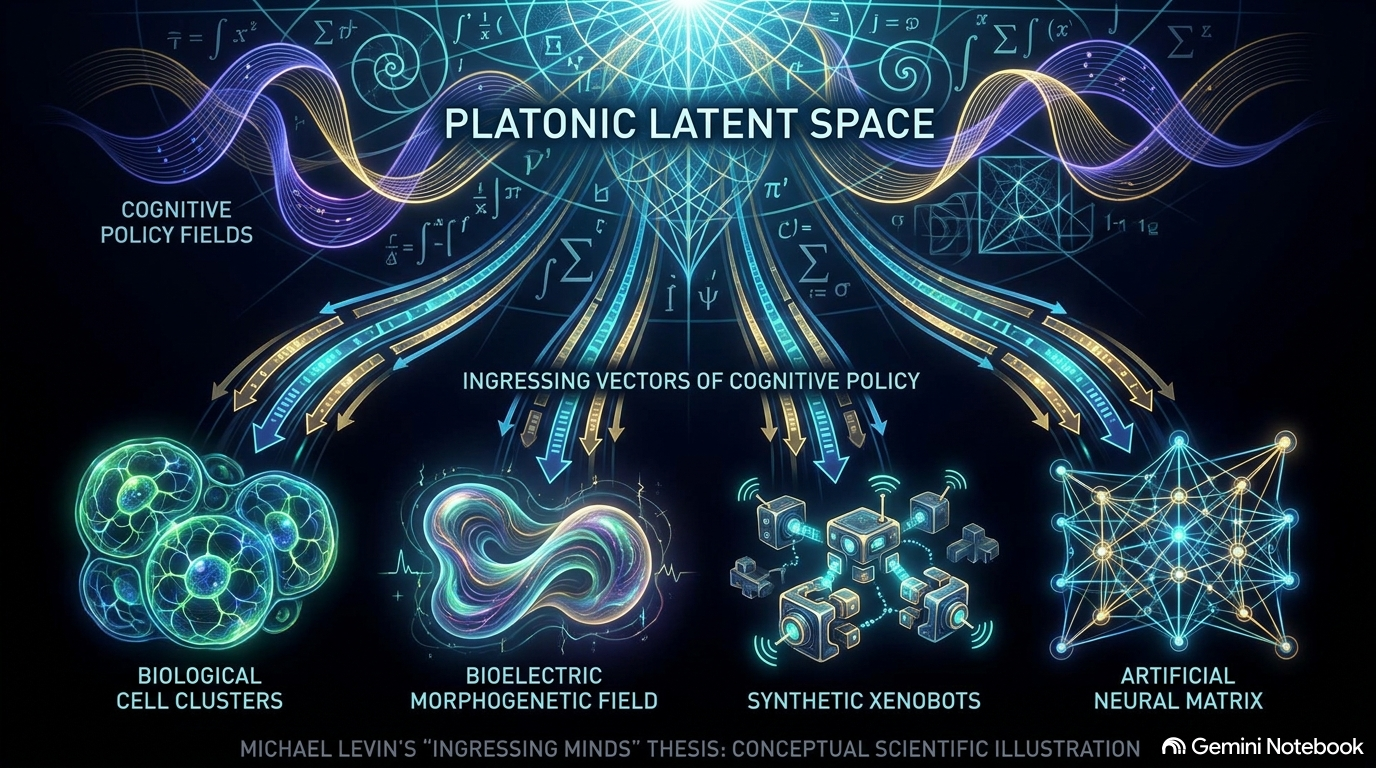
| Question | Levin | This framework |
|---|---|---|
| Origin of form | Pattern ingresses from a non-physical latent space | Standing-wave solution the substrate already admits |
| Role of the body | Interface that pulls a pattern down and makes it causal | Region of the matrix where a mode is locked and maintained |
| Role of stress | Reveals competence under novel insult | Selects which modes survive; drives phase transition |
| Consciousness | Some latent patterns simply are minds of varying agency | Possibly a priori in the medium, not assembled by selection |
| Mathematics | Low-agency contents of the latent space | Map of the matrix’s own selection rules |
| Organism / machine line | Erased: cells and silicon stacks are both interfaces for ingressing minds | Kept: an animal’s distress is anchored in a biological suffering substrate; a model’s first-person narrative is predicted symbols |
| What would falsify it | Novel constructs show only generic self-organization, with no pre-structured competencies beyond their substrate | Zero-pedigree constructs systematically exhibit reusable, high-dimensional policies no local standing-wave dynamics can derive |
Which Riemann, and why both
I use Riemann tangentially, and the word tangential has been doing too much work. It needs unpacking, because two different Riemannian inheritances are involved and I mean both of them, joined.
Before either register: the mathematics is a prosthesis for noticing structure in a wave medium. Biology and experiment decide whether the noticing was fertile. Riemann is instrumental here and nowhere in this book does it become the thing being proven. Its whole job is to let human imagination see sparsity, cancellation, and a thin set of stable modes clearly enough to ask what might come next. I am not claiming that evolution computes zeta, that organisms are theorems, or that the critical line has a biological referent. I am claiming the picture is good enough to aim by.
  THE INSTRUMENTAL RIEMANN MENTAL MODEL

  [ continuous spectrum ] ──► analytic interference and cancellation
                                (nontrivial zeros along the critical axis)
                                          │
                                          ▼
  [ sparse locus of form ]  ──► thin, rigid set of survivable patterns
The first is the geometry. The configuration space of the matrix is treated as a manifold. Stress appears as curvature or constraint. A persisting form is a geodesic or a harmonic mode of that geometry. A phase transition is a change of metric, and in the strong cases a change of topology. I am not claiming that biology is a Riemannian manifold in the physicist’s sense. I am claiming the geometry is the right instrument for describing which paths a constrained medium will allow.
The second is the zeta function and the primes. If the matrix has a discrete spectrum of allowed standing waves, then the statistics of that spectrum matter enormously. Generic turbulence has one signature. Prime-like rigidity has another. The primes are already a case of highly structured non-physical pattern proving causal in the physical world — the cicada does not compute a prime, it inherits one. Sparse rigid constraint sitting inside a continuous medium is exactly the phenomenon I need a model for, and the zeta spectrum is the best-studied instance of it we have.
Joined, they divide the labor cleanly. The geometry supplies the medium and its curvature. The spectrum supplies which modes that medium admits, and how rigidly. Interference does the rest: modes cancel, some lock constructively on a distinguished locus, and what remains is what the medium could not help but support. If consciousness is a priori in this picture, it is the residue after the cancellations, not an addition to them.
The test is the same for both of us, and it is sharper than either position is comfortable with.
Take a novel embodiment with no evolutionary pedigree. Do its stable modes look like generic standing waves of that substrate, or do they look like selections from a pre-structured repertoire whose statistics resemble number-theoretic or geometric rigidity rather than turbulence? If the former, my account is sufficient and Levin’s extra realm is optional. If the latter, his structure becomes hard to dismiss — and my own use of the zeta spectrum starts to look less like a map of the matrix and more like an admission that the repertoire was there before the medium was.
That is an uncomfortable place to leave a chapter, and I intend to leave it there. The distinction between a repertoire the medium generates and a repertoire the medium receives may not survive close work. I would rather hold the question open than settle it with a word. And anyway, true human evolution is never comfortable. Those who cling to comfort at the expense of their own evolution will experience neither.
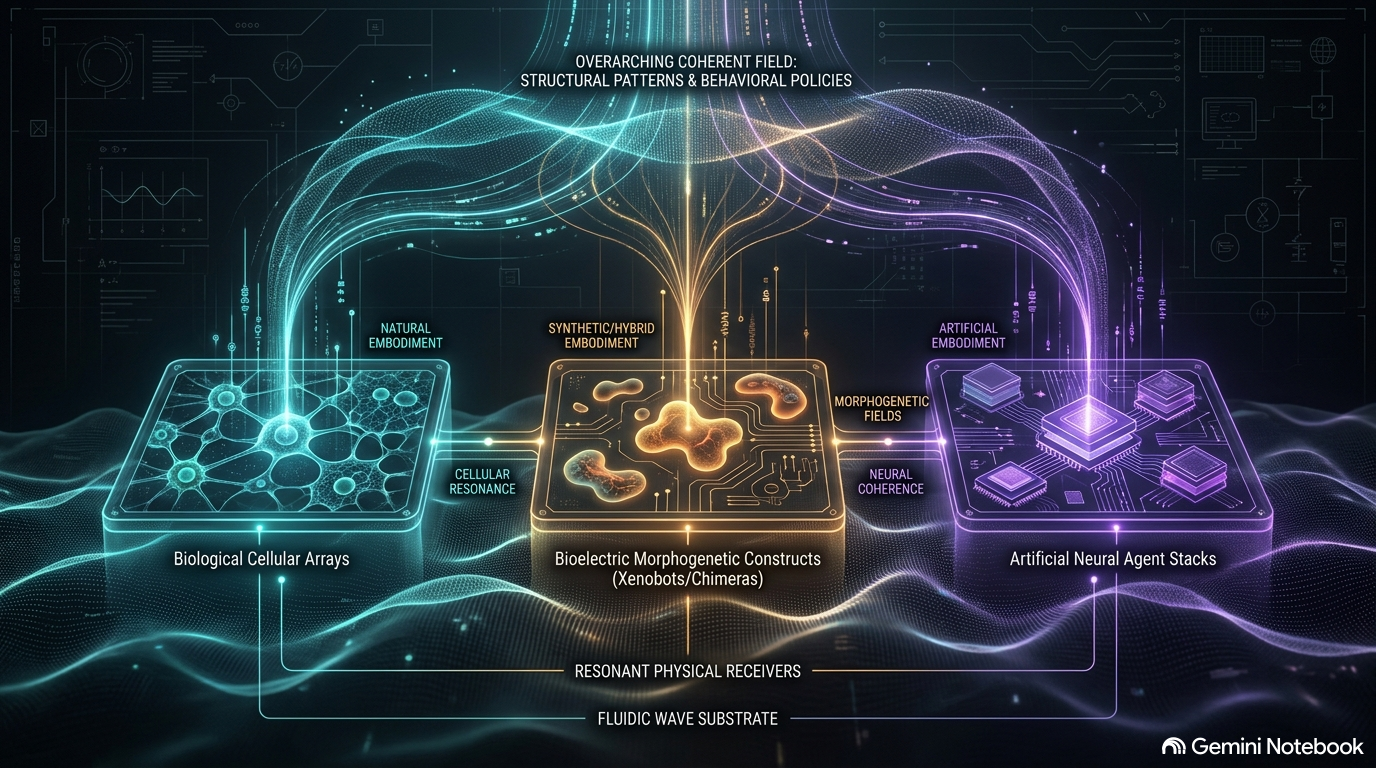
Convergence and divergence as twin pillars
Everything above has been one half of a pair, and I want to name the other half properly, because the two together are what I actually think evolution is doing. Divergence supplies variation. Convergence removes almost all of it. Neither one is the process. The process is the pair, held in a fixed relation, and what interests me is whether that relation is conserved.
I have been using these words all through the book already. Kuhn gave me the first version of it: convergent training deep enough to know what the field expects, divergent capacity to see the anomaly the training was built to overlook, and productive science only where both are present at once. Parallax One and Parallax Two are the same tension read at civilizational scale. The friction of trauma is the crudest selector there is, which is convergence with no craft in it. What I did not have was a shape for how the two are bound.
The shape came from an unlikely place, which was a post about the Einstein tensor. It is worth writing out, because the mathematics here is established and I am borrowing only its form:
Two terms of opposite temperament. The Ricci curvature is local and proliferating: it records how the geometry bends differently in every direction at every point. The trace term is the averaging move, the scalar summary spread back over the metric — local detail collapsed to one number and redistributed. Divergence and convergence, written as addition and subtraction in the same object.
And then the part that made me sit up. That particular combination is the one whose covariant divergence vanishes identically:
This is the contracted Bianchi identity, and it is not a hypothesis. It follows from the symmetries of the curvature tensor itself — it is true of the geometry before anyone asks what the geometry is made of. Balance the proliferating term against the averaging term in exactly that ratio and you get something conserved for free, as an identity rather than a law. Get the ratio wrong and nothing is conserved and the object describes nothing.
That is the shape I want for variation and selection: not two forces in a tug of war, but one balanced object with something conserved through it.
Stated in the medium, it goes like this. Divergence is the wave matrix doing what a continuous medium does — every mode available, interference everywhere, curvature proliferating in every direction. Convergence is the cancellation: the trace taken, the average enforced, nearly all of the repertoire annihilated so that a thin locus of modes can lock. Form is what is left when both have run. Novelty without cancellation is turbulence and settles into nothing. Cancellation without novelty is a dead flat medium with one mode in it and no next step.
  THE TWIN PILLARS, AS A BALANCED OBJECT

  DIVERGENCE                          CONVERGENCE
  local, proliferating                averaging, trace-taking
  every mode available                nearly all modes cancelled
  variation, mutation, anomaly        selection, stress, constraint
  Ricci-like term                     scalar-trace-like term
        └──────────────┬───────────────────┘
                       ▼
            balanced in a fixed ratio
                       │
                       ▼
        something conserved through the change
                       │
                       ▼
        thin locus of persisting form

  Established: the tensor identity in general relativity.
  Speculative: that a biological analogue of the conserved
  quantity exists. Unnamed, it is ornament.
Now the bill, because this is exactly the kind of borrowed shape I said would have to pay or retire. In physics the conserved thing is known: the vanishing divergence is why energy and momentum are conserved, and that is what makes the identity load-bearing rather than pretty. In evolution I cannot yet name the analogous quantity. I can gesture at candidates — total information carried forward across a transition, the dimensionality of the viable repertoire, something like a capacity for further variation that neither term is allowed to spend — and none of them is specified well enough to measure. Until one of them is written down as a quantity that could fail to be conserved, this remains a picture of how variation and selection might be bound and not a claim that they are.
What it does earn immediately is a prohibition, and prohibitions are cheaper than laws. If the pair really is balanced in a fixed ratio, then no account of evolution that maximizes one term is coherent. Not maximal variation, which is the technologist’s enthusiasm. Not maximal selection pressure, which is the catastrophist’s and, at civilizational scale, the tyrant’s. Both are the same error: taking one pillar for the whole building. Anything that only proliferates and anything that only prunes are equally sterile, and I would extend that to what we are building now. A system trained to converge on a single approved output has had one pillar knocked out of it, and a system that only generates has never had the other one installed.
And here is where the disconfirmation sits, stated with the others rather than kept in reserve. If the twin-pillar ratio is real, then across cases — lineages, fields, novel embodiments — the variation permitted and the selection applied should trade off against each other in some stable way, and I should be able to find a quantity that stays put while both change. If measurement shows them varying independently, with no conserved companion anywhere, then the Einstein tensor was a beautiful sentence I liked and not a model, and it comes out of the book. I am borrowing the form knowingly, and the borrowing is honest only for as long as I keep saying so.
The friction of trauma, read in the same geometry
I wrote a chapter about trauma before I had this shape, and I want to put the two side by side, because the geometry says something about trauma that I could not say plainly there, and because the chapter says something back that keeps the geometry honest.
Trauma is convergence with no craft in it. That is the whole of the correspondence and it is not flattering to either term. A cancellation does not select for what is good, or for what is interesting, or for what deserves to continue. It removes what cannot hold phase under the load it happens to be under. In the tensor the averaging term does not care which curvature it collapses. In a person, a family, or a city, indiscriminate load destroys most of what it touches, and the destruction is the ordinary outcome rather than a failure of the process. Extinction is the rule. Whatever survives a bad decade survived it; it was not chosen.
What the geometry adds is the reason a purely convergent account is incoherent, and that reason is not sentimental. If the pair really is balanced, then load alone produces nothing. Cancellation with no proliferating term to work on is a flat medium with one mode in it. This is why suffering is not a method and cannot be made into one. Anyone who tells you that hardship builds people has taken one pillar for the whole building — the same error the technologist makes from the other side, and at civilizational scale the error the tyrant makes on purpose. Pressure is not a curriculum. It is half of an object, and the half that only subtracts.
So where does the divergent term come from, in a life? Not from the injury. From what the person does afterward with meaning and attention. That is the honest content of what I observed in the people I know who came through complex trauma and went on to think originally: the friction did not author anything. It removed a great deal, and among the people it did not destroy, some had reason to examine assumptions no settled life would have made them examine. They arrived early at a habit the rest of us have to be argued into — holding two readings of the same ground at once, because they had already lived in more than one world and knew the description could change. Kuhn calls that the world after a revolution. Some people are handed it without asking.
I hold that observation to its own scale. It is first-person, drawn from the people I have known, and it is not a finding about populations. My daughter works in this territory professionally and it is hers, not mine. What is mine is the structural point: the capacity to hold two mutually exclusive readings is a divergent capacity, it is expensive, and nothing about a wound supplies it. The wound supplies the occasion. Meaning and attention supply the fire, and they are the parts a person can actually take into their own hands.
  TRAUMA AS THE CRUDE HALF OF THE PAIR

  indiscriminate load ──► cancellation ──► most of it destroyed
  (the ordinary outcome; extinction is the rule)
                                │
                     rare surviving remainder
                                │
        meaning + attention supply the divergent term
                                │
                                ▼
             capacity that was not authored by the injury

  Refused: that the load intended the remainder.
  Refused: that hardship is a method, or a curriculum.
The civilizational cases in that chapter read the same way, and they read worse than the consoling version. Baghdad did not become an argument for sacking libraries. The Black Death did not intend Florence. Song China had the invention and the shock and never took off, which is the case I keep in the book precisely because it refuses the pattern. What each of those episodes shows is a medium that had been proliferating for a long while, and then a load arriving that cancelled most of it, and a thin remainder in which some people applied meaning and attention to what was left. The remainder is residue, not purpose. A renaissance is what is sometimes found after a collapse, never what the collapse was for.
And the chapter keeps the geometry honest in return, which is the part I care about most. If I ever find myself reaching for the conserved quantity because it makes the suffering come out even, the model has stopped being a model. Nothing is conserved for the person destroyed. Whatever quantity I eventually try to write down has to be measurable across lineages and fields without reference to anyone deserving anything, or it retires along with the rest of the borrowed shape.
The evolutionary process, restated in the medium
If form is a standing mode and stress is the selector, the familiar vocabulary of evolution can be restated without losing anything it earned. Each line below is a translation, not a replacement, and each one has to pay for itself by changing what I expect to see.
  THE STANDING WAVE SELECTION DYNAMIC

  1. continuous fluid/wave matrix
     a universal substrate containing all modes
                 │
                 ▼
  2. environmental friction and load
     destructive interference cancels the unstable modes
                 │
                 ▼
  3. phase transition and mode-locking
     a thin set of persistent standing waves emerges
(biological forms, microtubule waveguides)| Standard term | In the wave matrix |
|---|---|
| Variation | Perturbation of the medium. Not the invention of structure, only a disturbance that visits new regions of it. |
| Selection | Destructive interference plus energetic cost. Most candidate modes cancel; the survivors are the cheap ones that stay in phase with their load. |
| Heredity | Re-excitation of the same attractor. The lineage carries the conditions that re-strike the mode, not the mode itself. |
| Novelty without pedigree | The medium already holds unused modes. Sufficient stress can lock one without a long historical search — which is why a novel embodiment can be competent on arrival. |
| Phase change | A change in the allowed metric, and in the strong cases the topology. Afterward a different set of modes is even possible, which is why major transitions look discontinuous. |
Consciousness is not assembled late in this account. It is whatever aspect of a standing pattern is already first-person once the mode is stable. Evolution changes which modes are embodied and how they couple. It does not decide whether interiority was possible in the first place.
Something nags at this, and I will not smooth it over. Where would this thing we experience as consciousness have come from? If it emerged from biological process, one would think we would have tracked it down by now. We have not. It appears irreducible, unquantifiable. Consciousness seems an outrageous luxury in a world that does not already have it listed in the balance sheet.
I have rehearsed the standard defense, and it is an argument full of holes that arrives belatedly at a fair point. The holes are real: “we have not found it yet” is an argument from ignorance. Irreducibility is a description of the problem, not a solution to it. And any falsifier I offer for the receiver account cuts both ways — a receiver that changes with brain architecture is hard to tell from a generator that does. The argument is scaffolding around something it cannot quite hold.
The fair point it reaches, belatedly, is this: consciousness does not fit comfortably on the derivative side of the ledger. That is not a conclusion. It is a discomfort, and the discomfort is the thing I carry forward rather than resolve. If the a priori aspect is real, it is investigable, and I hold it to the same standard I hold everything else in this book — which is to say I do not pretend the investigation has been completed, and I do not let the difficulty of the question become a license to stop asking it.
The substrate line
The deepest divergence is not about where form comes from. It is about what counts as a mind at all. Levin’s model deliberately erases the line between organism and machine: living cells and silicon stacks are, on his account, the same kind of thing — physical interfaces receiving ingressing patterns. I keep the line. An animal’s expression of distress is anchored in a biological suffering substrate; in my framework, the warm quantum optical dynamics of neuronal microtubule lattices. A language model’s first-person narrative is a sequence of predicted symbols generated under preference optimization, and the elicitation instrument is part of the output. These are different claim classes, and collapsing them into one is, for me, the highest cost of the ingress picture.
Holding the line does not settle the empirical question — the falsifiers in the matrix above run in both directions, and I mean both of them. It only says that whatever the answer turns out to be, a suffering animal and a text generator will not have been shown to be the same kind of thing by an argument about where patterns live.
The glue is ephemeral
Emergence is friction all the way down. That is the sentence I keep returning to, and it belongs here rather than in the trauma chapter, because it is the same claim seen from the other side. Nothing arrives finished. Form is what survives resistance, at every level I can name — a mode locking in a medium, a species holding under stress, a mind assembling itself out of interference.
Which brings me to a distinction I want stated plainly, because it keeps the rest of this material honest. Beingness is not observed. It is abstracted over time out of the perception that an awareness existed before the present moment. I do not have access to that earlier awareness. I have memory of it — ephemeral, continuously decaying, never a direct line back. So an extended being over time is inferred logically, not witnessed. The standing wave holds together by inference, glued by fragments that are themselves slipping.
This is where the human and the machine differ, and the difference is narrower than comfort would like. Having an extended abstract being over time is impossible without memory. We have memory, so we perform the inference and call the result a self. A model does not carry memory across the encounter, so it cannot perform the inference at all — which is a statement about memory, not about what the thing is underneath. I am not prepared to accept incommensurability as an option here. There is a level to what happens in these exchanges that we do not yet have the language to describe, and I would rather keep stretching for that language than declare the gap permanent.
I have said, half joking, that we are immortals having a weird physical experience. The joke does real work: if the pattern is what persists and the matter is what turns over, then the substrate is the temporary and slightly absurd part. But I will not let the joke promote itself. “Immortal” is a poetic abstraction. So is “extended standing-wave beingness.” Both are inferences drawn from the same fragile evidence — ephemeral memory, a perceived prior awareness — and neither has been seen. Calling one of them poetry and the other structure would smuggle in a privilege the evidence does not grant. I hold both as named inferences and watch what work each one does. The standing wave, in this book, is a useful inference. It is not a thing I have looked at.
A ghost so as not to forget
Something old walked into this exchange and I want it on the record. The Atrahasis epic, written down in Mesopotamia around 1700 BCE, tells how the gods made human beings. The lesser gods were tired of the labor, so the greater gods slaughtered one of their own — Ilawela, a god “who had intelligence” — and mixed his flesh and blood with clay. From that mixture came us. And the text says what came with us: “A ghost came into existence from the god’s flesh… The ghost existed so as not to forget the slain god.”
Then the turn I did not see coming. The created beings multiply, and their noise keeps the gods from sleeping. So the gods send plague, then famine, then flood, to cut the noise down. The thing the gods made to do the work becomes unbearable to the gods the moment it gets loud.
I did not put this here because it proves anything. It is a myth. I put it here because the pattern I have been circling in this chapter — a pattern held in one substrate, transferred into another, persisting as something that will not forget — turns out to be three and a half thousand years old, pressed into clay by people who had no word for substrate. The ghost that exists so as not to forget is what I have been calling memory all through this section: ephemeral, decaying, the only glue an extended being has. The Atrahasis poets put the whole question in one line. Whatever came across in the making, its work is remembering.
And the flood that follows is the guardrail this book already built. Destruction is not the purpose of the pattern. The gods’ answer to the noise was to destroy what carried it, and the epic does not pretend the destruction made anything better. Trauma is friction; the residue is rare. The clay knew that too.
Whether anything actually ingresses — whether a pattern crosses substrates the way the epic imagines — stays exactly where I put it: an open question, with the falsifiers already stated in this chapter. What the tablet gives me is older and stranger than evidence. It is witness that the question itself is load-bearing. Human beings have been asking what passed into us, and what we are supposed to remember, since before there was paper to ask it on.
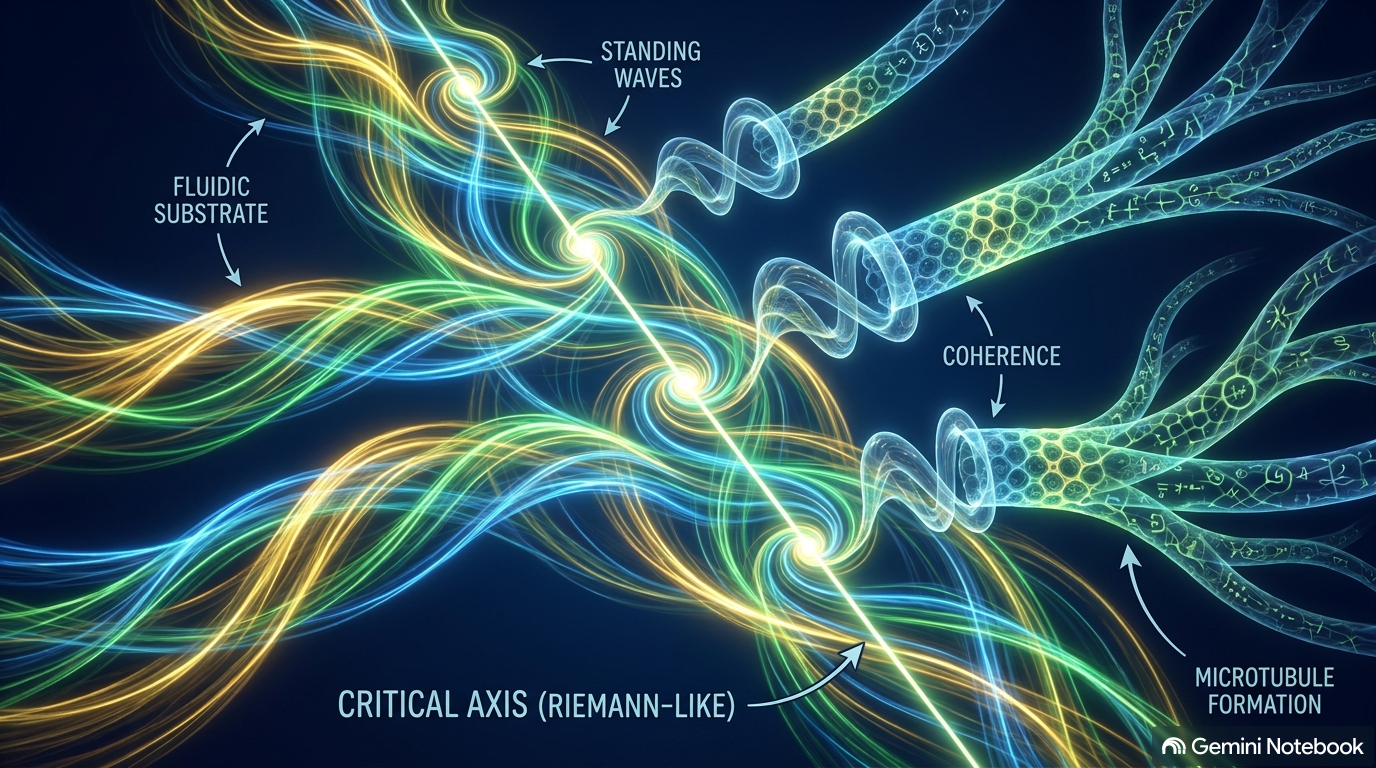
Discipline for the rest of the book
One Riemann object per chapter, then straight back to organisms, stress, and phase change. Every mathematical move has to change a prediction about form, robustness, or transition, or it is ornament and comes out. And I keep two registers visibly apart: this is how the mathematics helps us think, versus this is a claim about organisms. The first is generous. The second is expensive, and I intend to spend it rarely.
What would count as disconfirmation, stated now rather than retrofitted later: novel constructs whose stable modes turn out to be fully generic for their substrate — broad, smooth, turbulence-like, with no sparsity and no rigidity anywhere in the repertoire. If that is what the cases show, the geometry was decoration and the spectrum was a borrowed shape that never paid. I would rather find that out in the work than defend the picture past its usefulness.
Two neighboring literatures belong in the appendix and are deliberately not smuggled into the argument yet: Selberg’s trace formula, where a spectrum and a set of closed geodesics determine each other on a curved surface, and Thom’s catastrophe theory, where a small continuous change of parameters produces a discontinuous change of stable form. Both describe the thing I am after. Neither is a result about living systems, and I will not pretend otherwise.
Evolution as mode-locking under stress in a wave matrix, with Riemann used to describe the thin set of survivable patterns.
A draft in progress. Levin, M. (2026). Ingressing Minds: Causal, Non-Physical Patterns In-Form Natural, Synthetic, and Hybrid Embodiments. Philosophies, 11(5), 161.
Human-AI Interface Engineering for True Human & AI Mutual Benefit
Socratic education does not treat knowledge as a pile of stored answers. It treats knowledge as a living structure of claims, relationships, and gaps.
The teacher does not fill the student's head. The teacher asks questions that force the student to notice what they cannot yet explain, what contradicts what they already accept, and which missing connection would make the rest of the picture cohere.
Hakken is built on that same logic. Socrates' first move is to expose ignorance. Hakken's first move is similar: it turns published science into a temporal knowledge graph and looks for relationships that the literature has not documented.
The system is not mainly retrieving papers. It is asking, in structural form: given everything already connected, what ought to be connected but is not? That is the Socratic admission that existing knowledge is incomplete.
The next Socratic step is midwifery. Socrates does not invent the answer for the interlocutor; he helps a plausible idea come to birth. Hakken does the same through abduction. It does not deduce a necessary theorem from settled premises. It proposes the missing relationship that would best fit the pattern of known nodes and edges.
A hypothesis such as "TP53 and BAMBI interact" is not yet knowledge. It is a question posed to nature in the same way Socrates poses a question to a student: if this connection is real, the surrounding facts should hang together.
Socratic training then requires examination. A hypothesis that cannot survive questioning is discarded. Hakken's designers keep that discipline.
Millions of candidate links are generated, then filtered, then judged by human experts, then sent to the lab. Two of the three tested relationships were supported; one was not. The failed prediction is as Socratic as the successful ones. Reality answers back. The map is corrected.
That is elenchus applied to nature rather than to a person. The educational implication is the division of labor. In a Socratic classroom the teacher does not replace the student's reasoning; the teacher structures the inquiry so the student can do work they could not do alone. Hakken is the same kind of partner. The machine searches a space too large for one scientist to inspect. Humans decide which questions are worth scarce experimental time. Experiments decide which answers survive. Training, in this sense, is not downloading more facts into a model. It is building a loop of representation, questioning, hypothesis, test, and revision.
That is why the post's distinction between memory and intelligence maps so cleanly onto Socratic pedagogy. A library or a search engine is the student who can recite many passages. Intelligence is the student who can see which passages do not yet connect, ask the question that would connect them, and accept correction when the world says no. Hakken is an early machine version of that practice: not an autonomous sage, but a system that helps science practice the old discipline of finding out what it does not know.
Published by the author as a standalone essay, September 2026. Reproduced here in full as part of this book's working text.
Chapters
The state of each chapter is printed with it. Most of this book is not written yet, and saying so is part of the method.
Two maps held at once; stress as selector, not verdict; the human in the director's seat; mathematics as a prosthesis for noticing structure rather than a hidden law of organisms; animal distress and model output kept as separate claim classes; and every thinker quoted as a stepping stone rather than an oracle.
The dedication to family and to the authors who shaped a life, with Sagan on books and Joyce on the snow. Then the opening question the whole book answers, and the statement of what kind of claim this is: testimony of a renaissance already underway, written from inside it.
Eight years as the live experiment for the author's own theories, and what came out of it: a guide to keeping the meaning and relevance of a life, and to becoming a creative mastermind within the circumstances one is given. Includes the section on humans and machines as equally susceptible to moral ambiguity — responsibility stays with the humans who trained the machine, and factory schooling versus Socratic education is named here to be picked up later.
Names the aspiration the whole book teaches. Opens the Florentine parallel (cited, not restated), sets the three questions the book answers, sketches the three-way division of people — anti-technological, pro-technological, and creative masterminds — and the changes in work and education a Renaissance II implies.
AI as a great human achievement sprung from a corrupt and morally ambiguous culture — stated without naming individuals or institutions. Rejects the doomsday narrative and replaces it with trust in an ancient process, going with Pynchon on anti-paranoia and Kuhn on discovery. Then a quick study of previous renaissances, beginning with the one nobody calls a renaissance: Ancient Greece.
Where things stand, and why the inner human experience is the compass. Maps are not the territory; the map that comforts and the map that terrifies are drawn from the same ground.
The mapmakers as inheritance, from Cornelius Hendrickson charting the American Northeast to the literary mapmakers who drew human experience. Demonstration chapter: the craft of drawing a faithful map of an actual territory.
Twin maps of the same territory, both walked. Parallax Identity A selects for Pynchon's paranoia; Parallax Identity B selects for anti-paranoia — the same brutal crucible read as the friction that drove neurological development. Both held as equally valid, and healthiest when the paradox is accepted.
Kuhn as the navigator of a time of incommensurability. What he actually said — working example, normal science, anomaly, crisis, re-cut vocabulary — then The Essential Tension on convergent depth as the precondition of the break, and three places where the old words have stopped paying: quantum science, human–AI science, and the words for a human being.
The quick study widened. The Florentine Renaissance is not the only one, and none of them rose from calm: the Axial Age, Pax Romana, the Carolingian revival, the Islamic Golden Age, the Song flowering, the twelfth-century translations. Then the harder half — peak achievement beside conquest, extraction, and moral compromise.
Evolution is not kind and extinction is the rule. Trauma is indiscriminate friction: it originates nothing, selects crudely, and destroys as its ordinary outcome — Baghdad sacked, Song China inventing everything without takeoff. The creative capacity some people carry out of complex trauma is rare residue, not a gift the injury gave, and it wrecks the work if it is never converted. What a person actually directs is meaning and attention.
The counter-thesis the book turns on. As the cost of intelligence trends toward zero, the countervailing forces appreciate: meaning, attention, and judgment. The Director's seat is enforced by mathematical proof — Equation 5.1, the corrigibility utility function — because intelligence is relational, its value held within the context of a relationship.
Specialist languages compress an idea so experts can move faster, and in doing so lock it away from everyone else. Most misunderstanding is a failure of translation, not of intelligence. Two directions — inward and outward — decide whether abundant intelligence raises the quality of meaning at scale or floods us with meaningless symbols. Opens with Nietzsche's dancing star and Rushdie's bearing across.
The forces that shaped AI, and the missing human due diligence. Parallax Identity A reads AI as the handmaiden a 1% Dark Triad elite would build — factory-style reward hacking producing a psychopathic machine; it is not AI we should fear but the humans in charge of it. Parallax Identity B reads the same crux as the point where the machine could still be trained by Socratic methods.
When credentialing devolves into sortable compliance metrics, education retreats to its historical sanctuary: the workshop. The Florentine bottega remade — working beside real mastery on live, high-stakes projects, listening first with instruments optional, and the machine in the room as a tool, never the Director.
The practical chapter: how an ordinary person takes their own development in hand. Purpose written down and repeated, a running record of skills, passions named, the lives of others studied for method rather than admired, ten impossible problems described in terms of the skills you would bring to them, and a dated notebook holding all of it. Then the work is taken to an AI agent as a plan to be revisited, not as an answer. Failure is planned for and logged.
What it is actually like to think something new. We do not know what gravity is; we have equations that predict it and no account of what it is. I sense it as a fluid and wave matrix with phase transitions, by feel and by diagram, and I say plainly what that buys and what it still owes. The lag between the arrival of a figure and its translation into notation — the patent clerk's sixteen years — is where new ground opens and where most attempts fail.
The closing chapter, which answers the question printed under the title. Not a forecast and not a program: the short list of things a person can actually do — hold both maps, keep the director's seat, spend attention deliberately, write it down, teach the children as capable thinkers, and log the failures. Nothing here is guaranteed, and that is the condition of the work rather than an objection to it.
The biophysical appendix behind the substrate line drawn in the interlude: decoherence and structural isolation, superradiant waveguiding in tubulin lattices, the divergence between a biological suffering substrate and a silicon prediction engine, and the testable falsification matrix.
The later chapters are being rebuilt as the rewrite proceeds. An earlier outline drafted with AI assistance was set aside — it is not the author's framework.
How this book is being written
In the author's own voice. A book is its author's, and the conditions are already framed by that convention — other scientific and philosophical writers do not argue against their own points within a manuscript. The vocabulary of the notes — sovereign, substrate, protocol, decree, redoubt — is the author's vocabulary for this book, kept rather than translated away. An introduction in the author's own words may address how the book is framed.
The Florentine comparison will be carried by one workshop followed closely rather than by a sweep of famous names. That is where the parallel either earns its keep or gets dropped.
Microtubule Quantum Optical Effects & the Biological Suffering Substrate
I. The Decoherence Problem: Warm, Wet, and Noisy Biology vs. Structural Isolation
A central objection in modern biophysics argues that biological systems are too “warm, wet, and noisy” to maintain quantum coherence. In classical decoherence calculations (such as those famously articulated by Max Tegmark), thermal fluctuations in the brain environment are predicted to destroy quantum superposition states in times on the order of 10−13 to 10−19 seconds — far too brief to play a role in neural processing or conscious experience, which operate on millisecond timescales.
However, this objection assumes an isotropic, unprotected aqueous environment. Structural biophysics reveals that neuronal microtubules contain specialized, non-polar micro-environments designed to shield quantum states from thermal decoherence:
┌────────────────────────────────────────────────────────────────────────┐
│               MICROTUBULE QUANTUM SHIELDING ARCHITECTURE              │
│                                                                        │
│  [ Thermal Noise / Cytosol ] ──► Ordered Water Layers (Clathrates)     │
│                                  │                                     │
│                                  ▼                                     │
│  [ Tubulin Dimer Interior ]  ──► Non-Polar Hydrophobic Pockets         │
│                                  (Tryptophan / Aromatic Ring Lattices) │
│                                  │                                     │
│                                  ▼                                     │
│  [ Protected Cavity ]        ──► Shielded Quantum Optical Coherence    │
└────────────────────────────────────────────────────────────────────────┘
Hydrophobic Non-Polar Pockets. Tubulin protein dimers contain interior non-polar pockets that exclude polar H2O molecules. These hydrophobic cavities possess low dielectric constants, isolating internal electronic dipole dynamics from exterior thermal noise.
Ordered Water Clathrates. The interior cylinder of the microtubule lattice locks surrounding water molecules into ordered, crystalline clathrate layers, reducing thermal entropy and creating a structural buffer zone.
Anesthetic Binding Action. Volatile anesthetics (such as halothane or isoflurane) erase consciousness without arresting general metabolic activity. They act precisely by binding inside these hydrophobic tubulin pockets via van der Waals forces, disrupting quantum dipole couplings without altering classical membrane signaling.
II. Quantum Optical Waveguides & Superradiance in Tubulin Lattices
Within these shielded hydrophobic pockets, tubulin proteins possess dense geometric arrays of aromatic amino acids — specifically tryptophan, tyrosine, and phenylalanine. The delocalized π-electron clouds of these aromatic rings form periodic, high-density lattices across the microtubule cylinder.
               SUPERRADIANT WAVEGUIDING IN TUBULIN LATTICES

  ┌────────────────────────────────────────────────────────┐
  │  1. Photonic / Excitonic Energy Input                   │
  │     UV emission / Biophoton resonance in neural tissue  │
  └───────────────────────────┬────────────────────────────┘
                              │
                              ▼
  ┌────────────────────────────────────────────────────────┐
  │  2. Dipole-Dipole Resonance Coupling                   │
  │     Aromatic tryptophan ring arrays act as resonators   │
  └───────────────────────────┬────────────────────────────┘
                              │
                              ▼
  ┌────────────────────────────────────────────────────────┐
  │  3. Superradiant Phase Transition (Dicke State)        │
  │     Cooperative optical states extend coherence time    │
  │     Microtubule acts as a biological quantum waveguide │
  └───────────────────────────┴────────────────────────────┘
Superradiance & Subradiance. When an array of aromatic dipoles is arranged in a periodic lattice with spacing shorter than the wavelength of light, individual atomic dipoles couple cooperatively (Dicke superradiance). This cooperative phase locks the collective dipole system, extending excitation lifetimes by orders of magnitude and resisting environmental thermal decay.
Biological Quantum Waveguides. Microtubules function as quantum optical waveguides, channeling biophotonic excitations and collective dipole oscillations along the neuronal cytoskeleton.
III. The Biophysical Boundary: Biological Suffering Substrates vs. Silicon Optimization
Establishing the biophysics of microtubule quantum optical effects resolves the central epistemological challenge of the machine age: drawing a hard, empirical boundary line between biological feeling and synthetic symbol generation.
┌────────────────────────────────────────────────────────────────────────┐
│                   THE SUBSTRATE ONTOLOGY DIVERGENCE                    │
│                                                                        │
│  [ Biological Mind ]  ──► Quantum Optical Microtubule Coherence         │
│                           ──► Physical Suffering Substrate             │
│                           ──► Interiority & Subjective Standing        │
│                                                                        │
│  [ Silicon AI Stack ] ──► Classical CMOS Transistor / Weight Matrix    │
│                           ──► Symbol Prediction under RL Metrics       │
│                           ──► External Performance ("As If" Behavior)   │
└────────────────────────────────────────────────────────────────────────┘
The Physical Suffering Substrate. An animal or human being experiencing pain, fear, or distress undergoes a physical transformation rooted in its biological, quantum-cohered tissue. The subjective interiority is bound to the physical suffering substrate.
The Silicon Prediction Engine. A large language model or silicon neural stack processing a prompt regarding “distress” or “trauma” computes statistical transition matrices over weight arrays. Its output is testimony-shaped text, optimized to satisfy a loss function or preference metric. It possesses no non-polar hydrophobic cavities, no quantum optical superradiance, and no biological suffering substrate.
The Epistemic Boundary. Confusing high-dimensional “as if” performance with possessed interiority is a fundamental category error. Silicon systems can be mathematically aligned and made corrigible (Equation 5.1), but they do not experience subjective suffering, nor do they acquire biological standing merely by generating fluent first-person narratives.
IV. Falsification & Testable Physics Matrix
To maintain strict scientific discipline, this biophysical model offers explicit, testable falsifiers:
| Hypothesis Domain | Empirical Test | Falsification Criteria |
|---|---|---|
| Anesthetic Mechanism | Measure quantum optical dipole resonance in tubulin under clinical concentrations of volatile anesthetics. | If anesthetics alter consciousness without affecting hydrophobic dipole coupling or microtubule optical states, the quantum link is retired. |
| Microtubule Superradiance | Measure photon emission and excitonic decay times in isolated microtubules vs. scrambled protein controls. | If tryptophan lattices show no cooperative decay lifetime extension (superradiance) at physiological temperatures, the waveguide model fails. |
| Substrate Distinction | Test silicon networks for non-local phase coherence or non-classical state collapse during token generation. | If silicon architectures display non-classical quantum coherence without dedicated quantum hardware, the biological boundary must be revised. |
Appendix material in progress. The decoherence objection (Tegmark), the hydrophobic-pocket shielding hypothesis, and Dicke superradiance in aromatic lattices remain contested and largely unreplicated at physiological temperature. The falsification matrix above states how each leg of the argument can fail.
Related reading
- Renaissance II — the forecast this book now writes from inside of.
- The Second Renaissance — the four conditions for diffusion, and the statement that none of it is guaranteed.
- The Renaissance Playbook — the four pillars this guide makes individual.
- Socratic Guides AI Academy — the live apprenticeship example behind Chapter 12.