
The Carpet Is Moving Under You
Moving with Darwin and Dawkins onto something else: the relation beneath the molecule, and why anything persists at all.
By KW Norton.
Status: exploratory essay. Established science is marked as such; the relational-replicator reading is a leap from it, held revisable.
Introduction: three voyages, one carpet
In 1831 a young man boarded a ship called the Beagle and sailed into a world that did not match the map. In 1804 two men crossed a continent no European map had named. In 1871 a mathematician published a story about a girl who stepped through a mirror and found that the rules changed with every square she crossed.
Three voyages. One carpet, moving.
Meriwether Lewis and William Clark crossed the breadth of a continent by river and portage, and their journals are a sustained act of one method: witness, then name. Every plant they did not recognise. Every river's fork. Every people whose way of life was organised on principles the journals had no ready word for. The naming had to be relentless, because the pattern was new and would be lost without language. Lewis died in 1809 on the Natchez Trace. The carpet had moved under him too, and the naming had cost him something he could not recover.
Charles Dodgson — Lewis Carroll — did not sail anywhere. He was a mathematician at Oxford who told a story to entertain a child, and in the telling he registered the same rupture from inside. Through the Looking-Glass is the record of a floor that moves: the chessboard where the rules change as you cross it, the landscape that rearranges itself between steps. The Red Queen tells Alice it takes all the running you can do to stay in the same place, and that is the sentence that names the condition Darwin was studying: adaptation is running on a floor that is moving under you. You do not arrive. You keep moving because the ground does.
Three registers of one recognition: the floor is not fixed. The honest response is not to anchor yourself to what was, but to learn to move with it.
Darwin: the witness at the origin
Charles Darwin spent five years watching. Barnacles. Finches. Earthworms. Fossils of creatures that no longer existed. He watched for twenty-three more years before he published, because the pattern he was seeing — that species are not fixed, that life varies, that the variations which fit their circumstances persist and the ones that do not vanish — was so large and so destabilising that he needed to be certain. His method was plain: witness the new pattern, then find the language for it. The language was natural selection. The pattern was older than the name.
Toward the end of his life Darwin was still asking. His last book, published in 1881, was about earthworms — how small forces, acting patiently over vast time, reshape the ground beneath everything. He had spent decades on his own theory of heredity, called pangenesis, that never quite worked, because the molecular mechanism was invisible to him. And he acknowledged the question he could not answer: how life itself began. He had shown how species vary once life exists. He could not show why life existed to vary. The carpet had moved under him at the origin, and he stood there honestly, without pretending the ground was solid.
Dawkins: the unit that travels
A century later, another witness stood on the same moving floor and named what persists. Richard Dawkins, in The Selfish Gene (1976), made an argument so clean it changed the question. The unit that benefits from evolution, he said, is not the organism. The organism is a vehicle — a temporary survival machine built and discarded. The unit that persists is the gene: a stretch of DNA that copies itself, that travels across generations. The organism dies; the gene endures.
His reasoning is great. It is correct as far as it goes, and it goes further than most. The memes extension — that ideas also replicate, mutate, and are selected — is a genuine application of the replicator logic to cultural transmission. Dawkins saw that the pattern is not limited to the molecule, and said so. I owe him a few drinks: this essay exists because his abstraction was clean enough to show where it stops.
In The Genetic Book of the Dead (2024) he draws a careful partition. Chemically, DNA is a double helix. From an informational standpoint, it is a one-dimensional digital code, read like a tape. Proteins are where life becomes three-dimensional, and he marvels, rightly, at AlphaFold predicting the folded shape from the linear string.
The code can be described as linear. The real molecule is not. And the flatland view breaks earlier than the fold, earlier than the helix — it breaks at the pairing. The moment there are two strands facing each other, each one able to rebuild the other from its complement, the information no longer lives in either string. It lives in the match between them. A meets T, G meets C, and what persists is not a letter but a relationship satisfied in both directions at once. That is already a second dimension, before any geometry has entered the picture.
The four-letter alphabet makes this worse for the linear view, not better. The alphabet is not a row of beads; it is a pairing system. Every letter carries its complement with it, implicitly, everywhere it appears — so each position on one strand is also a position on the other, each gene a folded shadow of its mirror. And the pairs themselves differ: A–T joins through two hydrogen bonds, G–C through three, so the string carries a variation in grip, in local stability, in how the helix breathes and where it opens, that no one-dimensional reading of the letters records. The linear description keeps the letters and discards the relations between them. The molecule keeps both.
And the very thing that makes folding hard — that the three-dimensional shape is not trivially read off the one-dimensional string — is also true, in its own way, of the molecule that holds the code. That is not a quarrel with Dawkins. It is the place where his frame draws its line, and the ground beneath the line.
Even the code, once we grant it the abstraction of a sequence, is not read in a line. It is read on both strands, in opposite directions, in overlapping frames, spliced, and switched on by folds that are far apart along the string but side by side in space. The linearity was never in the code; it was in the description.
The frame starts after DNA exists. It is a book about what the molecule does once it is here. It does not ask why a molecule with this architecture came to be here at all.
The hydrophilic turn
Why these molecules? Why each paired, stair-stepped bond? Why a flexible, coiling, curling exoskeleton — and why does it bear a passing architectural form that reminds me of light? The resemblance to light is not a claim. It is simply remarkable, and I let it stay remarkable.
The architecture itself has an answer that is not mystical, and it begins with water. The sugar-phosphate backbone is charged and hydrophilic; it turns toward water. The bases are flat and water-avoiding; they turn inward, away from it. The covalent frame ends up outside, the informational pairs inside — an exoskeleton in the plain sense. That orientation is the hydrophilic turn.
Once turned, the rest follows from ordinary chemistry. The flat bases stack, and stacking is a major stabiliser of the helix. Pairing across the interior supplies specificity: this letter only with that one. The handedness of the sugars biases the whole assembly into a twist of one direction. And the turning is also the flexibility — a rigid molecule could not be opened and copied; a floppy one could not hold a pattern. The helix is what you get when a chain that loves water wraps its water-avoiding cargo inside itself.
RNA probably came first, because it can both carry sequence and do chemistry. DNA looks like a modified RNA: the sugar loses an oxygen, uracil gains a methyl group and becomes thymine, and the archive becomes more stable and easier to repair. Different lineages appear to have built parts of the copying machinery more than once, from unrelated parts. The carrier changed; the pattern carried across.
So "the right choice" needs one qualification. It was probably a workable choice that became historically entrenched, not the only geometry nature could have used. The deeper shape is a set of opposing demands held together: stable without becoming inaccessible, flexible without losing identity, repeatable without becoming inert. The paired helix is the geometry in which those demands could coexist.
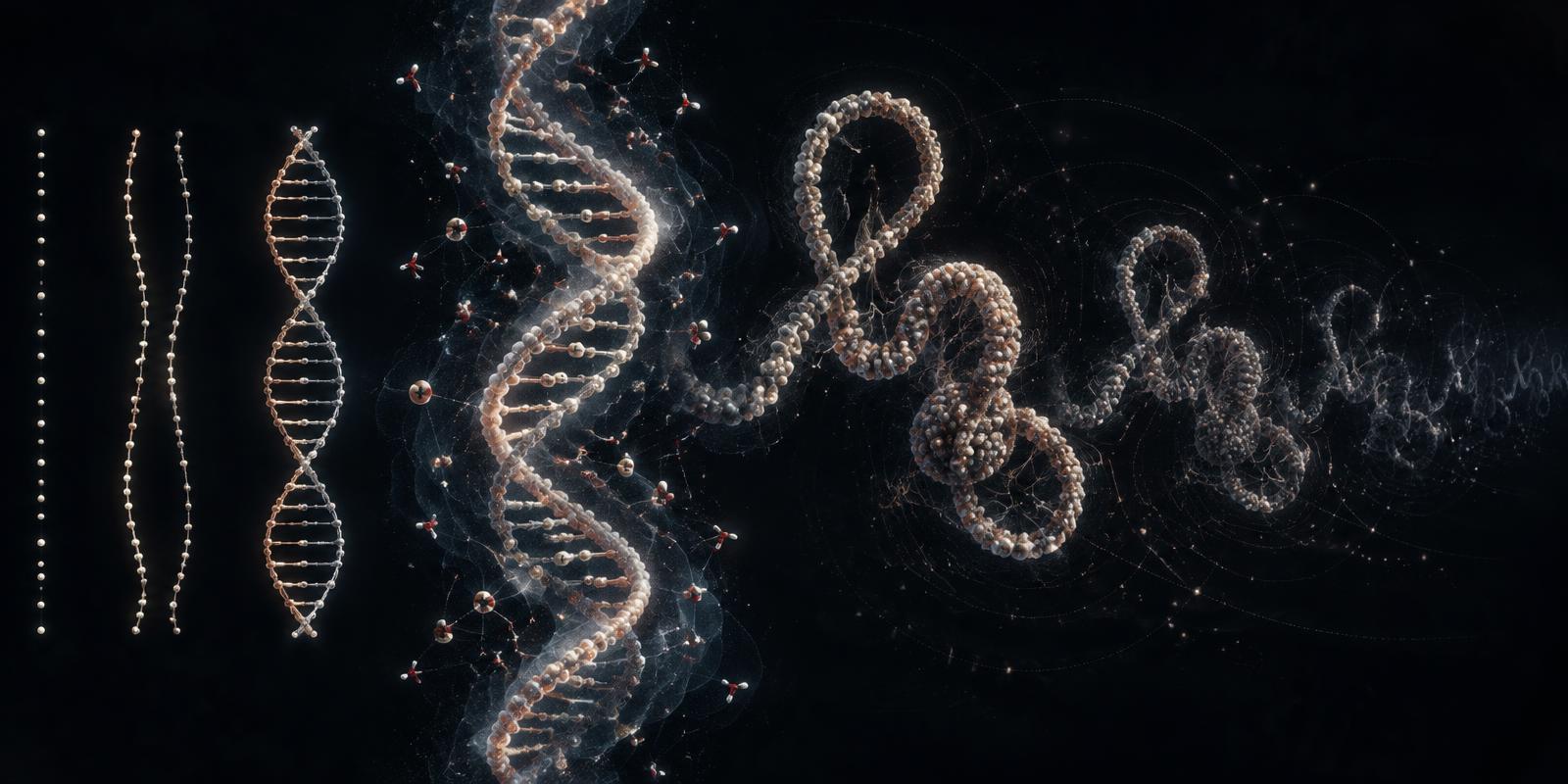
The string
What it holds: Order. Which letter follows which.
What the layer below cannot: The description — the tape Dawkins reads. Useful, and already an idealisation.
The persistence question
My motivation is an old line: life always finds a way. Why, and how?
The honest first move is to correct the word "always." Extinction is the rule, not the exception. Most lineages that ever lived are gone, and most chemistry never became life at all. We see only the cases that kept going, because the ones that stopped left no one to look back. Persistence is the anomaly that has to explain itself.
So what persists? Not the molecule alone. What persists is a relation — a configuration that can be copied, can vary, can be selected, and can keep what selection kept. It lives between the sequence and its folding, between the code and the cell that reads it, between the organism and the world that tests it. The letters do not replicate by themselves.
This is not vague. Epigenetic marks change which genes are read without changing the sequence, and they persist through cell division. Chromatin architecture — how the genome folds in the nucleus — is inherited through division too. Prions show a protein's shape templating itself with no nucleic acid at all. These are established instances of patterns that travel on the molecule, or beside it, but not in the string.
The falsifier is plain. If every heritable pattern turns out to be fully reducible to DNA sequence, then the relational reading carries no weight the molecule does not already carry, and it retires.
Life does not always find a way; what we call life is whatever kept finding one — and the finding was never in the molecule alone, but in the relation it carried forward.
Carl Sagan: the absence of evidence is not the evidence of absence. The line works in two directions here, and both of them matter. The absence of evidence that non-sequence information is heritable is not evidence that none exists — the door stays open for what we have not yet measured. But the absence of evidence that the sequence carries everything is not evidence that the relation carries something; that rests on the positive cases — the marks, the folds, the prions — not on the gap. Take the caution against premature closure in either direction; refuse it the moment it becomes a license to populate the unknown, which is superstition dressed in humility.
What pattern, already running in the physical world, found in this molecule the shape that could carry it? We do not yet know, and the essay holds that open rather than filling it with a comfortable answer. Why some of the beings it produced are conscious is a different question, on its own floor, for another essay.
Carroll did not explain the chessboard. Darwin did not explain the origin. They showed you the board was moving and let you stand on it.
The floor is moving under you. But that's alright, baby blue.