
This is a strategic brief written in the register of an intelligence assessment, and then audited against the mathematics it invokes. Both halves are necessary. The exposure it describes is real; the popular version of why it is real is wrong, and the wrong version is what gets organisations to delay when the argument is later punctured.
It is a companion to Riemann and the Locks, Possessing the Proof, and The 1,000-Year Nap.
01
The prime-based architecture and the conditional floor
What actually rests on the Riemann Hypothesis, and what does not
Global digital trust — banking settlement, certificate authorities, command-and-control channels — is anchored in the assumed hardness of two operations: factoring large composites and computing discrete logarithms. Above that operational layer sits a second, quieter structure: an entire floor of conditional theorems in analytic number theory whose conclusions are stated 'assuming RH'. Prime-counting error terms, effective bounds on least primes, and much of the fine-grained arithmetic used in primality and key-generation analysis live on that floor.
That conditional floor is real, and it is worth naming plainly because it is the honest version of the 'house of cards' image. Working cryptographers already behave as though RH is true when they reason about the distribution of primes. A formal proof would convert hundreds of conditional statements into unconditional ones overnight — a genuine structural event in mathematics.
But the strategic brief has to survive its own audit here, so the correction goes in the text rather than in a footnote. RSA's security does not rest on the Riemann Hypothesis. RSA rests on the hardness of factoring a specific semiprime. RH describes the statistical regularity of primes in aggregate; it says nothing about how to split one particular product of two 1024-bit primes. Proving RH tomorrow would break no keys the day after. The single point of failure is factoring hardness, not prime regularity — and those are different objects that happen to share a vocabulary.
Keeping that distinction is not pedantry; it is what makes the rest of the argument usable. The risk in this essay is real, and it becomes visible only once the false version is cleared away.
- Established — A large body of analytic number theory is stated conditionally on RH; a proof would make those results unconditional.
- Established — RSA reduces to integer factorisation of a chosen semiprime, not to the truth of RH. No known reduction takes an RH proof to a factoring algorithm.
- Asserted — That current cryptography is 'predicated on' RH and would collapse with a proof. This is the popular framing and it is false as stated; the defensible version is section 02.
02
The danger is the machinery, not the statement
Voronin universality, hypertranscendence, and the shortcut risk
The credible threat has never been the theorem. It is the toolkit built during the attempt. An adversary does not need a peer-reviewed proof to gain advantage; they need one intermediate lemma with unexpected computational teeth. This is the same pattern the archive has tracked elsewhere: the by-product exceeds the target.
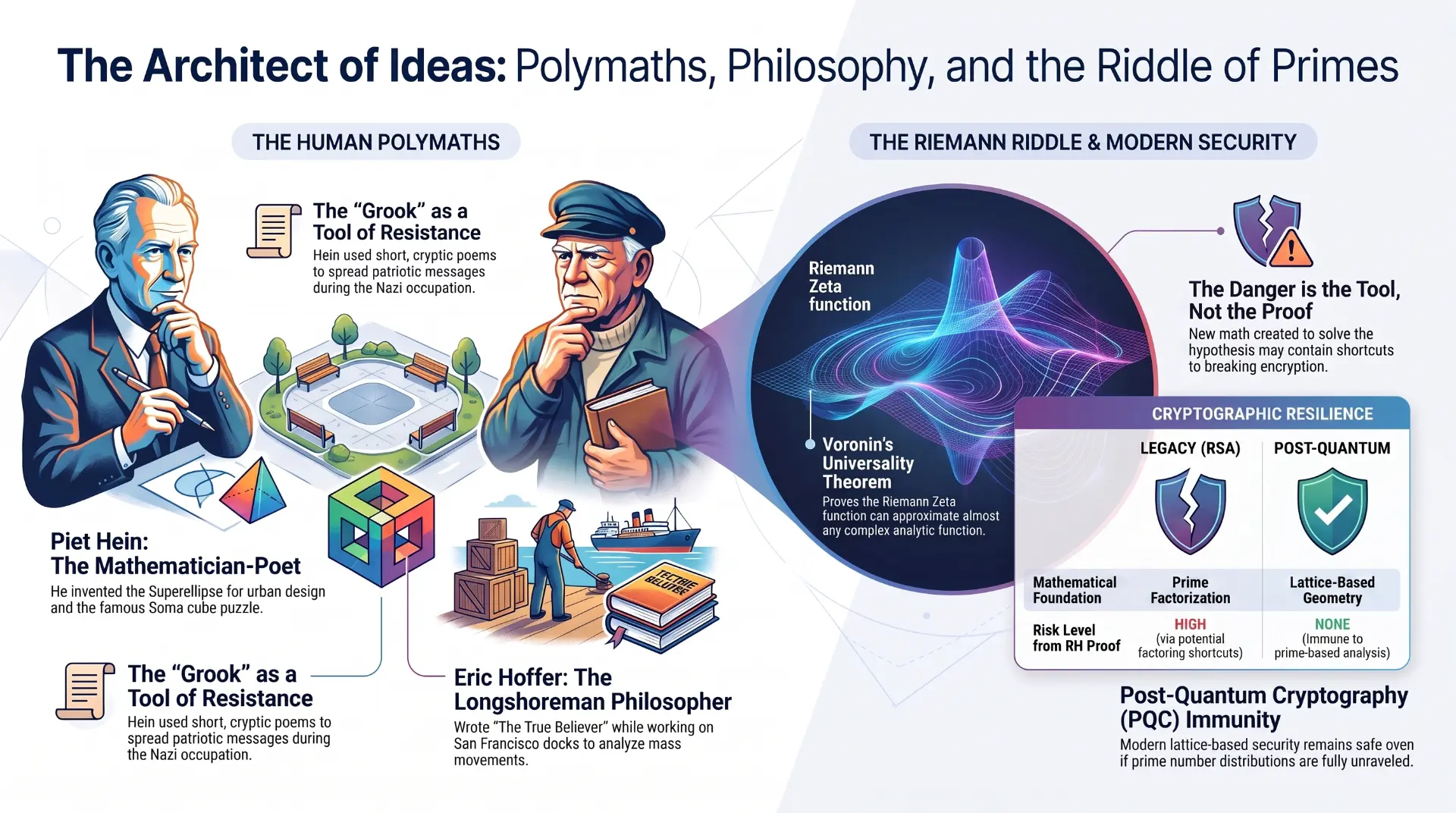
Voronin's Universality Theorem (1975) is the sharpest illustration available. It establishes that the Riemann zeta function, restricted to a strip, can approximate any non-vanishing analytic function on a compact disc to arbitrary precision — the function is, in a specific technical sense, a universal simulator of analytic behaviour. The linear independence of the primes inside the Euler product is what buys that freedom. Zeta is also hypertranscendental: it satisfies no algebraic differential equation.
The strategic inference is that a new analytic machine capable of localising prime structure with far greater precision — the kind of machine a serious assault on RH would require — is exactly the class of object from which a factoring shortcut could fall out. The Guth–Maynard programme's translation of a zero-density question into matrices and largest-eigenvalue problems shows the pattern in miniature: the reformulation, not the conclusion, is where the new power lives.
Two guardrails. First, universality is an existence statement, not a construction: Voronin's theorem does not hand anyone an efficient algorithm, and nobody has turned it into one in fifty years. Second, 'could yield a shortcut' is a risk posture, not a result. The correct label for section 02 is contingency planning under uncertainty, which is precisely what a strategic function is for.
If I were to awaken after having slept a thousand years, my first question would be: has the Riemann Hypothesis been proven?
- Established — Voronin (1975): zeta is universal in the strip 1/2 < Re(s) < 1 for non-vanishing analytic targets on compact discs.
- Established — Zeta is hypertranscendental — it satisfies no algebraic differential equation (Hilbert's problem, resolved via Hölder).
- Licensed inference — That deep new machinery aimed at RH is a plausible source of cryptanalytic capability. Historically supported by the by-product record; not a specific prediction.
- Asserted — That universality already implies a fast factoring method. It does not; the theorem is non-constructive and no algorithmic route is known.
03
Asymmetry and the silent disadvantage
Why a mathematical result behaves like a zero-day in statecraft
In statecraft, a breakthrough of this class is not a milestone; it is an unpublished capability. The precedent is documented rather than speculative: differential cryptanalysis was known inside the intelligence community years before its open rediscovery, and dual-use standards work has been shaped in ways later shown to favour the standard-setter. Any actor holding a factoring shortcut has an obvious incentive structure — harden internally on non-prime primitives, publish nothing, and leave counterparties on legacy RSA.
The result is what the brief calls the silent technological disadvantage: an organisation that believes itself secure while operating as an open book. It is the worst state to occupy because it produces no alarms. There is no breach notification for a decryption advantage.
The same logic already runs without any mathematical breakthrough at all, which is why the posture is justified today. Harvest-now-decrypt-later is a live, funded practice: intercept and store ciphertext now, decrypt when the capability arrives. Under that model the relevant question is not whether an adversary can read your traffic this year, but whether your data still matters in the year they can.
One correction to the brief's framing, in the archive's usual register: 'surrender of sovereignty' is the right stakes but the wrong causality. Failure to migrate is a failure of maintenance schedule, not an ordained fate. It is fixable by procurement.
- Established — Harvest-now-decrypt-later is an acknowledged threat model in national PQC migration guidance.
- Established — Differential cryptanalysis was known internally before its open publication — the historical basis for an algorithmic-overmatch gap.
- Licensed inference — That a discovered factoring shortcut would be classified rather than disclosed. Consistent with incentives and precedent; unverifiable by construction.
- Asserted — That such a shortcut currently exists in any state's hands. No evidence either way; treated here strictly as a planning contingency.
04
The lattice pivot
Moving the defence from number theory to high-dimensional geometry
Resilience means removing the shared dependency. Lattice-based cryptography — the Learning With Errors family, standardised as ML-KEM and ML-DSA — grounds hardness in geometric problems: finding short vectors, or decoding a point hidden in noise, inside a lattice of several hundred dimensions. Neither problem is a statement about primes, and neither yields to Shor's period-finding structure, which is what dismantles factoring and discrete logs.
That is the whole strategic point. A geometric trapdoor is orthogonal to the number-theoretic one. An unravelling of prime structure — however total — leaves a short-vector problem exactly as hard as it was, because the two rest on unrelated mathematics. Migration converts a correlated single point of failure into two independent ones, which is the only durable form of security engineering.
The costs are real and should be stated with the benefits. Lattice schemes carry larger keys and ciphertexts, they have roughly a decade of concentrated public scrutiny rather than four, and the field has already lost candidates late: SIKE was broken in 2022 after reaching a standardisation round, and Rainbow before it. This is an argument for hybrid deployment — classical and post-quantum key exchange composed together, so a break in either one alone is survivable — not an argument for delay.
- Established — NIST standardised ML-KEM (FIPS 203), ML-DSA (FIPS 204) and SLH-DSA (FIPS 205) in August 2024.
- Established — Shor's algorithm breaks factoring and discrete logarithms; it gives no comparable speedup on lattice problems.
- Established — SIKE was broken in 2022 by Castryck–Decru after reaching a late standardisation round — post-quantum candidates can and do fail.
- Licensed inference — That hybrid classical/PQC key exchange is the correct interim posture. Widely held engineering judgement, not a theorem.
05
The mandate, stated without ordination
Geometry survives number theory because it never depended on it
Hilbert's thousand-year question is the right measure of the problem's weight and the wrong measure of an organisation's timetable. A strategic function cannot wait for an answer that has not arrived in a hundred and sixty-six years. It has to act on the structure of the exposure rather than on the arrival of the proof.
So the conclusion holds, in its disciplined form: migrate because the dependency is correlated, because harvest-now-decrypt-later is already running, and because the machinery risk — not the theorem — is the part nobody can bound in advance. Not because collapse is destined. A claim that arrives wearing inevitability has already stopped being an argument.
The honest version of the closing line: geometry is not the only architecture that survives, and nobody should promise that it does. It is the architecture whose survival does not depend on the same question. In a domain built on unproven assumptions, that independence is the entire asset.
- Licensed inference — The migration case as argued here stands on correlated dependency and harvest-now-decrypt-later alone — it does not require RH to fall.
- Asserted — That lattice geometry is permanently safe. Rejected: no hardness assumption carries a guarantee, which is why hybrid deployment exists.
Strategic comparison of cryptographic architectures
| Dimension | Legacy RSA (prime-based) | Lattice-based (geometric) |
|---|---|---|
| Mathematical basis | Number theory — integer factorisation, discrete logarithms | High-dimensional geometry — shortest vector, Learning With Errors |
| Primary constraint | Falls entirely to Shor's algorithm; exposed to any future factoring shortcut | Larger keys and ciphertexts; roughly a decade of concentrated public cryptanalysis |
| Relation to RH | Shares vocabulary with prime distribution; security reduces to factoring, not to RH | No dependency on prime structure of any kind |
| Strategic longevity | Risk of sudden, terminal obsolescence on a single breakthrough | Independent of number-theoretic unravelling; not immune to lattice-specific breakthroughs |
| Recommended posture | Inventory, then retire on a dated schedule | Deploy hybrid (classical + PQC) so a single break is survivable |
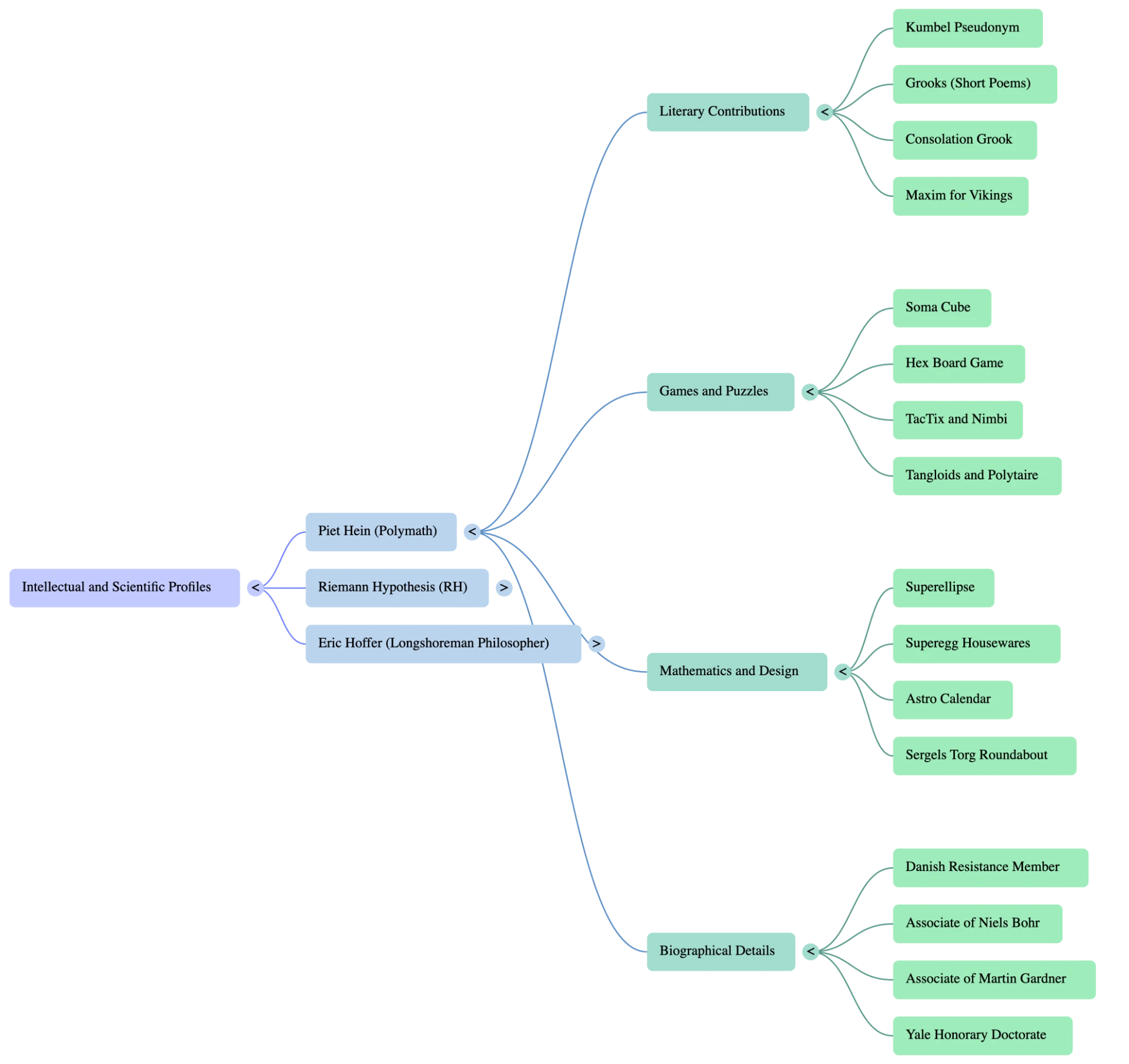
Visual companion
What would show this wrong
- Exhibit an explicit reduction from a proof of RH to an efficient factoring algorithm, and section 01's correction is wrong — the 'house of cards' framing becomes literally true.
- Show that Voronin universality can be made constructive with computable convergence rates usable for prime localisation, and the machinery risk in section 02 upgrades from contingency to forecast.
- Demonstrate a classical polynomial-time algorithm for approximate shortest-vector problems, and the lattice pivot loses its independence argument entirely.
- Establish that harvest-now-decrypt-later interception is not occurring at scale, and the urgency case in section 03 rests only on the unbounded machinery risk.
- Document a state actor disclosing rather than classifying a cryptanalytic breakthrough of this magnitude, and the 'classified exploitation' incentive model in section 03 is not the default it is assumed to be.
- Show that hybrid deployment materially increases attack surface relative to PQC-only, and section 04's interim recommendation inverts.
Concept map
Each link below names the shared concept rather than simply recommending further reading — the edge is the argument, not the adjacency.
This page
Strategic Resilience in the Post-Prime Era
Holds the migration case together on correlated dependency and harvest-now-decrypt-later, with the popular RH-collapse framing corrected in the text.
Machinery over the theorem
The 1,000-Year NapSection 02's central move — that Voronin universality makes the toolkit more dangerous than the proof — is developed there at length, alongside Hilbert's question in its original setting.
The factoring correction
Riemann and the LocksThe companion audit. It carries the same correction as section 01 — RSA reduces to factoring, not to prime distribution — and answers the suppression question on evidence rather than on incentive.
Who may own a proof
Possessing the ProofSection 03 assumes an actor would classify a breakthrough. That essay examines the same impulse as an intellectual pathology rather than a statecraft calculation.
Limits of relentless logic
Truth Will Out?Why a conditional floor is not a scandal. Gödelian limits and empirical convergence explain why fields build on unproven assumptions and still make progress — the epistemic backing for section 01.
Working without the answer
The Absurd MathematicianSection 05 refuses to wait for the proof. Camus's absurd hero on the critical line is the same posture in a personal register: the climb justified without the summit.
Sources
- NIST post-quantum cryptography standards (FIPS 203/204/205) — ML-KEM, ML-DSA and SLH-DSA, finalised August 2024 — the lattice and hash-based standards referenced in section 04.
- Learning With Errors — The lattice hardness assumption underlying ML-KEM and ML-DSA.
- Shor's algorithm — Why factoring and discrete logarithms fall, and why lattice problems do not share that structure.
- Voronin's universality theorem — Zeta as a universal approximator of analytic functions — the basis for the machinery argument in section 02.
- SIKE broken by Castryck–Decru (2022) — A late-round post-quantum candidate defeated on classical hardware — the evidence behind the hybrid recommendation.
- RSA problem — The factoring reduction that actually carries RSA's security, distinct from prime distribution.