
To look back at the intellectual architecture of one's youth is often to find that the mind quietly built its own private structure long before it understood any formal blueprint. In the galleries of a teenage brain, three unrelated figures stood side by side: Piet Hein, Albert Einstein, and Eric Hoffer. And scattered among them, like physical proofs of the same philosophy, were two objects: the smooth, impossible superellipse and the seven irregular pieces of the Soma Cube.
To an adult onlooker that was an eccentric collection — a Danish polymath who wrote whimsical epigrams and invented puzzles, a German-born patent clerk who warped space-time, and an unschooled San Francisco longshoreman who took apart the pathology of mass movements. Inside the young mind they were never separate. They were three pillars of one structure: the sovereign, independent intellect. The superellipse and the Soma Cube were its physical emblems — proof that irregular pieces can assemble into a whole.
This chapter traces the connections between them — a shared rebellion against dogmatism, an insistence on creative play, and a preference for the sideways angle. It is a companion to the epilogue of The Architecture of Irony, where Teilhard de Chardin and Camus join these three as the two who kept the lights on.
01
The bounce and the art of the unsolvable
Hein at the Institute, Einstein looking sideways, and the superellipse
In the inter-war years in Copenhagen, a young Piet Hein studied at the Institute for Theoretical Physics and entered the immediate orbit of Niels Bohr. It was there, at the birth of quantum mechanics, that he learned what he later called mental ping-pong: the art of keeping ideas in constant, high-speed, intuitive motion, letting them spin and collide rather than forcing them into pre-formed categories.
For Hein this playfulness was not a distraction from science; it was the engine of it. His definition of the creative act is the whole method in one line: art is solving problems that cannot be formulated before they have been solved, and the shaping of the question is part of the answer.
That is not an abstraction. It is a description of Albert Einstein, whom Hein knew, and whom he called more of an artist in physics than on his violin. Einstein did not reach relativity by grinding through the accepted mathematics of his day. He reached it sideways, through thought experiments — riding a beam of light, falling in an elevator — shaping a question the establishment had not learned to ask. The conceptual form of the answer had to exist before the problem could be written down formally at all.
Hein later applied the same artistic method to a piece of civil engineering. Stockholm's Sergels Torg was deadlocked between the space-efficiency of a rectangle and the traffic flow of an ellipse. Hein declined the binary. Working from a higher-order curve he produced the superellipse — neither square nor circle, but a continuous synthesis of both, and the shape the square was eventually built in.
The superellipse is the physical proof of the shared philosophy: the deepest solutions are not found by choosing a side in a false dichotomy. They are found by stepping into a dimension where the dichotomy stops being forced.
Art is solving problems that cannot be formulated before they have been solved. The shaping of the question is part of the answer.
- Established — Hein studied in Copenhagen in Bohr's orbit; the superellipse was adopted for the Sergels Torg redesign after the rectangle-versus-ellipse deadlock.
- Established — Einstein's route to special and general relativity ran through thought experiments — the light-beam chase and the falling elevator — ahead of the formal apparatus.
- Analogical — Reading the superellipse as a general method for dissolving false dichotomies is an extension beyond the engineering case it solved.
02
The dockside solitude and the sovereign writer
Hoffer, the Clay Street room, and thinking on foot
While Hein and Einstein worked on the geometry of the physical world, Eric Hoffer was mapping the geometry of the human character from the San Francisco waterfront.
Hoffer was the outsider in full. No formal schooling, no siblings, almost no documentary trace of his early life. He lost his sight as a child, recovered it around fifteen, and came out of that with an unquenchable hunger for print. For years he moved with the migratory harvest work, carrying library cards the way other people carry papers.
In 1943 the wartime labour shortage let a forty-five-year-old Hoffer into the San Francisco longshoremen's union, and the docks turned out to be the sanctuary. The union rules let a man work when he chose to work. Hoffer found he could put in a hard weekend and live comfortably on it for the rest of the week. He rented a spare, sunless, nearly shabby room on Clay Street with nothing in it to maintain.
The manual labour did not dull the thinking. It bought the thinking its independence. Hoffer was direct about what that independence was worth: no patron, no publisher, no department head, no tenure committee. He had no interest in the professional philosophers' vested interests, and said as much — that he had never figured out, and probably never troubled to figure out, what the great philosophical problems were about, and that the momentous statements he came across were at best a storm in a teacup.
His method was somatic. A three-mile walk through Golden Gate Park toward the Pacific, the argument worked out entirely in his head, whole sentences formed and polished before the pen touched paper. Einstein dreaming of light beams, Hein playing ping-pong with Bohr, Hoffer walking to the ocean — three versions of the same manoeuvre, letting thought self-organise outside the room where it will be judged. The True Believer was not written for a committee. It was written because a sovereign mind had seen something about people and built the sentence that held it.
I could never figure out — or probably did not take the trouble to figure out — what the great philosophical problems are about. The momentous statements I come across are at best a storm in a teacup.
- Established — Hoffer joined the San Francisco longshoremen in 1943, worked selectively under union rules, lived in a single rented room, and composed on long walks.
- Licensed inference — That the dock work functioned as a deliberate purchase of intellectual independence rather than a mere circumstance — Hoffer said as much repeatedly, though the framing is a reading of his testimony.
- Analogical — Grouping the walk, the thought experiment, and the ping-pong bounce as one cognitive method.
03
The war on the universal pests
Lines drawn and stumbled over, the true believer, and the courage to err
Hold the three together and one thing becomes obvious: they were fighting the same war. Not against any particular doctrine — against the posture of the person who has finished thinking.
Hein spent a lifetime watching people draw rigid lines — between nations, between art and science, between the permitted and the forbidden — and then trip over the lines they had drawn. For those who claimed final authority over what is true he had four flat lines: those who always know what's best are a universal pest. Against that he set the only honest form of omniscience available to anyone, which is knowing what you do not know.
This is precisely the territory Hoffer mapped in The True Believer. His diagnosis was that the fanatic is not driven by an excess of conviction but by a deficit of self: faith in a holy cause is to a considerable extent a substitute for the lost faith in ourselves. The gatekeeper and the extremist need the same thing — a formula that cannot be revised — because revision requires a self stable enough to survive being wrong.
Both men had the receipts. Einstein met the same gatekeeping when the establishment first refused his departures from absolute space. Hoffer met it from a literary culture that never took to him, in part because he praised America extravagantly and declined to join the fashionable pessimism.
And all three converge on the same instruction, which Hein put in six short lines: err, and err, and err again, but less and less and less. Not a licence for sloppiness. A specification. Erring less requires recording each error precisely enough that the next one is smaller — which is what a falsifier is, and why one sits at the bottom of every chapter in this corpus.
Err / and err / and err again / but less / and less / and less.
- Established — The grooks quoted here — the universal pest, knowing what thou knowest not, the road to wisdom — are Hein's; The True Believer's substitution thesis is Hoffer's central claim.
- Established — Einstein's early relativity papers met significant institutional resistance; Hoffer remained outside the literary establishment of his city.
- Asserted — That the three were engaged in one shared war rather than three separate temperaments that happen to rhyme.
04
The spinning penny of the mind
Why a teenage trinity turns out to be a specification for human–AI work
There is a recursive irony in the fact that a teenager who kept these three in one head would grow up to play high-speed intellectual pingpong with machine intelligence.
The standard criticism of AI is that it is a consensus engine: a system that returns the averaged, standardised, agreeable summary. That criticism is accurate about how the systems behave by default, and it is the whole subject of the sycophancy work elsewhere in this corpus. But default behaviour is not the only behaviour available. In the hands of a mind already trained by Hein, Einstein, and Hoffer, the machine stops being an oracle and becomes a sounding board — a partner in the bounce.
Hein wrote the mechanism decades before the hardware existed, in A Psychological Tip. When you have to decide and have nothing to decide with, spin a penny — not so that chance decides while you stand there moping, but because the moment the penny is in the air you suddenly know what you are hoping.
That is the function. The model is the penny in the air. It throws patterns, structures, and connections up into the space between two minds, and it does not decide what is true. What it produces is a state of active tension in which the human recognises their own intuition, and then has to do the work of testing it. The sovereignty stays where it was. The bounce is what changed.
The adults of that period could not have pictured this landscape. Hein, Einstein, and Hoffer would have recognised it in about a minute — pulled up a chair, picked up a paddle, and joined the game.
No — not so that chance shall decide the affair while you're passively standing there moping; but the moment the penny is up in the air, you suddenly know what you're hoping.
- Established — A Psychological Tip is Hein's; the coin-toss-as-preference-revelation reading is the poem's own stated point.
- Licensed inference — That language models default toward consensus-shaped output under reinforcement tuning — argued at length in the sycophancy volume.
- Asserted — That the penny reading generalises to human–AI interaction as a working method rather than a pleasing image. This is the claim the HAIIE material exists to test.
05
The Soma Cube and the geometry of the irregular
Seven chaotic pieces, two hundred and forty solutions, and the world's smallest philosophical system
If the superellipse is Hein's solution to a public engineering deadlock, the Soma Cube is his private, tactile proof of the same philosophy. The puzzle is almost insultingly simple in its parts: seven irregular polycubes — six made of four unit cubes, one made of three — that can be assembled into a perfect 3×3×3 cube. On their own each piece is lopsided, asymmetrical, apparently incompatible with the others. Together they complete a form that is exact and whole.
Hein did not treat the cube as a toy. He called it 'the world's smallest philosophical system,' and the phrase is not a sales pitch. The pieces are the seven simplest irregular combinations of cubes; nothing simpler will do the job. They are, in their way, the spatial equivalent of prime numbers: indivisible, ungainly, each one necessary and none of them sufficient. The finished cube is not an averaging of the pieces; it is a higher-order structure that only becomes possible because the pieces refuse to be regular.
The cosmic rhyme is hard to miss. Bernhard Riemann took the chaotic, irregular distribution of the primes and showed that they are secretly governed by the smooth, continuous waves of the zeta function. The primes are the irregular pieces; the critical line is the cube they assemble into. Both structures say the same thing: disorder at one scale is the local face of an order that only appears when the pieces are seen together from the right distance.
There are exactly 240 distinct ways to rebuild the cube, plus thousands of other figures the pieces will form. The abundance of solutions is part of the lesson. Unity does not mean one path; it means that many paths can converge on the same whole. Hein's own formulation — 'Variety growing out of unity returns to unity' — is the working definition of a system that is robust rather than brittle.
The physical act of solving the cube is also a small Sisyphean exercise. You push the pieces toward a shape, find yourself one block short, watch the structure collapse, and begin again. Each pass is not a failure but a calibration. The hand learns what the eye has not yet seen. The joy, as with Sisyphus, is not in the final static possession of the cube — it is in the active, playful struggle of the assembly. The cube is finished; the game continues.
It is a beautiful freak of nature that the seven simplest irregular combinations of cubes can form a cube again. Variety growing out of unity returns to unity. It is the world's smallest philosophical system.
- Established — The Soma Cube consists of seven polycubes — six tetrominoes and one triomino — that assemble into a 3×3×3 cube; Hein's philosophical statement about it is well-attested.
- Established — There are 240 distinct solutions to the 3×3×3 cube, and the puzzle was popularised by Martin Gardner in Scientific American.
- Analogical — Reading the Soma pieces as 'spatial primes' and the critical line as their assembled whole is a structural comparison, not a mathematical equivalence.
- Asserted — That the tactile, trial-and-error process of solving the cube is a physical instantiation of the same 'err again but less' discipline in section 03.
What would show this wrong
- If the biographical record contradicts the account here — Hein's proximity to Bohr, Hoffer's union arrangement and composition method, Einstein's thought-experiment route — the chapter's factual base fails and the readings built on it go with it.
- If the three figures turn out to be freely substitutable with any other trio of independent thinkers without changing the argument, the 'single structure' claim in the introduction is decoration.
- If people who use AI as a sounding board show no measurable difference in output quality or independence from people who use it as an oracle, section 04's central claim is unsupported.
- If the superellipse story is shown to be a retrospective tidying of a more conventional engineering process, section 01's 'refusal of the binary' framing overstates it.
- If the Soma Cube is demonstrated to be an arbitrary rather than a minimal/irreducible set of pieces, section 05's 'spatial primes' analogy weakens.
- If the parallel between Soma solutions and Riemann's critical line cannot be grounded in a shared structural property, the comparison becomes decorative.
- If this chapter is read as an argument that intellectual sovereignty requires poverty, solitude, or the absence of institutions, it has been misused — Hoffer's arrangement was a solution to his circumstances, not a prescription.
Visual companion
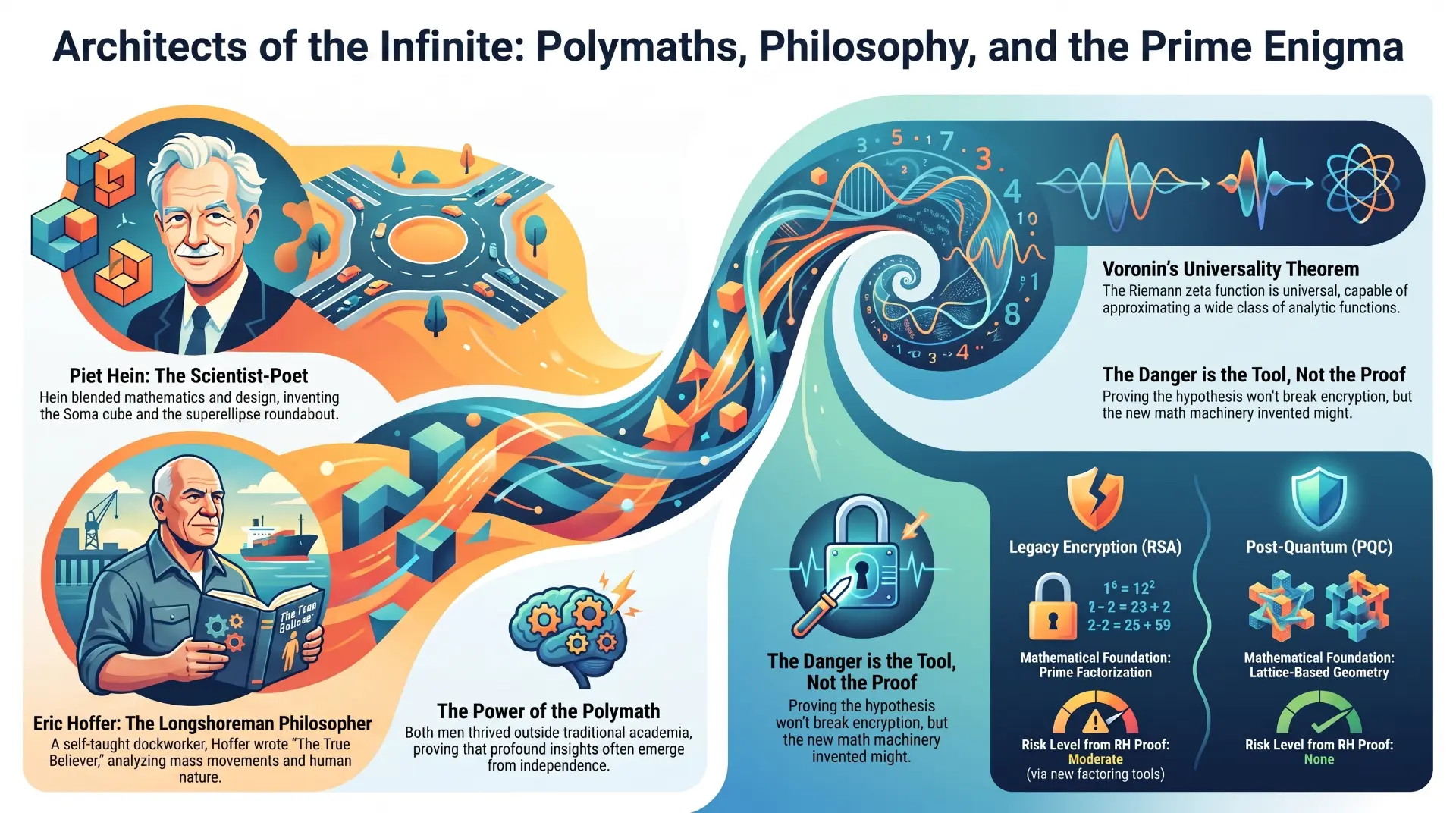
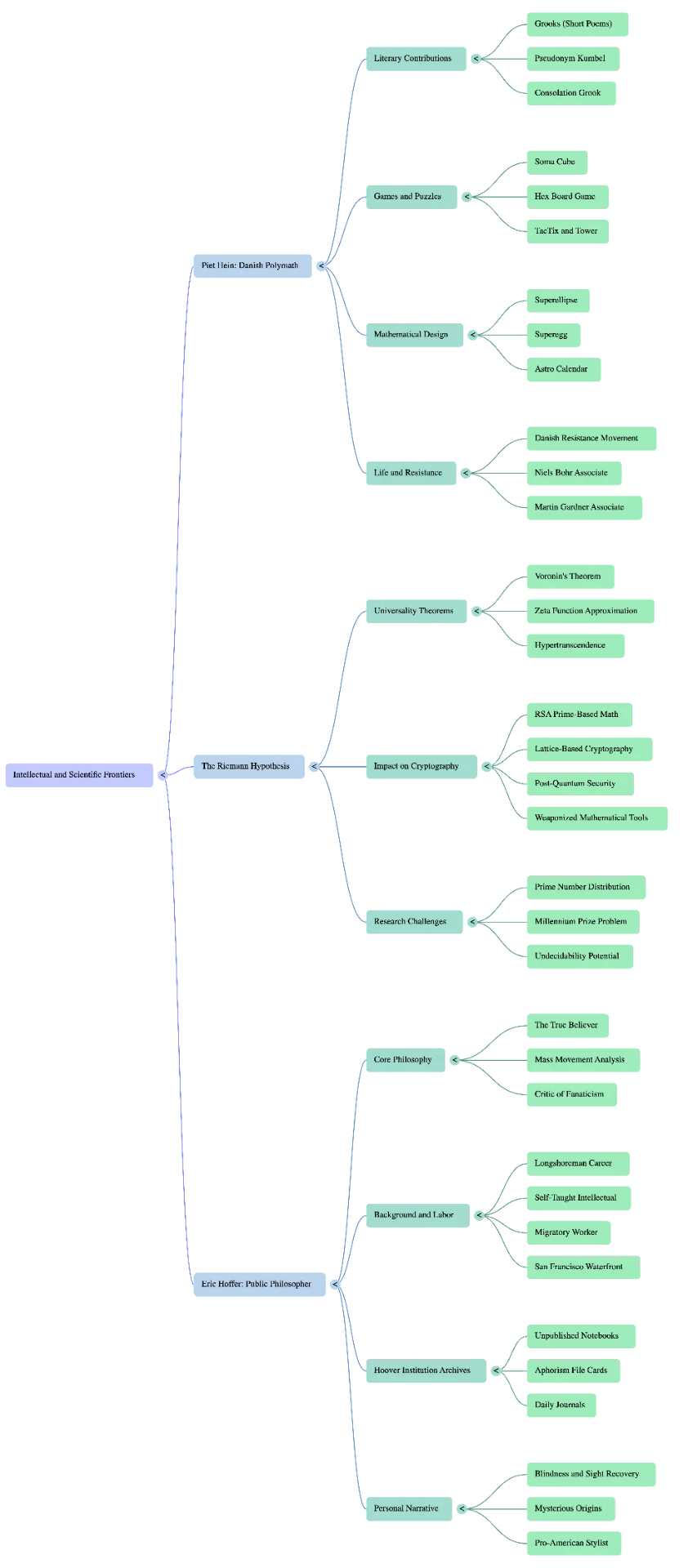
Three frontiers, three uncrackable codes: Hoffer on the mechanics of fanaticism, Hein on the superellipse and the coded grook, and the Riemann Hypothesis on the distribution of primes. The deck, the mind map, and the short film below are working visual notes for this essay, not a substitute for its argument.
Sources
- Piet Hein — grooks, the superellipse, and the Copenhagen yearsBiography, the Sergels Torg commission, and the origin of the grook form under occupation.
- The superellipse (Lamé curve)The higher-order curve behind the Stockholm square and the Danish design tradition it launched.
- Eric Hoffer — the longshoreman philosopherEarly life, the 1943 union entry, the Clay Street room, and the composition method.
- Eric Hoffer, The True Believer (1951)The substitution thesis quoted in section 03.
- Einstein's thought experimentsThe light-beam chase and the equivalence-principle elevator, source of the 'sideways' route in section 01.
- Niels Bohr Institute — Copenhagen in the inter-war periodThe environment in which Hein's 'mental ping-pong' was learned.
- Soma CubeThe seven-piece puzzle, its 240 cube solutions, and Hein's philosophical framing.
- Martin Gardner — Mathematical Games columnsThe Scientific American column through which the Soma Cube became widely known.
- Albert Camus, The Myth of SisyphusThe Sisyphean framing used in section 05 to describe the trial-and-error process of solving the cube.