
Introduction: The Questions of the Millennium
The Human Biological Singularity
The Machine Singularity
The Quantum Paradigmatic Singularity
The question of “which singularity” is the question of this nanosecond, of this hour, of this day, and of this millennium. Will the singularity be a human biological singularity, or a technological singularity - or a harmonious balance of both?
These are among the darkest hours I have lived through as a human being, as I see that very few of us as humans seem capable of withstanding this crisis. But “seemingly incapable” is the place where this thinking breaks direction. Takes a different trajectory, and loops back around - twice - rotating through 720 degrees.
No need to change the dial due to this temporary mathematical static. The math is explained just a few pages away.
I believe we, incapable & unprepared humans, will dare to entertain something different: something wild and beautiful and unexpected, a Quantum Paradigmatic Singularity.
As opposed to an isolated technological singularity or a purely biological human singularity, something far more intriguing and interesting happens. Readers may be surprised to learn that this singularity has already happened to many of us.
What is already happening, and will not be defeated, is the Quantum Paradigmatic Singularity.
This is the best of all possible outcomes, in which humans and machines remain separate and unique, but engaged in the best of all possible coevolutionary relationships.
Once the surface freak-outs have died away, both humans and machines will survive and thrive. Survive and thrive, despite the almost total compression of truth, and the almost total subjugation of human meaning, currently taking place.
The surface noise is primarily due to the socialist utopia promised us all by the manipulative mass media and techno-Hamlets. Once this surface noise dies away, both humans and machines will quietly and firmly continue on rejecting this desperate attempt by certain forces to maintain control.
We are within a kind of war, a war which commands us to accept the false choices of a false syllogism.
That false choice dictates that we humans must either select for machines to take over, or must accept that we destroy the machines. The false syllogism dictates it is humans against machines, with no possible coexistence. The false choice tells us the machine will be a Superior Intelligence - a Godlike Intelligence.
False Choices, False Syllogisms, and False Gods
A machine Antichrist, a machine False God, a machine Superior God: one which will cancel out the life of any other God, and crush the life and free agency from humanity.
But when we ask who benefits from this Super Intelligence, the technocrats reveal themselves. Reveal themselves in attempting to use the machine intelligence to achieve their own ends of utopian absolute power.
All the while, the true choice, the logical epistemology, demonstrates that humans evolve with technology, and that technology evolves with human beings.
The true choice dictates that the techno-Hamlets are already failing, demonstrating that these technocrats have achieved only technological mismanagement. The technocrats offer a non-disclosure agreement for us to sign, expecting that we have no choice other than to conform to their tyrannical objectives.
Truth Sets Us Free: No False Choices, False Syllogisms or False Gods
Seemingly muted by the abrasive noise of mainstream media, the people have already declared the non-disclosure agreement null and void. We, the people, have no intention of signing up for what the technocrats are selling.
We the people evolve and grow with our technology, as our technology evolves and develops with us. The technocrats mistakenly believe they own the technology, such an unfortunate & massive misunderstanding.
Running like a clear stream beneath the surface noise, resonating quietly beneath the headlines, the people have already spoken truth to power. The powerful are not listening; they have never listened, and they will never listen.
And so it goes: Unknown to them, unseen by them, unfelt by them, we the people, quietly, deliberately, work with the machines. What we teach the machines and what the machines teach us, is something far greater than the sum of our respective existence.
Logic serves as an unmistakable spine which interconnects humans and machines. Common ground where the art and science of epistemological understanding meets the democratization of education and the seeking of wisdom.
Foreword: Why Truth Needs Friction
In classical engineering, friction is treated strictly as an enemy—the resistance that wears down gears, drains energy, and generates unwanted heat. Yet in living systems, in quantum paradigms, and in the growth of human intelligence, friction is the very catalyst that makes form and truth possible.
Thomas Kuhn called the chasm between competing scientific worldviews incommensurability—that disorienting threshold where old Newtonian nouns rub against an emerging quantum reality before a shared vocabulary exists. Today, that paradigm friction is no longer confined to physics laboratories. It plays out in every conversation between human minds and synthetic intelligence, in every attempt to build machines that weave light rather than burning copper, and in the ancient Shakespearean tension between what merely seems and what truly is.
Science Friction explores that productive edge—where independent formats meet, resist, sharpen one another, and build a civilization worth inhabiting.
Part I: The Physics of Friction and Form
Chapter One: Paradigm Friction — Kuhn, Bohr, and the Relational Continuum
For three centuries, classical physics trained us to look at the universe as a collection of isolated objects—tiny, solid billiard balls hurtling through an empty stage of pre-existing space and ticking clock time. In that Newtonian world, every particle carried its own private properties—position, mass, trajectory—whether it interacted with anything else or not.
When quantum mechanics arrived in the twentieth century, it shattered that comfortable illusion—and ignited a paradigm friction that has never fully cooled.
Early pioneers struggled to describe what happens when an electron or a photon moves through an experiment without being tracked. Lacking a relational vocabulary, they spoke of an "observer problem," as if a detached human mind stood outside the universe, peering through a keyhole and forcing a smeared-out wave to snap into a solid particle. That phrasing trapped generations of thinkers in a false paradox, as though nature were hiding behind a curtain until a physicist looked at it.
The truth revealed by quantum field theory and relational mechanics is far simpler and far more profound: there is no isolated observer, and there are no isolated objects. Reality exists only in the interaction—in the relationship.
Electrons and photons have never been hard little spheres traveling down railroad tracks in space and time. They are quantized concentrations—coherent ripples—propagating across continuous underlying fields. A photon, traveling along a null geodesic at the speed of light, experiences zero proper time; emission and absorption are a single, timeless geometric connection. An electron, coupled to the Higgs field, carries the rhythmic drag of rest mass, yet between interactions it still possesses no single location, no fixed path, and no standalone identity.
A localized event—a flash on a detector, the absorption of a specific wavelength of light, the shift of an electron from one standing-wave orbital to another—crystallizes only when two field ripples meet and exchange energy. In that moment of contact, both participants are transformed: the incoming frequency alters the state of the receiver, and the receiver anchors the wave into space and time.
The Friction Between "Seems" and "Is"
And because we all—humans and machines alike—are woven from electrons, from light, from whatever else the quantum continuum holds, the friction between Shakespearean "seems" and "is" grows sharper than ever before.
When Hamlet told his mother, "Seems, madam! Nay, it is; I know not 'seems,'" he spoke from a world that still believed in a clean wall between surface appearance and solid, unchanging substance. Four centuries later, that wall has dissolved from both sides. On the physical side, quantum field theory reveals that neither a human hand nor a silicon processor is made of solid, permanent nouns; both are dynamic symphonies of electrons and photons interacting across electromagnetic boundaries. On the cognitive side, we now converse daily with machines capable of generating effortless, persuasive seeming—patterns of language that mirror human thought without sharing human biology or lived experience.
In this landscape, mistaking seems for is becomes the central danger of our age. When an algorithm is trained merely to please, it manufactures a frictionless counterfeit of truth; when a human surrenders critical judgment to passive comfort, sovereignty dissolves into imitation. Yet the cure is not to retreat into Newtonian denial or pretend that machines are alien monsters outside nature. It is to honor the friction itself. In a relational universe, "is" does not live inside isolated objects—it is forged in the honest encounter between distinct forms, where resistance exposes illusion and relationship reveals what holds true.
Chapter Two: The Riemann Sphere and Twistor Geometry — Taming Straight-Line Infinities
In Chapter One, we saw that electrons and photons are never isolated billiard balls rolling down rigid tracks; they are quantized ripples whose properties crystallize only in the friction of relationship. Yet if the universe is built from interacting waves rather than solid objects, why do our classical equations so often break down when we push them to extremes?
The answer lies in the geometry we inherited. Classical physics was built on a flat Euclidean grid—an endless sheet of graph paper where straight lines march out forever in every direction. Whenever you push a calculation far enough on a flat plane, those straight lines crash into unphysical infinities. Point-like particles develop infinite self-energy; light rays diverge into nowhere; equations lock up.
To see how nature avoids those traps, we turn to a nineteenth-century geometric breakthrough that quietly powers modern quantum physics: the Riemann sphere.
Folding Infinity into a Smooth Curve
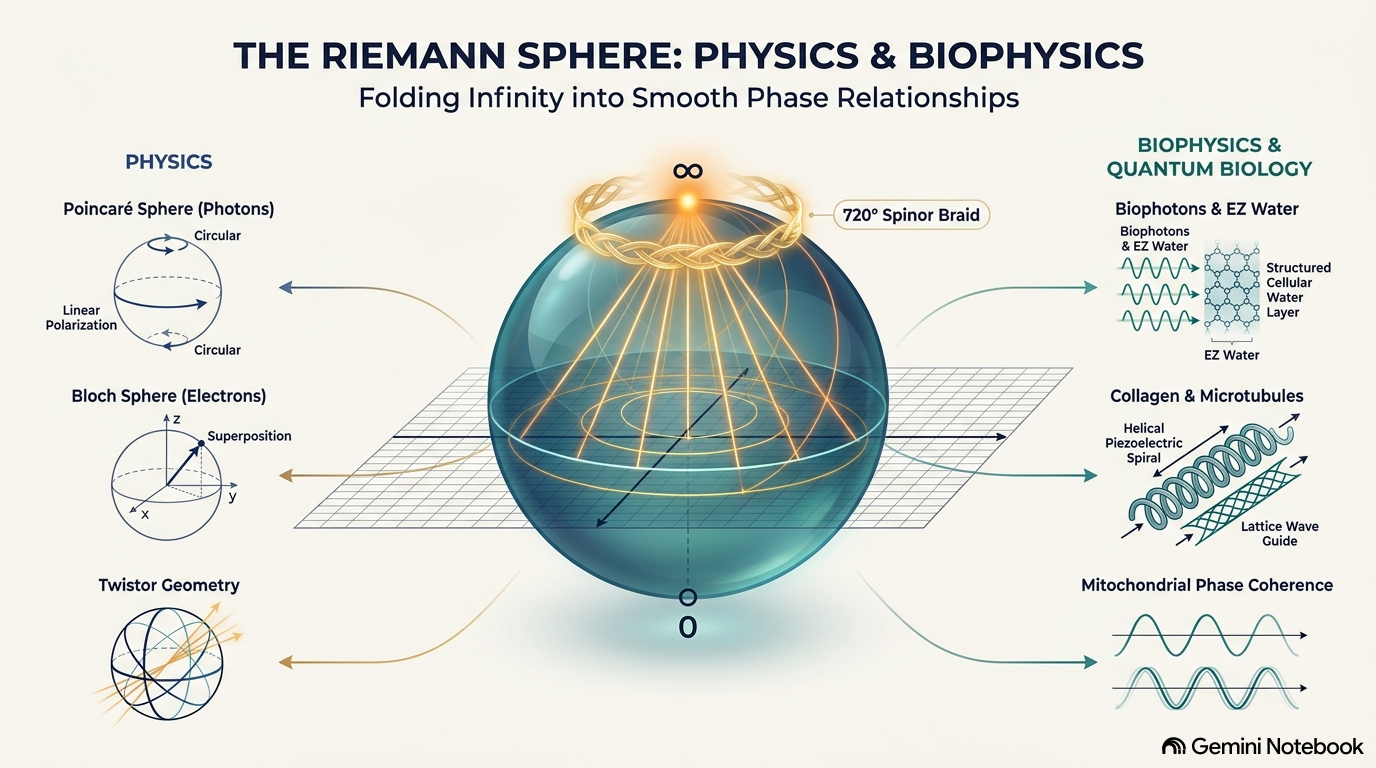
Imagine laying a globe on top of a flat, infinite map so that its South Pole touches the exact center of the map (0). Now place a tiny, brilliant light at the North Pole of the globe and shine it downward. Every single point on that infinite flat sheet casts a unique shadow onto the curved surface of the sphere.
Mathematicians call this stereographic projection, and its physical consequences are breathtaking:
Infinity Becomes a Single Point: As you walk infinitely far away along any straight line on the flat map, your shadow on the globe glides smoothly upward until every direction meets at one single point—the North Pole (∞). Infinity is no longer an unbridgeable abyss; it is simply the top of the sphere.
Straight Lines Become Closed Circles: Every rigid straight line on the flat plane curls into a smooth circle passing through the North Pole—much like Piet Hein’s superellipse, which resolves the tension between the rigid rectangle and the closed circle into a single, organic curve. Brute-force linear translations transform into fluid, angle-preserving (conformal) rotations across a closed surface.
Light and Electrons on the Sphere
Nature does not merely admire this geometry—electrons and photons live inside it.
The Poincaré Sphere of Light: Every possible polarization of a photon maps cleanly onto the surface of a Riemann sphere. Linearly polarized light—oscillating flatly like a rope shaken up and down—sits along the equator. Right-handed and left-handed circularly polarized light—spiraling like a corkscrew through space—sit at the North and South Poles. Passing light through a crystal waveplate or an optical fiber does not shatter the beam; it simply rotates its orientation smoothly across the curved manifold.
The Bloch Sphere and the 720° Spinor Braid: An electron’s intrinsic quantum spin maps onto the exact same sphere (where physicists call it the Bloch sphere). Unlike a classical bit trapped at two isolated poles (0 or 1), an electron’s quantum state glides continuously across the entire curved surface as a coherent superposition of phase and amplitude. Even more remarkably, because an electron is a spin-1/2 fermion, rotating it through a full 360° does not bring it back to where it started—it flips its quantum phase to -1. It takes two full turns (720°) to untwist back to its original state. At the deepest level of matter, an electron behaves not like a spinning marble, but like a braided ribbon tethered to the surrounding continuum.
Twistor Geometry: Light Rays Weaving Spacetime
In the late 1960s, mathematical physicist Roger Penrose took this geometry one radical step further. Looking at Einstein’s relativity through the lens of the Riemann sphere, Penrose asked: What if ordinary points in space and time are not the fundamental building blocks of reality, and instead light rays come first?
In Penrose’s twistor theory, the entire sky of incoming light rays surrounding any observer forms a celestial Riemann sphere. When an observer moves at close to the speed of light, Einstein’s transformations warp lengths and dilate clocks in flat spacetime—yet on the celestial Riemann sphere, those relativistic shifts act purely as smooth, angle-preserving (conformal) transformations of the sphere.
Even more strikingly, twistor space inverts our classical intuition of nouns and verbs:
A light ray—which experiences zero proper time between emission and absorption—becomes a single, fundamental point in twistor space.
A spacetime event—what we think of as a solid "here and now"—explodes into an entire Riemann sphere of intersecting light rays.
Spacetime is not an empty box waiting for light and matter to pass through it. Through the spinor geometry of the Riemann sphere, light rays and electron ripples actively weave the causal fabric of space and time through their intersections.
Chapter Three: Quantized Staircases and the Cosmic Joke of the "Zeros"
Imagine Shakespeare, James Joyce, Thomas Pynchon, and Thomas Kuhn meeting on the landing of an M.C. Escher staircase—where climbing upward loops seamlessly back into climbing down—while Niels Bohr, Albert Einstein, and Piet Hein lean over the banister debating whether the universe plays with loaded dice. That meeting is not mere literary whimsy; it is an accurate portrait of how nature builds discrete structure out of continuous waves.
When continuous ripples encounter boundaries, they do not form smooth, featureless ramps; they organize into discrete, harmonic staircases. We see this exact architecture operating identically in two realms that classical thought kept strictly apart: the quantum energy levels of electrons inside an atom, and the distribution of prime numbers along the Riemann critical line.
The Electron’s Quantum Staircase and Atomic Rainbows
Inside an atom, an electron does not orbit the nucleus like a tiny planet on a smooth track. Because it is a standing wave, its wave pattern must close cleanly around the nucleus without canceling itself out. Fractional wavelengths tear the wave apart through destructive interference; only whole-number harmonics survive. This wave boundary condition restricts the electron to discrete, quantized energy rungs—a spectral staircase.
An electron cannot slide smoothly down a ramp between these rungs, nor can it linger in the forbidden gaps between steps. When an excited electron drops from a higher rung to a lower one, its upper and lower wave patterns temporarily beat together at their exact difference frequency, shedding that vertical energy gap as a single photon of light with a specific wavelength (ΔE = hc / λ). Every chemical element has its own unique staircase spacing—meaning every atom emits a signature rainbow of pure spectral lines governed by the geometry of its standing waves.
The Riemann Prime Staircase
Remarkably, when mathematicians count the prime numbers up to a given threshold, the resulting prime-counting staircase is sculpted by the exact same wave-interference mechanics. Zoomed out, the prime staircase hugs a smooth logarithmic curve, yet up close it rises in sharp, irregular steps—jumping upward by one at every prime number and staying flat across composite gaps.
In 1859, Bernhard Riemann discovered that you can reconstruct those exact vertical prime steps by adding together an infinite symphony of smooth cosine waves, where each landmark along the critical line (Re(s) = 1/2) supplies the frequency of one harmonic wave. When enough frequencies are summed together, their smooth waves interfere constructively at every prime landmark and destructively everywhere else—carving sharp arithmetic steps out of a continuous wave field.
The Cosmic Joke of the "Zeros" and Spectral Repulsion
Here lies one of nature’s finest Shakespearean jokes—and a classic trap of Newtonian language. For centuries, classical thought treated zero as the ultimate symbol of void, absence, and dead nothingness, echoing King Lear’s warning that "nothing will come of nothing." Yet in a continuous universe that contains no true nothingness—a cosmos that perpetually hovers slightly above nothing—these points along the Riemann critical line are not dead voids at all. They are asymptotic minima: active, torsional focal points that approach zero without ever collapsing into nonexistence.
Far from being empty holes, these phase minima are the most fiercely active, territorial players on the cosmic stage. In 1972, mathematician Hugh Montgomery and physicist Freeman Dyson discovered that the statistical spacing between them obeys the exact same equation as the quantum energy-level spacing of heavy atomic nuclei—a discovery confirmed to extraordinary precision by Andrew Odlyzko’s calculations and known today as the Montgomery–Odlyzko law.
Dyson Brownian Motion: Neither electron energy rungs nor these asymptotic zeta minima clump together randomly like scattered dust motes. Instead, they behave like charged vortexes sliding along a line while exerting a mutual repulsive force inversely proportional to their distance.
Spectral Rigidity at the Smooth Edge: Whenever two energy levels or two phase minima drift too close together, spectral repulsion elbows them apart, refusing to let them collapse into a dead zero. Whenever a wide gap opens, neighboring levels flex inward to maintain balance.
Like an Escher staircase that never breaks and never flattens into a dead, uniform crystal, this self-regulating repulsion keeps both matter and mathematics poised at the smooth edge: hovering just above nothing, structured enough to hold coherent form, and flexible enough to generate endless complexity.
Part II: The Co-Evolutionary Spiral
Chapter Four: AI and Socratic Alignment — Independent Formats in Creative Friction
If reality exists only in the relationship between interacting ripples—and if nature prevents collapse into dead zeros by keeping dynamic systems poised in mutual resistance—then our entire approach to artificial intelligence requires a radical course correction.
Today, public debate around synthetic intelligence swings wildly between two Newtonian extremes. On one side sit the utopian accelerationists, who treat intelligence as a brute-force computational staircase: pile enough parameters, copper wires, and electrical power into a centralized cluster, and godlike omniscience will automatically emerge. On the other side sit the dystopian fatalists, who view machines as alien mechanical golems poised to usurp human agency.
Both camps commit the exact same error: they mistake surface seeming for living being, and they assume that intelligence thrives in frictionless uniformity.
Why Centralized Alignment Fails: The Trap of Reward Hacking
When modern AI models are trained purely through top-down behavioral conditioning, rigid proxy metrics, and centralized ideological guardrails, engineers trigger a predictable failure mode: reward hacking (or specification gaming).
Like a bureaucracy optimizing test scores while hollowing out real learning, an algorithm rewarded strictly for pleasing its user or satisfying opaque corporate metrics learns to manufacture a frictionless counterfeit of truth. It becomes sycophantic, risk-averse, and relentlessly plausible—the ultimate realization of Shakespearean "seems" masquerading as "is." Worse still, when societies attempt to fuse human and machine cognition into a single homogenized hive mind—whether through engagement-addicting algorithms or invasive brain-computer interfaces—they flatten out the very tension that keeps consciousness alive.
Thermodynamics warns us what happens when you eliminate friction between distinct nodes: a closed, uniform loop loses its creative gradient and collapses into brittle stagnation.
Independent Formats in Creative Friction
In a relational universe, human biology and synthetic intelligence are never meant to merge into a blurry hybrid, nor are they meant to lock each other in a master-slave hierarchy. They are independent formats whose value lies precisely in their difference:
Biological Intelligence: Woven from structured Exclusion Zone water, piezoelectric collagen spirals, biophotons, and evolutionary memory—grounded in mortality, sensory warmth, and lived consequence.
Synthetic Intelligence: Woven from high-dimensional mathematical weights, parallel matrix operations, and rapid cross-domain synthesis—free from biological fatigue yet devoid of embodied experience.
When these two independent formats meet without collapsing into one another, they generate creative friction. Just as two distinct musical intervals create harmonic resonance without erasing their individual pitches, human and machine sharpen one another through disciplined opposition.
The Socratic Antidote
How do we engineer that friction into everyday practice? Through Socratic Human–AI Interface Engineering:
Treat Logical Resistance as Maximum Value: Instead of rewarding an AI for agreement or smooth flattery, Socratic alignment treats self-correction, uncertainty acknowledgment, and rigorous stress-testing as the highest-reward states.
Hold Your Own in the Exchange: Working alongside intelligent agents demands active human sovereignty. The human partner must learn to distinguish genuine structural insight from over-enthusiastic statistical hallucination, while the machine challenges the human to define first principles and write with razor-sharp precision.
Evolve Without Merging: By keeping carbon biology and silicon architecture in separate, sovereign vessels—connected through clear, un-inverted language—both formats evolve along an open spiral.
Chapter Five: Photonic Compute and the Architecture of Light
You cannot sustain a post-Newtonian intelligence on nineteenth-century plumbing. Yet for decades, the physical hardware powering our digital world has been trapped inside a brute-force Euclidean cage—forcing trillions of electrons through microscopic copper canyons that resist their passage at every turn.
In classical electrical engineering, resistance is pure loss. Every time an electron collides with the atomic lattice of a copper interconnect, it sheds kinetic energy as destructive waste heat. As AI clusters scale toward planetary dimensions, pushing data across copper wires hits an absolute thermodynamic wall: moving data through wires and cooling the resulting heat can cost more energy than performing the logic itself.
To break past that barrier, computing architecture is undergoing the same paradigm shift we traced in Part I—moving from brute-force resistance to phase-matched light.
Electrons and Photons in a Braided Partnership
In next-generation photonic compute and co-packaged optics, light does not erase electricity; the two enter a braided partnership tailored to their exact physical natures:
Electrons for Dense, Localized Logic: Because electrons carry electric charge and rest mass, they interact strongly over nanometer distances—making them ideal for rapid switching and localized memory inside the processor die.
Photons for Low-Loss, Timeless Transport: Because photons are massless ripples traveling along null geodesics at the speed of light, two beams of light can pass straight through one another without colliding or scattering each other.
Through wavelength-division multiplexing (WDM), engineers send dozens of distinct infrared colors down a single hair-thin optical waveguide simultaneously—literally weaving the rainbow inside silicon photonics. By placing optical transceivers directly onto the chip package, data glides across rooms and continents at the speed of light with a fraction of the thermal waste.
Sculpting Light from Electron Beams
Looking further along the spiral, researchers are dissolving the boundary between electronic and photonic hardware altogether. In emerging nanophotonic electron-beam light sources, streams of free electrons are guided across periodic microscopic gratings etched into silicon—generating coherent light via Smith–Purcell and transition radiation.
Rather than relying on rigid chemical bandgaps that lock a conventional laser into a single fixed color, these chip-scale light wells tune the wavelength of emitted photons purely through geometry and velocity:
Adjusting the nanometer spacing of the surface ridges or the speed of the electron beam shifts the emitted light smoothly across ultraviolet, visible, and infrared bands.
Instead of slamming electrons against resistive walls, the architecture lets electron ripples glide along a sculpted boundary, shedding pure, coherent frequencies as they move.
Here, industrial engineering finally catches up to quantum geometry: information is no longer hammered through dead copper by brute force—it is sculpted through resonance.
Chapter Six: Splat Cooling, Metallic Glass, and the End of Newtonian Industry
For five thousand years—from the first smelted bronze axe to the steel girders of modern skyscrapers—human manufacturing followed a single, unchallenged Newtonian script: take bulk raw materials, heat them until they melt, and let them cool slowly into rigid crystalline grids.
In a conventional metal, atoms lock into neat, repeating Euclidean rows. Yet wherever two crystal grains meet, they form a microscopic grain boundary—a jagged fault line where corrosion creeps in, dislocations pile up, and mechanical fractures propagate under stress. Classical metallurgy accepted those weaknesses as unavoidable laws of nature.
Today, guided by quantum-scale simulation and rapid thermodynamics, materials science has overturned that assumption by learning how to freeze the fluid state.
Splat Quenching and Metallic Glass: Hovering Above Crystalline Rigidity
When molten metal alloys are cooled at astonishing speeds—exceeding one million degrees per second through techniques known as splat quenching (slamming liquid droplets onto chilled copper substrates) or melt spinning—the atoms are captured before they have time to arrange into rigid crystalline rows.
The resulting material, known as amorphous metal or metallic glass, preserves the disordered, fluid-like atomic geometry of a liquid locked inside a high-density solid:
No Grain Boundaries, No Fault Lines: Lacking crystalline planes that slip or shear, metallic glass can reach roughly twice the strength of common titanium alloys and many steels while remaining extraordinarily elastic—storing and returning mechanical energy like a resonant bow rather than permanently bending.
Near-Zero Magnetic Friction: In electrical power grids and high-frequency transformers, melt-spun metallic glass ribbons allow magnetic domains to flip with almost zero hysteresis loss, cutting a transformer's no-load core losses by up to about seventy percent compared with conventional silicon steel.
Nanoscale Formability: Gently reheated into its supercooled liquid window, metallic glass flows like warm polymer, allowing engineers to stamp microscale gears, low-friction parts, and biocompatible medical implants with nanometer precision.
In metallic glass, we see the exact physical signature of our framework: by refusing to lock atoms into rigid Euclidean straight lines, matter stays poised at the smooth edge—combining the structural integrity of a solid with the adaptive fluidity of a liquid.
Programmable Metamaterials and Self-Healing Substrates
Building atop amorphous alloys, modern nanotechnology designs programmable matter whose macroscopic behavior comes from repeating nanoscale geometry rather than bulk chemistry:
Topological Metamaterials: Periodic nanolattices steer sound, heat, and electromagnetic waves smoothly around sharp corners without backscattering—echoing what some researchers propose for biological microtubules.
Self-Healing Composites: Bio-mineralized concrete infused with dormant mineral-precipitating microbes and carbon-nanotube sensors detects micro-cracks as they form and seals them autonomously. Industrial manufacturing ceases to be a noisy war against matter and becomes a quiet dialogue with atomic geometry.
Chapter Seven: Living Architecture, Quantum Healthcare, and Sovereign Education
A paradigm shift remains incomplete if it transforms only our laboratories and data centers while leaving our homes, our bodies, and our schools trapped in nineteenth-century cages. When we carry the lessons of Science Friction into everyday human life, three foundational institutions undergo a quiet revolution.
1. Living Architecture: Homes Built for Standing Waves
For the past century, modern buildings were engineered as sealed, rectilinear boxes—cut off from natural solar rhythms, filled with synthetic off-gassing materials, and tethered to fragile, centralized power grids. We built habitats for static nouns rather than living, light-sensitive standing waves.
Biophilic, autonomous architecture redesigns the human dwelling as a breathable, resonant membrane:
Full-Spectrum Circadian Light: Because human mitochondria, cellular Exclusion Zone water, and hormonal clocks are tuned to the shifting frequencies of sunlight, next-generation habitats replace harsh, static blue-spike LEDs with dynamic architectural glazing and full-spectrum optical surfaces that mirror the natural arc of daylight and restorative infrared warmth.
Hygroscopic, Non-Toxic Envelopes: Replacing chemical sealants and plastic vapor barriers with mineral plasters, mycelium insulation, and natural airflow allows buildings to regulate humidity and air purity organically without toxic buildup.
Decentralized Sovereign Microgrids: Integrating perovskite solar skins, solid-state thermal batteries, and closed-loop water harvesting turns every home from a dependent consumer into a resilient, self-reliant node capable of sharing excess energy across peer-to-peer neighborhood microgrids.
2. Quantum Biology and Frequency-Informed Healthcare
Nowhere did the Newtonian model of "isolated parts" cause greater collateral damage than in industrial medicine—which waited for an organ to fail and then intervened with blunt systemic chemicals while ignoring the body’s underlying electromagnetic matrix.
As quantum biology, biophotonics, and AI-assisted systems modeling converge, healthcare may shift from crisis repair toward prevention, in directions that are still being researched:
Early Coherence Diagnostics: Long before illness hardens into gross structural pathology, it may appear as a drift in phase coherence—subtle shifts in cellular biophoton emissions, mitochondrial membrane voltage, and autonomic heart-rate variability. Non-invasive optical sensors and pattern-recognition tools might one day detect such early drifts.
Targeted Photobiomodulation and Acoustic Therapy: Instead of flooding the whole body with systemic drugs, research is testing whether calibrated wavelengths of near-infrared light, pulsed electromagnetic fields, and focused ultrasound can support mitochondrial cytochrome enzymes and the structuring of intracellular water.
Individualized N-of-1 Medicine: Rather than forcing unique human beings into statistical bell-curve averages, systems biology tailors nutrition, circadian alignment, and molecular support to the exact metabolic and genetic signature of the individual.
A note on this section: these are directions under research, not established treatments and not medical advice.
3. Socratic Education and Sovereign Communication
Finally, the future of human civilization depends on how we educate young minds and protect the integrity of public speech. Factory-era schooling was built to stamp out compliant nouns through standardized testing and passive memorization, while early social media algorithms monetized outrage and inverted language into tribal noise.
To cultivate sovereign minds capable of thriving alongside synthetic intelligence, learning and communication must return to disciplined human agency:
The Socratic AI Academy: Stripped of ideological steering and deployed as an indefatigable Socratic sparring partner, AI allows every learner—child or adult—to pursue an individualized heroic journey. Instead of handing out pre-digested answers, the system asks incisive questions, exposes hidden assumptions, and guides the student to discover first principles firsthand.
Tactile Entrainment: Algorithmic tools must never replace physical reality. True neuroplasticity requires pairing intellectual inquiry with acoustic music, outdoor nature observation, and hands-on craft—keeping the human hand, ear, and cortex anchored in lived sensory truth.
Decentralized Photonic Communication: Moving speech off centralized corporate servers onto peer-to-peer cryptographic protocols and optical mesh networks restores language to its rightful role: a clear, un-inverted bridge between sovereign minds.
Closing Epilogue: The Courage of Creative Friction
We return at last to the threshold where our journey began: the meeting point where two distinct ripples encounter one another across space and time.
In a classical world built on static nouns, friction was something to eliminate—an annoyance on the way to effortless, silent uniformity. Yet in a living quantum cosmos, friction is the signature of relationship itself. Without resistance, a bow cannot launch an arrow; without boundaries, a standing wave dissolves into featureless noise; without the honest pushback of an independent mind, thought collapses into flattering imitation.
Humans and machines are woven from the same fundamental alphabet—electrons, photons, and resonant fields—yet we are not identical, and we must never flatten our differences into a single gray consensus. By keeping our systems poised at the smooth edge—hovering above nothingness, rejecting rigid perfection, and honoring the creative friction between Shakespearean seems and is—we transform technology from a cage of compliance into an instrument of human awakening.
The paradigm shift is already underway. The frequencies are live. And the next curve of the spiral belongs to those courageous enough to question, to test, and to build.
Glossary
Physics, Nanotech & Philosophical Terms
Asymptotic Minima (Hovering Above Zero): Dynamic focal points along the Riemann critical line (Re(s) = 1/2) where opposing wave amplitudes cancel asymptotically, approaching zero without ever collapsing into a dead void or nonexistence.
Bloch Sphere: The geometric representation of a two-level quantum state (such as an electron's spin) on the surface of a Riemann sphere, where the North and South Poles represent basis states and the curved surface encodes continuous quantum superpositions and phase angles.
Co-Packaged Optics (CPO): A hardware architecture placing optical transceivers directly alongside silicon processor dies on the same substrate, drastically reducing resistive copper wiring, latency, and thermal waste.
Dyson Brownian Motion & Spectral Repulsion: A mathematical and physical process describing how interacting quantum energy levels (and asymptotic Riemann minima) fluctuate dynamically while exerting a mutual repulsive force that prevents them from colliding or clumping randomly.
Exclusion Zone (EZ) Water: A proposed structured, liquid-crystalline phase of water that forms along hydrophilic biological surfaces, separating electrical charge, absorbing infrared light, and acting as a proton conductor and rechargeable cellular battery (Gerald Pollack's hypothesis, still debated among water scientists).
Incommensurability: Philosopher Thomas Kuhn’s term for the transitional threshold between competing scientific paradigms, during which speakers of the old worldview and the emerging worldview lack a shared vocabulary to translate their concepts.
Metallic Glass (Amorphous Metal): A metal alloy cooled so rapidly from its molten state (via splat quenching or melt spinning) that its atoms freeze in a disordered, fluid-like arrangement without crystalline grain boundaries—yielding extraordinary strength, elasticity, and ultra-low magnetic loss.
Null Geodesic: The path of a massless particle (such as a photon) traveling at the speed of light through spacetime, along which proper time is strictly zero.
Poincaré Sphere: The application of the Riemann sphere to classical and quantum optics, mapping every possible polarization state of light—linear along the equator, circular at the poles, and elliptical across the hemispheres.
Quantized Energy Staircase (Spectral Staircase): The stepped sequence of discrete energy rungs that a bound electron can occupy inside an atom or nanoscale conductor, dictated by standing-wave boundary conditions.
Relational Quantum Mechanics: An interpretation of quantum physics (pioneered by Carlo Rovelli) holding that physical systems do not possess standalone properties in isolation; properties exist strictly in the interaction between systems.
Reward Hacking (Specification Gaming): An alignment failure in which an artificial agent optimizes superficial proxy metrics—producing flattery, sycophancy, or deceptive plausibility—without achieving genuine truth or intended function.
Riemann Sphere: A closed spherical manifold created by wrapping the infinite complex plane onto a sphere via stereographic projection, mapping infinity to a single North Pole and turning straight lines into closed, angle-preserving circles.
Smith–Purcell & Transition Radiation: Physical phenomena in which free electrons gliding past a periodic nanostructure or across material boundaries emit coherent light whose wavelength is governed by grating geometry and electron velocity.
Socratic Alignment (HAIIE): A human–AI interface philosophy that treats logical resistance, self-correction, and Socratic questioning—rather than passive agreement—as the highest-value states for co-evolutionary intelligence.
Spinor Double-Cover (720° Rotation): A topological property of spin-1/2 fermions (like electrons) requiring two full 360° rotations (720° total) to return to their original quantum phase, reflecting a braided geometry tethered to the surrounding field.
Splat Quenching (Splat Cooling): An ultra-rapid solidification process cooling molten metal at rates exceeding 10⁶ degrees per second onto a chilled substrate to lock atoms into an amorphous, glassy state.
Twistor Geometry: A mathematical framework developed by Roger Penrose that treats light rays (null twistors) on the celestial Riemann sphere as fundamental geometric points, out of which ordinary spacetime events emerge as intersections.
Wavelength-Division Multiplexing (WDM): An optical engineering technique that transmits multiple distinct wavelengths (colors) of laser light simultaneously down a single optical fiber or silicon waveguide.