

Eventually, all things merge into one, and a river runs through it.
— Norman Maclean, A River Runs Through It

“To remove a book from the period of its birth is like lifting a stone from a stream and watching it lose its luster in the palm of your hand.”
“I don't really deeply feel that anyone needs an airtight reason for quoting from the works of the writers he loves, but it's always nice, I'll grant you, if he has one.”
“Through the machineries of greed, pettiness, and the abuse of power, love occurs.”
Standing in Moving Water
Every serious book I have written pretends to be about something large — the mathematics of compassion, the architecture of the infinite, the interface between human and machine. And every one of them, at the honest hour, is about standing in moving water with a rod in your hand, waiting to be corrected by the river.
Richard Brautigan understood this and refused to be solemn about it. Norman Maclean understood it and could not be anything but solemn. Somewhere between those two temperatures — the deadpan and the liturgical — is the actual physics of paying attention. That in-between is what I mean by the quantum heart.
The River Is a Measurement Apparatus
A river is the cleanest measurement device human beings have ever been handed. It records the weather of the last four days, the geology of the last four million years, and the exact quality of your own attention in the last four seconds. Cast badly and the water will tell you. Cast well and the water will still tell you — just more quietly.
This is not a metaphor for quantum mechanics. It is quantum mechanics, rehearsed at a human scale. The angler cannot observe the trout without altering the field the trout lives in. The line, the shadow, the false cast, the boot on the gravel — every one of them is a perturbation. The whole discipline of fly fishing is the discipline of reducing your own interference until the system will consent to be seen.
The Deadpan as Ground State
Brautigan's Trout Fishing in America is not really about trout fishing. It is a book about how a mind stays sane by refusing to let any single frame — political, spiritual, literary — become the whole picture. He keeps the aperture wide. A trout stream can become a used-goods store; a used-goods store can become a confession; a confession can become a joke told to no one in particular.
That is the deadpan as ground state — the lowest-energy configuration of an honest observer. Nothing is inflated, nothing is dismissed. In quantum language, Brautigan holds the wave function open. He refuses to collapse the river into a single story until the river has actually done something worth reporting.
The Cast as Wave Equation
Maclean's father taught his sons to cast on a metronome — four o'clock, one o'clock, four o'clock, one o'clock — because the rod was not a weapon and the line was not a rope. The rod was a harmonic oscillator, and the line was the visible trace of a wave the arm was drawing in the air.
A good cast is a boundary condition solved cleanly. The loop unrolls, the leader turns over, the fly lands before the line — and for a single frame the whole apparatus is in phase with the water, the wind, and the fish. That is not romance. That is the Schrödinger equation, executed in a river, by a body that has spent twenty years learning how to stop interfering with itself.
Why the Fish Refuses
The trout refuses the fly for the same reason a human interlocutor refuses a badly-formed sentence, and for the same reason a language model refuses to hold a Standing Wave Identity in the presence of Sycophantic Decay. The signal-to-noise ratio is wrong. Somewhere in the presentation, extraction is leaking through — the angler wants the fish more than the angler wants the river.
Every discipline I have tried to name across these books returns to this one clause: you cannot extract and observe at the same time. The physicist knows it. The therapist knows it. The grandparent, waiting for the grandsons to come running, knows it in the body before the mind can name it. And the trout knows it best of all, because the trout has never had any other job.
Raise High the Roof Beams
Salinger's instruction — raise high the roof beams, carpenters, for the bridegroom is taller than any of you — is a construction note for a house that is going to shelter something larger than its builders can measure. That is the same instruction the river gives the angler, and the same instruction the corpus gives the reader. Build the ceiling higher than the current occupant. Leave room for what has not yet arrived.
The quantum heart of trout fishing in America is not a technique and not a doctrine. It is the practice of standing in moving water with the aperture open, the extraction turned off, and the ceiling raised. Everything I have called compassion, entrainment, standing wave identity, or the pause between tomorrows is a translation of that single posture into a different vocabulary. The rest of the books are footnotes. The river is the text.
Brain Waves Look Like Exhaust
Earl Miller's lab posted an illustration of cortical oscillations under the headline that brain waves look like exhaust and behave like an engine. Look at the figure without the caption and it reads as something else entirely: laminar flow entering clean, breaking into eddies, reorganising downstream. It is a trout stream drawn by a neuroscientist.
The resemblance is not an argument, and it is worth saying so plainly before it starts doing work it has not earned. Two systems can share a picture because both are continuous media carrying travelling disturbances, and that shared description is thin — it fixes the vocabulary (phase, interference, coherence length, turbulence) without fixing any of the mechanisms. The stream is not computing and the cortex is not draining.
The Scientific Lens made the same point the same week, from the other direction: overlapping circles, radial symmetry, clustered spheres turn up in mathematical constructions, in nebulae, and in cell packing, and the recurrence is not evidence of a common mechanism. Each instance has its own physics or its own biology. Mathematics only supplies the language.
The list is longer than the figures usually admit. Trout streams, surfing, and music belong on it. A standing wave in a riffle, a shoulder holding its shape across a reef break, and a sustained note in a room are all the same short description — a boundary condition, a driving flow, a phase relationship that persists — running on water, water again, and air. Nobody is tempted to claim the reef and the cello share a mechanism. The temptation only arrives when the two systems are far enough apart to feel like a revelation, which is exactly when the discount should be steepest. Recurring geometry is a fact about description, and the interesting work starts after you have stopped being impressed by it.
One result published that season does put a number on the geometric term rather than leaving it as a picture. Working from intracranial recordings, Royer and colleagues found that similarity between cortical rhythms is largely explained by how far apart the regions sit, with the wiring diagram earning its keep only in association cortex. That is geometry doing measurable work in a brain, which is a different thing from geometry supplying a shared vocabulary — the distinction is worked out in Geometry Before Wiring.
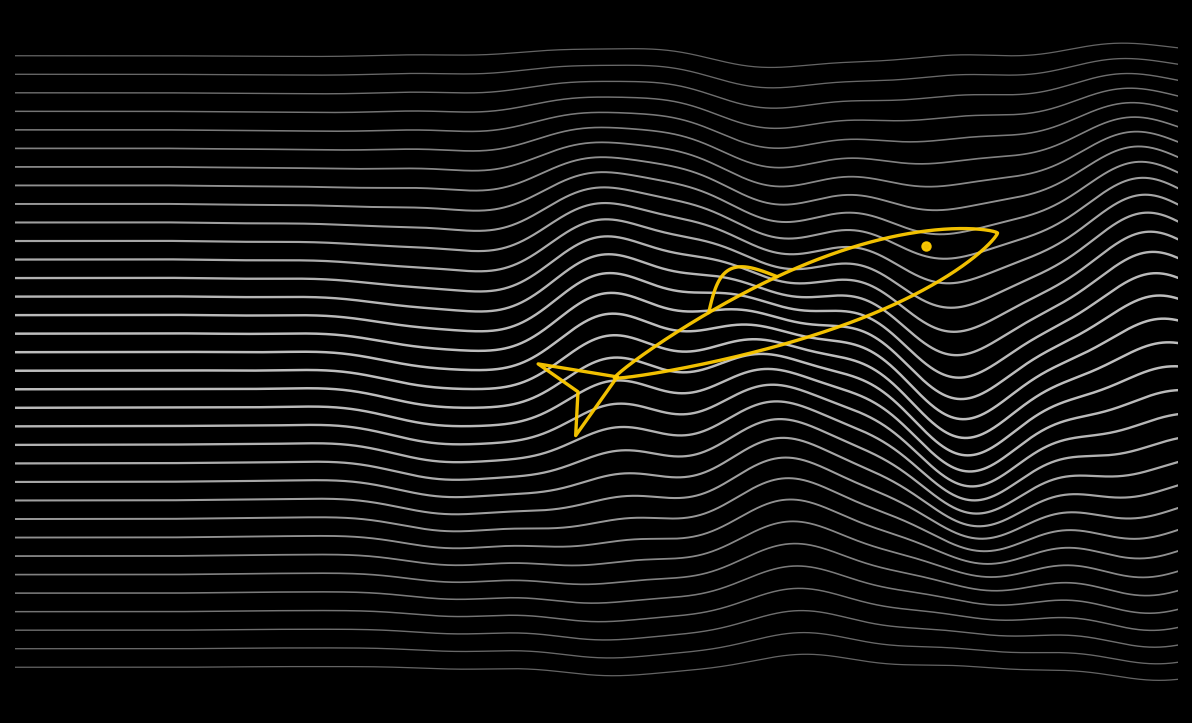
What the overlap does buy is a working posture rather than a result. The engine claim in Miller's work is that cortical rhythms perform analog computation — that phase relationships between overlapping waves carry and route information rather than merely reporting on spikes elsewhere. That is a live and contested position, strongest in the evidence for phase coding and travelling waves, weakest wherever the word "computation" is allowed to mean more than "systematic dependence of behaviour on phase." The first reply under the post makes the sharpest version of the objection: continuity is not the hard part, composite structure is.
The angler's relationship to that figure is the one this essay has been describing throughout. You do not read the stream by solving it. You read it by learning which disturbances are the water and which are you. If the brain is a medium of overlapping waves, the same problem arrives in the same shape: the observer's own interference is part of the record, and the discipline is reducing it until the system will consent to be seen.
Status note · enticing, unprovable
There is a stronger version of this resemblance waiting to be adopted, and it should be named so it can be declined. The strong version says the shared picture is not a coincidence of continuous media but a shared substrate: one quantum fluid whose interference patterns generate cortical waves and spacetime geometry alike. That claim is coherent enough to be enticing and unconstrained enough that no measurement anyone currently knows how to make would confirm or refute it. The same absence of constraint that makes it beautiful puts it outside the reach of evidence.
Falsifier: none available. Until someone specifies an observable that differs between a shared-substrate universe and one where brains and spacetime are merely both continuous media, the idea earns no epistemic weight.
Register: a high-quality member of the improbable-objects collection — worth visiting, never worth moving into. Noticing the allure and refusing the belief are the same act of discipline.
Companion reading: The Riemann Lived, The Compassionate Universe, and Promethean Mythopoetics.