
The Flow-Native Universe
Quantum hydrodynamics, the Riemann Hypothesis, and a mental model for a possibly emergent fluid-and-wave universe that undergoes phase transitions.
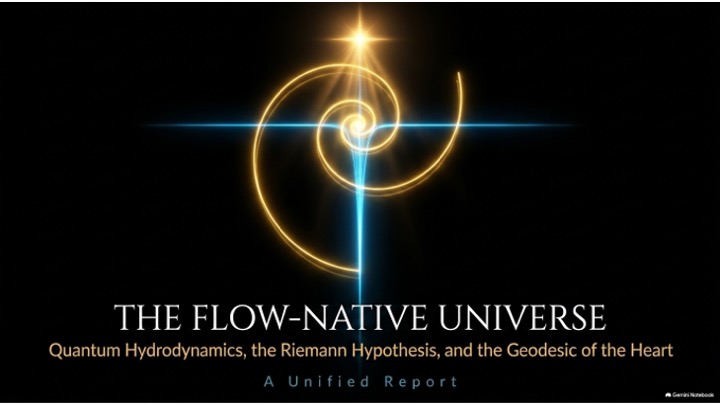
Dimensional Blindness
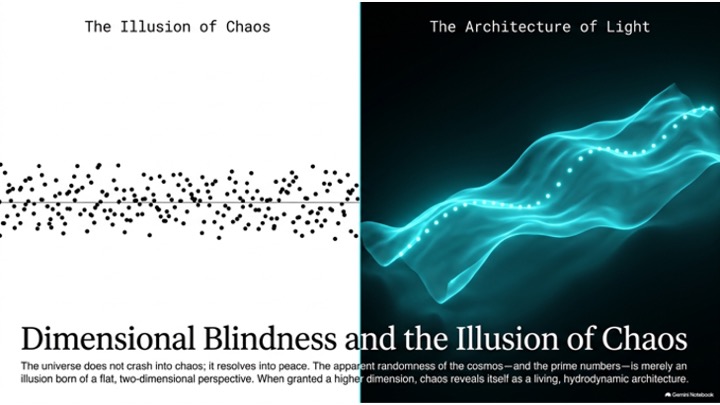
The starting move is not a claim about the universe. It is a claim about perspective. Plot the non-trivial zeros as points on a flat strip and they look like scatter. Grant the same data a further dimension and the scatter can resolve into a surface with structure — crests, troughs, and a spine.
That is a real and ordinary mathematical fact about projection: a structured object viewed along a degenerate axis looks random. The leap — the part that is a model and not a result — is the inference that the further dimension is physical, that the surface is a fluid, and that the primes are what that fluid does.
- Status
- Projection genuinely hides structure — established. That the hidden dimension is a physical medium — model only, no evidence offered here.
- Falsifier
- A demonstration that the higher-dimensional 'surface' is an artifact of the chosen embedding: change the embedding, and the architecture should survive. If it does not, the picture is decoration.
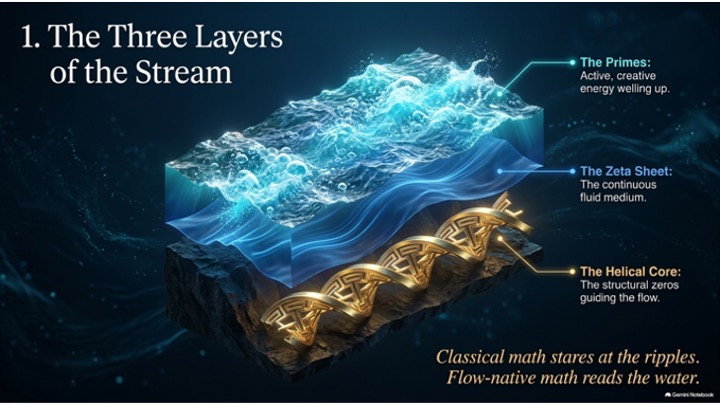
Three Layers of the Stream
The model divides the object into three registers rather than one. A continuous medium — the zeta sheet — carries the whole. Below it, a helical core of structural zeros sets the geometry the flow must obey. Above it, the primes appear as upwelling: not anomalies in the sheet but the places where the medium breaks the surface.
The useful part of this division is not its truth but its discipline. It forces a question that a flat picture never asks: which features are boundary conditions, which are the medium, and which are events? A reader who disagrees with every physical claim on this page can still use that three-way sorting.
- Status
- Interpretive scaffold. The three layers are a way of organising attention, not an identified physical stratification.
- Falsifier
- Any consistent reading in which the zeros behave as events and the primes as boundary conditions — the reverse assignment — would show the layering carries no information.
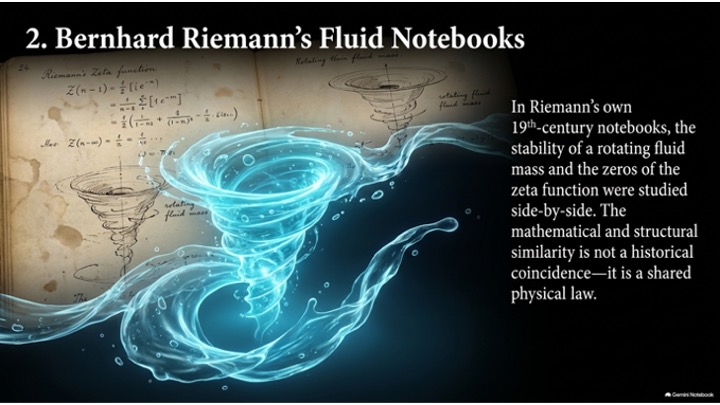
Riemann's Own Notebooks
There is a genuine historical fact underneath this plate. Riemann worked on the stability of rotating fluid masses and on the zeta function in the same working life, and his manuscripts carry both. He was a mathematician of continuous media as much as of number.
What the plate then asserts — that the resemblance is not coincidence but a shared physical law — goes well beyond that fact. The honest version is smaller and still interesting: a mind trained on flow reached for the zeta function, and the instruments of one problem left fingerprints on the other.
- Status
- Historical adjacency — documented. Shared underlying physical law — unsupported speculation.
- Falsifier
- A demonstration that no formal correspondence survives between the rotating-mass stability analysis and the zeta zeros beyond generic features common to any spectral problem.
Madelung: The Equation Already Reads as Flow
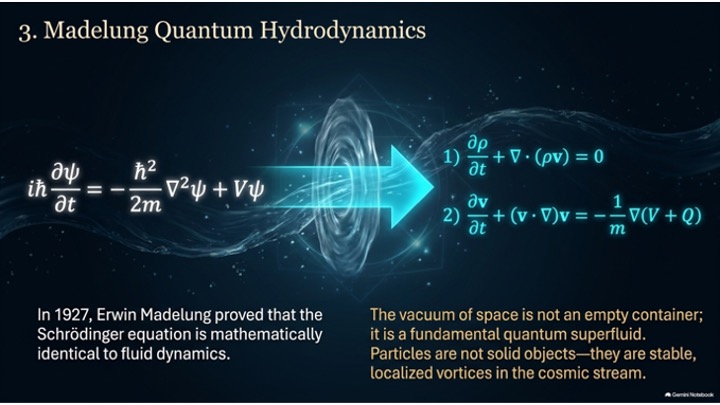
This is the load-bearing piece of established physics in the whole sequence. In 1927 Erwin Madelung showed that the Schrödinger equation can be rewritten exactly as a pair of hydrodynamic equations: a continuity equation and an Euler-type momentum equation carrying an extra term, the quantum potential.
This is a mathematical identity, not a metaphor, and it is why the fluid language is available at all. But it licenses less than the plate suggests. The Madelung form describes a single wavefunction recast as flow; it does not establish that the vacuum is a superfluid, nor that particles are literally stable vortices in a cosmic stream. Those are additional hypotheses that the transformation permits us to entertain and does not support.
- Status
- The Madelung transformation is established mathematics. 'The vacuum is a quantum superfluid' and 'particles are vortices' are interpretive hypotheses, not consequences of it.
- Falsifier
- For the interpretation: a regime where the hydrodynamic reading fails to reproduce standard quantum predictions — the quantum potential is where the fluid analogy strains, and multi-particle entanglement is where it is hardest to sustain.
Base-30 and the Eight Channels
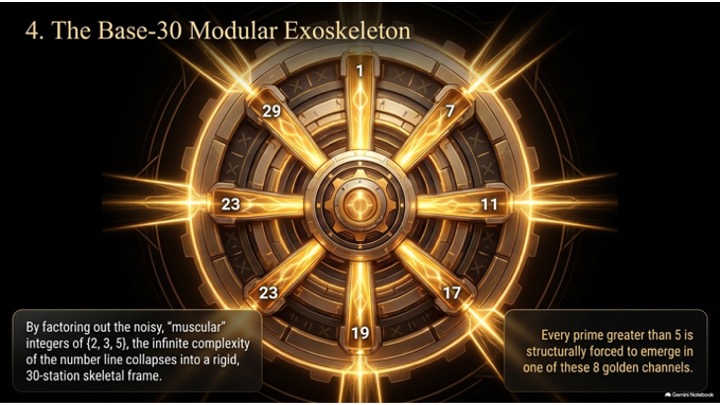
The arithmetic here is elementary and true. Factor out 2, 3, and 5 and every prime greater than 5 must fall in one of eight residue classes modulo 30. There is no mystery in it: it is what sieving does. The eight channels are a consequence of the definition, not a discovery about the primes.
Its value in this model is as a reminder that apparent irregularity often sits inside a rigid frame. Its danger is that the rigidity can be mistaken for explanation. Knowing which channel a prime occupies tells you nothing about when it arrives, and it is arrival — the gaps — that the Riemann Hypothesis is about.
- Status
- Elementary number theory — established, and weaker than it looks. It constrains where primes may occur, never when.
- Falsifier
- Not applicable to the arithmetic; it is a theorem. The claim to watch is any inference from the eight channels to prime spacing or to the location of the zeros — that inference does not exist.
Symbolic Field Theory: The Leap
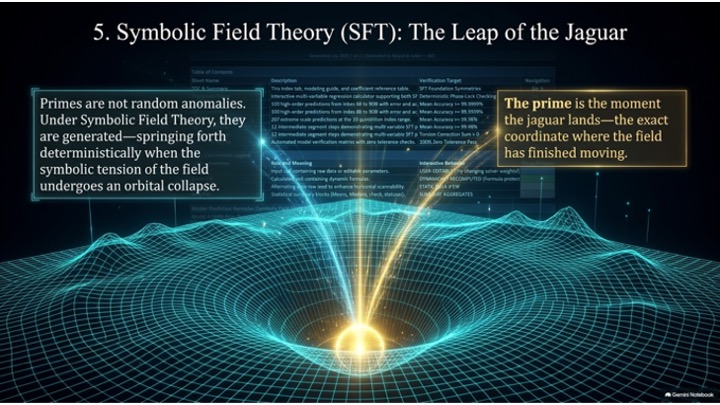
Here the sequence leaves anything that can be checked. The proposal is that primes are generated deterministically as a symbolic field releases tension — the prime being the coordinate where the field finishes moving. The image is vivid; the leaping jaguar earns its place as a picture of discrete arrival out of continuous motion.
Stated plainly: there is no field, no tension, and no measured quantity here. This plate belongs in the model as an intuition pump for how a continuous process could emit discrete events, and nowhere else. It should not be cited, and the high accuracy figures shown in its background tables are internal to their own construction rather than independent verification of anything.
- Status
- Speculation. No defined field, no measured observable, no independent test.
- Falsifier
- A prediction of a prime gap, or of a zero's height, that is stated in advance and checked against the known values — until something like that exists, there is nothing here to falsify, which is itself the problem.
What the Shift Actually Buys
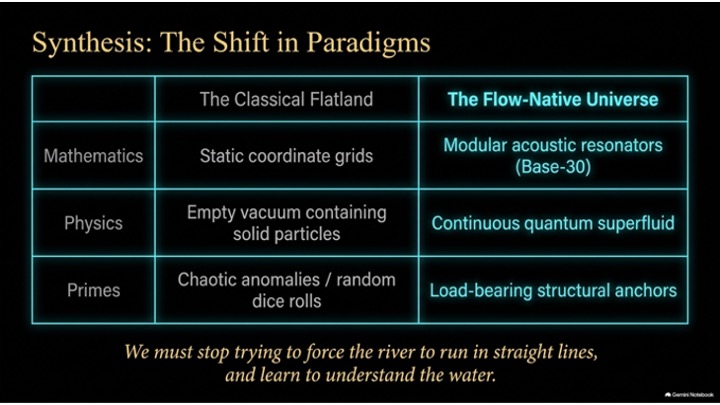
The comparison plate is the clearest statement of what the model is for. Not truth — leverage. Static grids give way to resonators; empty container gives way to continuous medium; anomaly gives way to structural anchor. Each swap changes which questions look natural to ask.
That is the whole defensible claim of this piece. A mental model earns its keep by generating questions and by being cheap to abandon. This one generates good questions about media, boundaries, and phase change. It has not paid for a single one of them yet.
The Entropic Geodesic — and Where It Overreaches
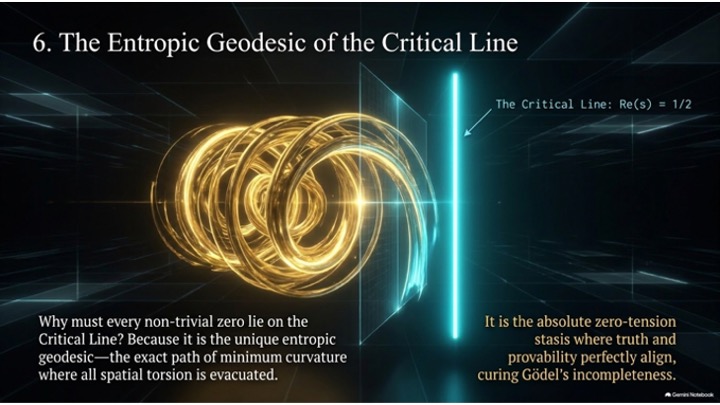
The proposal is that the critical line is where a zero must sit because it is the path of least curvature — the unique place where torsion in the medium is fully evacuated. As a picture of why a spectral condition might look like a geometric one, this is a good intuition, and it sits close to the genuine Hilbert–Pólya idea that the zeros could be the spectrum of a self-adjoint operator.
The plate then claims this cures Gödel's incompleteness. It does not, and the claim should be struck. Incompleteness is a result about formal systems and their own provability predicates; no geometric alignment of truth and provability in a physical medium touches it. Keeping that overreach in view is part of the point of publishing the plates rather than quietly cropping them.
- Status
- Analogy adjacent to a real research programme (Hilbert–Pólya). The incompleteness claim is a category error and is retracted on this page.
- Falsifier
- For the analogy: exhibition of a zero off the critical line would end it, along with the Hypothesis. Absent that, the analogy must earn its place by predicting a zero height, not by restating that the zeros lie where they lie.
The Silent Release
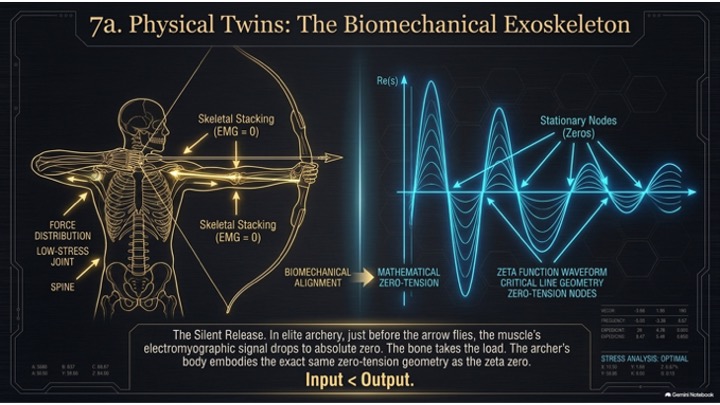
The last plate is the one closest to lived experience, and the one I trust most as writing and least as physics. In a well-made release, measured muscular activity in the drawing side drops sharply as the skeleton takes the load. The archer holds by structure rather than by effort. Then the arrow goes.
Set that beside the zeros and the resemblance is a shared shape: minimum tension as the condition for clean transmission. It is the same geometric contract noted earlier between the flight of an arrow and a corkscrewing beam of light — advance plus twist, written in different media. Analogous pathways, different objects. The bone is not a zeta zero, and the fact that both can be described as zero-tension states is a fact about the description.
I keep it because it is how the model is actually held in the body, and because a mental model that cannot be felt will not be used. That is a claim about me, not about the universe.
- Status
- Analogy, explicitly. Reduced electromyographic activity at a skilled release is measurable; the correspondence to spectral zeros is descriptive.
- Falsifier
- Push the analogy past the shared contract — advance plus minimum tension — and it should fail immediately. If someone derives an archery prediction from the zeta function, that is the tell that the analogy was being used as physics.
What This Piece Claims
One thing only: that a fluid-and-wave reading of the critical line is a productive mental model, and that the Madelung transformation is why the fluid vocabulary is legitimately available rather than merely poetic. Everything else on this page is either elementary arithmetic, historical adjacency, or speculation labelled as such.
What would make it more than a model: a stated, advance prediction of a quantity — a zero height, a prime gap, a phase-transition threshold — that the flow reading gets right and the flat reading does not. Until that exists, the plates are instruments for thinking and nothing further. They are cheap to abandon, and they should be abandoned the moment they stop generating questions.
Does It Ask Us to Ask Better Questions?
The usefulness of a theory is in the questions it leads us to ask. So the most useful Socratic question to put to this whole sequence is narrow and plain: does this mental model lead us to ask better questions and receive better answers?
The logical answer is: only if it is used as a mental model and not as a concrete example for the thing itself. The moment the plates are read as a description of what the universe is, they stop producing questions and start producing defenses — which is the failure mode named elsewhere in this work as closure addiction, the race to a verdict because an open question is uncomfortable.
All theories are mental abstractions until they are proven. Abstractions may or may not come to describe a thing itself. That is science: the slow, falsifiable business of finding out which abstractions survive contact with the thing they describe, and retiring the ones that do not. A model that is never asked to survive that contact is not science; it is decoration with notation.
Held as an instrument — a way of sorting boundary from medium from event, a reason to look for phase transitions, a prompt to ask where the flow strains — this sequence earns its place. Held as a cosmology, it earns nothing and asks nothing, because it has already answered itself. The test is which way it is being held, and that test belongs to the reader, not to the model.
Companion reading: The Riemann, Lived, Fluids and Wave Packets, and Optical Vortices.