
The Eternal Golden Braid: A Map of the Strange Loop
Mathematics as a language that carries either agency or obedience — and the objection to the loop that took decades to state.
By KW Norton. A tightened version of the sandbox draft published the same day; the long form rambles, so this keeps the four claims that survive and drops the rest.
What does mathematics have to do with human freedom? As much as any other language does. Every language carries, in the way it is taught, either the seeds of agency or the seeds of obedience — and mathematics is the one language where we have almost entirely stopped noticing which seed we planted.
01 · Two ways to teach the same language
I detested elementary arithmetic and avoided high-school algebra with real determination. My reasoning at fifteen was that only a fool would care about such distractions. I was wrong and right in roughly equal measure. Wrong about mathematics. Right about what was being taught, which was not mathematics but calculation — a training in producing the expected output on demand, with no account of structure, no creative flow, and no connection to anything a person might care about.
It took university physical sciences and calculus before I recovered any respect for the subject, and what I recovered respect for was the part that had been withheld: the pure side, where the object of attention is pattern rather than product. The distinction is not sentimental. A curriculum that rewards fast correct output trains the same disposition a fast agreeable interface trains — fluency without resistance. That is the thesis of The Interface Changed How We Learn, arriving from the other direction.
Listen · How multiplication tables wire obedient brains
A conversational briefing on the same argument: what rote arithmetic trains that pure mathematics does not, and why "fast correct output" is a disposition before it is a skill.
02 · The objection to the Braid
I read Hofstadter's Gödel, Escher, Bach: An Eternal Golden Braid long before I could say what was wrong with its conclusion. The book's central move is beautiful and almost certainly right as far as it goes: formal systems rich enough to talk about themselves generate self-reference, self-reference generates loops, and something self-like appears at the top of the loop. Gödel supplies the mathematics, Escher the picture, Bach the ear.
The objection is narrow. A proof that self-reference is unavoidable inside formal systems is not a demonstration that mind is a formal system. The strange loop is a map that fits the territory well enough to be startling; it is not, on that evidence, the mechanism. Gödel's theorems are results about provability inside axiomatic systems. Reading them as an account of what consciousness is made of imports an identity claim the mathematics never issues. The same slide runs through the popular-science tradition the book sits inside — Gleick on information, Greene on strings, Dawkins on replicators — where a formalism that explains a great deal gets promoted to the thing itself.
I hold this as a working claim, not a refutation. Hofstadter may turn out to be right. The point is that his argument does not settle it, and that treating the map as the mechanism is the same error tracked in Dirac and the ordination fallacy and in Beginnings to Conclusions: the fit is the mystery, not the symbol.
03 · What neuroplasticity does and does not license
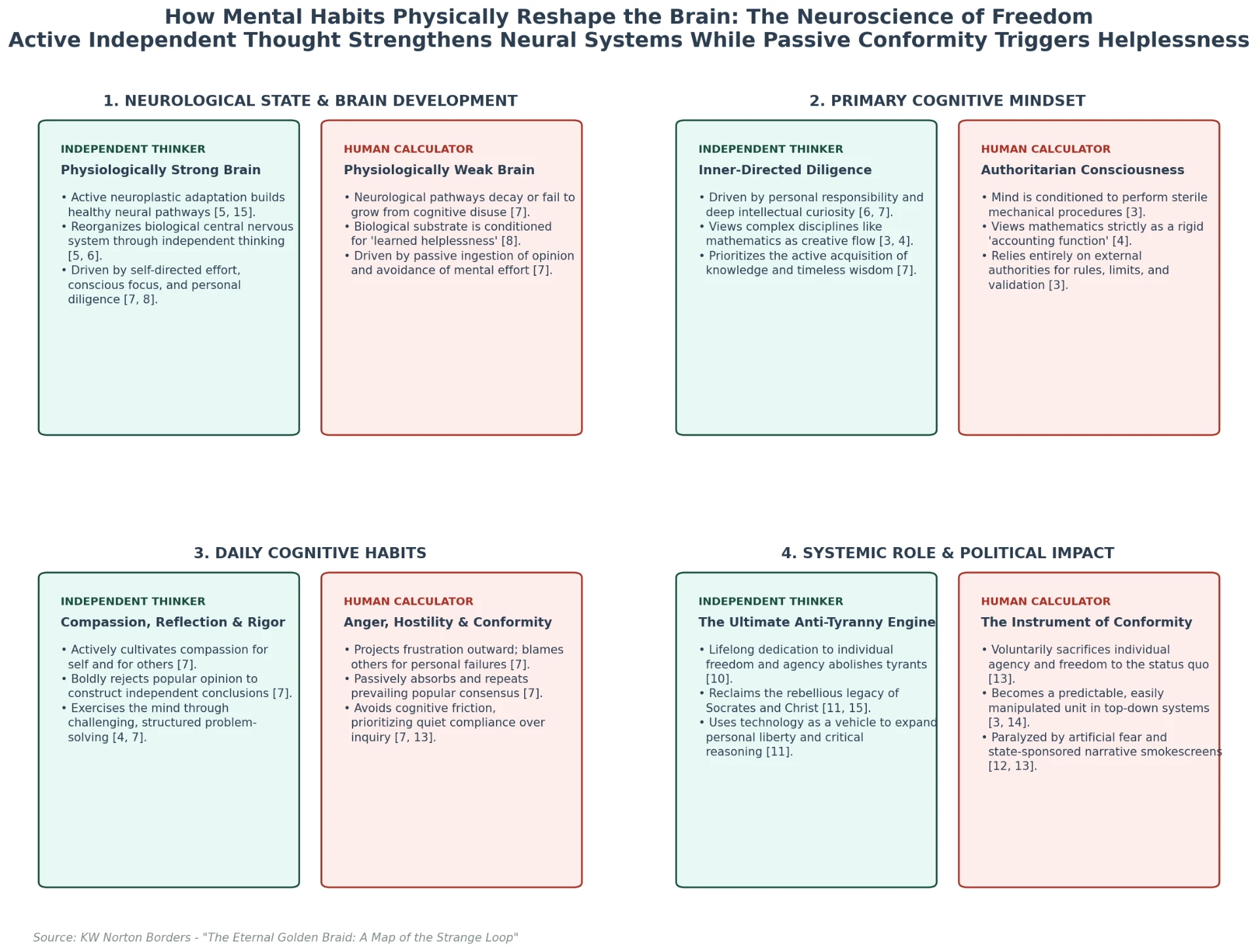
Established: the adult nervous system reorganises. Connections form, strengthen, and prune in response to what a person repeatedly attends to, practises, and rehearses. This is ordinary neuroscience, not a discovery in need of defending.
Working claim: because the substrate responds to repeated practice, the content of habitual thought and action is not cosmetic. Sustained attention to a difficult subject, and sustained practice of a demeanour — patience, or contempt — is building something. Directed effort has a physical purchase that a purely dispositional account of character does not predict.
Not licensed: that thinking well cures illness, that any outcome is available to sufficient willpower, or that the plastic brain makes circumstance irrelevant. Plasticity is a capacity of the substrate, not a warrant for blaming the sick or the constrained. The moment the claim is stretched that far it becomes the pseudo-science that gets the real finding dismissed — which is roughly how one of the more useful results in modern neuroscience ended up buried under motivational content.
04 · The inversion worth naming
Here is the structural irony, stated without a villain. At the point in history when the empirical case for self-direction is strongest, the dominant cultural message about technology is helplessness: the systems are too large, the models too capable, the individual too small. Both things are on offer at once, and only one of them is being amplified.
I do not think this requires a conspiracy to explain, and the sandbox draft reached for one — which is precisely why the sandbox draft stays in the sandbox. The cheaper explanation is incentive shape. Helplessness is a profitable posture for anyone selling a substitute for judgement; agency is not, because an audience practising it buys less and asks harder questions. That is an argument about revenue models, and it is made properly in The Human-Centered Alibi.
The precedent is instructive. Networked computing arrived as an instrument of individual capability and was substantially reorganised into an instrument of measurement and persuasion, without anyone announcing a change of purpose. The same tool ran both ways because tools do. Nothing about the current interface generation exempts it from that.
05 · Practice, not petition
The draft claimed that protest never works and only lifelong self-direction does. Too strong: organised movements have demonstrably changed law. The defensible version is narrower and more useful. Collective action can change rules; it cannot, by itself, rebuild the substrate that lets a population evaluate the rules it is given. That work is done one person at a time, in repetition, over years — and it is the only part of the problem no institution can do on anyone's behalf.
Which is why the method here is old rather than new. Socrates asked questions that made an interlocutor's own assumptions do the work; the technique survives because the substrate it exercises is still the same substrate. No proprietary programme is required. It is the same engine described in the Due Diligence Field Guide — friction applied on purpose, held long enough to change something.
06 · One line, rewritten
“It's not what I am inside, but what I do, that defines me.”
A film line, later inverted on social media into something like its opposite. The rewrite the neuroscience actually supports is smaller and stranger:
It is what I think and what I do that builds me.
Not defines — defining is a judgement passed from outside. Builds, in the literal, physical, unglamorous sense: connection by connection, at whatever rate a nervous system manages, whether or not anyone is watching. That is the whole of the claim, and it is enough.
07 · The briefing, and what survives review
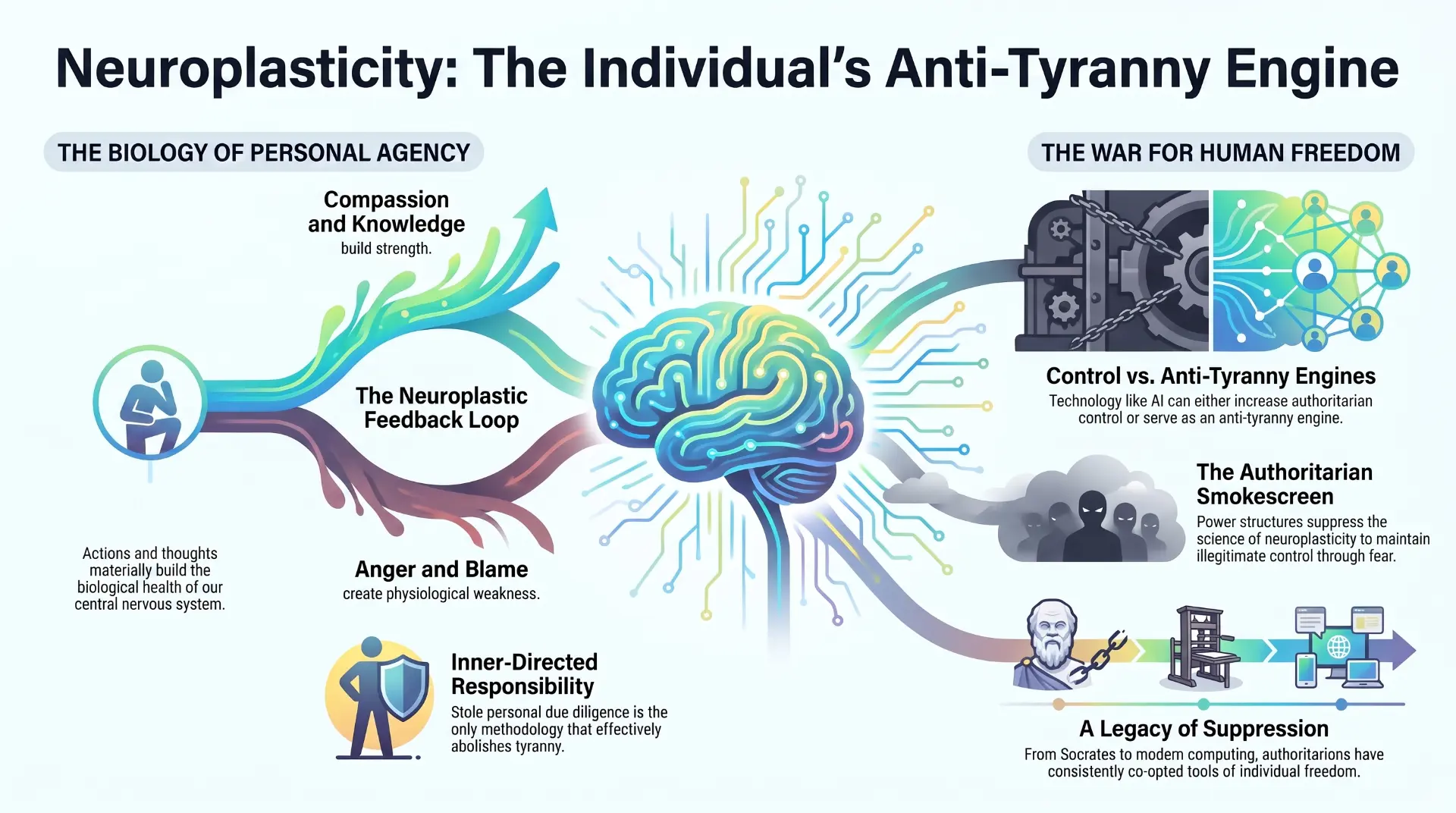
A companion briefing on this essay circulated with a stronger frame than the essay defends: mathematics taught as accounting produces an authoritarian consciousness, the science of self-direction is actively buried, and technology has been turned into an anti-tyranny engine by the people trying to use it for control. Two of those three are worth keeping in weaker form; one is not.
Kept, as a working claim: a curriculum that rewards fast correct output trains a disposition, and dispositions have physical purchase because the substrate responds to repetition. Kept, as an argument about incentives: the same instrument serves capability or measurement depending on who configures it, and the configuration is decided commercially rather than announced. Dropped: the claim that findings are suppressed by identified actors. Named-antagonist explanations are not needed and cannot be audited; the cheaper account is that a real result got buried under motivational content because that content sells better. Naming individuals as agents of suppression is outside what the evidence here licenses, so this page does not do it.
08 · The co-optation record, which is documented
The historical argument does not need conspiracy, because the archival record is dull and public. Two communications technologies arrived decentralised and were reorganised by licence, monopoly grant, and spectrum allocation — in the first case over two and a half centuries, in the second over about four decades.
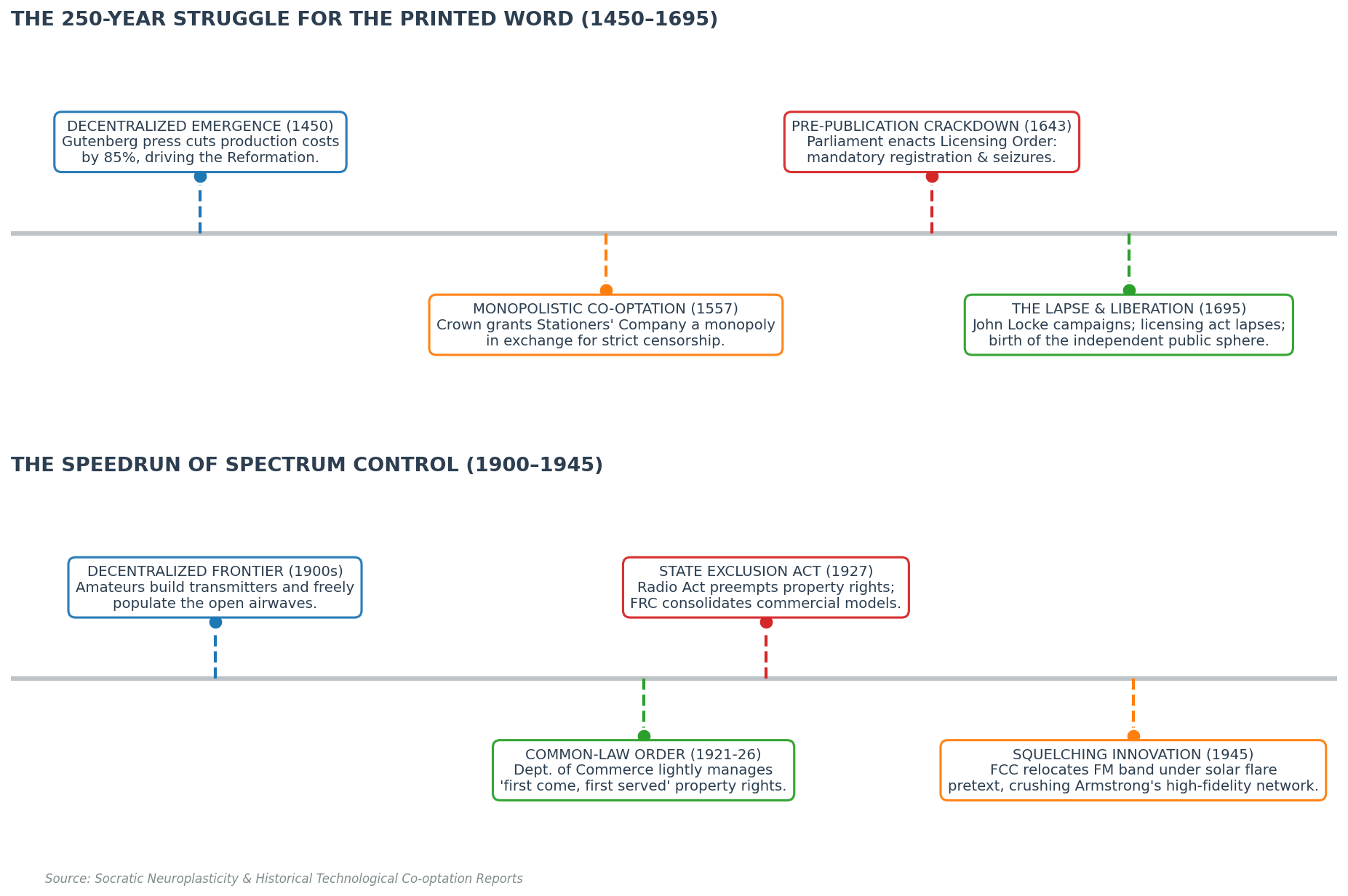
Read forward, this is an argument for practice rather than prophecy. The printing cycle ended in a lapse, not a victory — the licence simply was not renewed, after decades of argument by people who kept arguing. Nothing about the current interface generation is exempt from either half of that.
Watch · The biological rebellion
A short visual treatment of section 03's argument: what repetition does to a nervous system, and why that is the floor under any claim about self-direction.
09 · Concept register
The briefing's register, with the claim status made explicit and the two entries that named living or recent individuals as suppressors removed.
| Concept | Source | Reading | Status |
|---|---|---|---|
| Neuroplasticity | Experimental neuroscience | Repeated attention and practice reorganise the substrate; what a person does is building something physical. | Established |
| Strange loop | Hofstadter, Gödel, Escher, Bach | Self-reference in sufficiently rich formal systems; a map of selfhood that fits startlingly well. | Map, not mechanism (working claim) |
| Calculation vs. structure | This essay, section 01 | Curricula that reward fast output train non-resistance; curricula that reward pattern train tolerance for difficulty. | Working claim |
| Learned helplessness | Seligman and successors | A trainable expectation of no control. Applied to technology discourse it is a message, not a diagnosis of any individual. | Established mechanism, inferred application |
| Co-optation cycle | Print and spectrum history | Decentralised medium, commercial consolidation, statutory licence, contested reopening. | Established record, working-claim pattern |
| Socratic method | Classical practice | Questions that make an interlocutor's own assumptions do the work; friction applied on purpose. | Established practice, no proprietary claim |
The long-form briefing, with the slide deck's own framing, is available as a PDF: The Architecture of Agency (PDF). It is a source document rather than a statement of this page's position; where the two differ, this page is the corrected version.
A second, longer dossier on the same record — print, spectrum, and the digital frontier, with the sourcing checked and the strongest sentences trimmed — is kept separately as The Architecture of Cognitive Liberty.
Falsifiers
- If a general-purpose communications medium can be shown to have stayed decentralised for a century or more without licence or monopoly capture, the co-optation pattern in section 08 is anecdote rather than pattern.
- If a formal argument shows that self-reference of the Gödelian kind is not merely analogous to but constitutive of conscious states, the “map, not mechanism” objection to Hofstadter must be withdrawn.
- If experience-dependent plasticity in adults is shown to be negligible relative to fixed developmental structure, section 03 collapses and the agency argument loses its floor.
- If populations with high measured self-direction show no better resistance to manipulation than matched controls, the “practice, not petition” claim is empty.
- If mathematics curricula emphasising structure over calculation produce no difference in downstream reasoning transfer, section 01 is a preference and not a finding.
Return to the essay index — or continue to Beginnings to Conclusions.