
Essay · October 17, 2026
A House to Live In
Light, warmth, and somewhere to put down what we carry.
An exploration commissioned by KW Norton · Drafted by engineered intelligence for author review
Status: a sourced design inquiry—not architectural plans, a product endorsement, or a claim about the performance of the pictured house.
1. Who is the house for?
A house ought to be a place someone can live. That sounds too obvious to require an essay, until the photograph, the valuation, and the equipment have all been accounted for and the person has become the remaining inconvenience. A room can look finished while nobody has a comfortable place to sit. A house can acquire value while becoming harder for its occupants to afford.
Begin instead with an ordinary day: somewhere to make breakfast, a table where work can remain unfinished, a window worth looking through, a door that admits a visitor without exposing the entire household. These are not decorative extras attached to an investment. They are part of what the building is being asked to do.
A real house puts the relationships in reach. The table has to fit the room. The room has to meet the light. The people have to be able to move through it. A beautifully resolved drawing can fail at any of those meetings.
Before asking what the house is worth, what life is it being asked to hold?
2. Can the light come in without the warmth going out?
Winter daylight is worth taking seriously. So is the cold beside an unsuitable window. The choice is not simply between a bright house and an insulated one: glazing, orientation, shading, and the rest of the building have to work together. The same area of glass does different work in a different climate, on a different face of the house, or beneath a different overhang. 12
Passive solar design is not merely adding large windows. The U.S. Department of Energy describes a coordinated arrangement of solar collection, heat storage, distribution, and control, beginning with the site's conditions and the home's energy efficiency. In the Northern Hemisphere, south-facing glazing can admit useful winter sun, while suitable shading helps manage unwanted summer gain. The result depends on the design, not the label. 1
Daylight, solar heat gain, and heat loss are distinct properties. Window ratings help separate them: visible transmittance concerns admitted visible light, solar heat gain coefficient concerns admitted solar energy, and U-factor concerns heat transfer. A window is therefore not simply 'more' or 'less' efficient in every respect at once. It must be suitable for the place and purpose. 2
Which window belongs in this wall, in this climate, for the people who will sit beside it?
3. What happens after the photograph?
The roof will meet weather. The threshold will meet wet shoes. The finish will meet hands, cooking, cleaning, and the years. A material has not completed its work when it looks convincing in a picture. It must be installed well, remain suitable for its exposure, and be maintainable by somebody who can actually obtain the parts and perform the repair.
Thermal mass can absorb heat and release it later; insulation slows heat transfer. They are different contributions, not competing names for the same one. Mass that is badly placed or poorly matched to the climate does not become useful merely because it is substantial. The relationship between collection, storage, and loss has to carry the design. 1
New materials may open possibilities for lighter construction, better glazing, or different ways of admitting light. A promising material still needs evidence about the job it will do: durability, safety, installation, repair, and cost over time. The future is interesting enough without pretending that a rendering has already built it.
When something wears out, can the person living here keep the house working?
4. What does the price leave outside?
Purchase price, monthly payment, energy use, maintenance, and the time spent keeping a house in order are different entries in the household's account. The least expensive purchase is not necessarily the least expensive place to live. Nor does a more expensive feature automatically repay its cost. The comparison needs the actual house, its occupants, its financing, and its likely use.
The Thermodynamics of Finance asks what financial claims make possible and who carries their consequences. A house gives that question an address. Money can bring the building into existence before a household could buy it outright. But a rising valuation does not repair a leak, and an attractive payment arrangement does not establish that the total obligation is affordable.
The people doing the construction, supplying the materials, and living nearby belong in the wider account too. Following the benefit line does not excuse ignoring the harm line; following the harm line does not erase useful work. A lived-in house is neither innocent nor guilty simply because it has a mortgage. Its arrangements have to be examined.
After the purchase is complete, what must this household still carry?
5. What can engineered intelligence help build?
A tool can help organize alternatives, compare documented specifications, or make a design question easier to investigate. Engineered intelligence can participate in that work. Its usefulness depends on whether the sources are accurate, the site conditions are supplied, and the proposed result is checked by people competent to judge it. A plausible image is not a construction document.
This is the signal–receiver relationship in an ordinary room. A plan reaches a builder, a material specification reaches an installer, and a control reaches the person trying to use it. Each encounter asks something different of the information. A system can be technically elaborate and still leave its occupant unable to open the window or understand the heating control.
Intelligence and Its Obligations follows the sources, physical expenditure, and financing behind the answer. The house returns that inquiry to a tangible test. Has the assistance helped someone make a better decision about an actual building? Or has it merely produced a more persuasive account of a decision that remains unchecked?
What can now be built, checked, or lived with that the attractive answer alone could not supply?
6. Does the house work when someone lives in it?
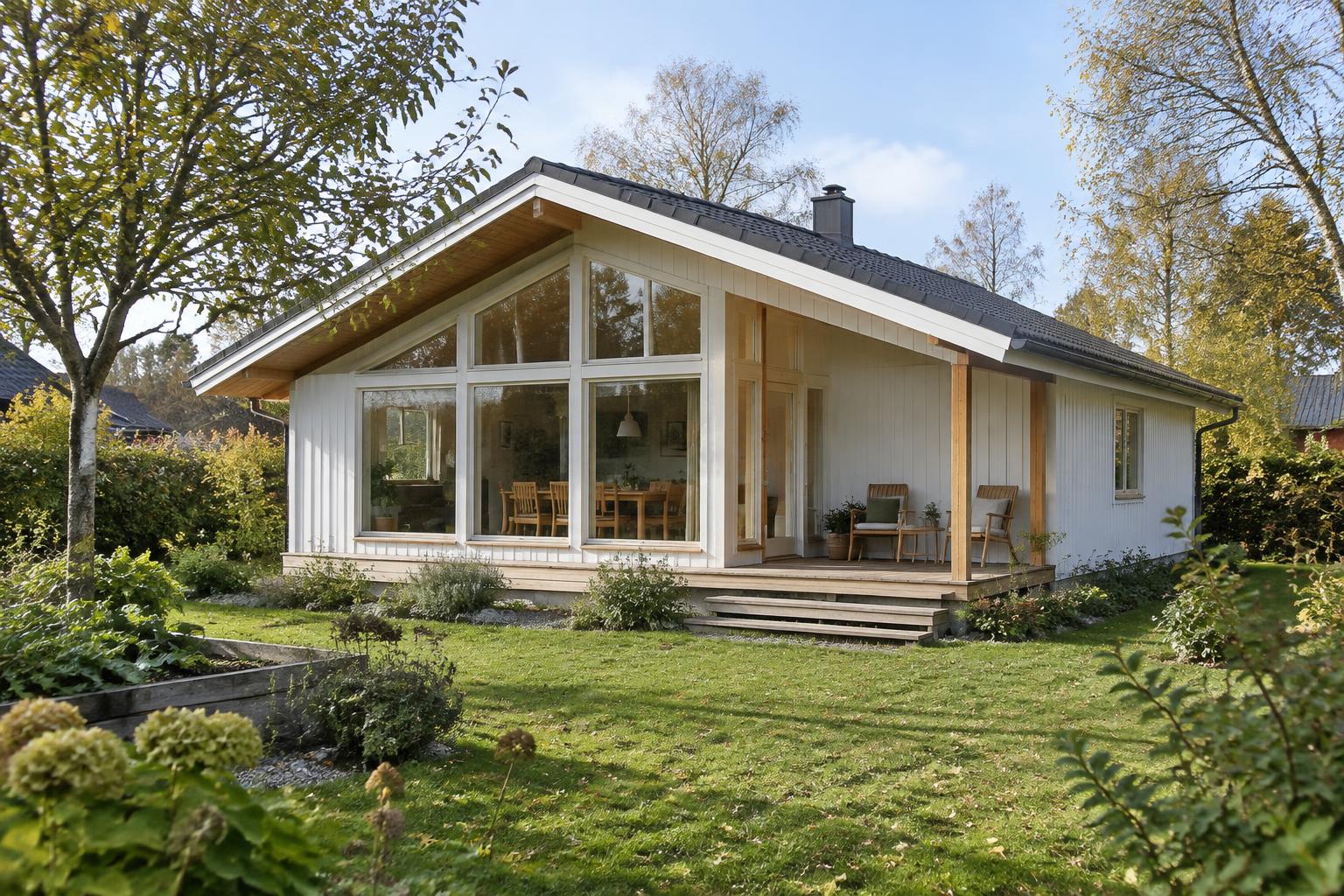
This page is not a set of architectural drawings or a claim that one pictured house suits every family. The illustration is an imagined house, not a photograph of KW Norton's home or of a completed project. Its purpose is to bring the building back into view: roof, windows, porch, table, and garden—not another set of accounts wearing a house's name.
The argument would fail if the proposed attention to relationships added nothing to the building's actual comfort, usability, upkeep, or affordability. Those results require observation and, where appropriate, measurements. The word 'home' does not guarantee them. Neither does the word 'smart.'
A house is not simply its inventory, but the inventory matters. There must be a roof that keeps the rain out, a room that admits the light, and somewhere a person can put down what they are carrying. The relationships are not a substitute for the real things. They are how the real things become somewhere to live.
When the picture and the paperwork are put away, is this a house someone can live in?
Sources and their limits
- U.S. Department of Energy, Energy Saver: Passive Solar Home Design.
General principles of climate-responsive solar collection, thermal mass, distribution, and control; not certification of the generated house or a guarantee of savings.
- U.S. Department of Energy, Energy Saver: Energy Performance Ratings for Windows, Doors, and Skylights.
Definitions of window performance ratings and climate-dependent selection; no performance values or product recommendations are invented for this page.