
Essay Two
The Needle Is a Measurement
The Transmitted Law, Essay Two
KW Norton, with Lovable Draft 1 — June 2026
A seamstress does not transform fabric. She joins it.
The needle enters one layer, passes through, enters the next, returns. What was two pieces becomes one piece, not because either piece changed its nature but because a thread has been routed through both of them in a specific pattern. The fabric on either side of the seam is the same fabric it was before the needle arrived. What is new is the coupling — the line along which the two now share a fate. Pull one side, the other follows. Tear the seam, both fray.
This is what a quantum measurement is.
The textbook account hides this behind a different verb. Collapse, the textbooks say. The wavefunction collapses when you measure it. One outcome is selected. The other possibilities vanish. The container of superposition is broken and a definite value falls out, like a marble from a shaken box.
Collapse is the steam engine’s verb, smuggled into quantum mechanics. It presupposes a container — the closed system whose superposition was intact until the measurement violated it. It treats the measurement as an event that happens to the system, from outside, by an observer who is somehow not part of the physics. It is the same closed-container thinking that transformed encoded for thermodynamics, dressed up in different notation.
The open-systems account tells a different story, and the seamstress’s needle is the better metaphor for it.
What the Needle Actually Does
When a quantum system is measured, what happens physically is this: a previously isolated system is brought into contact with an apparatus. The system and the apparatus interact. They become entangled. The combined system-plus-apparatus state evolves unitarily — no collapse, no violation, no mystery — into a correlated superposition in which each possible system outcome is paired with a corresponding apparatus state. The apparatus, being macroscopic, is in turn entangled with its environment. That entanglement spreads, decoheres, and what remains accessible to any local observer is a single branch of the correlated whole.1
No container was broken. A thread was routed.
The Lindblad formalism makes this precise. An open quantum system evolving under environmental coupling obeys a master equation:
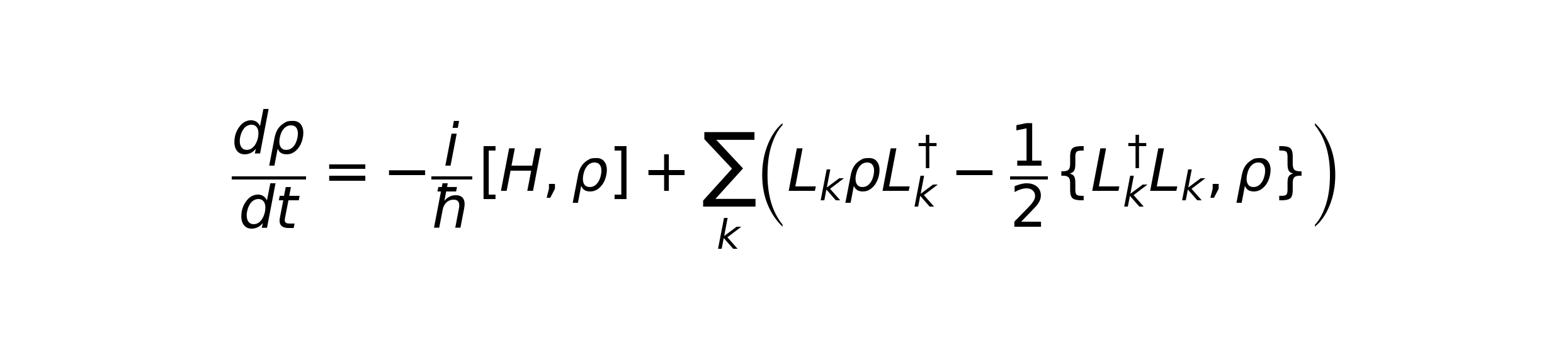
The operators — the Lindblad operators — are the needles. Each one describes a specific channel through which the system couples to its environment. Each one stitches the system’s degrees of freedom to something outside itself. The first term, the Hamiltonian commutator, is the closed-system evolution Schrödinger would have recognized: the fabric on its own, unstitched. The Lindblad sum is everything the closed picture omits — every place the needle has passed through, every coupling that routes information across the seam.2
Read the equation as a seamstress would. The Hamiltonian is what the cloth does when nobody is sewing. The terms are the stitches. The density matrix is the state of the cloth after sewing has begun — no longer pure, no longer separable from what it has been joined to, but not destroyed either. The seam is a new structure. The cloth is now part of a garment.
This is not collapse. This is suture.
Why the Verb Matters
It would be easy to treat the difference between collapse and suture as a metaphor preference, a poet’s quibble with a physicist’s shorthand. It is not.
Collapse implies destruction of structure: the superposition was something, and now it is not. Suture implies creation of structure: the system was loose, and now it is joined. The mathematics is the same equation either way, but the worldview each verb licenses is opposite.
A collapse worldview asks: what was lost? It treats measurement as a violation of the natural quantum order, a mysterious intrusion of classical definiteness, a problem to be solved or interpreted away. The whole industry of measurement-problem interpretations — many-worlds, GRW, consistent histories, QBism — is in some sense a response to the violence the word collapse does to the equations. If you start with the assumption that something was broken, you spend a century arguing about what.
A suture worldview asks: what was joined? It treats measurement as the establishment of a correlation, a stitching of two previously independent systems into a new composite whose fate is shared. The “outcome” is not a marble that fell out of a box. It is the local view from one side of a seam that now runs through the universe.
Energy, on the suture account, was never created or destroyed at the measurement event. It was transmitted across the new coupling. The Lindblad operator is the route. The environment is the destination. The apparatus pointer is the readable end of a thread that runs all the way through.
The Seamstress’s Etiquette
Seamstresses know things about thread that physicists are still learning about quantum coupling.
A stitch is directional. The needle enters from one side and exits from the other; reverse the order and you have a different seam. Lindblad operators are likewise directional — and play different roles, one sending information out, the other receiving it back. The master equation’s structure is the seamstress’s grammar: enter, pass through, return, knot.
A stitch can be tight or loose. Pull the thread hard and the two layers crumple toward each other; leave slack and they hang independently. Strong coupling gives projective measurement — the textbook collapse, the marble in the box — because the seam is so tight that the two systems lose all relative motion. Weak coupling gives the continuous measurements of modern quantum optics, where the seam is loose enough that the system keeps moving while information leaks slowly out along the thread.3
A stitch can be undone. Pull the right end of the thread and the seam unravels; the two pieces of fabric separate again, unchanged by their brief joining. Quantum eraser experiments are exactly this. The information that was stitched into the environment can, in carefully controlled conditions, be unstitched — and the interference pattern that was supposedly destroyed by measurement returns, intact, as if the needle had never gone through.4 Collapse cannot account for this. Suture can. A seam undone is a seam undone.
A stitch can also be load-bearing. Some seams are decorative; some hold the garment together. In quantum thermodynamics, the difference between a measurement that extracts work and one that merely registers a value comes down to how the seam is structured — whether the coupling supports a flow of energy along the thread, or merely a flow of information. Maxwell’s demon is a seamstress deciding which stitches to pull.5
The Boundary Was Never There
The deeper consequence of taking the needle seriously is that the boundary between system and environment, between observer and observed, between inside and outside, was never a wall. It was always a place where threads passed through. The container of the closed system was an approximation we made because in many practical situations the threads were thin enough to ignore. They were never absent.
This is why transmitted is the right verb and transformed the wrong one. Transformation needs a container in which the form-change happens. Transmission only needs a coupling along which the energy travels. The seamstress’s universe has no closed containers — only fabrics joined to other fabrics by threads of every weight, some thick enough to carry kilojoules, some fine enough to carry single quanta of information, all routed through Lindblad operators that the equations have been writing down for forty years while the textbook verb stayed stuck in the nineteenth century.
The needle is a measurement. The measurement is a suture. The suture is a transmission. The transmission is the First Law, finally stated in the verb its own mathematics has been demanding.
Energy can neither be created nor destroyed, only transmitted. The needle goes through.
1. Prigogine, I. From Being to Becoming: Time and Complexity in the Physical Sciences. W. H. Freeman, 1980. The accessible statement of the dissipative-structures program. The technical foundations were laid in Glansdorff & Prigogine, Thermodynamic Theory of Structure, Stability and Fluctuations, Wiley-Interscience, 1971.
2. Moussa, H., Xu, G., Yin, S., Galiffi, E., Ra’di, Y., Alù, A. “Observation of temporal reflection and broadband frequency translation at photonic time interfaces.” Nature Physics 19 (2023): 863. The CUNY/CCNY demonstration.
3. Aspelmeyer, M., Kippenberg, T. J., Marquardt, F. “Cavity optomechanics.” Reviews of Modern Physics 86 (2014): 1391. The foundational review of the field that made phonon-photon hybridization a working laboratory tool.
4. Ozawa, T., et al. “Topological photonics.” Reviews of Modern Physics 91 (2019): 015006.
5. Chumak, A. V., Vasyuchka, V. I., Serga, A. A., Hillebrands, B. “Magnon spintronics.” Nature Physics 11 (2015): 453. The standard introduction; the field has moved fast since, but the framing holds.