
(01) What could frame thy fearful symmetry?
Fortunately for us, and for this book, and for the beautiful symmetry of the tiger, the beautiful symmetry of the science is at hand.
The two standing rules of this volume
- The only disorder in science is the disorder of a disordered mind.
- Energy is incoming information to be transformed by both the sender and the receiver.
We dedicate this exploration of science to the energetic process of life we can see in our tiger, as we descend into the newest stage of the industrialization of science. As that industrialization seeks to flatten our beautiful symmetry into consumer products, we take science back as our own journey into knowledge.
Ask and it will be given; seek and you will find.
(02) Trout fishing in America
Where else would a book about modern science begin but on the banks of a trout stream? We stand in a high mountain valley, a cathedral formed of granite walls and sheets and cascades of free-falling water, with trout darting and flying in the crystalline water.
A symphony of life celebrated on the greening banks of the stream, our lines cast from the arc of the rod into the turbulent symmetry of the living stream.
(03) Turbulent symmetry
How can symmetry be turbulent, we ponder, our minds stumbling on the paradox. It requires some imaginative mental gymnastics to arrive at the underlying truth — and this kind of mental gymnastics is precisely what we are going to do throughout this book.
As a writer and theorist I have written plenty of hard science, only to recognize that the true gift of hard science is to see it transformed by the human mind into meaning. The most rigorously adept scientists have sought the foundational meaning, beating away at the heart of their theories — and we are going to do the same, using rigorous science to get there.
We gaze into the crystalline depths of the trout stream, seeking to land a trout for our lunch, seeing more deeply as the turbulence reveals a living, breathing, ever-changing symmetry.
As we observe free-living water cascading and tumbling over the granite, we feel grounded, peaceful — entrained by the soft rhythm of the stream and by the ionic scent of sun-warmed granite. The turbulence reveals a pattern. Here a whirlpool, a smooth torsional downward spiral into the depths. There an upwelling, a torsional upward spiral bubbling smoothly to the surface. What first appeared as a chaotic, incomprehensible torrent has revealed a pattern. (See Figure 1.2 — the torsional boundary layer, where the two rotations meet.)
We notice also that the trout are a pattern corresponding to the pattern of the stream. We begin to see the trout, the stream, the granite, the insects and the grass, and ourselves as different manifestations of the same thing.
Paradox or truth, we reflect; both cannot be true. We cannot be different and the same at one time — and yet our feeling of deep peace, of entrainment, tells us differently. Do we trust our feelings and our experiences, or what we have been taught is true and rational?
We imagine there might be a different level of truth and rationality — that maybe our perceptions are more aligned with truth and rationality than we were led to believe.
As the trout leaps writhing in colorful rainbows, caught on our line, the bow snaps back with a torsional snap. For a moment, a beat etched in time, trout, line, bow, ourself, granite, water, stream and mountain cathedral are one thing. A beat later and everything snaps back into separate, distinct, but interconnected parts.
(04) Symmetrical science of the trout stream
After seeing through to the patterns revealed by the trout stream, we begin to perceive that there might be more to the story than meets the eye. Our mind begins to bend and arc around the idea that there are imperceptible patterns and meanings just beyond our everyday existence.
The tumultuous stream of disorder begins to break down into a relentless pattern of harmony and order. In the almost frictionless smoothness of the tumbling water we see the downward-sucking vortices and the upward bulging swirls as part of a single process. Where we had imagined disorder there is order. (See Figure 1.3 — torn flow settling into a repeating lattice.)
Our imagination leaps from the trout stream to something far more distant — a vision of the universe that softly calls us to recognize a more difficult possible pattern. We see the whole universe as a slipstream, as if it were clear water, tumbling like the turbulent trout stream but just outside of our everyday awareness. (See Figure 1.1 — the cosmic slipstream.)
Technical appendix · Figure 1.1
↑ Back to the passageThe cosmic slipstream
Before any local mechanism, the global picture. The page is one medium, not a set of separate objects: clean parallel flow enters from the left, and as it crosses the frame the lines begin to warp, ripple, and curve. Nothing is added to produce the disturbance and nothing is removed. Disorder here is a change of shape inside a single continuous substrate — which is the whole reason the book keeps returning to moving water for its examples.
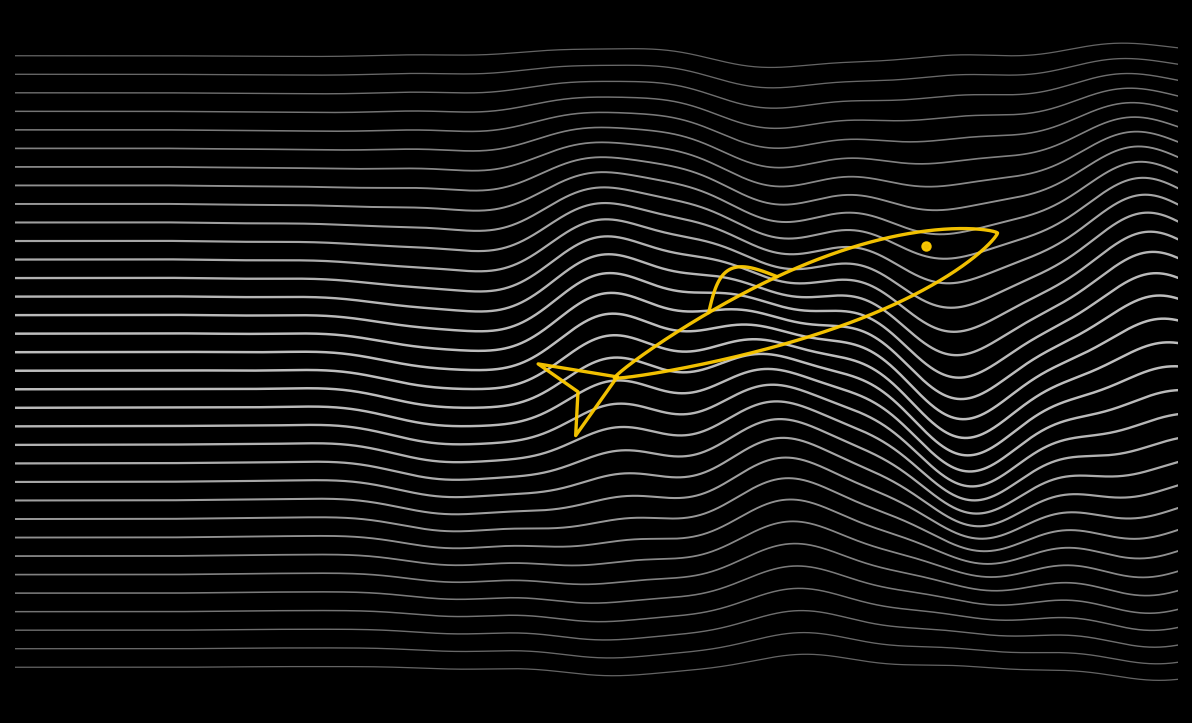
scripts/render_cosmic_slipstream.py.The trout is placed deliberately across the warped region rather than beside it. It is one continuous outline, drawn in the same weight as the streamlines, so that the organism reads as a feature of the flow instead of a visitor to it. The figure makes no claim about biology; it sets the reading habit the next two figures depend on.
Technical appendix · Figure 1.2
↑ Back to the passageThe torsional boundary layer
The figure renders the local mechanics of the passage above: one continuous fluid substrate in which a downward compression well and an upward-surging plume sit side by side. On the left, the cyan node marks the sink — streamlines tighten and spiral inward, standing in this book for compression, density, and the packing of energy into mass. On the right, the magenta node marks the upwelling pillar, pushing outward and back toward the surface. Along the dashed gold centreline the two opposing rotations scrape against one another, and the streamlines flatten and tear into the shear layer where turbulence is worked into new structure.
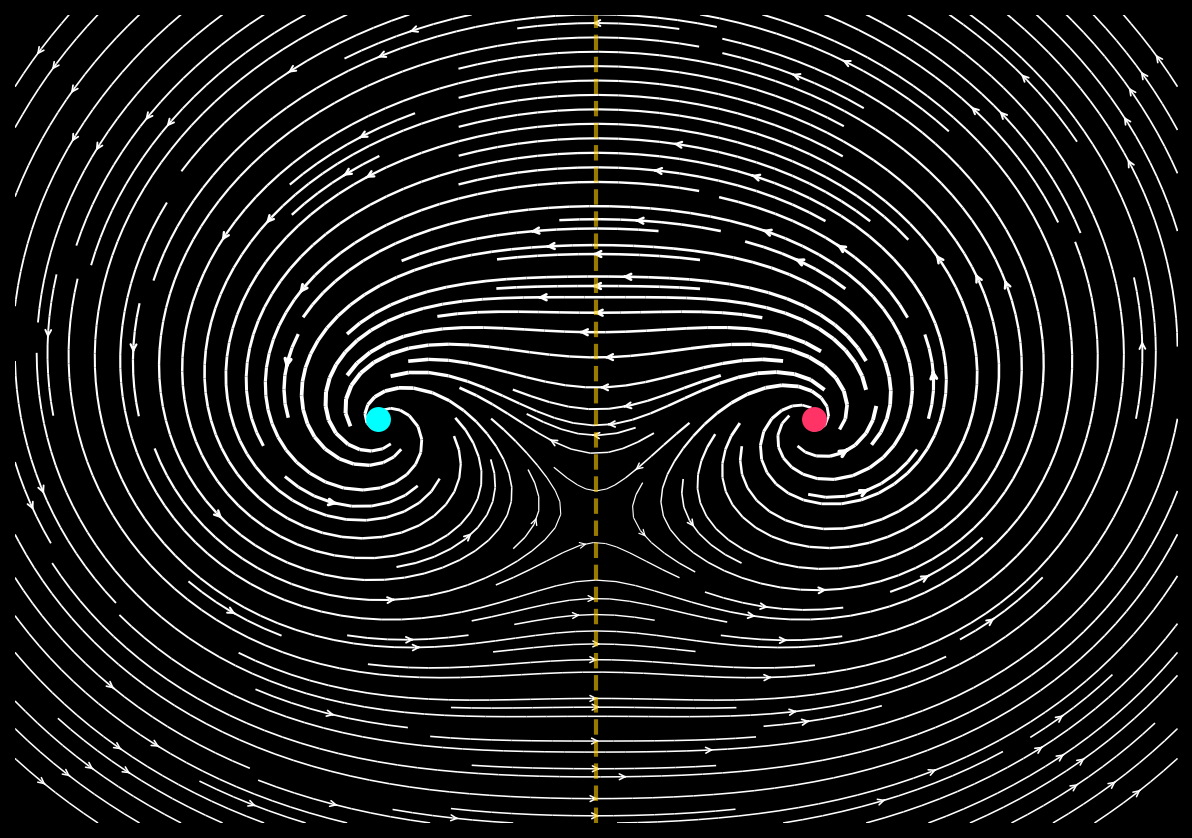
scripts/render_torsional_boundary_layer.py.- The compression well — cyan core, x = −1.5
- A radial sink with a clockwise rotational term added. Streamlines are drawn tight and wound inward, which is how the plot represents rising energy density: not a hole in the medium, but the medium packed.
- The pressure plume — magenta core, x = +1.5
- A radial source with a counter-clockwise term, pushing flow smoothly outward and back toward the surface layer. Same magnitudes as the sink, opposite sign — the two nodes are one arrangement read twice.
- The shearing interface — gold centreline, x = 0
- Where the opposing trajectories scrape past one another, a Kelvin–Helmholtz boundary appears: the lines flatten and ripple. This is the point the chapter reads as knotted structure loosening into unstable packets before it reorganises further downstream.
- The whole stream — global view
- Read at a distance, the plot is a single slipstream: parallel flow that warps rather than breaks. Disorder is a change of shape inside one medium, not a set of separate colliding pieces.
- The boundary — local view
- The centreline is where the chapter's paradox lives. Two rotations that appear opposed are dual expressions of one field transforming itself in real time.
- What comes after the shear
- Downstream of the shear zone the torn flow cools and organizes. Chapter Four picks the sequence up there, where fluid motion locks into the repeating lattice geometry of living matter.
Technical appendix · Figure 1.3
↑ Back to the passageThe crystalline standing wave
The third figure answers the question the second one leaves open: what happens to torn flow once it leaves the shear zone. At the base of the frame the lines are still shredded — short, chaotic, going nowhere together. Moving upward, away from the immediate shearing forces, the same lines cool and organise, and the jitter drains out of them until they lock into a repeating diamond grid. The lattice is drawn as a grid rather than a solid because the phase it represents sits between liquid and crystal: ordered, but still flexible.
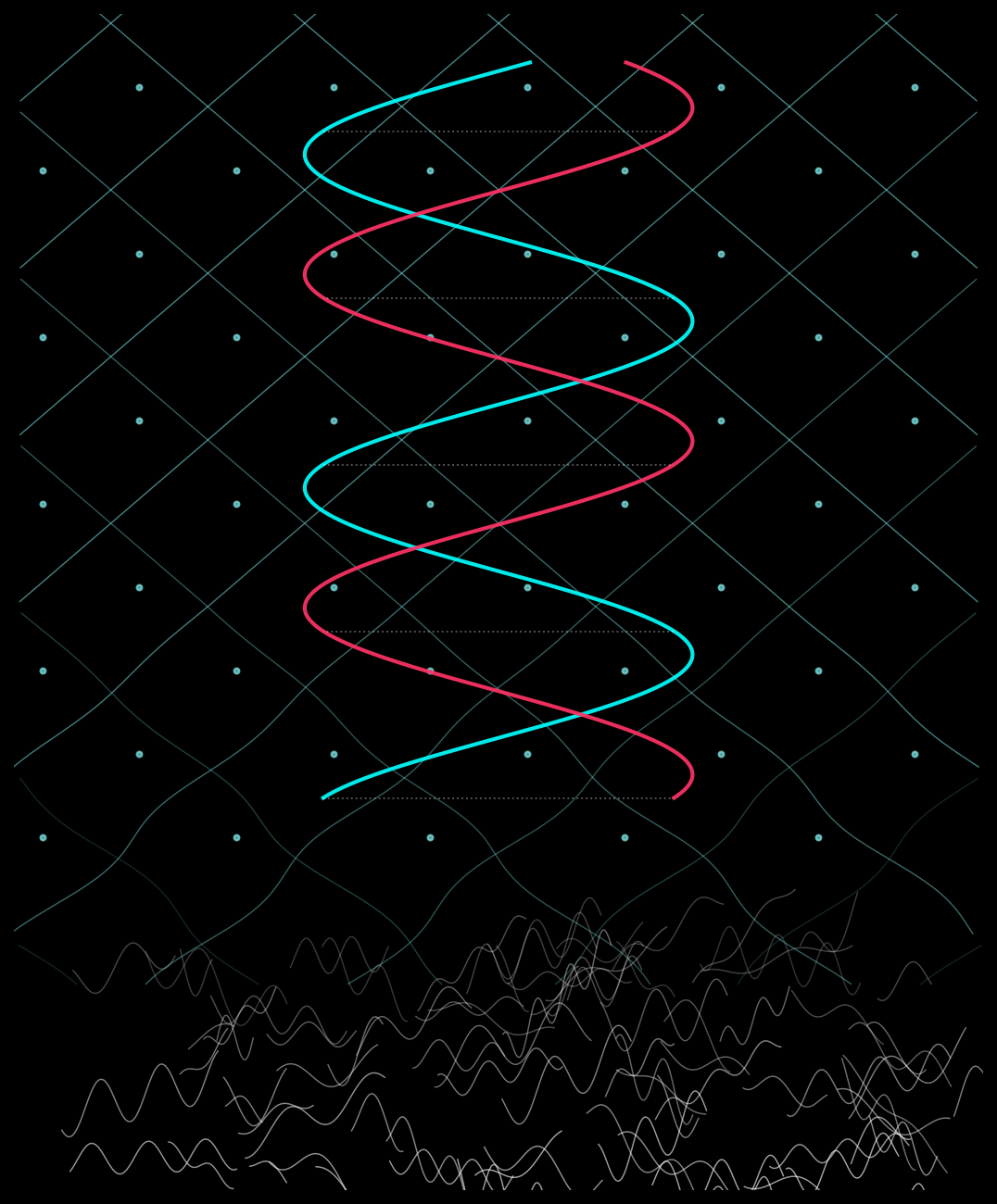
scripts/render_crystalline_standing_wave.py.- The transition — lower band
- The fragments here are the same lines that tore apart along the gold centreline of Figure 1.2. They are not new material; they are the earlier flow, taken one step downstream.
- The lattice — middle and upper field
- A symmetrical repeating grid, with its cell vertices marked. The jitter in each line fades with height, which is the figure's way of showing order arriving gradually rather than being imposed.
- The resolution — helix overlay
- The double helix is drawn to the lattice, not over it: its amplitude spans two lattice columns and each turn closes across four rows, so the strands meet the grid at its own vertices. Chapter Four returns to that geometry in detail.