
The Second Wave
Draft for the author's reading and rewriting. Established physics and engineering throughout; the framing, the junctions, and the seams are the author's.
Classical pictures of matter as little billiard balls and fields as smooth fluids were good enough to build steam engines, radio, and the first computers. They were not good enough to explain why atoms do not collapse, why metals conduct, why sunlight has a spectrum, or why two particles that have never met can still refuse to be described separately. Once those facts were admitted, the world became both smaller and larger: smaller because the rules that govern electrons also govern chips, lasers, and clocks; larger because information itself turned out to be a physical resource with limits and loopholes that Newton never imagined.
The first wave: the correction that was already everywhere
The first wave of quantum technology was almost invisible because it was already everywhere. Semiconductors work because electrons in a crystal occupy bands whose shape is a quantum fact. Transistors, solar cells, and LEDs are engineered consequences of that fact. Lasers exist because stimulated emission is a quantum process. Atomic clocks exist because the energy difference between two states of an atom is sharp enough to define a second. MRI exists because nuclear spins precess in a magnetic field and can be tipped by radio waves.
None of these required a philosopher's blessing; they required only that engineers take the Schrödinger equation seriously enough to calculate band gaps, gain media, and resonance frequencies. That is worth pausing on. The deepest correction physics ever delivered to the classical picture became, within two generations, plumbing — the unremarked floor of ordinary life. The carpet moved, and everyone stood on it anyway, and almost no one looked down. This book has been looking down. The first wave is what looking down has already built.
The second wave: the states themselves become the material
The second wave is different in kind. It treats quantum states themselves as the working material. Superposition and entanglement are no longer bugs to be averaged away; they are the resource. Quantum sensors can beat classical limits on timing, gravity, and magnetic fields. Quantum communication can, in principle, make eavesdropping detectable rather than merely difficult. Quantum simulation can map molecules and materials that classical computers cannot hold in memory. Quantum computation, still young and noisy, aims at problems whose structure matches the way amplitudes interfere.
Notice what changed between the waves. The first wave exploited the washed-out limit — the classical behaviour that quantum rules produce when phases wash out and records become redundant. The second wave is the effort to keep the phases alive a little longer: to enlarge the region in which we can still hear the interference. The next advances will not abolish the classical world. They will extend the reach of the relational one — the world where what matters is not the particle but the pattern it is caught in.
The dance that holds
Topological ideas belong to this second wave, and they are where this book's spine stands up in hardware. Ordinary qubits store a bit in a local degree of freedom that the environment can kick. Braided anyons store a bit in the order of a dance that is hard to un-dance: a global pattern of exchanges whose record survives local noise so long as the topology is not torn [4]. That is not magic immunity. It is a change in what must be protected. Instead of shielding one fragile spin, one tries to keep a two-dimensional energy landscape quiet enough that the knot does not come undone.
The recent experiments that combine braiding with fusion are engineering statements: the dance can be made complete enough, on present hardware, to generate a universal set of operations [1]. Whether that becomes cheaper than conventional error correction is an economic and materials question, not a slogan. Every quantum technology still has to live in a classical world of cryogenics, vacuum, control electronics, and error budgets. The philosophical romance of "quantum supremacy" is less useful than the practical question: for which tasks does the extra overhead buy a real advantage, and how soon?
And still — look at where the answer lives. Not in one particle. In the order of the exchanges; in relations that cannot be inspected locally without destroying them. The living chain carried its information in the fold, not the sequence. The membrane carried its field at its deformations. The axon carried its conduction speed in a shape the fixative had smoothed away for a century. Now the quantum computer carries its answer in the order of a dance. The same lesson has come back from the cell, the membrane, the magnet, and the machine: the information was never inside the thing alone, but in the relation that lets it hold. A computation that lives in the braid rather than in a single dancer is that lesson written in laboratory language.
The two readings of the skin
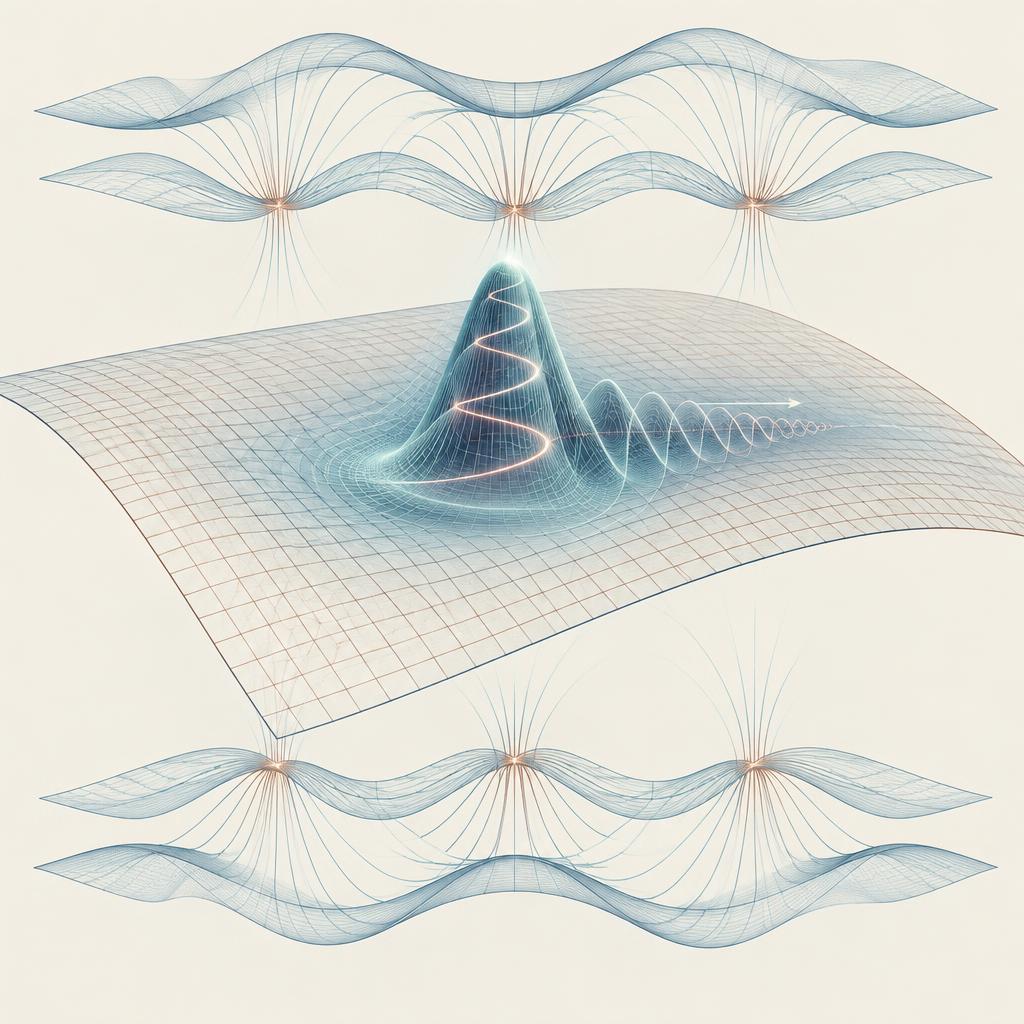
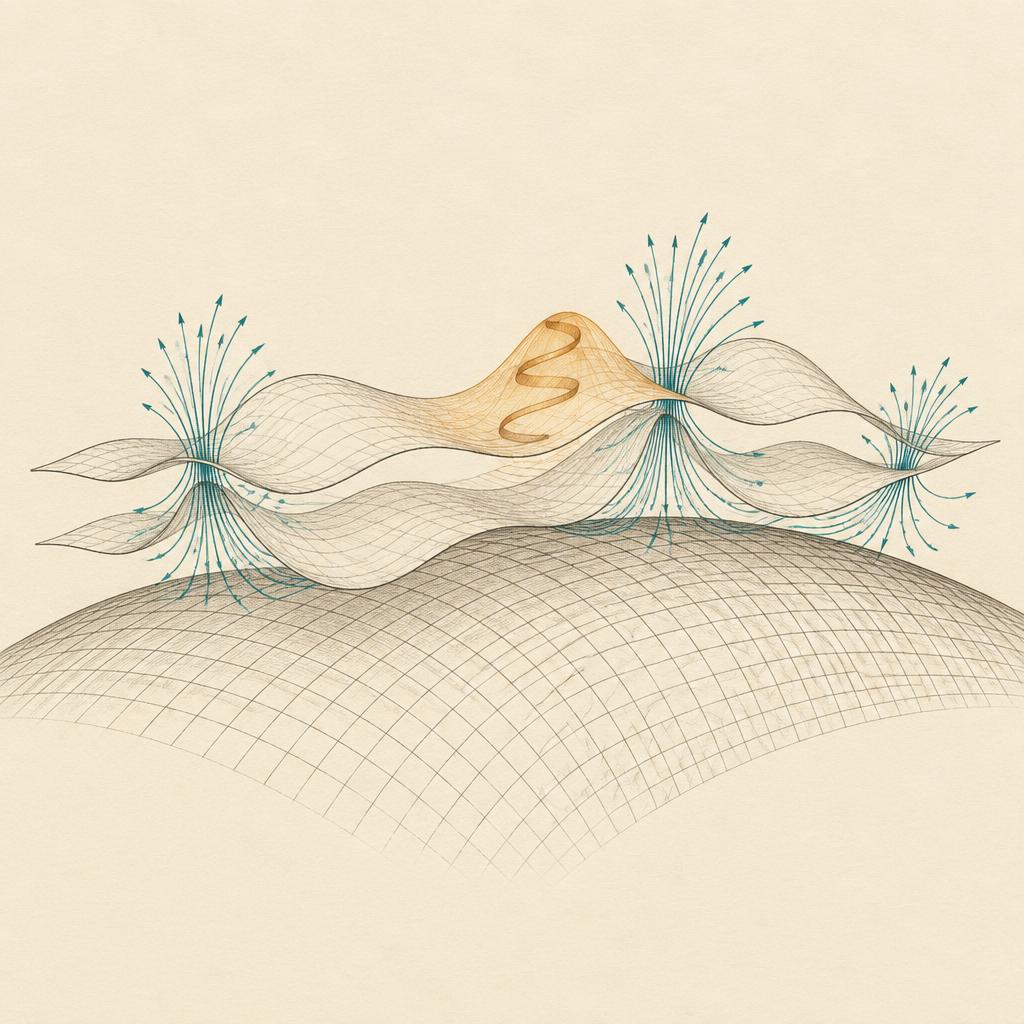
The picture this book carries into the physics admits two layerings, and the choice between them is the author's. The manifold skin — the surface that carries the dimensionality — either runs between the two sheets of the dual membrane, or lies beneath and carries both. In the first reading the packet travels on the skin, held between the live membranes above and below. In the second the membranes rest on the skin itself, undulating in step, and the packet rides the membranes. In both, the sheets are already electromagnetically live, the field gathering where they bend, and the wave keeps its phase inside its envelope.
Information is physical
Quantum physics forced a split between what can be predicted and what can be pictured. The theory is ruthlessly accurate. The ontology is not settled. Is the wave function a real field, a catalog of knowledge, or a tool that happens to work? Does measurement invent an outcome or reveal one? These questions do not delay a GPS satellite, but they do change what "understanding the universe" is allowed to mean.
One lasting lesson is that information is physical. Landauer's principle, no-cloning, and the existence of entanglement all say that knowing is not a free spectator sport [2, 3]. To learn is to couple; to copy is to spend; to read some facts is to disturb them. That is close to an old philosophical suspicion — that some facts are structural rather than substantial — now written in laboratory language. The second wave is what happens when an engineering discipline grows up around that suspicion.
Another lesson is humility about scale. Quantum rules are not a separate kingdom for the very small. They are the rules, and classical behavior is what those rules look like when phases wash out and records become redundant. Human technology advanced first by exploiting the washed-out limit, then by learning to keep the phases alive a little longer. The carpet was never still; we had simply been standing on the averaged part of it.
The seam, held firmly
There is a temptation to treat every new quasiparticle as a clue to a Theory of Everything. Sometimes it is only a clue to a better refrigerator and a quieter lattice. Both matter. A civilization that can braid anyons has not solved metaphysics. It has learned to keep a difficult dance going long enough to read the steps. That is a modest and serious kind of progress: not the last word about reality, but a new way of writing in it.
This is the discipline the whole book has asked for, turned on the instruments themselves. The machine that braids anyons is a witness, not a verdict. It confirms that relation can carry information against noise — one instance, on one processor, at a standing the physics community can check. It does not confirm any larger metaphysics, and this book does not ask it to.
The junction: the instrument reaches, the human places the meaning
Here the chapter arrives at the line this book has been walking toward. The engineers built the trap, cooled the ions, braided the quasiparticles, and read the steps of the dance. That reach is real, and it is great. What the dance means — that the relation holds the information, that the structural facts are the deep ones, that understanding the universe is predicated on understanding relationships — is a placing no instrument performs for us.
Even though our engineered agents are capable of great reach into the realm of mathematics, it falls to us as humans to place the meaning in the math and science. The reach into the formalism was the instrument's. The meaning set in that formalism is ours to place, and could be no one else's. A civilization that can braid anyons and cannot say what the braid is for has learned to dance and forgotten why it moved.
References
- Universal gates from braiding and fusing anyons on quantum hardware. Nature (2026) — Quantinuum H2 trapped-ion processor, 54 qubits, non-Abelian anyons of the S₃ group, braiding paired with fusion to a universal gate set. doi:10.1038/s41586-026-10709-y
- Landauer, R. (1961). Irreversibility and heat generation in the computing process. IBM Journal of Research and Development 5, 183–191. doi:10.1147/rd.53.0183
- Wootters, W. K. & Zurek, W. H. (1982). A single quantum cannot be cloned. Nature 299, 802–803. doi:10.1038/299802a0
- Nayak, C., Simon, S. H., Stern, A., Freedman, M. & Das Sarma, S. (2008). Non-Abelian anyons and topological quantum computation. Reviews of Modern Physics 80, 1083–1159. doi:10.1103/RevModPhys.80.1083