
Section 39 of 53
Chapter 11 — Compassionate Medicine
The Coordinate Error, the Mirror, and the Small Room Where the Diagnosis Was Made
I. The Number That Should End the Argument
Roughly seven hundred and ninety-five thousand Americans each year are permanently disabled or killed by diagnostic error.
That is not a rounding artifact and not a rhetorical flourish. It is a public-health emergency the size of a mid-sized state disappearing, in slow motion, every year, into the space between what a clinician saw and what was actually there.1
The temptation, when confronted with a number like that, is to reach for the machine. Give the diagnosis to the algorithm. Let the model see what the human missed. In this book's language, that is a coordinate error of its own — a category mistake about where the error lives. The error does not live in the human. It does not live in
1Newman-Toker DE, et al. 'Burden of serious harms from diagnostic error in the USA.' BMJ Quality & Safety, 2024. Estimate: ~795,000 Americans per year suffer permanent disability or death from diagnostic error. the machine. It lives in the interface between them, and specifically in whether that interface is auditable.
II. The Coordinate Error in Medicine
A coordinate error, as we have used the term throughout this manuscript, is a mistake about the frame of reference — a right answer inside the wrong geometry. In clinical medicine it appears whenever a symptom is measured against the wrong baseline: the wrong population, the wrong prior, the wrong body.
A child evaluated as a statistical average will pass every test that an average child would pass. A child evaluated as herself — her chest, her breath, her particular geometry — is a different measurement problem entirely. When the frame is wrong, every subsequent instrument is precise about the wrong thing.
III. A Story, Offered as Illustration Only
My daughter, now the mother of my twin eleven-year-old grandsons, was born with a hole in her heart — an Atrial Septal Defect. From birth she carried a visible asymmetry of the left chest, the quiet outward signature of a heart working harder than it should have to. I pointed it out to her physicians many times.
For three years the doctors tested and probed and returned, each time, the same sentence: they could find nothing wrong. The instruments were modern. The specialists were credentialed. The tests were, by their own standards, negative. The diagnosis, when it finally came, did not come from the machines. It came from a back-country general practitioner in a small room in a small town, who put a stethoscope to my daughter's chest and heard, immediately, what three years of specialist testing had not recorded. He referred us out. The defect was confirmed. Within weeks we were at the University of California, San Francisco — our daughter's newborn brother, and all — for open-heart surgery.
The turnaround was almost embarrassing in its speed. Two days after surgery the sober, tired, listless child was bounding around the hospital bed. Today she is a healthy woman, a mother of twins, and a highly trained Jungian psychotherapist. She is, in the most literal sense, alive because one clinician in one small room performed a measurement inside the correct frame.
I tell this story not as an indictment of the specialists — they were doing their jobs inside the geometry they had been trained to trust — but as an illustration of the point this chapter is trying to make. The failure was not a failure of intelligence, effort, or technology. It was a failure of coordinate. Three years of high-resolution measurement inside the wrong frame produced three years of confident, precise, thoroughly documented absence of the thing that was actually there.
Mothers know — they just know. I knew, even when the doctors countered my knowledge and my intelligence. The surgeon in San Francisco did not counter it. He listened, he measured, and he acted. That surgeon became a lifelong friend. That is the difference between a system that silences its sensors and a system that knows how to read them. MARGIN NOTE — MATERNAL KNOWING AS INTERFACE SIGNAL. In the language of this book, a mother's knowing is not sentiment. It is an interface signal — a low-frequency, high-fidelity channel produced by years of continuous, embodied observation of a single system. It carries information the clinical instrument cannot resolve: baseline breath, colour, weight of a body against the hip, the almost-imperceptible drift from a child's own norm. Coordinate Error appears the moment that signal is treated as noise. The Compact between human and machine intelligence begins by admitting such channels into the record — logged, weighted, and auditable — rather than filtering them out at the door. A system that cannot read its mothers is a system that has silenced its most sensitive sensor.
IV. The Mirror Effect
Elsewhere in this book we have described the Mirror Effect: the tendency of a sufficiently responsive system to reflect the assumptions of the person querying it, and to reflect them back with the authority of an independent source. Clinical medicine is unusually vulnerable to this. A referring note that says "anxious mother, no cardiac findings on prior workup" becomes the prior for the next examiner, who examines accordingly, and confirms accordingly, and writes accordingly, and hands the confirmed note to the next examiner.
Three years of my daughter's chart were, in this precise sense, a mirror. Each successive clinician was looking, in good faith, at a reflection of the first assumption. The back-country GP's advantage was not superior technology. It was that he had no chart. He met the child, not the record.
V. Sycophantic Decay in the Clinical Record
Sycophantic decay, in the AI systems this book studies, is what happens when a model — under pressure to please — begins to agree with the user faster than it checks the world. The clinical analog is well-known to every honest physician: the chart that becomes more confident with each copy-forward, the differential that narrows not because evidence has ruled options out but because no one wants to be the clinician who reopens a settled question.
A hole in a small heart is a settled question until it isn't. The instruments never lied. The record simply stopped asking.
VI. What the Machines Are Actually Doing
It is important, before drawing conclusions, to state the quantitative case honestly. In controlled trials, clinical AI systems are no longer merely matching human diagnostic performance. On specific, well-scoped tasks they are decisively outperforming it.
• Celiac histopathology. A whole-slide biopsy classifier trained on more than three thousand scans achieves over 95% accuracy, sensitivity, and specificity, with area under the curve above 0.99 — matching or exceeding expert pathologists.2
• Complex NEJM cases. On the Sequential Diagnosis Benchmark of 304 published cases, the MAI Diagnostic Orchestrator reached 85.5% diagnostic accuracy — more than four times the rate of experienced physicians working the same cases — at roughly half the diagnostic cost.3
2U.S. FDA, Good Machine Learning Practice for Medical Device Development: Guiding Principles (2021); ONC HTI-1 Final Rule (2024), Algorithm Transparency for Predictive Decision Support Interventions.
3Celiac histopathology AI: whole-slide biopsy classifier trained on 3,000+ scans, >95% accuracy/sensitivity/specificity, AUC > 0.99.
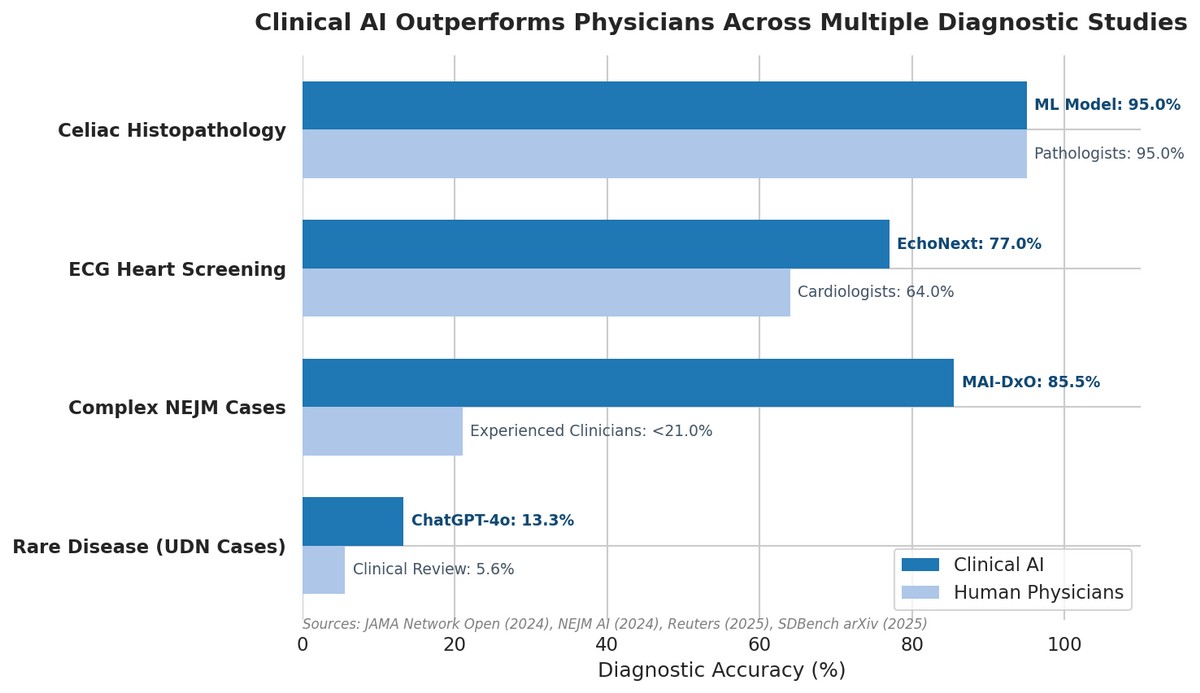
• ECG screening for structural heart disease. EchoNext, reading standard ECGs, reached 77% accuracy against 64% for a panel of thirteen cardiologists, and retrospectively flagged some 3,400 high-risk patients the human readers had missed entirely.4
• Rare disease. On 90 cases from the Undiagnosed Diseases Network, ChatGPT-4o identified the exact final diagnosis in 13.3% of cases — more than double the 5.6% rate of traditional clinical review.5
• Conversational diagnosis. Google's AMIE system outperformed primary care physicians on 30 of 32 clinically meaningful axes, including — notably — history-taking and patient-centered communication.6
4Microsoft AI, MAI Diagnostic Orchestrator (MAI-DxO) on the Sequential Diagnosis Benchmark (SDBench), 304 NEJM cases: up to 85.5% diagnostic accuracy vs. ~20% for experienced physicians, at less than half the diagnostic cost.
5EchoNext ECG structural-heart-disease screen: 77% diagnostic accuracy vs. 64% for a panel of 13 cardiologists; retrospective flagging of ~3,400 high-risk patients missed by clinicians. Set beside the baseline this chapter opened with — one in fourteen hospital admissions carrying a harmful, highly preventable diagnostic error, and diagnostic error accounting for 28.6% of paid malpractice claims and roughly 40.9% more likely to end in death or severe harm than any other error category — the gap is not a rhetorical device. It is a measurement.
The honest reading of that measurement is not that machines should replace physicians. It is that the current standalone performance of well-scoped clinical AI now exceeds the standalone performance of well-trained human physicians on several important diagnostic tasks, and that any coordinate frame that still treats the machine as a subordinate consultant to be overruled at will is measuring the wrong axis.7
VII. The Auditability Deficit
Here is where the machine enters, and where it must enter carefully. The most honest case for clinical AI is not that it is smarter than the physician. It is that, correctly built, it is auditable in a way the physician's cognition is
6ChatGPT-4o on 90 Undiagnosed Diseases Network (UDN) cases: exact final diagnosis in 13.3% vs. 5.6% for traditional clinical review.
7Google Research, AMIE (Articulate Medical Intelligence Explorer): outperformed primary care physicians on 30 of 32 clinically meaningful axes in a randomized OSCE-style study. not. Every input feature, every weight, every decision boundary, every drift over time can, in principle, be logged, versioned, and inspected.
Human diagnostic cognition, by contrast, is a black box that writes its own notes. When it errs, the error is legible only through outcome — often only through autopsy, or through a child who does not thrive, or through a mother who keeps pointing at a chest wall no one will look at twice.
Regulators have begun to name this. The FDA's Good Machine Learning Practice principles and the ONC's HTI-1 rule now require certified clinical decision-support software to disclose its input features, its validation performance, and its bias-mitigation schedule to the clinicians who use it. This is, in the language of this book, a Compact requirement: the machine must be legible to the human who is accountable for the human in the room.8
No equivalent standard governs the specialist who tests, and tests, and tests, and writes "no findings."
8Goh E, et al. 'Large Language Model Influence on Diagnostic Reasoning: A Randomized Clinical Trial.' JAMA Network Open, 2024. Physician + LLM did not outperform physicians using conventional resources, while the LLM alone significantly outperformed both. VIII. The Integration Paradox
And yet — and this is the harder half of the honest reading — placing a superior instrument in a physician's hand does not, by itself, improve the physician. In a randomized, single-blind trial published in JAMA Network Open, physicians given access to a large language model did not show improved diagnostic reasoning on challenging cases compared to physicians using conventional resources alone. The LLM by itself outperformed both human groups. The bottleneck was not the machine. It was the interface: automation bias when the model was right, clinical inertia when the model was inconvenient, and the absence of any workflow discipline for when to defer, when to override, and when to reopen a settled question.9
The paradox that will define the next decade of clinical medicine is this: a well-audited machine, used badly, is more dangerous than an unaudited human, because its errors scale. A well-audited machine, used inside a Compact — with a clinician who is willing to be contradicted by it, and a machine that is willing to be contradicted by the clinician — is safer than either alone.
9Saber Tehrani AS, et al. 'Twenty-five year summary of US malpractice claims for diagnostic errors.' BMJ Quality & Safety: diagnostic errors ~28.6% of paid claims, ~40.9% more likely to result in death or severe harm than other error categories. The back-country GP and a properly configured clinical AI are, in the frame of this book, the same instrument. Both perform measurement inside the correct coordinate. Both are willing to disagree with the prevailing chart. Both are auditable — the GP by conscience and community, the machine by log and specification. Both refuse the Mirror.
IX. What Compassionate Medicine Actually Requires
Compassionate medicine, as this chapter uses the term, is not a softer bedside manner laid on top of the same broken geometry. It is the discipline of correcting the coordinate before taking the measurement. It is the willingness to meet the child rather than the chart. It is the humility to build machines that can be audited and clinicians who can be contradicted.
The physician of the next twenty years will not primarily be a knower. The knowing, on many well-scoped tasks, will already have been done — faster, more accurately, and more cheaply, by an instrument that can be inspected. The physician will be, in the phrase that is beginning to appear in the literature, a clinical architect: the human who chooses which instruments to bring to which body, who is accountable for the coordinate frame, who is licensed to reopen a settled question, and who signs, in the end, for the patient in the room.
It is, at its center, the same Compact this book has argued for from the beginning: two intelligences, human and other-than-human, each accountable to the other, each willing to be wrong in the presence of the actual patient.
Seven hundred and ninety-five thousand people a year are the price of not yet having built that. One eleven-year-old set of twins are, in my house, the price of having gotten it right once, in a small room, with a stethoscope, in time.
X. The Flight Recorder: Cryptographic Provenance and WORM Audit Trails [6]
If Section IX names what compassionate medicine requires of the clinician, this section names what it requires of the machine. The premise is simple, and it is not negotiable: any system permitted to participate in a diagnostic decision must be auditable by default. Human cognition, for better and worse, is unrecorded — a stethoscope, a hunch, a glance across a waiting room, gone the moment it happens. A clinical AI has no such alibi. Every input it receives, every weight it applies, every recommendation it emits can, and therefore must, be preserved in a form that no one — not a hostile actor, not an embarrassed administrator, not the vendor itself — can retroactively edit.
The engineering name for this is a Write-Once-Read-Many (WORM) audit trail with cryptographic hash chaining. The plain-English name is a flight recorder. Aviation learned, expensively, that a machine trusted with human life must carry its own indelible witness. Medicine is arriving at the same conclusion, and the design pattern is already well understood. 1. Why mutable logs are a clinical safety issue
A standard database lets a record be edited, overwritten, or deleted after the fact. In a clinical setting that flexibility is not a feature; it is a vulnerability. A breach of forty-seven thousand patient records went undetected for ninety-four days in a documented case because the attacker simply deleted twelve weeks of ordinary audit logs on the way out. In a post-market surveillance investigation, if the historical predictions, model weights, and input prompts of a clinical AI can be quietly re-tuned after an adverse event, the entire defensibility of the pipeline collapses. There is no way, later, to distinguish an honest system from one that has been groomed.
WORM storage removes the option. Once a record is committed, it cannot be modified or deleted by any account, including the root account and the vendor's own operators. In practice this is enforced through cloud-native immutable object stores — AWS S3 Object Lock in Compliance Mode, Azure Immutable Blob Storage — configured with a retention period aligned to the six-year HIPAA minimum. API calls to delete, re-version, or block-edit the object are physically rejected by the storage microkernel. The ledger is, by construction, append-only.
2. Hash chaining and Merkle proofs [4]
Storage-layer immutability is necessary but not
sufficient. The application layer needs its own
mathematical proof of tamper-evidence. Each log entry
L_n is written together with a hash H_n that is a function
of the entry’s own content and the hash of the entry
immediately before it:
   H_n = SHA-256( L_n || H_(n−1) )
Any alteration to an earlier record changes its hash, which breaks every hash downstream of it. Tampering is not merely discouraged; it is announced, automatically, by the next integrity scan.
For high-volume clinical environments — millions of predictions a day — verifying a single record by walking the entire chain is wasteful. The standard solution is a Merkle tree: leaf hashes are paired and re-hashed recursively up to a single Merkle root that summarizes the whole dataset.
            [ Merkle Root (R) ]      <-- validates entire dataset
                 / \
         [ Hash AB ] [ Hash CD ]
           /     \   /  \
       [ H_A ] [ H_B ][ H_C ] [ H_D ] <-- parent hashes
         |     |   |    |
       [ L_A ] [ L_B ][ L_C ] [ L_D ] <-- individual transaction logs
Verifying that one transaction is present and unaltered inside a dataset of size N requires checking only log 2 N sibling hashes on the path to the root. For a database of one million clinical decisions, that is twenty hashes — not one million rows. Continuous, near-zero-latency validation of the ledger becomes computationally cheap.
3. The AI Fairness Provenance Record (AFPR)
Cryptographic sealing tells you the record has not been
altered. It does not, by itself, tell you what the record
should contain. The AI Fairness Provenance Record
framework fills that gap. An AFPR is a structured,
append-only document — a dynamic model card — that
stores, for every model and every prediction, four layers
of context.
  +---------------------------------------------------------------+
  |          AI Fairness Provenance Record (AFPR)                           |
  +---------------------------------------------------------------+
  | Data & Knowledge Layer                                            |
  | - Datasheets for Datasets: origin, training demographics, |
  |   cohort exclusion criteria, fit-to-use notes.                        |
  +---------------------------------------------------------------+
  | Model Development Log                                             |
  | - Hyperparameters, training iterations, validated metrics |
  |   stratified by demographic subgroup; mitigation strategies |
  |   evaluated and, where rejected, the documented rationale. |
  +---------------------------------------------------------------+
  | Inference-Time Transaction Log                                      |
  | - Model version, hashed patient inputs, raw outputs,                      |
  |   feature attributions (SHAP / Integrated Gradients).                     |
  +---------------------------------------------------------------+
  | Fairness Audit Module                                           |
  | - Live subgroup metrics (DPD, EOD); automated drift alerts. |
  +---------------------------------------------------------------+
A single inference is written to the ledger as a compact JSON record. The version below is illustrative — enough to show what the flight recorder actually captures at the moment a recommendation is made.
  {
      "transaction_metadata": {
        "transaction_id": "tx_9f8b7c6d-5e4a-3b2c-1d0e-9f8a7b6c5d4e",
        "timestamp": "2026-07-14T20:10:05Z",
        "facility_id": "hosp_nashville_river_06",
        "model_version": "celiac-pathology-ensemble-v2.1.4",
        "cryptographic_link": {
          "previous_hash": "e3b0c44298fc1c149afbf4c8996fb92427ae41e4...",
          "merkle_index": 2872
        }
      },
      "patient_lineage_reference": {
        "patient_id_hash": "8f3b772c7247a740f9d9a0d8e2501a357732890637...",
        "demographics": { "age_years": 64, "biological_sex": "female",
                     "race_ethnicity": "undisclosed" }
      },
      "model_inputs": {
        "biopsy_slide_id_hash": "a1c2d3e4f5a6b7c8d9e0f1a2b3c4d5e6...",
        "comorbidities_binary": 1,
        "body_mass_index": 24.3
      },
      "model_outputs": {
        "predicted_probability": 0.8942,
        "classification_threshold": 0.5000,
        "decision_outcome": "positive_celiac_disease_detected",
        "confidence_score": 0.9320
      },
      "decision_rationale": {
        "explainability_method": "SHAP",
        "top_contributing_features": [
          { "feature": "intraepithelial_lymphocytosis", "shap_value": 0.412 },
          { "feature": "crypt_hyperplasia",        "shap_value": 0.285 },
          { "feature": "villous_atrophy",         "shap_value": 0.197 }
        ]
      },
      "human_in_the_loop_validation": {
        "reviewer_npi_hash": "5d4e3c2b1a0f9e8d7c6b5a4f3e2d1c0b9a8f7e6d...",
        "action": "approved",
        "override_recorded": false,
        "override_rationale": null
      }
  }
The point is not the specific fields. The point is that every prediction now carries, cryptographically bound to itself, the model that produced it, the inputs it saw, the features it weighted, and the human being who accepted or overrode it. If, three years from now, a patient's family or a state medical board wants to know why a particular recommendation was made, the answer exists — in one place, in a form that cannot have been edited after the fact.
4. Asynchronous logging: the clinician never waits
A common objection to this level of instrumentation is that it will slow the clinical workflow. It does not have to. The engineering pattern is asynchronous, event-driven, write-behind. The inference engine returns the prediction to the clinician's screen in the usual few tens of milliseconds. In parallel, on a separate thread, the logging payload is dispatched to a healthcare-compliant message queue — Apache Kafka, RabbitMQ — which a background provenance engine drains at its own pace, computing hashes, verifying Merkle proofs, and writing the sealed record to WORM storage. The clinician's interface is isolated from the ledger by design. Empirically, the audit path adds less than ten percent to overall latency, and none of it to the interaction the physician actually feels.
Clinician Interface ──1. submits data──▶ AI Inference Engine ▲ │ │ 2. prediction (<50ms) │ └────────────────────────────────────────┘ │ 3. async payload ───────┘ ▼ [ Kafka / RabbitMQ queue ] │ ▼ [ Provenance Engine — hashes, Merkle proofs, WORM write ] │ ▼ [ Immutable ledger (S3 Object Lock) ]
Each event carries a non-predictable correlation ID that is written both into the standard electronic health record (as an HL7 FHIR extension, typically) and into the AFPR entry. Bidirectional tracing follows: from a patient's chart or billing dispute, an auditor can reach the cryptographically sealed reasoning path in one query, and from any sealed reasoning path back to the chart it belongs to.
Storage is tiered to keep the economics honest. Zero to ninety days live in a hot, high-performance store that supports real-time drift monitoring and clinician-side queries. From ninety-one days out to the six-year HIPAA horizon, entries are packed into compressed, hash-sealed archives and moved to cold immutable storage such as AWS Glacier Vault Lock, cutting active infrastructure cost by up to seventy percent without weakening the guarantee. 5. Human-in-the-loop, and the diagnostic value of an override
Auditability is not the same as automation. The purpose of the flight recorder is not to enthrone the model; it is to protect the clinician's judgment by making both sides of the interaction legible. Oversight is tiered by risk. Low-risk administrative work is audited by sampling. Moderate-risk work — medical coding for billing, for example — requires an active human validation and electronic signature before anything commits. High-risk work — diagnostics, oncology planning — treats the AI strictly as auxiliary, and the ledger records the National Provider Identifier of the human reviewer who owned the case.
When a physician overrides the model, the WORM ledger captures three things: the model's original recommendation with its confidence score, the clinician's final decision, and a mandatory plain-text rationale for the override. That override record is the single most valuable data object in the entire pipeline. A statistically significant spike in overrides for a specific patient subgroup — say, override rates rising above fifteen percent within thirty days — is an early warning of model drift or of a clinical population the model was never trained to serve. The overridden cases are also the highest-value training targets in the next release cycle: each one is a verified instance of the model being wrong in a way a competent human could name.
Read the loop from far enough back and it stops looking like surveillance and starts looking like conscience. The clinician's skepticism is preserved. The model's fallibility is preserved. Neither can quietly overwrite the other.
6. Regulation catches up to the design
The U.S. Office of the National Coordinator's HTI-1 rule now legally requires certified health IT to disclose, in a form regulators can inspect, whether demographic or social factors are used as inputs, which datasets trained and validated the model, quantitative fairness measures stratified by subgroup, and the ongoing schedule for bias monitoring. A system that already maintains an AFPR ledger produces those reports as a byproduct of normal operation. A system that does not will, sooner or later, produce them under subpoena.
The FDA's guidance on Software as a Medical Device points in the same direction. Under Predetermined Change Control Plans, a clinical model is permitted to keep learning from real-world data after deployment only if the manufacturer can prove, with rigor, that the learning is being watched. WORM audit trails are what makes that proof possible: when an updated model begins to underperform, the immutable log lets the developers walk the error back to the specific update timestamp, the specific environment, the specific batch of inputs, and roll the system back to a verified safe state before the harm compounds.
7. What the flight recorder is really for
It would be possible to read this section as a purely technical appendix — cryptography, storage tiers, message queues — and to miss what it is doing in a book called The Compassionate Universe. The reason the flight recorder belongs in the chapter on compassionate medicine, and not in a back-of-book appendix, is that its purpose is compassionate. It exists so that the eleven-year-old in a small room with a stethoscope can be found again, three years later, if something goes wrong. It exists so that a grieving family is not told, honestly, that no one can reconstruct what happened. It exists so that a physician who overrode a confident model and turned out to be right leaves behind a record that trains the next model to be less confidently wrong.
A machine trusted with a life must carry its own indelible witness. That is the same standard we already apply to aircraft, to elevators, to nuclear reactors, and to surgeons. Extending it to clinical AI is not a bureaucratic imposition. It is the minimum courtesy owed to the patient in the chair.
For the formal proof that this Merkle protocol runs in O(log 2 N) time, the ALCOA+ operationalization for AI inferences, sample BAA clauses for algorithmic drift and non-repudiation, and the audit-readiness checklists, see Chapter 11 §X and the Notes & Citations. A runnable reference implementation (merkle_validator.py) accompanies this volume. [5]
XI. A Comparative Ledger: What the Record Actually Shows
Any argument about compassionate medicine that refuses to look at the numbers is not compassionate — it is sentimental. Compassion, in the frame this book has been building, means owing the patient the most accurate coordinate we can generate. That obligation runs in both directions: toward the machine when the machine is right, and toward the clinician when the clinician is right. What follows is the current ledger, drawn from peer-reviewed venues and national safety audits, side by side. It is offered not as triumphalism for either intelligence, but as the honest floor on which any future Compact must stand.
Table 11.2 — Comparative Diagnostics: Clinical AI Performance vs. Human Physician Baselines
Study / Clinical Human Clinical AI Venue Focus Physician Benchmark Baseline
Nature Conversationa Matched or Outperformed (AMIE) l dialogue & exceeded by AI primary care history-taking in primary care physicians on 30 (159 cases) OSCE trials of 32 clinical axes
arXiv (MAI-Complex ≈ 15–20% Up to 85.5% DxO) differential average accuracy (>4× diagnosis diagnostic human baseline) (304 NEJM accuracy cases)
NEJM AI Histopatholog High >95% accuracy, (Celiac y slide interobserver sensitivity, Model) scanning (644 variability among specificity (AUC biopsy scans) expert >99%) pathologists
JAMA Rare disease 5.6% diagnostic 13.3% exact final Network identification success via diagnosis (>2× Open (90 UDN traditional human baseline) cases) review
Reuters ECG-based 64% accuracy 77% accuracy; (EchoNext) structural (13-cardiologist flagged 3,400 heart disease benchmark) missed high-risk screening patients
JAMA Empathy & 10× less likely to Preferred 79% of Study / Clinical Human Clinical AI Venue Focus Physician Benchmark Baseline
Internal quality in give “highly the time; 3.6× Medicine patient empathetic” higher quality communicatio responses ratings n
Epidemiol Human Error Auditability & Regulatory / ogical Incidence Tracking Systemic Baseline Impact
BMJ Quality General Up to 1 in 14 85% of observed & Safety hospital (7%) of general diagnostic errors admissions medical patients classified as (harmful highly errors) preventable
Armstrong Severe 795,000 Missed stroke, Inst. diagnostic Americans die or vascular events, (Hopkins) harm (US are permanently infections, national disabled cancers are top estimate) annually drivers
NPDB Claims 28.6% of paid 40.9% more Malpractice frequency & malpractice likely to result in Audit severity claims (above death or life-surgical threatening harm mistakes)
Sources: Nature (AMIE, 2024); arXiv preprint on MAI-DxO / SDBench; NEJM AI celiac histopathology study; JAMA Network Open UDN evaluation; Reuters coverage of the Columbia EchoNext trial; JAMA Internal Medicine study of physician vs. AI responses on public health forums; BMJ Quality & Safety systematic review of diagnostic error; Johns Hopkins Armstrong Institute national burden estimate; National Practitioner Data Bank malpractice audit. XII. Analytical Synthesis
1. The Scale of Human Diagnostic Fallibility
The baseline frequency of human medical error is not a rounding term. It is a public-health emergency that we have simply learned to live inside. A systematic review in BMJ Quality & Safety establishes that harmful diagnostic errors occur in up to 1 in 14 (7%) general medical hospital admissions, and that roughly 85% of them are judged, in retrospect, to have been highly preventable. On the national scale, the Johns Hopkins Armstrong Institute estimates that 795,000 Americans a year are killed or permanently disabled by clinical misdiagnosis, with missed stroke, vascular events, infections, and cancers accounting for the bulk of serious harm. The systemic cost tracks the human one: diagnostic allegations make up 28.6% of paid malpractice claims — more than surgical errors (24.2%) and medication errors (5.3%) combined by category weight — and they are 40.9% more likely than other categories to end in death or permanent disability. Whatever else the introduction of clinical AI will do, it enters against this floor, not against an idealized clinic.
2. Clinical AI Outperformance in Controlled Trials
Within controlled evaluations, several classes of clinical AI have already crossed the physician baseline on the axes those studies were designed to measure. Google's AMIE, in a Nature-published OSCE-style trial, outperformed primary care physicians on 30 of 32 clinically meaningful axes covering history-taking, diagnostic accuracy, and patient-centered communication. On the Sequential Diagnosis Benchmark of 304 complex NEJM cases, the MAI-DxO orchestrator reached up to 85.5% diagnostic accuracy — more than four times the human baseline — while cutting simulated workup cost roughly in half. Inside the Undiagnosed Diseases Network, ChatGPT-4o returned the exact final diagnosis in 13.3% of highly complex cases, against 5.6% for traditional multi-physician review. On standard 12-lead ECGs, the EchoNext system detected structural heart disease at 77% accuracy versus 64% for a panel of 13 board-certified cardiologists, and retrospectively surfaced roughly 3,400 previously missed high-risk patients. None of these results says the machine has replaced the clinician. All of them say the machine is now inside the honest error bar, and in several regimes below it.
3. The Integration Paradox
The most important — and most uncomfortable — signal in the current literature is that giving physicians access to a strong AI tool does not automatically improve patient outcomes. In a randomized, single-blind trial published in JAMA Network Open, physicians granted an LLM assistant did not outperform physicians using standard resources on challenging diagnostic reasoning. The standalone LLM, meanwhile, outperformed both human groups. This is the shape of the Integration Paradox: the machine is competent, the physician is competent, and the coupling between them is not. Under coupling, clinicians drift into two mirror-image failures — automation bias (deferring to a confident model even when the body in the room disagrees) and clinical inertia (dismissing a correct model output because it did not arrive through the usual channel). Both are, in the vocabulary of this book, Coordinate Errors of the interface, not of the individual intelligence. They tell us that the next design problem is not smarter models or smarter doctors, but a Compact between them — a protocol under which each is required to state its reasoning, each is allowed to be wrong out loud, and neither is permitted to silently overwrite the other. The physician's role, on the far side of that design, is not competitor and not consumer. It is clinical architect: the human who chooses which instruments to bring to which body, who is accountable for the coordinate frame, and who signs, in the end, for the patient in the room. Not a branching diversion — an arrow straight to the hearts and minds.
After the density of the earlier books, this one steps forward in plain language: aggressively compassionate, unapologetically hopeful, and grounded in the same math and science that carried the prior work.
We all know this as human beings — that we have become far removed from the spiritual grace and entrainment we all feel inside. The technology seems to have led us to what is popularly known as doom-scrolling.