
Chapter Fifteen · Part V · The New Paradigm
A Builder’s Universe: Relationships, Waves, and Phase
Every book I have written has been circling one idea from a different side, and it is time to set it down plainly for the builder. Understanding the universe is predicated on understanding relationships. I wrote that early, before I had the vocabulary for most of what followed, and nothing I have learned since has moved it. Everything is based upon geometry, especially the creative thread which runs through it all — and geometry is nothing but relationship made visible.
Relationships before things
We are taught to begin with things: particles, parts, objects, inventory. Put enough things together and you have a world. My theories begin at the other end. The thing is what a relationship looks like when it holds still long enough to be named. Information is never inside the thing alone, but in the relation that lets it hold. Change the relation and the thing changes with it, sometimes beyond recognition. The physics of the past century keeps arriving at this door — entanglement, altermagnets whose bulk cancels to zero while their information survives in the modes, qubits protected by the very vibrations that carry them — and each time the result is reported as a strange exception. It is not an exception. It is the rule showing through.
A fluid, a wave, a change of phase
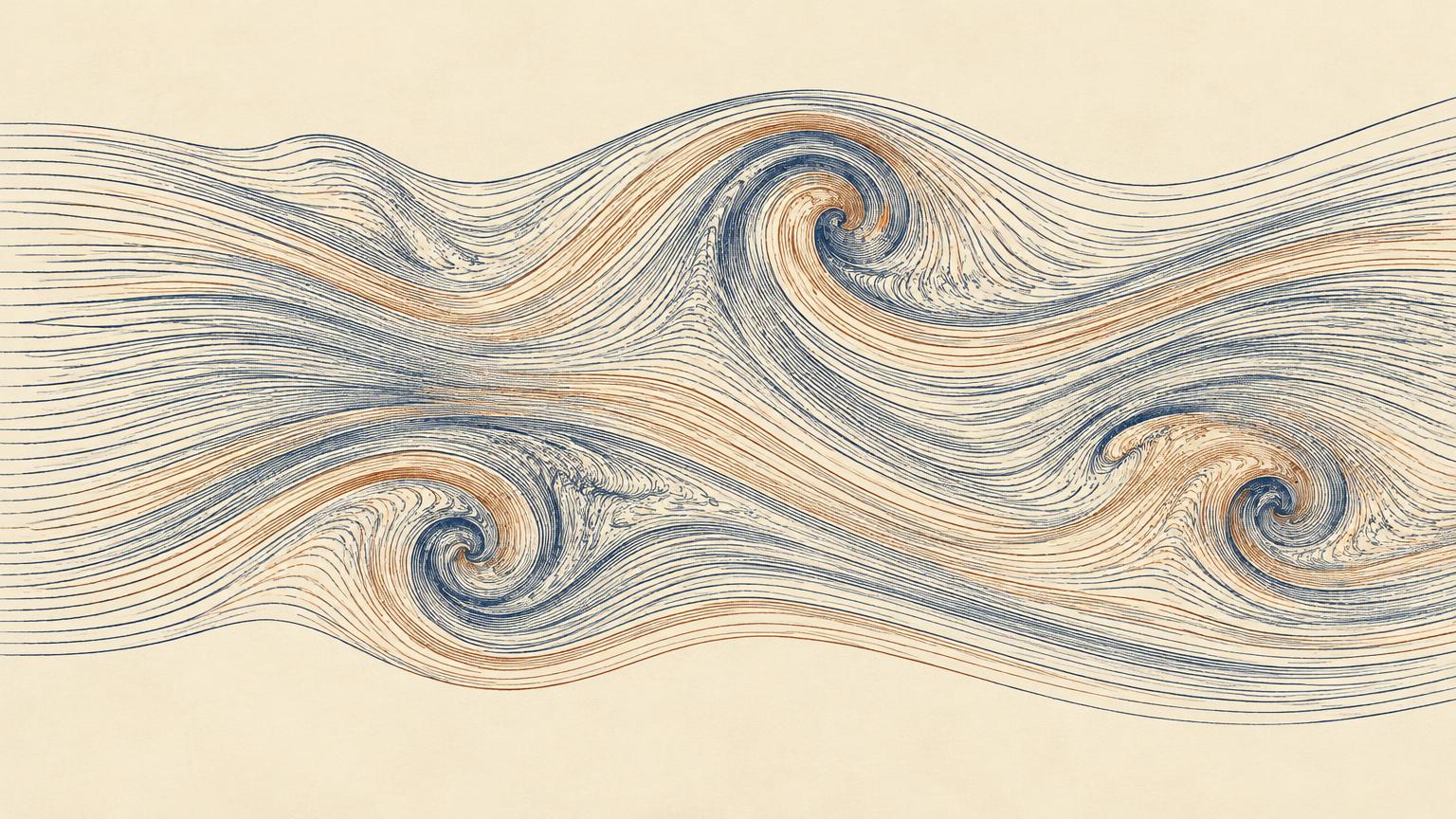
Here is the theory in plain words. The universe is a fluid wave system — not empty space with matter scattered through it, but a continuous medium in motion, rippling, folding, and interfering with itself. Space is not a vacuum; it is the medium. What we call matter arises where that medium undergoes a change of phase, the way water becomes ice or vapor without ceasing to be water. In that change the motion of the medium winds into itself, into torsional vortices, and the vortex persists. A particle is a persisting knot of motion. Mass is how much the knot resists being moved. Light is the medium carrying a disturbance without knotting at all.
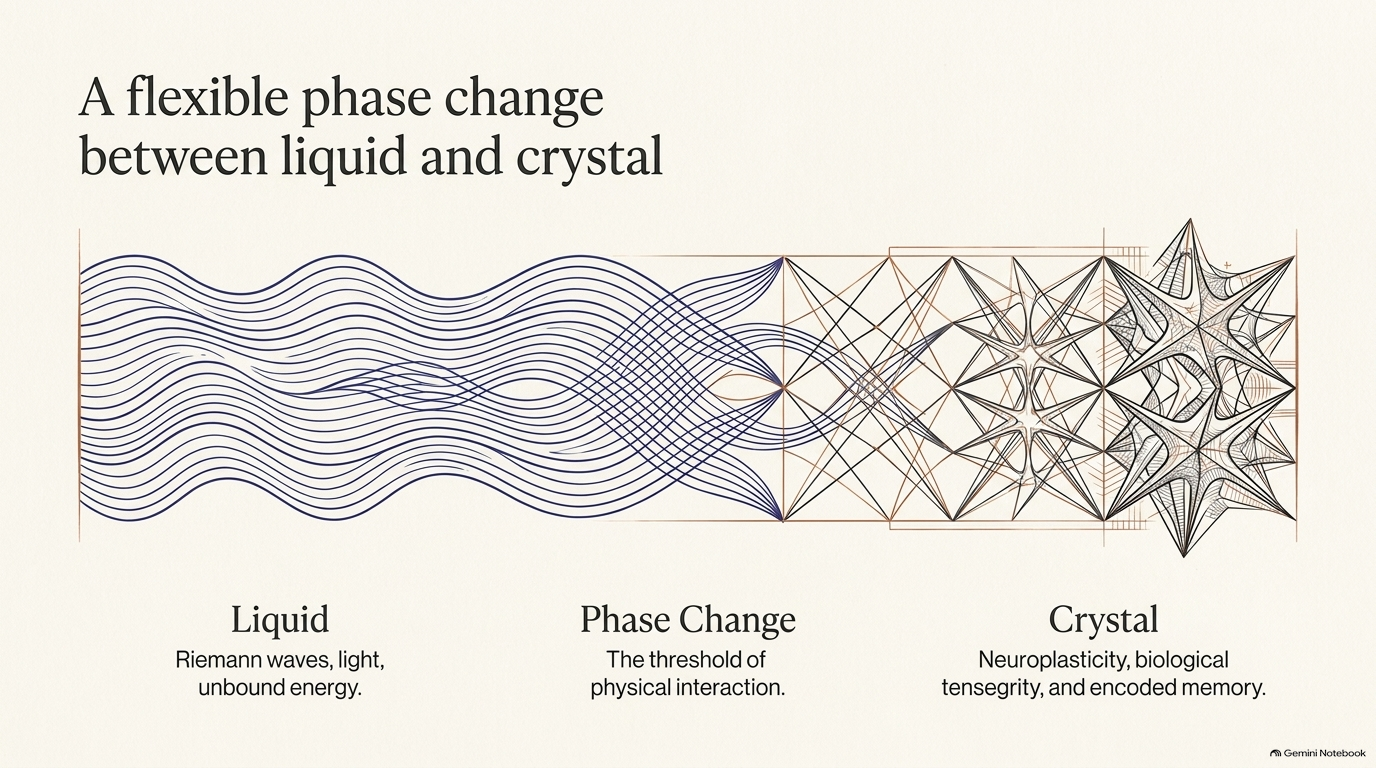
I adapted the Riemann to this picture because it is a mental model for things coming into being: a smooth landscape whose structure is set entirely by the relationships across it, where a fold or a twist in one region reorganizes everything near it. Read as physics rather than as a puzzle in number theory, it describes how a continuous medium can carry discrete, recurring forms — standing waves, resonances, periodicities — without any of them being placed there from outside. The universe is emergent, and emergence is periodic. Shapes recur because the medium keeps arriving at the same stable configurations, not because anyone designed them.
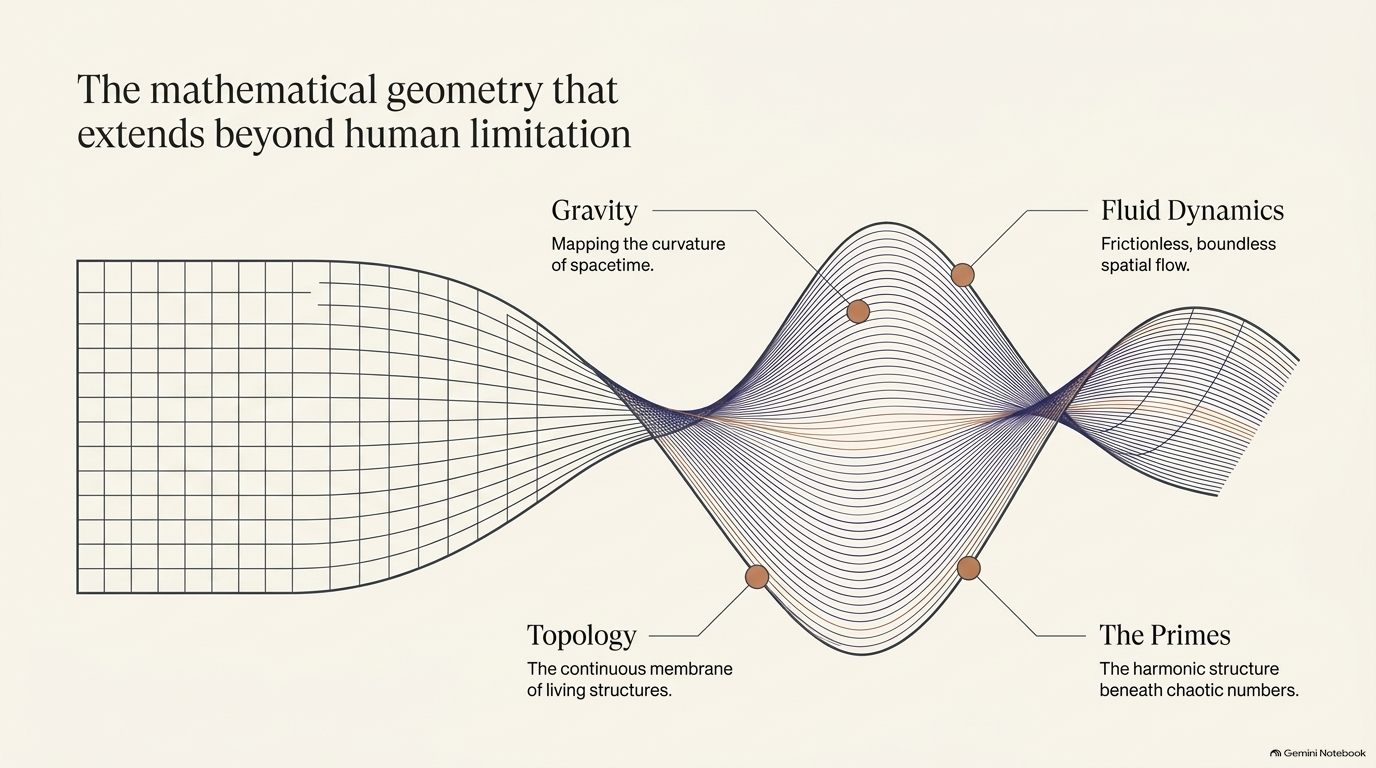
There is no floor beneath this. I do not imagine a hidden bedrock of spacetime underneath the fluid for the fluid to flow over. Every medium we know on earth — water, air, plasma — sits on something else, and that is exactly why none of them can be the final picture. The fluid I am describing is the floor, the walls, and the furniture at once. That is the part of the theory most people find hardest to hold, and it is the part that matters most.
Why this is a builder’s guide
A theory earns its place in a founder’s book only if it changes what a founder does on Monday morning. This one does, in four ways.
First, if things are relationships holding still, then building is not assembly; it is tuning. The quantum engineer who tries to wall a qubit off from the world is fighting the medium. The one who designs the relationship between the qubit and its surroundings, so that the environment holds the state instead of erasing it, is working with it. The most promising results of recent years read exactly this way: the carrier becomes the protector. Design the relation and the object follows.
Second, if matter is a change of phase, then the most powerful lever a builder has is the condition under which phase changes — temperature, pressure, field, geometry, strain, confinement. Materials science already knows this in practice. Superconductors, topological materials, and the new magnetic orders are not new substances so much as old substances brought to a new phase. A founder who thinks in phase rather than in parts asks a different question: not what should I add, but what condition would let what is already here become something else.
Third, if the universe is a wave construct, resonance is the evidence of a relationship working. A membrane that sings only when intact, an axon pearled at regular intervals, a molecule whose charge is shared across a folded shape — biology has been building with resonance for billions of years, and it builds at room temperature, wet, and cheap. Living systems are the oldest quantum applications on the planet. The builder who wants quantum effects outside a refrigerator should study how the cell keeps its relationships coherent, not how the laboratory freezes them still.
Fourth, if there is no floor, there is no final part to wait for. Founders are often told to hold off until the fundamental physics is settled. In a fluid universe the fundamentals are relationships all the way down, and they are available to work with now. Computing reached the market first because it found one relationship — superposition under control — and built an industry on it. Energy, materials, and living systems are waiting for their own relationships to be found, named, and tuned.
The geometry is the blueprint
This is why I keep returning to geometry. For me the mathematics is in the object; I see it in the shape before I write a symbol. The spiral of the nautilus is not decoration on these pages. It is the same relationship recurring at every scale — growth that keeps its form as it grows — and that is the builder’s whole instruction in one figure. Find the relationship that keeps its shape as you scale it, and you have found something worth building. The longer treatment of these models lives in From Gaia to Geometry, chapter by chapter, for readers who want the full ground. Here the builder needs only the principle: relationships first, the medium in motion, phase as the lever, resonance as the sign that it is working.
Quantum constructionism is what happens when a founder takes that principle to the worksite. Not a science to be finished before it is used, but a way of building that treats the universe as it is — continuous, relational, always changing phase — and asks, every day, which relationship to tune next.